
 Artificial Intelligence is expected to handle many things in the future; is predicting that future one of them? In a recent Article by The Economist, an AI called GPT-2, created by Openai, was asked to do just that. GPT-2 answered questions on the big themes for 2020. At this time of year, predictions are front and center. What did our AI have to say about the year ahead? Read the article to see how GP2 answered these questions.
The Globotics Upheaval
In a recent book, Richard Baldwin takes us on a fascinating journey to the past, and then provides a peak into the next great transformation. In The Globotics Upheaval, Mr. Baldwin describes a cycle that has played out multiple times throughout human history. The cycle of transformation, upheaval, backlash and resolution (Let’s call it TUBS) was experienced each time the world entered periods of major disruption.  Mr. Baldwin introduces the Globotics Transformation as the third great economic transformation to shape our societies over the past three centuries. As he describes, the first was known as the Great Transformation started in the early 1700s, and it switched societies from agriculture to industrial and from rural to urban. The second started in the early 1970s, shifting the focus from industry to services – the Services Transformation. I take a different view of transformation in the context of Tipping Points – but the cycle is the same.
More Scenarios Added to our Emerging Future
I periodically add more future scenarios to this visual that attempts to describe all the dots that are connecting to create our future. This future is complex, emerging from the combination of new and existing building blocks – a dynamic that enables the rapid pace that society is experiencing. The visual is described in detail Here.
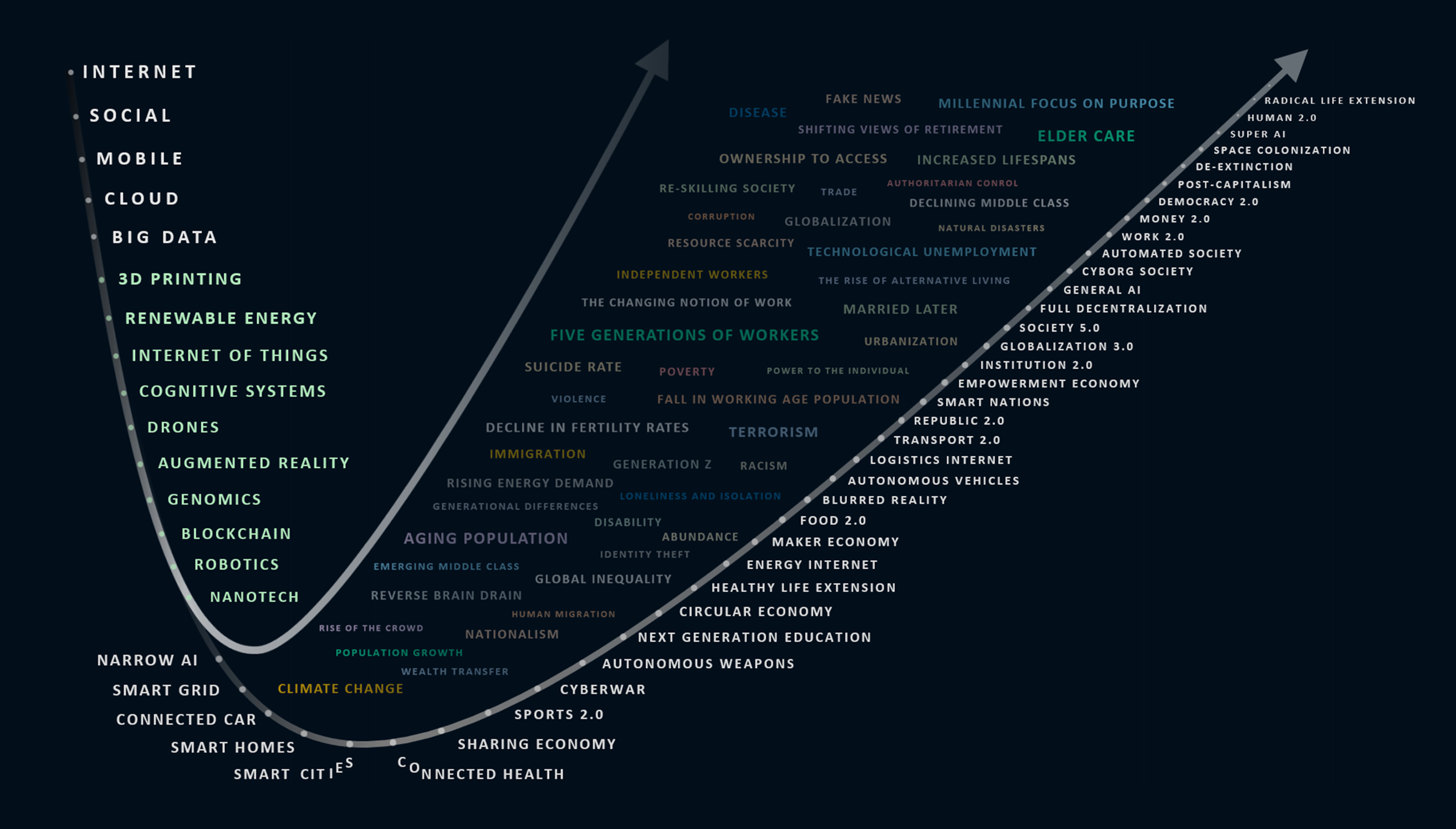
I have added two new Future Scenarios to the visual: Society 5.0 and Smart Nations. I have written about both recently. Each scenario is individually impactful – but the combinatorial effect is massively transformative. Tracking scenarios in an effort to See their path is the only hope in understanding their impact.
Smart Nations
Add Singapore to the list of Nations establishing a Smart Nation agenda. In a recent Article authored by Eileen Yu, she describes the launch of Singapore’s national artificial intelligence (AI) strategy. The Singapore government aims to drive AI adoption to generate economic value and provide a global platform on which to develop and test AI applications. As future scenarios go, Smart Nations represent a complex intersection of multiple ecosystems – broader than similar complexities associated with the Smart City scenario.
The Circular Economy
In a recent Article via the World Economic Forum, author Alexandre Lemille – Co-founder and general secretary, African Circular Economy Network – describes the Circular Economy – a future scenario on my anchor Visual. In doing so, he shows how our current model extracts resources, transforms them into products, and consumes or uses them, prior to disposal. He describes how recycling actually distracts from the realization of a true circular economy – as recycling only starts at the throwing-away stage: this is a process that is not made to preserve or increase value nor to enhance materials.
Capitalism Alone
I just added Capitalism Alone to my Book Library. Written by Branko Milanovic,  the book chronicles the journey of capitalism towards the dominant economic system in the world. A major focus of the book is the comparison of Liberal Capitalism in the west yo Political Capitalism exemplified by China. Another book that instructs from a historical context – providing possible Guidance as we look forward. A great look into why communism and socialism failed, how they are linked, and what the future of capitalism might look like. The book abstract from Amazon is included below.
ABSTRACT
We are all capitalists now. For the first time in human history, the globe is dominated by one economic system. In Capitalism, Alone, leading economist Branko Milanovic explains the reasons for this decisive historical shift since the days of feudalism and, later, communism. Surveying the varieties of capitalism, he asks: What are the prospects for a fairer world now that capitalism is the only game in town? His conclusions are sobering, but not fatalistic. Capitalism gets much wrong, but also much right―and it is not going anywhere. Our task is to improve it.
Milanovic argues that capitalism has triumphed because it works. It delivers prosperity and gratifies human desires for autonomy. But it comes with a moral price, pushing us to treat material success as the ultimate goal. And it offers no guarantee of stability. In the West, liberal capitalism creaks under the strains of inequality and capitalist excess. That model now fights for hearts and minds with political capitalism, exemplified by China, which many claim is more efficient, but which is more vulnerable to corruption and, when growth is slow, social unrest. As for the economic problems of the Global South, Milanovic offers a creative, if controversial, plan for large-scale migration. Looking to the future, he dismisses prophets who proclaim some single outcome to be inevitable, whether worldwide prosperity or robot-driven mass unemployment. Capitalism is a risky system. But it is a human system. Our choices, and how clearly we see them, will determine how it serves us.
Societal Impact of the Millennial Generation
A changing of the guard has been in motion for some time. In 2020, Millennials will be the dominant workforce on the planet. The five generations in our workforce introduce a leadership challenge, alongside disruptive forces swirling around society.  The truth is that millennials are likely the generation tasked with solving this broad set of societal challenges. This recent Forbes Article says it well. The challenges likely facing this generation include: technologies like AI, shifting business models, the implications of near zero marginal cost, the resources of the planet, the nature of house ownership, transportation, healthcare, work, education and families.
Fundamental questions about Why and how we Educate will have to be addressed for the first time since the introduction of high school. Additionally, this generation will have to deal with an Aging Society. As Michael Gale – the author of the above article – describes, one in four millennials are already directly managing a parents’ ill health on a daily basis. The added burden of college debt could create additional obstacles to success.
There has been a negative stigma associated with this generation. However, they are not the problem but part of the solution. As 72% of the Global 2000 continue their digital transformation journey, millennials offer a perspective that helps realize intended outcomes. The Forbes Article describes five things that you can do to enable this – take a look.
The Economists’ Hour
I just added another fascinating book to my Book Library titled The Economist’s Hour authored by Binyamin Appelbaum. Mr. Appelbaum is the lead writer on economics and business for The New York Times Editorial Board. From 2010 to 2019, he was a Washington correspondent for the Times, covering economic policy.
I find every journey to the past instructive,  and my hope is we can Learn from History. This book chronicles the role of the Economist, their foray into political waters, and their societal impact. Looking back in time can be surprising, as core beliefs are challenged. What can we learn from this look back? What do we do differently as a result? This is a fascinating journey that I highly recommend. The book abstract from Amazon is included below. The author’s conclusion?
Their fundamental belief? That government should stop trying to manage the economy. Their guiding principle? That markets would deliver steady growth, and ensure that all Americans shared in the benefits. But the Economists’ Hour failed to deliver on its promise of broad prosperity. And the single-minded embrace of markets has come at the expense of economic equality, the health of liberal democracy, and future generations.
The Future of Employee Compensation
A recent Article on the future of work focused on an important piece of the story: a future employee compensation model. Author Dwight Chestnut proposes a new model that he calls the Empowered Employee Compensation Model (EECM). This new workplace compensation model was the result of a new economic research initiative. The model replaces hourly wages, salaries and benefits with ten new income resources and benefits and is projected to drive a three-fold increase in the aggregate standard of living.
The Greatest Wealth Transfer in History
We spend so much time focused on disruption driven by advancement in science and technology – that we can lose sight of the massive amount of societal factors to be considered. When looking at the interplay between an exponential progression of innovation and those factors that impact society, we can see that the impacts run in Both Directions.
The Hybrid Job Economy
The notion that a renaissance man is more important today than ever is presented in recent Research by Burning Glass Technologies. Perhaps the best renaissance man of all time was Leonardo da Vinci, who was highly esteemed for his broad knowledge of many fields. The research concludes that we must all become more da Vinci-like in our careers. Said another way: learning a single skill in isolation has a short shelf life. Learning complementary skills becomes critical in what the research describes as a hybrid job economy.
The Five most Important Job Skills of the Future
In a recent Article, author Bernard Marr describes the five most important job skills of the future. A conversation that is tightly linked to the role of education, and a topic I have explored in Several Posts. Mr. Marr states that the pace of change is being driven by several factors. He paints a picture of an interconnected world that allows us to work remotely and with people from different cultures as easily as if they were in the office next door. The Healthy Extension of Life allows us to work longer, creating an age-diverse workforce. Combined with science fiction becoming reality, machines suddenly augment our skills and free us up to focus on higher-level activities.
The Global Fertility Crisis
Bloomberg BusinessWeek recently posted an article describing the Global Fertility Crisis. As we look at the forces likely to shape our future, we spend a lot of time and media cycles analyzing the exponential progression of science and technology.  This powerful force is having a profound impact on society. But the opposite is also true: society is influencing the path of innovation. Societal Factors play as big a role in establishing the path of our emerging future. I placed societal factors in the middle of the visual I use to connect an overwhelming number of dots. The two curves that surround them are the science and technology foundation; and the future scenarios that it spawns. Societal tension happens in both directions; out towards the curves, and in from the curves.
The Next 50 Years of Digital Life
Dr. Micah Altman – Director of Research, Center for Research in Equitable and Open Scholarship (CREOS) at MIT – recently made me aware of a Survey that probed several questions about the future of our Digital world. The survey was conducted by Elon University and the Pew Research Internet and Technology Project to imagine social and technological evolution over the next 50 years. The respondents were technologists, scholars, practitioners, strategic thinkers and others.
The Future of Farming
The global population is projected to reach 9.7 billion in 2050 – up from 7.6 Billion today. This population growth along with city expansions are having major consequences, driving a lack of growing space and food in many parts of the world. Add to this the concerns of extreme weather events that will disrupt food production, and you have a scenario that forces us to find creative solutions. According to various statistics, 795 million people don’t have enough food; and keeping pace with population growth requires a focused effort on realizing food abundance.
Reimagining the Future: Revised
Our world certainly has a way of moving quickly. Keeping pace with a myriad of advancements and scenarios is a full-time job. I have spent the better part of one year focused on History – as I look for evidence of similar periods in the past. That work has been very instructive. The results of that analysis – along with an ever changing view of the future – have been incorporated into the latest version of my presentation. You can view or download the current version Here.
Futuristic Developments in the next Ten Years
“When considering potential risks from future technology, one should not be content with merely analyzing what’s likely to happen—instead, one should look at what’s possible, even if unlikely.” – Jaan Tallinn, founding member of Skype, and co-founder of the Centre for the Study of Existential Risk
Continue readingThe Highest Skilled Workers Reside in Switzerland – Why?
A recent Article on education reveals that Switzerland has the most highly skilled workers in the world. In an era where job growth is likely to tilt towards high skilled jobs, Switzerland is doing something right. At the heart of our skilling challenges lies an education paradigm and system that were built in and for a different era. I have spent considerable time on the need for a shift in the Learning Paradigm. Has Switzerland made the shift?
Which U.S. State Generates the most Wind Energy?
Although we spend a lot of cycles debating climate change, some have placed economic development above ideology. You wouldn’t expect a state tied economically and in the American imagination to oil, gas and coal, to lead the U.S. in wind power generation. Less restrictive zoning, taxation systems that encourage building, and robust transmission lines can enable this type of progress.
Target Transforms by taking a Long Term View
A recent Article describes how Target transformed from a Retailer with stores in disrepair and leaders that struggled to adapt to changing consumer behavior, to a company that is thriving. Their first quarter results for 2019 beat analysts’ expectations, the store’s private-label lines are exploding, and the stock price is trading at an all-time high.
Target CEO Brian Cornel made a huge announcement in March of 2017 that it planned to invest over $7 billion in a turnaround strategy – Wall Street was not impressed, as Target suffered its largest stock plunge in almost a decade on the day of the announcement. But Mr. Cornel took a page out of Jeff Bezos book and pushed forward on a plan that included:
 Reimagining the Future