
My ongoing work on emerging future scenarios has driven a renewed focus on experience. Several factors are converging to shift the experience end game; specifically, the evolution of Ecosystems and the transformation of Interaction. These two forces – themselves the result of combinatorial innovation – are converging. While the way we interact continues to shift, a parallel evolution towards ecosystems is occurring. This ecosystem evolution introduces systemic complexity and combines with a shifting interaction paradigm to alter the way we think about experience.
Business
 Figure 1: Phase One of a pending shift in interaction paradigms
The Transformation of Interaction
Back in 2013, as Smartphone use was growing, I wrote about Next Generation Experiences; viewing customer experience through a lens of constant change, where failure to address foundational elements meant falling further behind. Since then, our mode of interaction witnessed a third transformation, as touch became a critical piece of our everyday experiences. Now, we find ourselves approaching the next significant change in interaction paradigms: the Fourth Transformation driven by mixed reality.

Innovation Killer Organization Chart
Heidi Schwende recently shared a picture on LinkedIn that perfectly captures the challenges facing large traditional companies. Exponential progression, the pace it is driving, and the capacity of companies native to digital to innovate put the traditional company at a severe disadvantage.
Technological Socialism and Demonetization
In a recent post titled Demonetized Cost of Living, Peter Diamandis describes how technological socialism (i.e. having our lives taken care of by technology) will drive our cost of living close to zero. A similar case was made by Economist Jeremy Rifkin in his book titled The Zero Marginal Cost Society. Diamandis defines demonetization as the ability of technology to take a product or service that was previously expensive and making it substantially cheaper, or potentially free; removing money from the equation. Demonetized is one of the Six D’s of digital, as described by Diamandis.
Ecosystem Models and Value Design
The road to future ecosystems is paved by stakeholder action in the coming decades. These ecosystems support life experiences and have no regard for industry boundaries. Over time, established peer-to-peer relationships lead to value creation and capture for all ecosystem participants. Along the way, value design gets complicated, as multi-stakeholder ecosystems introduce complexity. It is value design that I believe challenges traditional thinking, both in how we view relationships and how we share value. As traditional thinking gives way, the resulting ecosystems have the potential to move towards the collaborative commons described by Jeremy Rifkin.
The Driverless Car: Fast Lanes or Speed Bumps?
The driverless car is one of many emerging future scenarios that drive multiple paradigm shifts. As these shifts converge, they intensify the critical need for leaders to think differently about a world where the future arrives faster than people think. This speed is unappreciated, undermining the levels of urgency required to survive in this exponential age. I sat with Chunka Mui recently to discuss these shifts, using the driverless car to explore the challenges of our emerging future.
Chunka Mui is the managing director of the Devil’s Advocate Group, a consulting group that helps organizations design and stress test their innovation strategies. As a consultant on strategy and innovation, Mr. Mui has spent considerable time analyzing the driverless car scenario. He asked a question in his book The New Killer Apps about autonomous vehicles and what happens if traffic accidents are reduced by 90% as Google predicts. This simple question makes visible the broad and deep implications of these future scenarios. As society responds to their implications, new ecosystems emerge that alter our world. In this case, the driverless car is one of numerous components of an emerging mobility ecosystem that is defined by the responses that are playing out right now.
I will share insights from our interview in a series of posts, starting with this one. In this segment of the interview, Mr. Mui and I discussed the growing need to rehearse the future.
Women Leadership in an Exponential World
I was honored to deliver the opening keynote at the SIM Women Executive Leadership Forum on Thursday May 5th. SIM Women Founder Kristen Lamoreaux did a wonderful job organizing the program. I met some fascinating leaders that selflessly give their time to their communities and society in general. As we look at the challenges that face our world, these are the type of leaders I want to stand with. In a room full of outstanding women, I saw the leaders of our future. As our exponential pace accelerates, a gap widens between exponential progression and our linear and incremental progress. This gap represents disruptive stress or opportunity – and increasingly, it is our right brain characteristics that help determine which.
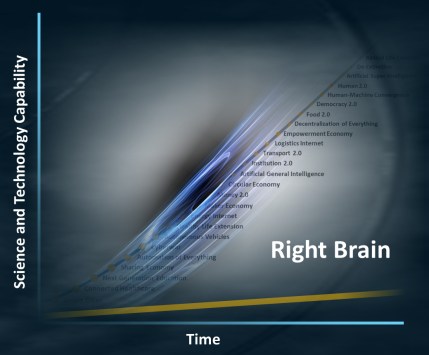
Creativity, imagination, big picture vision, emotional and social intelligence, empathy, and other human characteristics are critical to navigating in an exponential world. As automation accelerates, these human traits become even more critical. In a recent report by Citi on Technology at Work, the authors point to our propensity for social interaction, communication, and empathy being something machines can never replace. Women excel in these areas, positioning them as leaders of our emerging future. In a different Citi report on Women in the Economy, they highlight the importance of women in the labor market, where a 50% reduction in the gender gap can lead to a 5% increase in global GDP. Women are uniquely positioned to play a critical role in the digital economy.
At this SIM event, I focused on our emerging future and the unlearning that it requires. The last time we faced a similar scenario was a century ago, as a shift occurred from the steam engine era to the electricity era. That transition did not go well – something I’ll explore in future posts. We find ourselves approaching another transitory point in history. Will we learn from history? My focus remains on this transition and the mindset shift so crucial to navigating the change. This time, I believe women leadership could be the difference. You can view the presentation Here.
Our Emerging Future
In my last post, I added more future scenarios to this visual describing the complexity and impact of our emerging future. The one piece left unfinished was the expansion of innovation accelerators to include emerging and future accelerators. With input from TCS CTO Ananth Krishnan, I have added a number of accelerators to the visual.

Cyberwar, De-Extinction, and Precision Agriculture
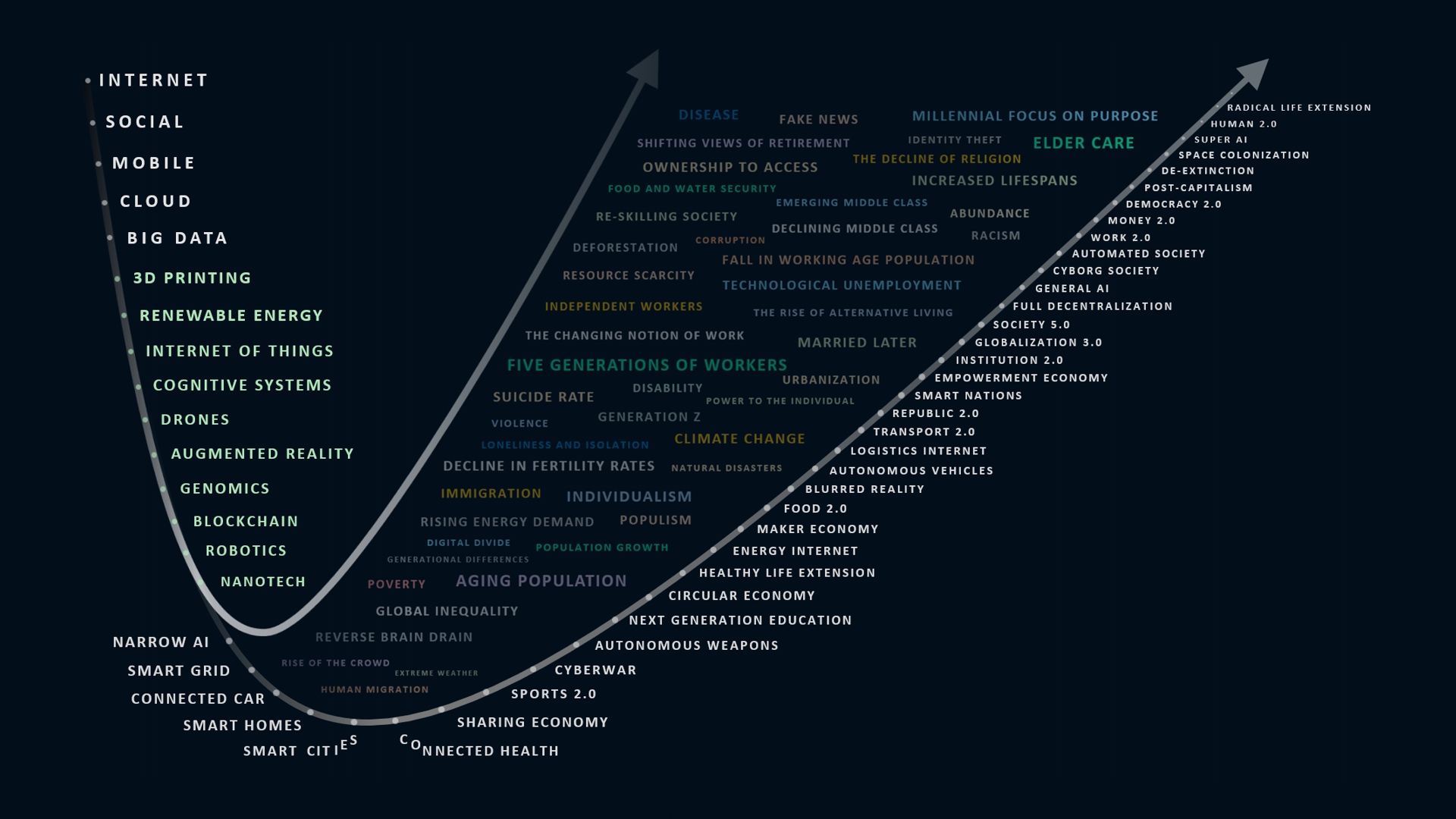
I’m wrapping up another book titled The Industries of the Future. Author Alec Ross explains the advances and stumbling blocks that emerge in the next ten years, and describes a way to navigate them. He is one of America’s leading experts on innovation, serving four years as Senior Advisor for Innovation to Secretary of State Hillary Clinton. Mr. Ross is currently a Distinguished Visiting Fellow at Johns Hopkins University. His book identified three future scenarios that I have added to the visual below. These scenarios are Cyberwar, Precision Agriculture, and De-Extinction.
Technology, Social Change, and Future Scenarios
If we are to Think about the Future in a way that helps us thrive in that future, we must excel at connecting dots. I developed the Future Scenarios visual in an attempt to help visualize the dots, as well as the various intersections that amplify the impact of those dots. In parallel with this scenario view, I have looked at various aspects of social change that both influence and impact these scenarios – and vice versa – but until now, those views were separate. Convergence is occurring not just across the technology and future scenario curves, but also the various aspects of social change. So in the interest of maximizing future thinking impact, I have combined the two views and will describe a connecting the dots scenario. First, the new future scenario visual:

2016 Predictions
On Wednesday December 16th, I will participate in another Game Changers radio program with host Bonnie D. Graham. She will be joined by 16 guests that will share their predictions for 2016. To prepare for the show, I pulled together my predictions across six broad categories. These predictions are a mixture of leading indicators and hope. Here it goes…
Emerging Platform
Digital today has a bolt-on feel to it. Dominated by Marketing, the initial focus was channel oriented, isolated in nature, and layered on top of that which existed. It expanded to support a narrow customer experience and efficiency agenda. I say narrow, because digital is primarily applied to existing process, as opposed to leveraged to re-imagine process. As the main digital forces converge (Social, Mobil, Big Data, Analytics, and Cloud), a platform emerges to enable re-imagination. Yet Digital to date remains isolated on two levels: within company silos and across the main forces.
Future Structures
Some time ago, I did a series on the enablers required to propel organizations into t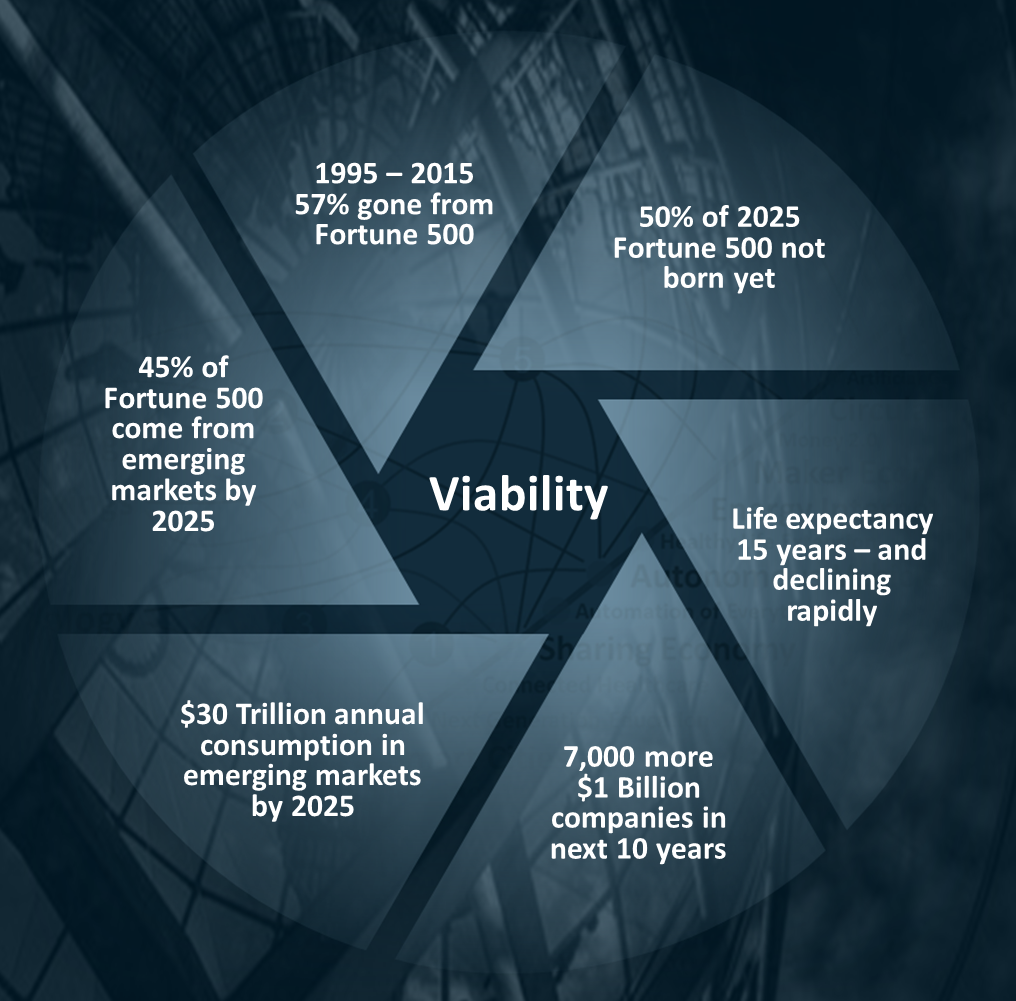 he future. With the passage of time, and after considerable dialog, the time has come to update that point of view. In continuing with this future of business series, the next several posts will provide an updated list and perspective on these enablers. Leaders must effectively manage the exponential forces that drive them on a path to viability. In the absence of a burning platform, the growing gap between these exponential forces and the linear constructs of our day should spur leadership action. Continue reading
Competing in the Age of Disruption
This future series continues with a look at a new book by Geoffrey Moore titled Zone to Win: Organizing to Compete in an Age of Disruption. In my last post on Emerging Models, I looked at a model based on business type. The model explored by Mr. Moore is based on zones, and came to life in his work with Salesforce.com and Microsoft. With Salesforce, the model supported a focus on disruption (offense), and with Microsoft, it supported a posture against disruption (defense). The four zones as identified by the author are depicted in the visual below:

Emerging Models for the Future
This future series continues with a look at a Deloitte report titled “The hero’s journey through the landscape of the future”. The report focuses on the organizational journey required to re-position for viability in the future landscape. As the landscape simultaneously fragments and consolidates, the authors see these forces and others changing the nature of relationships among businesses. A very good framework for this re-positioning is presented, along with great descriptions of the big shifts that are driving the need. The report sets the stage by identifying the main drivers of this future business landscape:
- Pressures on companies
- Pressures on individuals
- Eroding barriers: Lowered barriers to entry, commercialization, and learning
- Fragmentation: Staying niche, nimble, and small is the new goal for many
- Concentration: Emerging scale-and-scope operators will fuel and benefit fragmentation
- The need for mobilizers to connect and mobilize the ecosystem
A Report on Creative Disruption
A recent report by Bank of America Merrill Lynch sheds more light on our future focus. The authors see cyclical and secular trends transforming the world at a rapid and meaningful pace. They find a common denominator in the form of three Ecosystems of Creative Disruption, and see them reducing barriers to entry for new businesses. These ecosystems allow companies to improve productivity and time-to-market while allowing broader customer reach. In a big shift, the ecosystems redefine competitive advantage by leveling the playing field between large and small companies. Success is therefore dictated by imagination and ability to maximize the ecosystem. The three ecosystems are:
Continue readingThe Future of Business
This list of 99 Facts pulled together by SAP continues to build the case for inevitable change. The title of this SAP presentation is “The Future of Business”. Here are some of the key facts from various sources. There are embedded links in the content that take you to the source documents. Enjoy.
 Reimagining the Future

