
History teaches us that transformative technologies do not emerge in isolation, nor do they reshape the world overnight. Instead, they follow a discernible pattern – an evolutionary journey that unfolds in response to human needs. Two phenomena help us understand this journey: the Evolutionary Phases of General-Purpose Technologies (GPTs) and the role of necessity, invention, and convergence (NIC). When viewed together, they provide a powerful lens for understanding not just how technologies evolve, but why they emerge and when they reach their full potential.
Continue readingTechnology
The Great AI Shift: Services As Software
I came across a very good article that describes the emerging phenomenon that some have termed Services-as-Software. For decades, businesses have structured their operations around human-driven services – coders developing applications, analysts interpreting data, consultants optimizing workflows. Software has long played a supporting role, but the core work remained in human hands. That paradigm is shifting. Here is a summary of the article.
Artificial intelligence (AI) is transforming the very nature of services. What once required teams of specialists is increasingly being handled by AI-powered systems capable of executing tasks autonomously. This transformation isn’t just about automation – it’s about redefining how businesses consume and deliver services. The emerging model, as mentioned, is often called Services as Software, and it marks a profound departure from the past: software is no longer a tool for human workers; in many cases, it is the worker.
Continue readingThe Fragile Future: Why Stability Is More Uncertain Than Ever
History does not repeat, but it often rhymes. As I read Robert D. Kaplan’s Waste Land: A World in Permanent Crisis, I was struck by his argument that the 20th and early 21st centuries have been especially bloody because the stabilizing force of monarchy has vanished. He suggests that despite our moral progress in areas like human rights and the environment, the world remains tightly wound, vulnerable to clashing interests and aggressive authoritarian states. He draws an analogy to Weimar Germany – a moment of fragile democracy, economic strain, and rising nationalism that ultimately collapsed into war.
Continue readingThe Persuasion Paradox – Reclaiming Truth In The Age Of Digital Persuasion
At the heart of the Persuasion Paradox lies a profound contradiction between the transformative promise of the Information Age and its unintended consequences. Initially, the internet was envisioned – and widely celebrated – as a revolutionary tool for democratizing knowledge, dismantling barriers to information access, and fostering global understanding. Yet, we now face a reality starkly different from that optimistic vision. The abundance of information, rather than elevating clarity and truth, has birthed a “noise-to-signal” problem, where misinformation, disinformation, and emotionally charged narratives often obscure the truth. This phenomenon resonates deeply with themes I’ve explored previously – the democratization of knowledge and the unintended consequences inherent in rapid technological and societal transitions.
Continue readingMeeting Today’s Grand Challenges – The Next Wave of Convergence
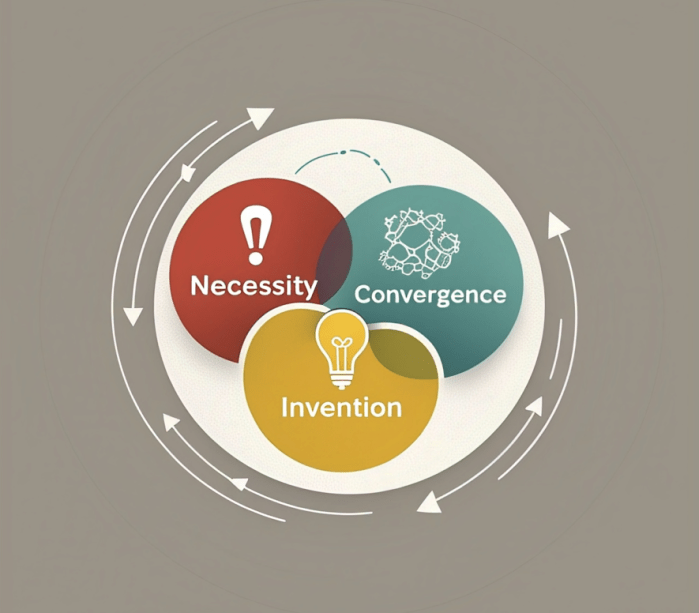
Throughout this four-part series, we’ve seen how necessity sparks invention – and together, they transform our society in profound ways. Today, our world faces an array of urgent challenges, from climate change and demographic shifts to economic and geopolitical instability, cybersecurity threats, and healthcare crises. These pressures are igniting a fresh wave of convergence, where inventive and innovative responses to pressing needs are poised to reshape our future. As we enter this transformative era, the cycle of necessity and invention reminds us that bold, purpose-driven invention and innovation is our best path forward.
Continue readingThe Converging Forces Of Progress: Necessity, Invention, And Systemic Outcomes
What if the very inventions that propel humanity forward also sow the seeds of our greatest challenges? History shows that progress is rarely a straight line. Instead, it moves in cycles: necessity sparks invention, and inventions converge to reshape society. From the steam engine’s role in the Industrial Revolution to the internet’s impact on globalization, each wave of transformation has brought profound change – economic shifts, new social structures, and unintended consequences. These disruptions, from rising inequalities to environmental crises, often take decades to address. As we stand on the brink of the next great convergence – whether in AI, biotechnology, humanoid robots, cyber, climate or health – we must ask – how can we harness innovation to create a more equitable and sustainable future?
Continue readingThe Necessity-Invention-Convergence Framework
The Necessity-Invention-Convergence Framework provides a structured way to analyze the forces that drive human progress. At its core, necessity serves as the fundamental driver of change, arising from pressing challenges, constraints, or demands. Whether economic, social, environmental, or geopolitical, necessity compels action and forces innovation. Throughout history, this dynamic has played out in transformative ways. The Industrial Revolution was fueled by labor shortages and an increasing demand for goods, just as the Digital Revolution emerged in response to the need for faster, decentralized communication. Today, the global energy transition is being shaped by the necessity of addressing climate change and resource limitations.
Continue readingPolyintelligence: The Fusion Of Nature, Human Ingenuity, And AI
In recent discussions across media, business, and academia, much has been said about the convergence of human and artificial intelligence. This powerful combination is already leading to remarkable discoveries. However, there is another form of intelligence that often goes unrecognized – nature’s intelligence.
A recent article I came across highlights this critical dimension, introducing the concept of polyintelligence – an integrated framework of natural, human, and machine intelligence. The notion that nature itself embodies intelligence, with its ability to learn, adapt, and encode knowledge, aligns closely with the interdisciplinary approach I have long advocated. It also reinforces the need for a lateral, ecosystem-driven perspective – one that transcends silos and embraces holistic thinking.
Continue reading2025 Global Risks Report
Every year, the World Economic Forum’s Global Risks Report offers a critical snapshot of the forces shaping our world. The 2025 edition paints a picture of escalating tensions, deepening fractures, and an accelerating transformation of our societal foundations. As we navigate an increasingly complex landscape, the report underscores the necessity of adaptability, resilience, and the capacity to thrive – what I call the ART of navigating uncertainty.
More than ever, this year’s report validates the idea that we are in a period of convergence – where geopolitical instability, technological disruption, societal shifts, economic volatility, environmental stress, and philosophical reorientation are colliding in ways that will redefine our future. Below, I’ve categorized the major risks identified in the report under the seven core convergence domains that I frequently discuss: science, technology, society, geopolitics, economy, environment, and philosophy.
Continue readingSensing And Responding: How AI Is Helping Us Navigate An Uncertain World
Over the years, I’ve chronicled how rapid change and pervasive uncertainty have become the hallmarks of our times. In my previous writings, I argued that survival in this dynamic environment depends on a sense and respond approach – rapidly detecting meaningful signals and acting decisively. Today, that vision is evolving into reality. With the convergence of generative and agentic AI, we’re not only theorizing about this paradigm; but moving towards a practical reality that allows us to navigate complexity and turn uncertainty into opportunity.
Continue readingBook Review: Genesis: Artificial Intelligence, Hope, and the Human Spirit
Genesis: Artificial Intelligence, Hope, and the Human Spirit is a rare and thought-provoking collaboration among a statesman whose influence has spanned decades, Henry Kissinger, and two technology visionaries, Eric Schmidt and Craig Mundie. Together, they present a sweeping examination of artificial intelligence (AI) – its towering promises, its urgent perils, and its profound implications for human identity, governance, and morality.
Continue readingThe General-Purpose Technology Evolution Framework
General purpose technologies, from the steam engine to electricity, have historically followed a predictable evolutionary path. Each GPT begins at the status quo, disrupting established ways of operating. Next, it moves to point solutions, where its application enhances specific areas without fundamentally transforming broader systems. Over time, these point solutions give way to broader applications, where the technology begins to reshape processes on a larger scale. Finally, the journey culminates in system-level change, where the technology redefines the way society, industries, and systems function as a whole.
Continue reading2025’s AI Revolution
As we look toward 2025, artificial intelligence is poised to bring transformative changes across various industries. A recent article by Julian Horsey highlights how advancements in AI technologies like ChatGPT are set to redefine software development, education, creative fields, and more. I summarize the article below and offer my perspective on how these changes might impact us, exploring their implications and discussing the challenges we need to address to fully realize AI’s potential.
Continue readingLearning From The Past: Unlearning For The Future
In an era of rapid change, the traditional understanding of literacy has become increasingly insufficient. Historically, literacy was defined simply as the ability to read and write – fundamental skills that enabled individuals to participate in society. However, as Alvin Toffler wisely pointed out, the definition of literacy in the 21st century has expanded far beyond these basic abilities. Today, true literacy encompasses the capacity to continuously learn new skills, let go of outdated knowledge, and acquire fresh perspectives. This shift reflects the profound changes in our world, where scientific and technological advancements, societal shifts, geopolitical tensions, and economic uncertainty are constantly reshaping the demands placed on individuals.
Continue readingA Vast Possibility Space
The concept of a “possibility space” in this new era of great invention represents the expanding landscape of opportunities, challenges, and uncertainties that emerge with each new breakthrough. As technological advancements accelerate, we find ourselves surrounded by an increasingly complex and dynamic array of potential futures. Innovations in artificial intelligence, biotechnology, energy, and communication have transformed what is possible, widening the range of scenarios we can imagine and pursue. This broadening of the possibility space means that, for every exciting new capability, there exists an accompanying set of risks and ethical dilemmas, creating a dual path forward that must be navigated with care.
Continue readingLarge Behavior Models: A New Frontier In AI
Large Behavior Models (LBMs) are emerging as a powerful new tool in AI, offering profound insights into complex human, social, and even organizational behaviors. By processing and learning from enormous datasets—ranging from individual actions to societal trends—LBMs can generate nuanced and adaptive responses, enabling machines to interact with humans in ways that feel natural, responsive, and contextually aware. This capability opens a world of transformative possibilities, blurring the lines between human and machine interaction and reshaping how we experience the digital world.
Continue readingReturn On Learning: Pioneering The Future
In the preceding four-part series, I explored the convergence of knowledge, invention, and societal transitions, tracing the democratization of knowledge from the dawn of language to the present day. The series examined how pivotal inventions have expanded human capabilities and transformed civilization, while also considering how today’s accelerating pace of scientific and technological advances is creating an expanding space of opportunities and challenges. As we stand on the threshold of a new age of invention, potentially more profound than past eras, the series emphasized how organizations can adapt, build resilience, and thrive. Building on these key themes, this post shifts focus to Return on Learning (ROL), a crucial concept that equips organizations to navigate this evolving landscape. By prioritizing learning, leaders can proactively shape the future and ensure long-term success in an era of rapid transformation.
Continue readingGeopolitics In Flux: Why The Current Moment Matters
“New Cold Wars: China’s Rise, Russia’s Invasion, and America’s Struggle to Defend the West” by David E. Sanger offers a comprehensive analysis of the current geopolitical landscape, focusing on emerging tensions between the United States, China, and Russia. Sanger, a veteran national security correspondent for The New York Times, draws on his extensive experience to provide readers with a nuanced understanding of the complex challenges facing the world.
The book explores how the traditional concept of a Cold War has evolved in the 21st century, with China’s economic and technological ascendancy and Russia’s aggressive military actions reshaping global power dynamics. Sanger argues that these new cold wars differ significantly from the US-Soviet conflict of the 20th century, presenting unique challenges for global stability.
Continue readingBeyond the Silo: How Exploding Possibilities Are Fueling the Rise of Horizontal Ecosystems
The second industrial revolution ushered in an era of vertical integration, where companies built empires within clearly defined industries. Today, however, a new revolution is upon us – one driven by an explosion in the possibility space. Scientific and technological advancements are happening at an unprecedented pace, blurring the lines between disciplines and creating opportunities that transcend traditional industry boundaries. This is giving rise to a fascinating phenomenon: horizontal ecosystems.
Continue reading2024 Consensus Predictions
In a recent article the team from Visual Capitalist put together a listing of the most common predictions, from over 700 analysts, as to what they believe we’ll see in the next 12 months. In this now fifth year of Prediction Consensus they summarized 25 of the most common predictions and forecasts by experts into a single visual of what’s expected to happen in 2024. The visual below and article referenced above offer an overview of the most cited trends and opportunities that experts are watching for the rest of the year. Have a look.
 Reimagining the Future