
For decades, banking has been a place you go, a brand you see, and an interaction you initiate. In this current state, even though much of it is now digital, the model still revolves around channels – apps, websites, and branches – where customers show up to make things happen. AI has entered the picture in narrow, tactical ways: a fraud alert here, a chatbot there, a dashboard with basic insights. Helpful, yes – but far from transformational.
Continue readingBusiness
The Future of Business
Sense And Respond: A Survival Trait For A Converging World
In an era shaped by accelerating change, convergence across domains, and an ever-expanding possibility space, traditional methods of prediction and planning have become increasingly inadequate. The static nature of scenario planning—once a cornerstone of strategic foresight—fails to keep pace with the velocity and complexity of today’s world. What’s needed instead is a living, breathing approach. One that adapts, evolves, and acts in real time.
Continue readingBook Review: Technology And The Rise of Great Powers By Jeffrey Ding
Why Diffusion, Not Invention, Determines Who Leads in the Age of Transformative Technologies
In an era obsessed with technological “firsts,” Jeffrey Ding’s Technology and the Rise of Great Powers delivers a counterintuitive revelation: the nations that dominate the future won’t necessarily be those that invent the most, but rather those that diffuse innovations the fastest. By shifting the spotlight from invention to diffusion, Ding fundamentally reframes the debate on global competitiveness – with profound implications for policymakers, businesses, and societies.
Continue readingThe Next Phase Of Power Transitions
My latest series of posts are driven by what I believe are two of the biggest forces that ultimately determine our future: General Purpose Technologies and geopolitical dynamics. In a previous post, I described the role of Necessity, Invention and Convergence in driving the diffusion of general purpose technologies. Necessity drives invention, but true trasitions occur when necessity and invention converge across industries, economies, and societies. However, as technological competition accelerates, particularly in artificial intelligence (AI), a deeper question emerges: What determines the diffusion of transformative technologies, and how does that shape global power dynamics?
Continue readingThe Great AI Shift: Services As Software
I came across a very good article that describes the emerging phenomenon that some have termed Services-as-Software. For decades, businesses have structured their operations around human-driven services – coders developing applications, analysts interpreting data, consultants optimizing workflows. Software has long played a supporting role, but the core work remained in human hands. That paradigm is shifting. Here is a summary of the article.
Artificial intelligence (AI) is transforming the very nature of services. What once required teams of specialists is increasingly being handled by AI-powered systems capable of executing tasks autonomously. This transformation isn’t just about automation – it’s about redefining how businesses consume and deliver services. The emerging model, as mentioned, is often called Services as Software, and it marks a profound departure from the past: software is no longer a tool for human workers; in many cases, it is the worker.
Continue readingRehearsing The Future: Navigating Complexity With Mimi Brooks
In an age of accelerating change and complexity, leadership requires more than traditional planning – it demands a mindset of rehearsal. This principle framed my recent conversation with Mimi Brooks, CEO of Logical Design Solutions, on her Bold Agendas podcast. Our discussion spanned the evolving role of ecosystems, the dual edges of innovation, and the critical importance of adaptability and resilience. Together, we unpacked strategies for thriving in an unpredictable world and explored the transformational shifts leaders must embrace to navigate 2025 and beyond.
Continue readingThe Haier Approach: Structurally Aligning Organizations With The Ecosystem Era
A recent article describes an astonishing achievement enabled by an ecosystem mindset. In 2016, Haier, the world’s largest appliance manufacturer headquartered in China, acquired GE Appliances. As author Bill Fotsch states: “What followed was nothing short of astonishing. Market share, which had languished around a mere two percent for the previous four years, skyrocketed to 20 percent. Haier had achieved what GE could not: a resounding success in the appliance market.”
Continue readingThe Second Gilded Age
ANALYSIS OF KEY POINTS:
A recent article discusses the resurgence of “robber barons” in the modern era, particularly highlighted by the 2024 U.S. election. It draws parallels between the industrial magnates of the late 19th and early 20th centuries – such as Cornelius Vanderbilt, John D. Rockefeller, and Andrew Carnegie – and today’s tech billionaires like Elon Musk, Jeff Bezos, and Mark Zuckerberg. The core argument is that these contemporary titans wield immense economic and political power, much like their predecessors, and have significant influence over markets, governments, and even the media.
Continue readingNavigating The Horizons Of 2024: Thoughts Across Diverse Fields
As we stand on the precipice of 2024, a year brimming with potential and uncertainty, experts across various domains will offer their insights into the shape of things to come. From scientific breakthroughs to geopolitical shifts, from societal transformations to environmental challenges, these insights paint a multifaceted portrait of the year ahead. I’ll add my thoughts to the conversation. The uncertainty that exists across these domains adds to the difficulty in understanding possible futures. It is convergence that occurs across them that illuminates the possibilities.
Continue readingGuarding Against Future Crises In Business
In the early days of 2021, there is still an uneasy feeling involved in any search for a silver lining to the COVID-19 pandemic. Indeed, it may be that this will always remain the case. And yet, without disregarding or minimizing the tragedy that the pandemic has inflicted all across the globe, there are certain potential positives coming to light.
Continue readingRehearsing the Future
 I had the pleasure of participating on a radio show titled Geeks, Geezers, and Googlization. Hosts Ira Wolfe and Keith Campagna did a great job of facilitating our discussion about the future. Check out their Summary of our conversation, and/or listen to our conversation via this rebroadcast.
The Convergence of Science and Technology
In looking at transformative periods throughout history, it is apparent that Convergence was a critical driver of change. While I am still hopeful of the ultimate convergence across societal, political, environmental, philosophic, economic, and business domains, it is clear that convergence is already occurring in the science and technology domains. This synergistic relationship where advances in one domain fuels rapid advances in the other is the force behind our rapid pace. As we saw in the Poll that looked at the catalysts that drive convergence, it is this rapid pace of innovation that many believe will ultimately drive it. This initial convergence is altering long-held Beliefs and Intuitions – eventually forcing convergence across the other domains.
Catalyst Poll Results
Updated results: April 9th, 2019. The response has been great, but I’d like to capture more voices. Please consider taking this very short Poll.
In a recent post on What to Expect in 2019, I launched three focus areas for the coming year. This focus attempts to identify the key drivers of change and the outcomes they enable. The three areas are:
- Convergence is one of the key dynamics I expect/hope to see more of this year. A century ago, convergence across multiple domains ushered in unprecedented advancements in human development. Multiple forces will drive a similar level of convergence in the coming decade.
- The pace of innovation and change is often cited as a key difference between the next revolution and prior ones. This is one of the key catalysts driving change, and I expect it to Accelerate.
- I believe the world will experience a burst of Possibilities enabled by these forces of convergence and acceleration
Convergence
As I described in my Thoughts on 2019 post, convergence is one of the key dynamics I expect/hope to see more of this year. A century ago, a convergence across domains ushered in unprecedented advancements in human development. As Robert J. Gordon describes, the special century (1870 – 1970) that followed the Civil War was made possible by a unique clustering of what Mr. Gordon calls the great inventions. The great inventions of the second industrial revolution significantly improved our well-being. In his view, the economic revolution of 1870-1970 was unique in human history, unrepeatable because many of its achievements could only happen once. What makes this century so special, is that these inventions altered what until then, was a life lived in misery. I captured the advancements made during that period using an Innovation Wheel to map them to our areas of well-being (click on visuals in this post to open in a separate window).
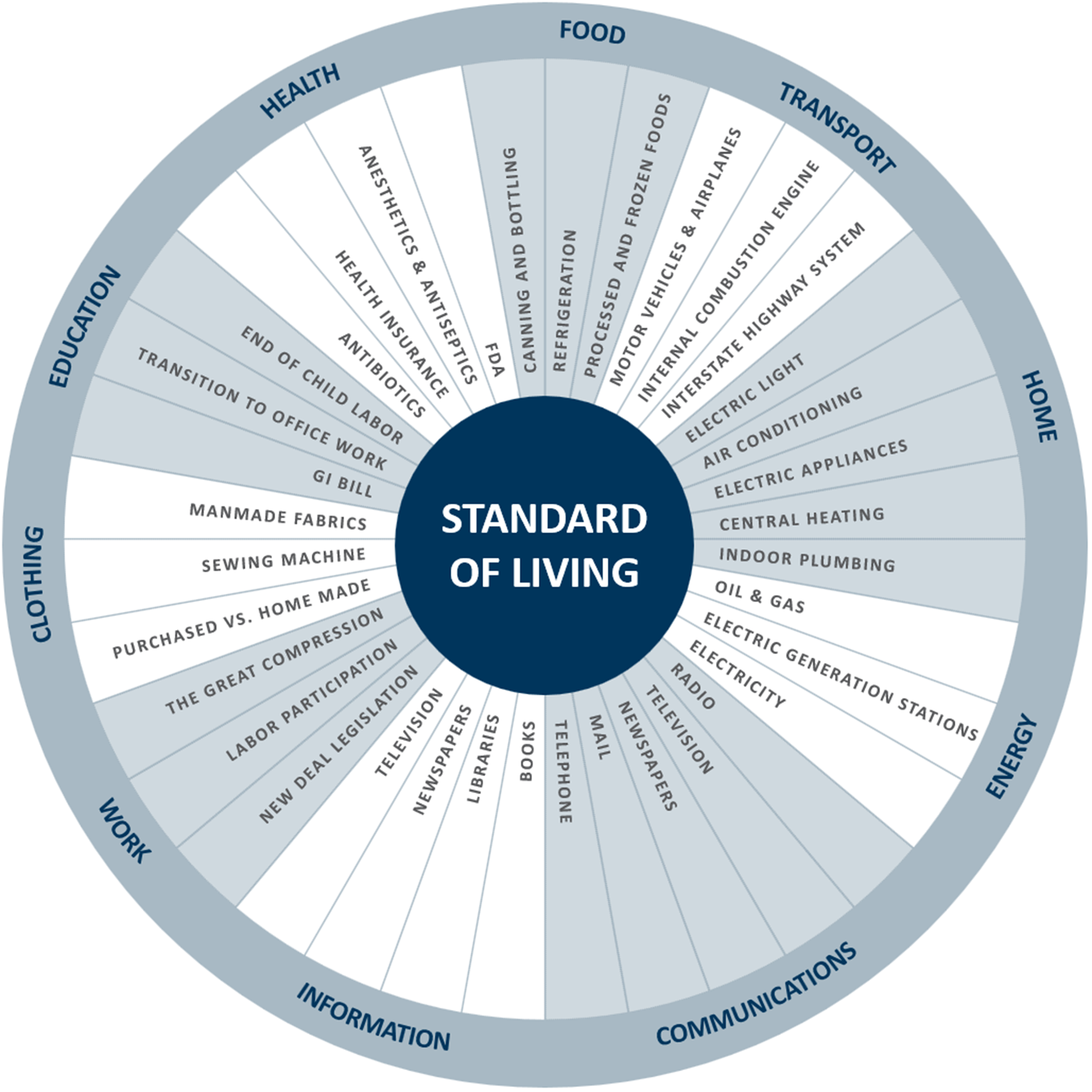
A look at history is very instructive, as several dynamics from that period have the potential to emerge once again – the biggest being the opportunity for convergence. In this context, convergence refers to a virtuous cycle where events in one domain spur action in another. The great inventions (electricity, telephone, and internal combustion engine) were clustered together at the end of the 19th century, forming a virtuous cycle that drove a period of astounding innovation. This innovation cycle continued well into the 20th century – a dynamic that could be emerging again. Yet, science and technology are simply two domains that converged during the special century. The others were the economy, business, politics, and a broader set of societal issues. What enabled this convergence and created the most dramatic improvement in human development? There were several key catalysts.
MBA Education and Short Term Thinking
This recent Article focuses on the failure of MBA programs to prepare leaders and innovators to cope with a fast-changing world: leaders that can put the long-term health of their company and customers first. Here is the bottom line straight from the article:
Far from empowering business, MBA education has fostered the sort of short-term, balance-sheet-oriented thinking that is threatening the economic competitiveness of the country as a whole. If you wonder why most businesses still think of shareholders as their main priority or treat skilled labor as a cost rather than an asset – or why 80 percent of CEOs surveyed in one study said they’d pass up making an investment that would fuel a decade’s worth of innovation if it meant they’d miss a quarter of earnings results – it’s because that’s exactly what they are being educated to do
Digital Transformation of Business and Society
At a recent KPMG Robotic Innovations event, Futurist and friend Gerd Leonhard delivered a keynote titled “The Digital Transformation of Business and Society: Challenges and Opportunities by 2020”. I highly recommend viewing the Video of his presentation. As Gerd describes, he is a Futurist focused on foresight and observations – not predicting the future. We are at a point in history where every company needs a Gerd Leonhard. For many of the reasons presented in the video, future thinking is rapidly growing in importance. As Gerd so rightly points out, we are still vastly under-estimating the sheer velocity of change.
With regard to future thinking, Gerd used my future scenario slide to describe both the exponential and combinatorial nature of future scenarios – not only do we need to think exponentially, but we also need to think in a combinatorial manner. Gerd mentioned Tesla as a company that really knows how to do this.
Business Evolution
This Presentation tells the full business evolution story articulated below.
Several key drivers have positioned the next two decades to deliver a staggering – perhaps unprecedented – amount of change. The accelerating pace of business, the growing impact of digital, and several other major indicators suggest that a next generation enterprise is on the horizon. The first of these indicators is the level of societal change impacting everything from business to war. In the business world, the implications of this change can be seen in our employees, where for the first time in history, four generations of workers are in our work force. The associated challenges are coming into focus, as some of these workers are digital natives, but the vast majorities are digital immigrants. With customers, the shift of power to the individual has changed their role forever and placed them at the center of the company ecosystem. Other indicators include an intense focus on growth, which increasingly requires collaboration within and outside the four walls of the Enterprise. This growth agenda drives a new type of value ecosystem, enabling growth that in many cases is outside a company’s traditional business.
Autonomous Vehicles: The Automotive Ecosystem
This post continues the disruption scenario discussion initiated by my earlier Insurance Industry Case Study. I’ve been using the autonomous vehicle (AV) as an example of a disruptive scenario with potential societal, economical, and environmental impact. In this post, the focus shifts to the scenario’s possible effect on the automotive ecosystem.
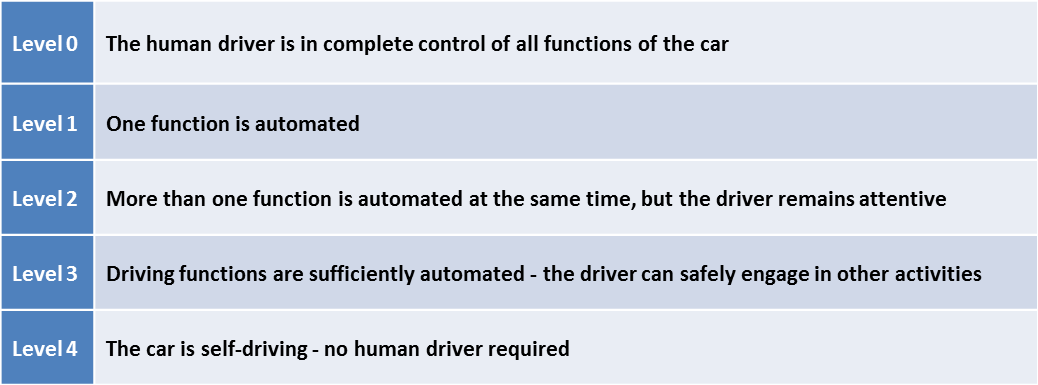
Autonomous vehicle technology can be viewed using a five-part continuum suggested by the National Highway Traffic Safety Administration (NHTSA), with different benefits realized at different levels of automation:
Last month, an IHS Automotive study predicted the world will have nearly 54 million self-driving cars by 2035. The study also predicts that nearly all vehicles in use are likely to be self-driving cars or self-driving commercial vehicles sometime after 2050. Meanwhile, automakers and others are unveiling both their plans for – and introduction of – automated features:
 Reimagining the Future