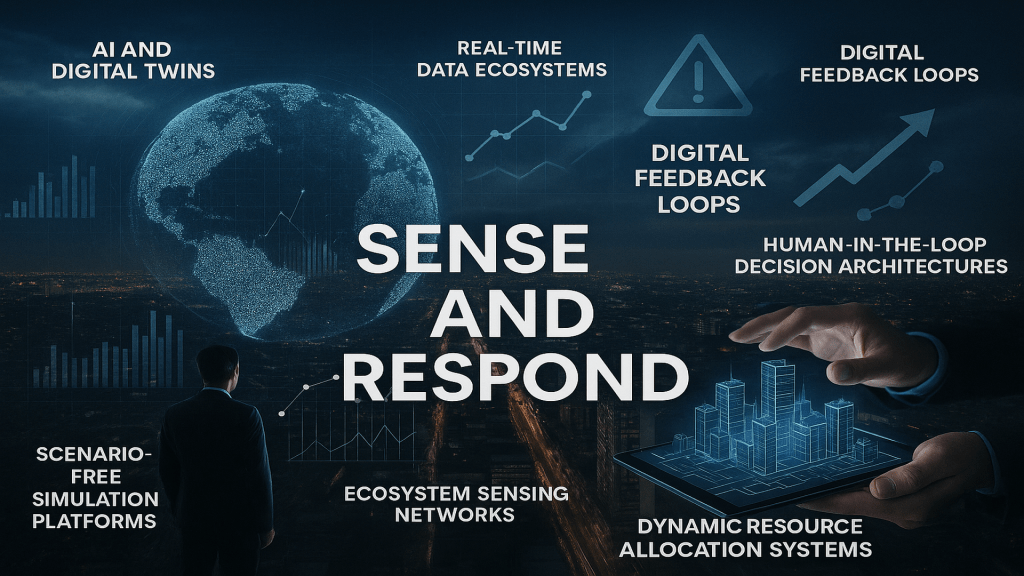
In an era shaped by accelerating change, convergence across domains, and an ever-expanding possibility space, traditional methods of prediction and planning have become increasingly inadequate. The static nature of scenario planning—once a cornerstone of strategic foresight—fails to keep pace with the velocity and complexity of today’s world. What’s needed instead is a living, breathing approach. One that adapts, evolves, and acts in real time.
This is where Sense and Respond emerges—not as a planning technique, but as a survival trait.
Sense and Respond: A proactive approach that monitors shifting conditions across domains to recognize emerging change and enable timely, adaptive action in a complex, fast-moving world. It is not about predicting the future. It is about preparing to move with it.
Moving Beyond Scenarios
For years, strategic foresight has leaned heavily on scenarios – discrete narratives that attempt to anticipate what might come next. But as convergence drives change across science, technology, society, geopolitics, the environment, and philosophy simultaneously, the boundaries between possible futures have blurred. The pace of disruption is no longer linear or localized—it is systemic and accelerating.
In this environment, the real advantage lies not in planning for a predetermined set of possibilities, but in building the capacity to perceive, interpret, and respond to change as it unfolds. Sense and Respond does exactly that.
Enabling the Vision
To realize this paradigm, we need more than mindset—we need infrastructure. A collection of interdependent mechanisms that make it possible to sense meaningfully and respond rapidly. Here are the key enablers:
AI and Digital Twins
At the core of the Sense and Respond architecture are AI and digital twins. Together, they form the cognitive and operational backbone. AI reveals hidden patterns, correlations, and disruptions across large datasets. Digital twins replicate physical systems in real time, allowing leaders to simulate decisions before they’re made. These tools don’t just inform decisions—they transform them.
Real-Time Data Ecosystems
Awareness begins with visibility. Real-time data ecosystems break down silos, integrate across domains, and deliver continuous insight. They allow organizations to maintain a living view of reality – not just what was, but what is – and adapt accordingly.
Adaptive Operating Models
Fast-moving environments demand structures that are equally fluid. Adaptive operating models empower decision-making at the edge, replacing hierarchy with agility. These are not just organizational charts – they are dynamic systems that flex with change.
Digital Feedback Loops
Digital feedback loops create continuous learning systems by capturing real-world outcomes and feeding them back into decision processes. This real-time recalibration ensures that organizations evolve with changing conditions – refining actions, adjusting strategies, and improving responsiveness over time.
Human-in-the-Loop Architectures
Even as machines accelerate our capacity to respond, human judgment remains critical – especially in moments where values, ethics, and nuance matter. Human-in-the-loop systems blend speed and sensemaking, ensuring that technology enhances decision-making rather than replacing it.
Dynamic Resource Allocation
Responding effectively requires more than awareness—it demands action. Dynamic resource allocation systems enable organizations to shift capital, talent, and operational capacity in real time based on emerging needs. These systems move beyond static planning, turning strategy into movement by aligning resources with rapidly changing priorities and conditions.
Ecosystem Sensing Networks
No organization can sense the full picture alone. Ecosystem sensing networks extend awareness beyond the enterprise by linking stakeholders across industries, sectors, and geographies. These networks create shared visibility into emerging conditions—combining diverse perspectives to reveal risks and opportunities that would remain hidden in isolation. In a world shaped by convergence, this collective intelligence becomes a strategic necessity, enabling organizations to detect change earlier and respond more effectively.
Scenario-Free Simulation Platforms
Instead of relying on fixed narratives, scenario-free simulation platforms enable continuous exploration of how decisions play out across unfolding conditions. These platforms model dynamic interactions and evolving variables, allowing organizations to stress-test choices and rehearse responses in real time. The goal is not prediction, but preparation – building adaptive capacity by navigating a broad range of plausible futures.
The Future Belongs to the Responsive
Sense and Respond is more than a framework. It’s a new way of operating in the world. It reflects a deep truth of our time: that we are navigating not a single future, but a constantly shifting field of possibilities. Some pathways elevate humanity. Others diminish it. Organizations and leaders that develop the capacity to move with change – quickly, ethically, and strategically – will be those that shape the future, not just survive it.
The world doesn’t wait. Neither can we.


Leave a Reply