
I’ve asked this question before: Is Creativity the Sole Domain of Humans? As each day passes, the answer becomes clearer. One of the most impactful videos I use captures a conversation between Sophia the robot and Jimmy Fallon. As you watch their interaction, you quickly lose sight of the fact that Sophia is a robot. It’s easy for humans to be threatened by a robot that seems to encroach upon the characteristics that make us distinctly human. However, the other side of this discussion represents the potential for a positive human outcome. One example is the introduction of Companion Robots that help deal with the challenges of loneliness and isolation. Another is the role of robots in healthcare and elderly care.
Continue readingAutomation
The Future Always Follows Two Paths
In a Post from 2016, I explored the balance required when the forces of innovation take hold. The pace of innovation four years ago was already staggering, and the engine that drives it continues unabated. From that post:
Continue readingThe unabated exponential progression of science and technology has driven a staggering pace of innovation. The building blocks are mostly there, allowing creative minds to combine them in ways that attack the world’s most difficult challenges. Additional forces have emerged to position the next two decades as a period that is purpose-focused and transformative. Innovation itself is no longer the sole purview of business, universities, government, and military, as our connected world provides an ideation and innovation engine never seen before.
Watch A Robot Perform Surgery On A Banana
As we march relentlessly towards an Automated Society, scenarios emerge to provide signals. How far will we take this automation scenario? My post last week focused on sports and a robot that Shoots Baskets with stunning accuracy. My post for today looks into robotic surgery, which is traditionally defined as any surgery done with a complete robotic surgical system. It was originally developed for the military so that surgeons could remotely do open surgery on wounded soldiers in the field. This Article on the topic describes it this way:
Continue readingColliding Trends Reshape 2030
A recent book explores aspects of a broader Convergence story. The book – 2030: How Today’s Biggest Trends Will Collide and Reshape the Future of Everything – was authored by Mauro F. Guillen. In exploring a number of trends, he shows how the only effective way to understand the global transformations underway is to think laterally. Said another way, we need to think at the systems level. Understanding pieces in isolation blinds us to the combinatorial nature of change. The book abstract says it this way:
Continue readingEight Trends Amplified By COVID-19
I just finished another book and added it to my Library. Pandemic, Inc. explores eight trends that are amplified by the current pandemic. Author Patrick Schwerdtfeger believes we will see more change in the next 12 months then we saw in the last 12 years. He views the current crisis through an optimistic lens, seeing a time of incredible change, but also opportunity.
Continue readingLong-Term Does Not Mean What It Used To
The news cycle these days makes it hard to catch our breath. More importantly, our focus is increasingly on short-term dynamics versus long-term trends. By long-term, I mean a little beyond what is right in front of us. I captured this thought in a Post last year: When someone says to me: “I’m not worried about five years from now”, my reaction is always the same. What looks to be five years out is likely only 18 months away: A phenomenon I describe in this piece on Acceleration.
Continue readingThe Future Of Jobs
Data gathered by LinkedIn, Coursera and the World Economic Forum was captured in a Future of Jobs Report recently published by The World Economic forum (WEF). A good summary is provided by senior writer Kate Whiting in her recent Article on the WEF website. Report content is showing up in varied places, with key finding.
Continue readingAccelerating Towards Automation
The acceleration of automation is not a direct outcome of the pandemic – it is simply more visible now. That visibility is one of the few bright spots in an otherwise horrible several months. The inequities that exist in the world are now more visible. The lack of preparation for a digital future has exposed those who did not see the need. In the case of automation, it was going to accelerate for a number of reasons, but the pandemic will Accelerate the Acceleration. One clear reason that this decade will see a massive investment in automation is the fall in Working Age population. Said another way, it is getting increasingly difficult to find skilled resources.
Continue readingRobots Are Constructing a Dam in Japan. Are Buildings Next?
Here is a scenario I expect to see play out increasingly over time:
To address Japan’s rapidly aging workforce and labor shortage, contractor Obayashi Corporation has turned to automation by constructing a dam almost entirely with robots
Continue readingIs The Future Of Work A Return To The Past?
For those of us alive today, our core beliefs, the way we live, and our notion of work are rooted in the way it has been for the last 250 years. To us, it has always been this way. When a transformative era emerges, we struggle to imagine a different way of doing things – even when the emerging future is begging us to think differently. One great example lies in the future of work. As we struggle to envision a world where work is no longer required, we fail to realize that History is very Instructive.
Continue readingAutonomy Is The Future Of Business
Several recent articles have focused on a world that is changing faster than anything the world has ever experienced. From the socioeconomic front, to the geopolitical, to the technological, and more, the pace is accelerating. This Acceleration is not new, but it seems that it finally made the radar of organizational leaders. This phenomenon calls into question the traditional view of five-year plans. The world in five years likely looks quite different than our current world. This puts the ability to pivot and change at the heart of future organization success criteria. This new-found awareness highlights the need for flexibility, resilience, and adaptability, likely accelerating the path Towards Digital Transformation.
Robots And The Future Of Work
The phrase “The robots are coming” is often repeated these days. What does their arrival mean for the future of work? That question has short term implications, and the potential for profound long-term impacts. Ask around and you get vastly different perspectives on the question. We seem as polarized on the topic as we are about anything these days. A very good perspective was provided recently in an Article authored by Daphne Leprince-Ringuet. The article explores the possible changes to work as robots become a common feature in the work environment.
The Augmented Age: An Accelerated Path
In a post from the summer of 2019, I explored the notion of an Augmented Age: a future where our natural human capabilities are radically augmented in three ways: Computational systems will help us think. Robotic systems will help us make. And a digital nervous system will connect us to the world far beyond what our natural nervous system can offer. Fast-forward to a world altered by COVID-19: Are we on an accelerated path to augmentation and automation? This recent Forbes Article takes an interesting look at the question from the perspective of lights out factories.
Does COVID-19 Accelerate The Loss of Jobs To Automation?
In a virtual roundtable hosted by C-Level on May 14th, we used several polls to gain insight on how people are thinking about the post-pandemic world. The topic of the roundtable was “Rehearsing Post-Pandemic Futures.” You can view a video of the virtual roundtable Here. I posted the results of polls One and Two earlier. You can participate in those polls by visiting the posts. The third poll that we launched during the session probed the question of jobs.
Accelerating Towards Digital Transformation
It’s easy to view the current crisis as a catalyst for change. Lying beneath the surface are signals that major change is required, and when crisis emerges, hope for that change emerges with it. In most cases however, that change never materializes. The last two months have brought countless predictions of what is to come. While we need to consider the low percentage of successful post-crisis predictions in the past, two trends look likely to materialize: accelerated digital transformation, and a rapid path to automation.
COVID-19: Both Accelerant And Obstacle
As we peer into the Looking Glass, we know that uncertainty is staring back. Our exponential world and all its building blocks and scenarios has created this looking glass phenomenon – something I explored in this Leadership Course back in 2017. COVID-19 underscores this uncertainty, serving as both an accelerant and an obstacle. A good example is explored in this Article on automation.  Will the pandemic serve as an automation accelerant, as businesses replace laid off employees via automation? Or is it an obstacle to the capital investment required to enable automation?
What Skills Do You Need To Outsmart Robots?
What job skills do we need for the future? A popular question that comes up a lot. In a Recent Post, I listed several: emotional intelligence, creativity, flexibility, adaptability, data literacy, and technology savviness. This Tweet of a World Economic Forum video adds complex problem solving, critical thinking, people management, working with others, and decision making to the list.
From Automation to Hyper-Automation
In a recent Article, Gartner says that no single tool available today can replace humans in the workplace. The article goes on to say that hyper-automation is a response to this challenge – bringing together different tools, technologies and techniques to amplify every company’s ability to automate more processes, more rapidly, with better results.
It is no secret that productivity has slowed. In a Post from 2016, I described this phenomenon in detail. According to Wikipedia, productivity is an average measure of the efficiency of production. It can be express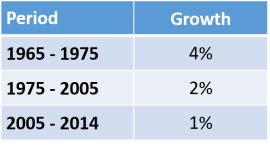 ed as the ratio of output to inputs used in the production process. In a Citi Report I shared in that post, they describe the significant slowing of labor productivity growth, which drives a focus on next generation gains. But In spite of technological progress and innovation, measured productivity growth is low by historical comparison.
A World Without Work
I Just finished another great book. This one is titled A World Without Work authored by Economist Daniel Susskind.  The author explores a phenomenon that we have discussed many times over the centuries: Technological Unemployment. Drawing on almost a decade of research in the field, Susskind argues that machines no longer need to think like us in order to outperform us, as was once widely believed. The book describes a world where more and more tasks that used to be far beyond the capability of computers – from diagnosing illnesses to drafting legal contracts, from writing news reports to composing music – are coming within their reach. Mr. Susskind tells a compelling story to support his conclusion: the threat of technological unemployment is now real.
Jobs will be very different in 10 years
As many focus on the future of work, various different perspectives are presented. A common theme is emerging: Jobs will be there, but they will be very different within the next decade. This recent Article draws three conclusions:
- In 10 years time, 50% of jobs will be changed by automation – but only 5% eliminated.
- 9 out of 10 jobs will require digital skills.
- Young, low-skilled and vulnerable people – all need help with up-skilling.
Several critical points are made by the World Economic Forum article:
 Reimagining the Future