When I finished a recent book by Alec Ross titled The Raging 2020s, I spent time reflecting on the various signals captured in the book and what they might mean for the future. I wrote about both the book and the signals in early January. My team at TCS then produced this short video to capture the message. I have long believed that history can be very instructive – and these 19 signals could be just that. A special thank you to Kevin Mulcahy, April Harris, and Adam Boostrom for their efforts on the video.
Books
Geopolitical Forecasting
The growing convergence story promises to alter our view of possible futures. There are a number of likely shifts that make Geopolitics a critical piece of the story. These shifts add to the high degree of uncertainty reflected in the current environment. In light of this, evaluating geopolitical implications and their influence on the future is growing in importance. But how? I just finished a book titled Geopolitical Alpha that offers a perspective on how to improve forecast accuracy in the geopolitical domain.
Continue readingThe era of geopolitical ignorance is over. The days when investors and corporate decision-makers could be successful without much understanding of politics will be a footnote in the annals of history.
Marko Papic – Geopolitical Alpha
The Economy Is A Critical Area Of Convergence
Much is said about the critical role that science and technology play in shaping the future. This area of convergence continues to have a profound impact on that future. I have described the importance of convergence in various posts in the past, highlighting the impact of other domains like geopolitics, philosophy, and society. Another key domain is the economy. Understanding the global economy is critical to illuminating possible futures. The role of Central Banks has been instrumental in navigating extreme events like COVID-19, as well as the various boom and bust financial cycles of the past.
Continue readingHow Artificial Intelligence Will Transform Everything
In 2015, best-selling author Martin Ford gave us Rise of the Robots: Technology and the Threat of a Jobless Future. In the fall of 2021, he followed that up with Rule of the Robots: How Artificial Intelligence (AI) Will Transform Everything. In his recent book, he explores various aspects of artificial intelligence – both positive and negative. He likens AI to electricity, perhaps the greatest general-purpose technology the world has ever known. A general-purpose technology is pervasive, improving over time, and able to spawn new innovations. In the Second Machine Age, the authors describe this phenomenon as a common element of each industrial revolution, including steam (First), electricity, Telephone, and internal combustion engine (second), and Internet (third).
We can go all the way back to fire to witness the impact of these pervasive innovations. In an article from July of 2021, Sundar Pichai, the chief executive of Google’s owner Alphabet, said that he believes artificial intelligence (AI) will eventually have a bigger impact than fire, electricity, and the Internet. This poll from my post on the topic explored the reaction to that belief. Fifty-eight percent of respondents agreed with him. Please take the poll and lend your voice to the conversation.
Continue readingWinning The Right Game
My belief in a shifting organizing system dates back several years. The work of leading think tank RethinkX effectively highlights why. History tells us that a collapse is inevitable when the existing system can no longer adapt fast enough to order-of-magnitude improvement in technological capabilities. When this condition is present, a new organizing system is required. RethinkX defines an organizing system as:
Continue readingPresent Future
Time is the dimension of historians and futurists, of chroniclers of what was, and speculators of what may be. Here is a truth: In making any decision, we are by definition deciding what to do . . . next. We must choose amongst known possibilities and paths, simulate outcomes and consequences in our minds. Another truth: At any decision point, 100% of the information we have is based on the past, while 100% of the value and consequences of the decision we make lies in the future, which is inherently probabilistic and unknown
Guy Perelmuter, Present Future: Business, Science, and the Deep Tech Revolution
That quote comes from a recent book titled Present Future authored by Guy Perelmuter, Founder at GRIDS Capital. The book takes a look at history and the future. The foreward echoes one of my strong beliefs: “when it comes to our endlessly unfolding future, the only certainty is uncertainty, and the only way to reduce uncertainty is to have a deep sense of history and reliable clues to the future.” That foreward was written by Josh Wolf, Founder and Managing Director, Lux Capital. He describes the book as follows:
Continue readingAI 2041: Ten Visions For Our Future
In a recent post on quantum computing, I referenced a new book (published in September 2021) that I recently added to my library. The book titled AI 2041: Ten Visions for Our Future was authored by Kai-Fu Lee and Chen Qiufan. The authors use highly effective approach that combined fiction with expert analysis to help the reader imagine possible futures. The storytelling was brilliant (my compliments Chen Qiufan), and Kai-Fu Lee provides analysis after each story, showcasing his grasp of AI and its possible applications.
Continue readingThe Exponential Era
Much of what is driving our emerging future is the exponential pace of science and technology. When combined with the Convergence of building blocks that span multiple domains, it becomes easy to see why the world seems to be moving so quickly. In a recent book titled “The Exponential Era”, authors David Espindola and Michael Wright explore this phenomenon and present an approach for surviving in a future that is moving so fast. This story is about an overwhelming number of building blocks and the rate at which they are converging. As this happens, long-standing beliefs and institutions are rendered obsolete. I had the honor of providing a quote for the book jacket:
Continue readingAre We Heading Towards A New World Order?
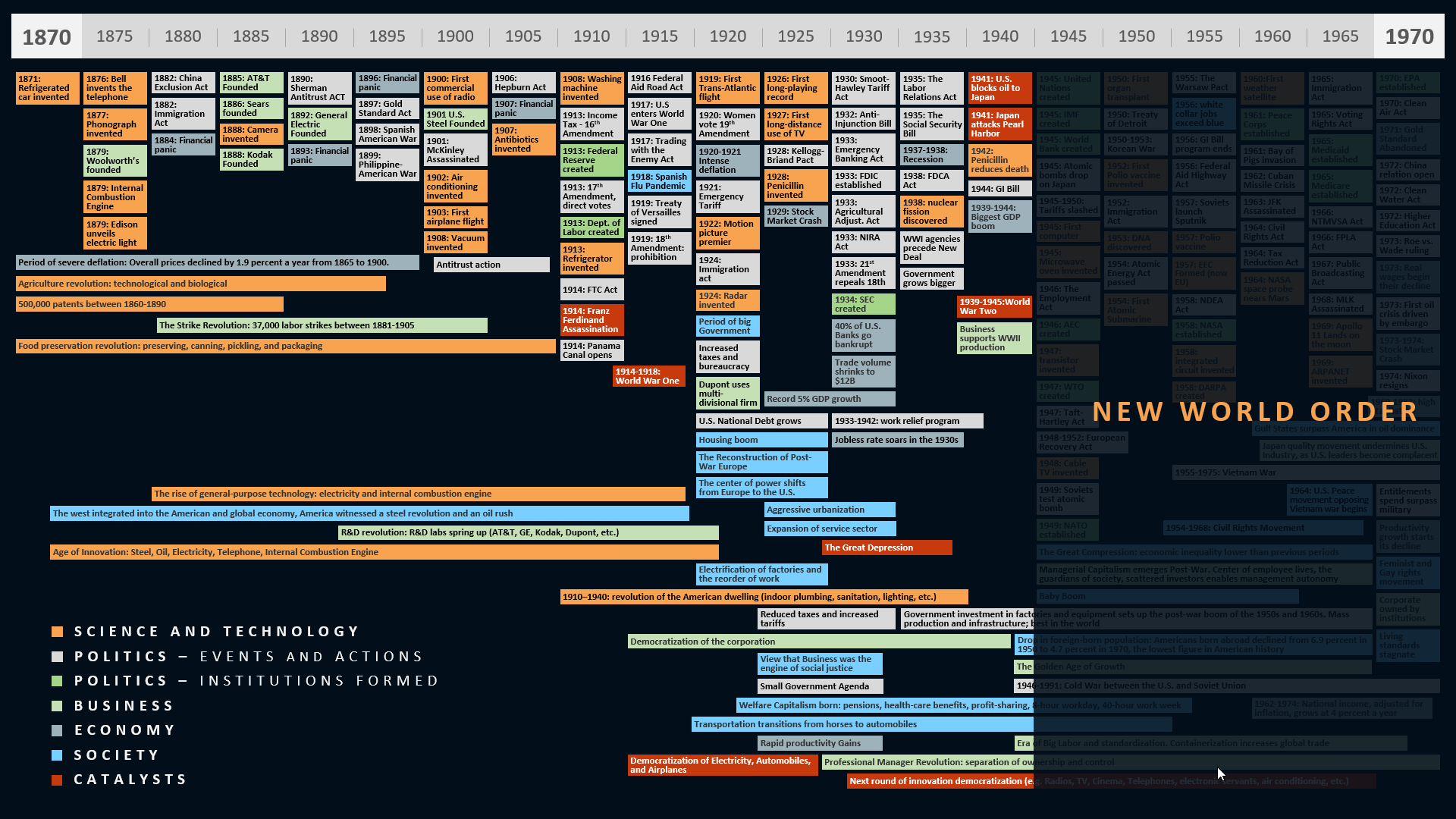
After World War Two, 730 delegates from all 44 Allied nations gathered in the U.S. at the Mount Washington Hotel in Bretton Woods, New Hampshire. The Bretton Woods Conference aimed to regulate the international monetary and financial order after the war ended. Held from July 1 to 22, 1944, agreements were signed and ratified by member governments, establishing the institutions that represented a new world order. This led to what was called the Bretton Woods system for international commercial and financial relations.
Continue readingPost Corona: From Crisis To Opportunity
“I begin with two theses. First, the pandemic’s most enduring impact will be as an accelerant. While it will initiate some changes and alter the direction of some trends, the pandemic’s primary effect has been to accelerate dynamics already present in society.” – Scott Galloway
That is a quote from a book I just finished. Scott Galloway is a professor at New York University’s Stern School of Business, where he teaches brand strategy and digital marketing to second-year MBA students. In his new book, he looks at the world post corona. The book titled “Post Corona: From Crisis to Opportunity” has been added to my Book library. He points to remarkable things that have happened since the virus reared its ugly head, like: It took Apple 42 years to reach $1 trillion in value, and 20 weeks to accelerate from $1 trillion to $2 trillion (March to August 2020), and we registered a decade of ecommerce growth in eight weeks. Additionally, Tesla became not only the most valuable car company in the world, but more valuable than Toyota, Volkswagen, Daimler, and Honda combined.
Continue readingTen Lessons For A Post-Pandemic World
“There are decades when nothing happens and weeks when decades happen.” – Vladimir Lenin
That quote is highlighted in a new book by best-selling author Fareed Zakaria. In “Ten Lessons for a Post- Pandemic World”, Mr. Zakaria helps readers to understand the nature of a world that emerges after the pandemic: the political, social, technological, and economic consequences that may take years to unfold. He does this by focusing on ten lessons:
Continue readingNon-Obvious Mega Trends
I just completed another book titled “Non-Obvious Mega Trends”. Author Rohit Bhargava focuses on seeing what no one else sees, and helping his readers do the same. Per the Amazon abstract, in the past ten years, his signature annual Non-Obvious Trend Report has helped over a million readers discover more than 100 trends changing our culture. The opening section focuses on the art of non-obvious thinking. From there, he explores the five mindsets of non-obvious thinkers, and reviews his Haystack Method for curating non-obvious Ideas.
Continue readingColliding Trends Reshape 2030
A recent book explores aspects of a broader Convergence story. The book – 2030: How Today’s Biggest Trends Will Collide and Reshape the Future of Everything – was authored by Mauro F. Guillen. In exploring a number of trends, he shows how the only effective way to understand the global transformations underway is to think laterally. Said another way, we need to think at the systems level. Understanding pieces in isolation blinds us to the combinatorial nature of change. The book abstract says it this way:
Continue readingOrganizing For Disruption
Back in 2015, I was looking at emerging organization models for a societal shift to a very different era. While organizations have experimented with many of these, the truth is, most still struggle with this critical structural change. One impactful model was positioned by Geoffrey Moore in his book titled Zone to Win. Given how relevant the topic is today, I am reposting my synopsis of the book below. In addition, here are three additional posts on the topic:
Continue readingThe New Map
I just finished another book and added it to my Library. Author Daniel Yergin explores the convergence of energy, climate change, and a world where an existing power is confronted by an emerging power. The New Map helps us understand global dynamics, historical perspectives, the entrenched role of oil and gas, the forces that are driving an energy transition, and the impact of a raging pandemic.
Daniel Yergin is a highly respected authority on energy, international politics, and economics, and a Pulitzer Prize-winning and bestselling author. He is vice chairman of IHS Markit, one of the leading information and research firms in the world, a member of the board of the Council on Foreign Relations, a senior trustee of the Brookings Institution, and has served on the Secretary of Energy Advisory Board under the last four presidential administrations.
Continue readingGeopolitics: A Complex Area Of Convergence
The critical need to understand the rapidly approaching future relies upon our understanding of various domains that are Converging. It is difficult enough to stay abreast of rapid advancements in science and technology, but Introduce societal factors, geopolitical, economic, and environmental considerations, and the task gets harder. Yet a high-level appreciation for these domains is necessary if we hope to understand the future and steer it in constructive directions.
Continue readingThe World
When we look into the future and try to understand its path, we must consider the geopolitical sphere as a key area of influence. To that end, I just added another book to my Book Library. The World: A Brief Introduction was written by Richard Haass, an American Diplomat. Per the book abstract, The World is designed to provide readers of any age and experience with the essential background and building blocks they need to make sense of this complicated and interconnected world.
Why We’re Polarized
I have added a new book by Ezra Klein to my Library. The book titled “Why We’re Polarized” takes us on a fascinating journey to the past, helping us see that for all our problems, we have been a worse and uglier country at almost every other point in our history. Having said that, our current polarization has made it impossible to govern. I found his historical perspectives on the framing of our current political system very timely, and the notion that what works in one era fails in the next. The institutions, frameworks, and beliefs born in a vastly different era, struggle to keep pace in an era that looks very different.
The Ecosystem Edge
I just finished another book and added it to my Book Library. Ecosystem Edge was written by Peter J. Williamson and Arnoud De Meyer. The move towards ecosystems as an organizing principle for market activity has been a foundational piece of my research on the future of business. You can find that research here. The book goes into depth on the what, why, and how of ecosystems. Anyone looking for detailed guidance on how to execute in this ecosystem world, this is the book for you. Supported by several real-world examples, the authors explore the different aspects of succeeding in the ecosystem world. I highly recommend the book. The abstract is included below.
The Rise Of Digital Currency
I just finished another great book: Beyond Blockchain: The Death of the Dollar and the Rise of Digital Currency.
I just added it to my Book Library and highly recommend the read. Author Erik Townsend has a great blend of financial and software expertise, making him uniquely qualified to talk on the topic. He explores a wide range of topics from the basics of money to global scale digital currencies.
Although launched in early 2019, the book is very timely given the current geopolitical environment. Mr. Townsend does a great job of describing various aspects of our financial system, thereby building a foundation of knowledge that makes the discussion of digital currency more impactful. Although a big proponent of cryptocurrencies and the values and motivations of the original inventors, he is a pragmatist and practical thinker – which I found very refreshing.