A Future Thinking Canvas

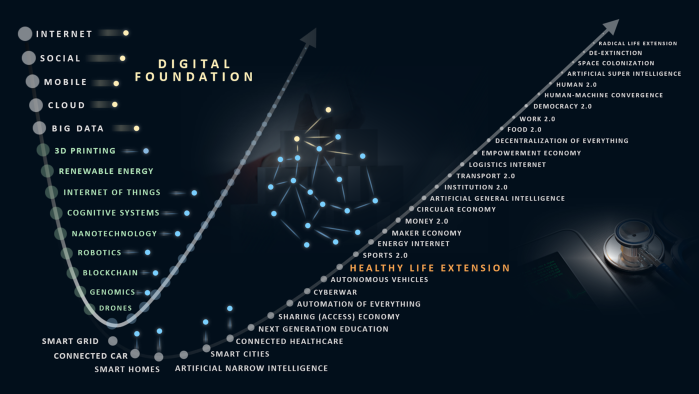
Our exponential pace is due in part to the overwhelming number of building blocks available to innovate. Understanding how these building blocks combine provides a glimpse into possible futures. In this visual, dots connect to portray the building blocks that are likely to extend our healthy lives – a key emerging future scenario.

Healthy Life Extension - Combinatorial

Continue reading

Transforming for the Digital Age

Digital transformation means different things to different people. As I strive to change mindsets, I am sensitive to these distinct perspectives and the individual filters applied to terms like digital and transformation. In my view, Digital has been more narrow than holistic, while in some organizations ERP implementations are considered transformation. So, does digital transformation represent the narrow use of digital technology to improve some aspect of our organization? Or, is it the wholesale change of a set of structures, institutions and paradigms built for a different era? Although I have mostly abandoned the phrase, when I do use it, I mean the latter.

Let’s call it what it is, starting with the term transformation. To truly transform means to change from one nature, substance, form, or condition into another. I’d maintain that the pace of change has made the archaic nature of our industrial era structures, institutions, and management paradigms very apparent. Therefore, to transform in this sense means to change from the nature, form and substance of our industrial past, to a state that is viable for our digital future. Digital is foundational: the building block for which this future state is built upon. Therefore, for clarity sake, a better way to describe digital transformation is:

TRANSFORMATION FOR THE DIGITAL AGE: a change in the nature, substance, and form of our industrial past, to a future state that allows us to thrive in our emerging digital future.

Continue reading

Next Generation Education

The World Economic Forum estimates 65 per cent of children today will end up in careers that don’t even exist yet.

“Individuals and companies that succeed in the future will be those who adopt the philosophy of lifelong learning,” says Nigel Heap, managing director of Hays UK and Ireland. “Businesses that facilitate the resources, tools and time to support learning will not only have employees who are more engaged, but their business will be better placed to face challenges and remain innovative.”

From the Future of Learning


I’ve attempted to link innovation and our well-being via a visual that I’ve shared previously in this forum. It allows us to envision our emerging future and leverage story telling techniques to describe it in ways that become actionable. One of the most critical aspects of this emerging future in my humble opinion is the future of learning and education.

Reimagining Education

Our education system must prepare individuals for the world that is, not the one that was. It must ensure that those educated embody the qualities and competencies essential to life in a society very different than our industrial past. Among them are: creativity, critical thinking, innovative thinking, curiosity, social intelligence, a collaborative spirit, adaptability, entrepreneurial spirit, connecting dots, and knowing how to ask the right questions. Our need for life-long learning and unlearning drives us to reimagine education and transform through combinatorial innovations that leverage AI, Mobile, Cloud, Virtual Reality, Augmented Reality, Big Data, and more. Some of the facets of next generation education include:

Continue reading

What are your thoughts about the Future?

I had the pleasure of developing an online thought leadership course focused on our emerging future back in May of this year. I had the added pleasure of working with futurists Gerd Leonhard, Gray Scott, and Chunka Mui, along with several industry leaders. The free Thought Leadership Course is available through May of next year. The course has been invaluable to me, as it provided a platform for dialog about our emerging future. I was thrilled with the thought provoking dialog that occurred through our moderated forum. For all those that participated thank you.

During the two week course, several poll questions were positioned to help us understand how the community is feeling about critical topics like ethics, our economy, and the likely transformative period that lies ahead. Here are the questions and their responses. There is plenty of time to take the course and add your voice to the conversation.

Continue reading

A Shift to Purpose and Well-Being

Singularity University has been talking about purpose for some time now. They describe a focus that is audaciously big and aspirational, causing significant transformation to an Industry, community, or the planet. There is a clear “why” behind the work being done, something that unites and inspires action. They call this a Massive Transformative Purpose.

A focus on purpose has a motivating effect with the potential to trigger incredible outcomes. A proven approach in high-growth organizations according to Singularity University, with a focus on purpose in common across the 100 fastest growing organizations. In an era that challenges much of our belief system, an aspirational quality of purpose is a mechanism that helps us think differently. Shared passion within communities and shifting generational views of mission-driven work can fuel the fires of purpose. An organizational focus on purpose is a vehicle for attracting and retaining top qualified talent. A purpose that is aspirational and focused on creating a different future is what ignites passion in individuals and groups; it’s what engages people’s hearts and minds to work together to realize their goal. Breakthroughs in science and technology can be linked to the deeply unifying and motivating ability of purpose. Setting out to solve big problems brings purpose and meaning to work. The more we organize around purpose, the better the outcomes and the more fulfilled we will be with our work.

Continue reading

The Singularity: Connecting Dots

I have found that the metaphor “Connecting the Dots” is a good way to think about the emerging future. With the sheer number of dots emerging, and the pace at which they advance, we are challenged both by the number of dots, and the speed at which they emerge and Intersect. These dots are combining to form virtuous cycles; complex chains of events that reinforce themselves through feedback loops. Visualizing both the connections and the cycles is one approach to finding the signal through the noise.

Continue reading

Mary Meeker: Internet Trends 2017

Mary Meeker recently delivered her now famous Internet Trends Report for 2017. She covered:

  1. Global Internet Trends
  2. Online Advertising and Commerce
  3. Interactive Games
  4. Media and Distribution Disruption
  5. The Cloud and Accelerating Change Across Enterprises
  6. China Internet and the Golden Age of Entertainment and Transportation
  7. India Internet
  8. Healthcare Digital Inflection Point
  9. Global Public / Private Internet Companies

Continue reading

The Future Ain’t What It Used To Be

For those that have taken the thought leadership course focused on our emerging future, thank you. For those that may have interest, the course will run for foreseeable future. In this post from last year, I summarized the key messages from the course. It has been updated to reflect the progression of our emerging future.

Yogi Berra is credited for once saying that the future ain’t what it used to be. What a perfect way to describe what is coming: a complete change in the way we think about the future. Our journey to the future begins with a look back. A convergence of multiple forces during a special century following the U.S. Civil War established the standard of living in developed economies. Some believe that we will never see a convergence of forces as dramatic and impactful as that which occurred during this period. I pulled this wheel together to capture that convergence across the various areas of our well-being, leveraging the work of economist Robert J. Gordon. I captured his thinking in a recent post titled Revolution and the Innovation Wheel.

Continue reading

The Timing of Future Scenarios

Timing. It’s one of the most difficult facets to consider when thinking about the future. We know that convergence across societal, political, economic, science and technological forces is creating many future scenarios. We also know that enablement is happening at an exponential pace. Some believe (present company included) that the coming macro-level tipping point is likely to impact humanity on a scale only experienced twice in human history (hunter-gatherer to agriculture and agriculture to industrial). There will be many micro-level tipping points on the journey towards an automated society – and the timing of those tipping points is impossible to predict.

Continue reading

Banking on Disruption: TCS and the Clayton Christensen Institute

TCS and the Clayton Christensen Institute have collaborated to produce a series of articles and whitepapers that explore the future of industries through the lens of a set of fundamental theories developed by Harvard Business School Professor Clayton Christensen (Mr. Christensen is a TCS Board member). The theories offer a form of what-if analysis that leaders can leverage to better understand the cause and effect between actions and results. These theories include Disruption Theory, the Theory of Jobs to Be Done, and Modularity Theory. In this case, the author focuses on the disruptive potential of innovation, and this first piece in the series tackles Disruption in the Banking Industry.

Continue reading

Future Sports: Connecting the Dots

Last week, I presented on the future of sports at a fund raiser for the Rutgers University Women’s Soccer team. A local Article on the topic captured the high-level themes, but for those interested, here is the full presentation along with two very good reports I tapped into from Delaware North on the future of sports: The Future of Sports 2016 Report and The Future of Sports 2015 Report.

Continue reading

Privacy and Corporate Responsibility

coffee-break-with-game-changers

I joined another episode of Coffee Break with Game Changers on Wednesday of this week. A very good discussion on privacy and data. Here is a brief abstract.


The buzz: “You already have zero privacy – get over it” (Scott McNealy). We as individuals have welcomed Internet-connected, mobile devices to help us make daily decisions. But when we share data with companies, and they share it with their business partners, are their built-in and bolted-on data security capabilities enough to protect our personal information?

Continue reading

Discussing the Future of Sports

This story was posted this morning to promote a fund raiser that I am participating in on Tuesday evening, June 13th at 6:00 p.m. We will be discussing the future of sports, and its implications to fans, stakeholders, arenas, the athlete, humans, and the sports themselves. Here is an excerpt from the article by  and a glimpse into what I will be presenting.

This event will take place from 6 to 8 p.m. Tuesday night in the Brown Recruiting Pavilion behind the south end zone, with proceeds to benefit the Rutgers women’s soccer team. Details for the event can be found here.

Join us if you live in New Jersey.

Continue reading

CXOTALK: June 9th Episode

CXOTALK Episode

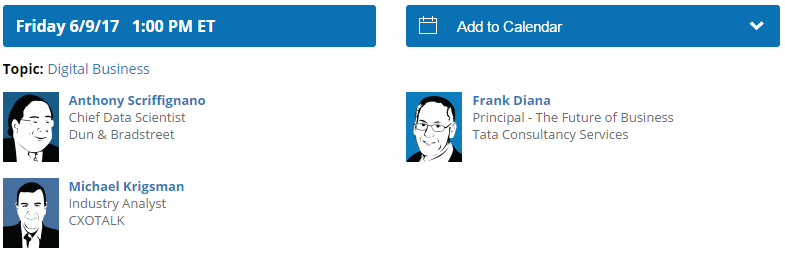
Update 6-9-17 3:00 pm: It was an absolute pleasure spending time with Anthony Scriffignano and Michael Krigsman discussing very important and difficult issues regarding our future. The rebroadcast is available here.

Continue reading

Our Emerging Future: Revised

Our Emerging Future

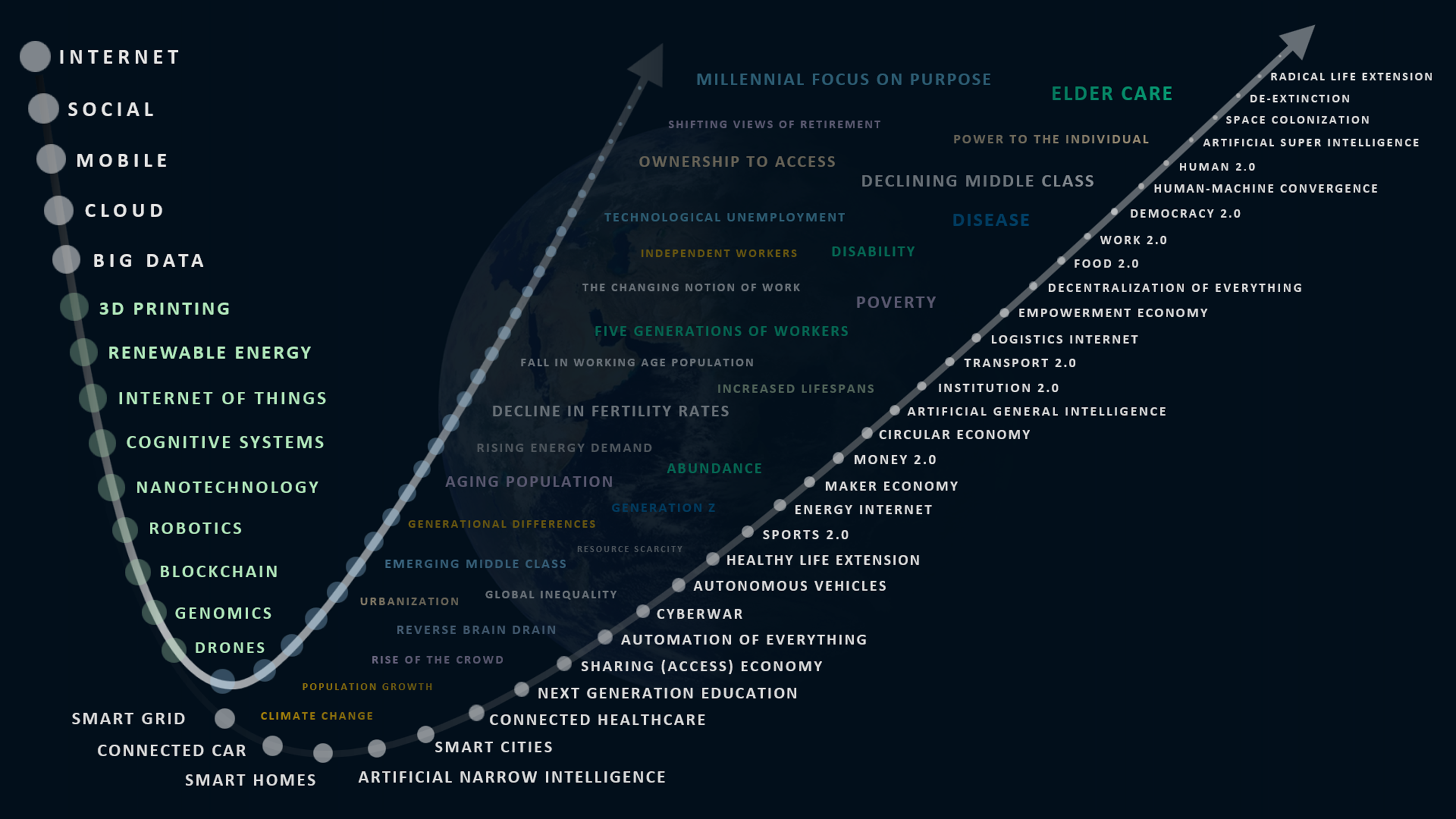
Several months have past without adding to the emerging future visual. In this post on Visualizing our Emerging Future, I described the origins of the visual and how it is being used. Two specific activities have prompted me to add two new scenarios to the visual:

Continue reading

Reimagining the Future: Week Two of the Online Course Launched

Week two of Reimagining the Future has just launched! Week one drew a large audience and generated great dialog. A big thank you to those who have participated so far. As discussed in the course, we must collectively take control of creating our future. Our hope is this course and related dialog are just one small step on that journey. There is still plenty of time to take the full course, you can enroll here.

Continue reading

Reimagining the Future Athlete

On June 13th, I will be presenting at a Rutgers Athletics Fund Raiser with a focus on the future of athletes and athletics. We will explore

1) Automation – robots replacing athletes, sensors and software replacing officiating

2) Performance – more data and machine learning lead to improved performance through better insights

Continue reading

Technology vs Humanity – The Future is already here

In a recently released video, Futurist Gerd Leonhard delivers his key messages in a powerful and passionate plea for balance between technology and humanity. This five minute video is a must see. Some of his key messages are:

Sector after sector, industry after industry, we are waking up to the fact that the future is already here. My note: after struggling to drive a level of urgency regarding the speed at which the future is approaching, leaders are now beginning to embrace a future-back mentality.

Continue reading

Dual Transformation

In a recent book titled Dual Transformation, the authors (Scott D. Anthony, Clark G. Gilbert, and Mark W. Johnson) focus on the challenging task of transforming the core while simultaneously creating a growth engine. They refer to it as dual transformation: Transformation A – repositioning the core, and Transformation B – creating the new. This complex tension is represented in this visual from our upcoming leadership course: Reimagining the Future: A Journey through the Looking Glass.

Continue reading

Disruption and the Future of Work

CXOTALK Episode

Join me on the June 9th episode of CXOTALK with Industry Analyst and host Michael Krigsman. We will be joined by Anthony Scriffignano, Chief Data Scientist, Dunn & Bradstreet. A quick description of the episode:

What are the implications of technology and new business models on the future of work? The impact of technologies such as artificial intelligence and robotics have profound implications for both companies, individuals, and society. At the same time, government policy on these issue lags technology and the impact on people. On this episode, a respected futurist and well-known data scientist explore these complicated and important issues.