The Traits We Need For The Future We’re Entering

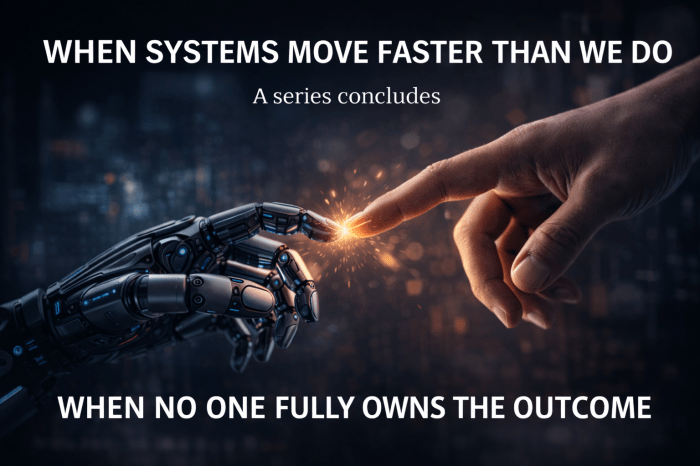
Over the last ten posts, we have been building a clearer picture of what it means to live in a world approaching a systemic turning point. We began by examining why today feels unusually active and uneven, then traced the deeper pattern behind major shifts in history. We explored how change accumulates, compresses, destabilizes, and eventually reorganizes life around new assumptions. We introduced the seven domains that shape every transition and showed why no single force ever moves a civilization forward on its own. We examined the three drivers that push societies across thresholds and built gauges that make systemic pressure legible. Using those gauges, we read four major transitions in the long arc of history: from hunter-gatherer life to agriculture, from agriculture to the Axial reorientation of ideas, from the Axial age to the Renaissance, and from the Renaissance into the Industrial world. We then applied the same lens to the present, showing why the 2020s feel dense, fast, and tightly connected. Most recently, we explored the possibility of another transition forming and the kind of governance required when intelligence itself becomes a shared utility. Together, these posts formed a simple arc: understand the moment, understand the mechanics, understand what may be forming next.

Continue reading

Rehearsing The Future: Navigating Complexity With Mimi Brooks

In an age of accelerating change and complexity, leadership requires more than traditional planning – it demands a mindset of rehearsal. This principle framed my recent conversation with Mimi Brooks, CEO of Logical Design Solutions, on her Bold Agendas podcast. Our discussion spanned the evolving role of ecosystems, the dual edges of innovation, and the critical importance of adaptability and resilience. Together, we unpacked strategies for thriving in an unpredictable world and explored the transformational shifts leaders must embrace to navigate 2025 and beyond.

Continue reading

The Haier Approach: Structurally Aligning Organizations With The Ecosystem Era

A recent article describes an astonishing achievement enabled by an ecosystem mindset. In 2016, Haier, the world’s largest appliance manufacturer headquartered in China, acquired GE Appliances. As author Bill Fotsch states: “What followed was nothing short of astonishing. Market share, which had languished around a mere two percent for the previous four years, skyrocketed to 20 percent. Haier had achieved what GE could not: a resounding success in the appliance market.”

Continue reading

Return On Learning: Pioneering The Future

In the preceding four-part series, I explored the convergence of knowledge, invention, and societal transitions, tracing the democratization of knowledge from the dawn of language to the present day. The series examined how pivotal inventions have expanded human capabilities and transformed civilization, while also considering how today’s accelerating pace of scientific and technological advances is creating an expanding space of opportunities and challenges. As we stand on the threshold of a new age of invention, potentially more profound than past eras, the series emphasized how organizations can adapt, build resilience, and thrive. Building on these key themes, this post shifts focus to Return on Learning (ROL), a crucial concept that equips organizations to navigate this evolving landscape. By prioritizing learning, leaders can proactively shape the future and ensure long-term success in an era of rapid transformation.

Continue reading

Agile Leadership

Steve Denning knows a thing or two about management. In a recent article, he talks about the baggage of agile and the critical need to reinvent the very concept of management. He identifies the practices of industrial-era management and labels them as “obsolete”. He goes as far as to say those practices constitute a disease that must be eradicated. In a post-pandemic world, resilience is the new buzzword. Our uncertain times dictated a focus on adaptability years ago – yet it took a pandemic to bring it into leadership consciousness. Eradicating the disease of industrial-era management is therefore long overdue.

Continue reading

Ecosystem Leadership

In today’s world, the most effective CEOs recognize that no one is an island: no CEO, no company, no industry, no country. The lines have permanently blurred, and chief executives must embrace the opportunity to help shape our shared future — as enterprise leaders who are moving across and beyond — to influence entire ecosystems

Continue reading

Leadership Advice From Futurist Kevin Benedict

Sharing this short video on leadership via colleague and Futurist Kevin Benedict.

Innovating In An Uncertain World

Two words have come up frequently in leadership dialog: Innovation and Ecosystems. Several posts have described ecosystems and the dominant role they are likely to play in future economic activity. The number of organizations pursuing ecosystem-related initiatives is growing rapidly. Innovation on the other hand has been a topic of conversation for most of our economic history. Yet, something is different. The conversation about innovation culture is intensifying and the need for an innovation mindset to permeate the organization is increasingly recognized. Why? What changed? We can attribute some of the change to uncertainty. One could argue that business has always operated in uncertain environments. I would argue that a number of factors make the uncertainty in our current environment unique, comparable only at some level to past transformative periods in history. We then must consider complexity, pace, volatility, unpredictability, and the unexpected.

Continue reading

An Education Revolution

There could hardly be anything more important for the future of the country than the strength of its education system. 

Steve Denning

I read a great Article on education the other day written by leadership thinker Steve Denning. My passion for the future of education is expressed in frequent Posts on the topic – so the article struck a chord. As a leadership guru, Mr. Denning focused on the management of education and provided some fascinating statistics. For example, in 2006, only 43% of school personnel in the US were teachers, while in other countries, that percentage was 70 to 80%. Seems that this imbalance is driven by a compliance focus that has employees trying to monitor and comply with federal and state requirements. Mr. Denning believes that lost in this period of industrial-era bureaucracy is the purpose of organizations involved in education. He describes a current corporate revolution in management and leadership that he believes needs to take root in education. There are two very critical points made in the article that speak to a need to Think Differently.

Continue reading

Dots in a Complex System are Connecting Rapidly

In their now popular book on The Second Machine Age Andrew McAfee and Eric Brynjolfsson describe one of the forces behind our accelerating pace. This force could be key to understanding the dynamics of our environment; the number of potentially valuable building blocks is exploding around the world, and the possibilities are multiplying like never before.

Continue reading

Perspectives on the Journey

A key message in the Reimagining the Future body of work is that our growing digital world challenges every aspect of how we do business, how we govern and how we live. It will drive significant strategic, tactical and structural changes and fundamentally alter our long-standing beliefs, success strategies and institutional constructs. We’re already seeing it.  Just look at companies like Amazon, Uber, Airbnb, Tencent, Google, Alibaba and Facebook.  They are rewriting the rules and redefining how value is created and captured, using digitally-centered platforms and ecosystem-enabled business models.

Continue reading

Belief Systems, Purpose, and Balance

At the Health Summit in D.C. two weeks ago, I was asked to articulate those things that leaders should consider as they navigate the complexity of our emerging future. The three that always top my list are:

  1. Resetting our intuition and belief system for a new era – think differently
  2. Shifting to a hybrid profit and purpose orientation
  3. Seeking a balance between innovation that enhances society and mitigating the risk of unintended consequences.

This two minute video captures that portion of our panel discussion.


Women Leadership in an Exponential World

I was honored to deliver the opening keynote at the SIM Women Executive Leadership Forum on Thursday May 5th. SIM Women Founder Kristen Lamoreaux did a wonderful job organizing the program. I met some fascinating leaders that selflessly give their time to their communities and society in general. As we look at the challenges that face our world, these are the type of leaders I want to stand with. In a room full of outstanding women, I saw the leaders of our future. As our exponential pace accelerates, a gap widens between exponential progression and our linear and incremental progress. This gap represents disruptive stress or opportunity – and increasingly, it is our right brain characteristics that help determine which.
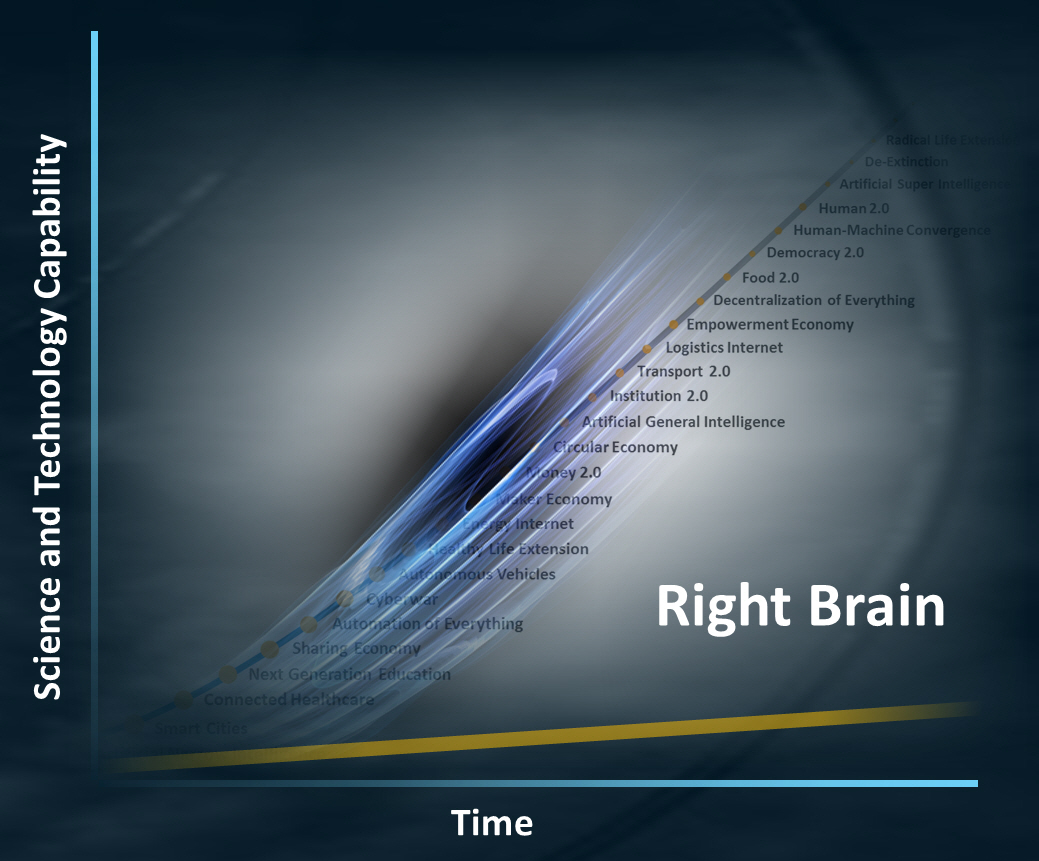
Linear to Exponential Shift

Creativity, imagination, big picture vision, emotional and social intelligence, empathy, and other human characteristics are critical to navigating in an exponential world. As automation accelerates, these human traits become even more critical. In a recent report by Citi on Technology at Work, the authors point to our propensity for social interaction, communication, and empathy being something machines can never replace. Women excel in these areas, positioning them as leaders of our emerging future. In a different Citi report on Women in the Economy, they highlight the importance of women in the labor market, where a 50% reduction in the gender gap can lead to a 5% increase in global GDP. Women are uniquely positioned to play a critical role in the digital economy.

At this SIM event, I focused on our emerging future and the unlearning that it requires. The last time we faced a similar scenario was a century ago, as a shift occurred from the steam engine era to the electricity era. That transition did not go well – something I’ll explore in future posts. We find ourselves approaching another transitory point in history. Will we learn from history? My focus remains on this transition and the mindset shift so crucial to navigating the change. This time, I believe women leadership could be the difference. You can view the presentation Here.

Future Structures

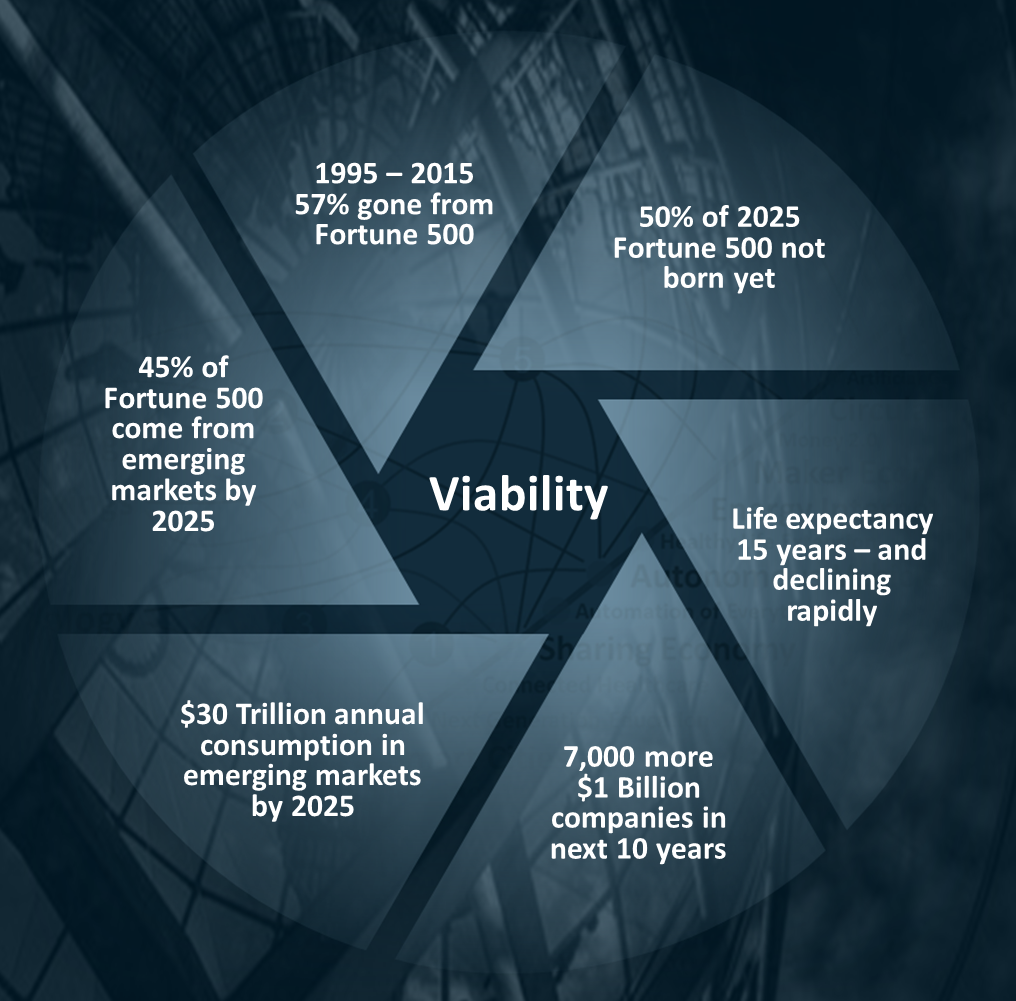
Some time ago, I did a series on the enablers required to propel organizations into tViabilityhe future. With the passage of time, and after considerable dialog, the time has come to update that point of view. In continuing with this future of business series, the next several posts will provide an updated list and perspective on these enablers. Leaders must effectively manage the exponential forces that drive them on a path to viability. In the absence of a burning platform, the growing gap between these exponential forces and the linear constructs of our day should spur leadership action. Continue reading