
An op-ed I recently published in a French publication called LA TRIBUNE explored a shift I believe is becoming essential in the age of artificial intelligence: the move from return on investment to return on learning. That article focused on a simple but important idea. As AI takes on more tasks once tied to human productivity, the value of people does not disappear. It moves. It shifts toward judgment, creativity, empathy, sense-making, and the ability to work effectively with intelligent systems. In that world, the real differentiator is no longer just efficiency. It is learning. But I want to take the idea a step further here, because this is the part that matters most to me.
Continue readingEducation
Learning in the Age of AI
I recently wrote about the evolution of learning. A recent article takes this conversation further. Here is a short summary:
Continue readingLearning’s Next Phase, Captured On Video
Yesterday, I explored a powerful story: how human learning has evolved from vertical to horizontal, and now toward something even more transformative – ambient.
For most of history, learning was vertical, flowing down through families and traditions. The rise of schools, books, and digital platforms expanded it horizontally, allowing knowledge to move sideways across communities and institutions. But today, a new phase is emerging: ambient learning. In this model, knowledge doesn’t just pass down or across – it surrounds us. Supported by AI, sensors, and connected environments, learning becomes ever-present, context-aware, and seamlessly woven into daily life.
Continue readingThe Evolution Of Learning: From Vertical To Horizontal To Ambient
For most of human history, learning was vertical. Knowledge flowed downward, generation to generation, through families and traditions. A farmer taught his child the rhythms of the land, a craftsperson trained an apprentice at the workbench, a parent passed on rituals of faith and culture. The family was the classroom, and survival depended on what could be remembered and repeated.
Continue readingUnbearably Quiet
In a recent post, The Year the Playground Went Quiet, I explored the deeper story behind declining fertility rates—beyond statistics and headlines. It’s not just about fewer children; it’s about the future of communities, economies, and what we value as a society.
Today, I’m sharing a short video that brings those messages to life. It captures the emotional and systemic dimensions of this global shift—why it matters, what’s driving it, and what it means for all of us. Watch and reflect on how the choices we make now may shape generations to come.
Too Few Hands
What happens when the world still has work – but not enough people to do it?
The Snapshot
By 2030, something strange had taken hold in the global economy.
It wasn’t a recession.
It wasn’t a collapse.
In many ways, it looked like prosperity: demand was strong, innovation surged, and open roles stretched across nearly every sector. But quietly, and then all at once, we ran into a different kind of scarcity:
Reimagining Learning In The Age Of Intelligence
In the late 19th century, industrialization compelled the world to reconsider the relevance of its educational systems. Traditional classical education – rooted in Latin, philosophy, and abstract theory – proved inadequate for the practical demands of a rapidly industrializing society. In response, new institutions emerged, including Worcester Polytechnic Institute, Stevens Institute of Technology, and the land-grant colleges established through the Morrill Acts. These institutions championed a radical notion for their time: education should be practice-oriented, embedded in real-world contexts, and designed to prepare individuals not for abstract contemplation, but for active participation in an evolving industrial economy.
Continue readingA Different Kind Of Disruption: Skills, Invention, And The Future Of Work
As the world enters what may be the most transformative period since the dawn of industrialization, comparisons to past eras of great invention are both understandable and necessary. The steam engine, electrification, and mass production systems redefined economies, reshaped societies, and triggered massive employment shifts. Today, artificial intelligence, quantum computing, and synthetic biology are poised to do the same. Yet beneath the surface of these historical parallels lies a crucial divergence – one that could reshape not just work, but the social fabric itself.
Continue readingWhat If Everything We Know Is Holding Us Back?
In a time of unprecedented change, our society finds itself at the crossroads of transition. If we accept that we are in the Crisis phase of what historians William Strauss and Neil Howe term The Fourth Turning – a cyclical theory suggesting that societies repeatedly cycle through periods of stability and upheaval – we must confront a crucial question: Are we choosing to proactively unlearn outdated models, or will we be forced to do so reactively in the wake of crisis?
Continue readingThe Converging Forces Of Progress: Necessity, Invention, And Systemic Outcomes
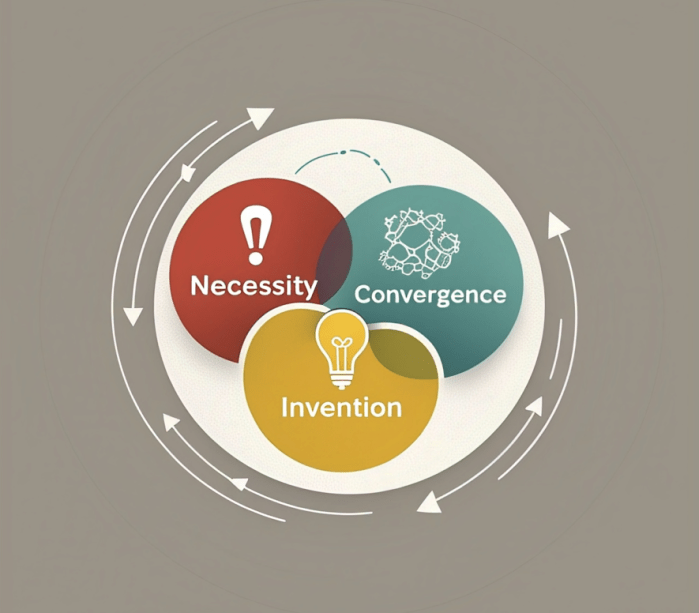
What if the very inventions that propel humanity forward also sow the seeds of our greatest challenges? History shows that progress is rarely a straight line. Instead, it moves in cycles: necessity sparks invention, and inventions converge to reshape society. From the steam engine’s role in the Industrial Revolution to the internet’s impact on globalization, each wave of transformation has brought profound change – economic shifts, new social structures, and unintended consequences. These disruptions, from rising inequalities to environmental crises, often take decades to address. As we stand on the brink of the next great convergence – whether in AI, biotechnology, humanoid robots, cyber, climate or health – we must ask – how can we harness innovation to create a more equitable and sustainable future?
Continue readingRehearsing For 2025: A Year-End Reflection
As another year draws to a close, I find myself drawn to a practice that transcends simple predictions. Rather than attempting to forecast the future, I focus on rehearsing it – imagining possible scenarios that help us prepare for whatever may unfold. Predictions often fail to capture the complexity, volatility, and cultural nuances of our interconnected world. Rehearsal, by contrast, is an active and flexible exercise: it invites us to consider “what if” and then equip ourselves with the tools, mindsets, and strategies to adapt.
As we look toward 2025, I invite you to consider a set of interrelated themes. These are not forecasts, but lenses through which we can examine global currents. By exploring these possibilities, we do not claim certainty. Instead, we gain the agility and resilience necessary to respond thoughtfully, no matter how events evolve.
Continue readingLearning From The Past: Unlearning For The Future
In an era of rapid change, the traditional understanding of literacy has become increasingly insufficient. Historically, literacy was defined simply as the ability to read and write – fundamental skills that enabled individuals to participate in society. However, as Alvin Toffler wisely pointed out, the definition of literacy in the 21st century has expanded far beyond these basic abilities. Today, true literacy encompasses the capacity to continuously learn new skills, let go of outdated knowledge, and acquire fresh perspectives. This shift reflects the profound changes in our world, where scientific and technological advancements, societal shifts, geopolitical tensions, and economic uncertainty are constantly reshaping the demands placed on individuals.
Continue readingWhat Should My Children Study in School?
As a keynote presenter and futurist, I am frequently asked by parents the pressing question: “What should my children study in school to thrive in an increasingly automated world?” In an era where technological advancements are rapidly reshaping the job landscape, my response emphasizes a balanced education that cultivates foundational skills like critical thinking and emotional intelligence, embraces STEM and digital literacy, and fosters adaptability and lifelong learning. Additionally, I advocate for focusing on human-centric fields, entrepreneurial abilities, ethical reasoning, and global awareness. By integrating these elements, we can equip the next generation with the tools they need to not only navigate but also shape the future of work and society.
To test the appropriateness of my response, I asked ChatGPT how it would respond. Here is the response:
Continue reading
Return On Learning: Pioneering The Future
In the preceding four-part series, I explored the convergence of knowledge, invention, and societal transitions, tracing the democratization of knowledge from the dawn of language to the present day. The series examined how pivotal inventions have expanded human capabilities and transformed civilization, while also considering how today’s accelerating pace of scientific and technological advances is creating an expanding space of opportunities and challenges. As we stand on the threshold of a new age of invention, potentially more profound than past eras, the series emphasized how organizations can adapt, build resilience, and thrive. Building on these key themes, this post shifts focus to Return on Learning (ROL), a crucial concept that equips organizations to navigate this evolving landscape. By prioritizing learning, leaders can proactively shape the future and ensure long-term success in an era of rapid transformation.
Continue readingBrave New Words: Unleashing The Potential Of AI-Driven Education
I just finished reading my most recent book titled Brave New Words, written by renowned education innovator and entrepreneur Salman Khan. In “Brave New Words”, Salman Khan explores the transformative potential of artificial intelligence in education. With his signature clarity and vision, Khan outlines a future where AI-powered learning systems enhance human teaching, increase accessibility, and foster a more equitable education system. This book offers a roadmap for educators, policymakers, and learners to navigate the AI revolution in education and unlock the full potential of humanity. I highly recommend it and have added the book to my Library.
Continue readingTransforming Education: Learning In The Modern World
A recent article by Forbes Councils Member MacKenzie Price explores the role of AI and humans in emerging transformation of education. As readers of my Blog know, I view education as the bridge to a new era. Here is a brief summary of the article:
Continue readingEducation: The Bridge To A New Era
Throughout history, education has been the bridge between eras. Whether it was learning for factory work during the first industrial revolution, or the high school enabled office work of the second, education has played a role in managing the transition. If we assume that we are in the early days of a new era driven by staggering scientific and technological invention, what does education need to do to provide that bridge?
Continue readingThe Virtual You
I have written about digital twins over the past year and participated in several articles describing a future where virtual representations of all things physical are viable. You can explore the topic here. The art of the possible is coming into focus.
Continue readingWhere Is Population Growth Actually Heading?
Demographics matter. An aging society, fewer children, less workers, immigration, to name a few, are likely to shape our future in ways we cannot predict. There is much uncertainty, exemplified by mixed messages regarding the global population. Some estimates have us reaching 11 billion people by the year 2100 – with most of that growth coming from Africa and some countries in Asia. Studies have now emerged with significantly less growth. A recent article describes one such study.
Continue readingWill Virtual Reality Revolutionize Education?
ChatGPT is getting a lot of attention, and one area driving dialog is education. While the attention is warranted, another innovation is quietly making advances. Historically, education has been a bridge between eras – something that I explored in depth here. If you accept that signals point to a transition between eras, then education will be looked at to provide a bridge. But the question that must be answered is this: can education in its current form be that bridge? I maintain that the answer is no. Can that other innovation help? Virtual reality has quietly advanced. This article explores those advances.
Continue reading Reimagining the Future