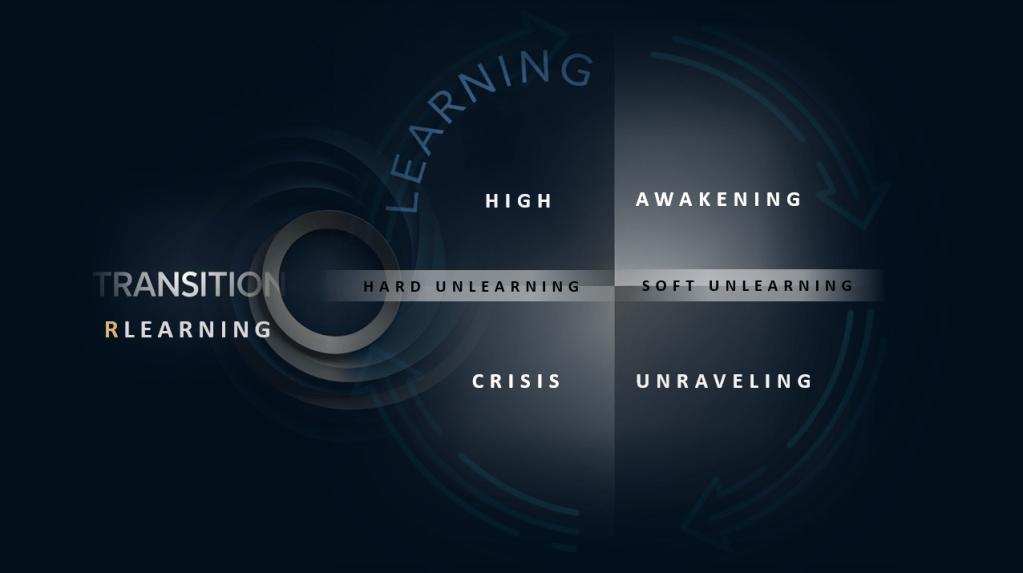
In a time of unprecedented change, our society finds itself at the crossroads of transition. If we accept that we are in the Crisis phase of what historians William Strauss and Neil Howe term The Fourth Turning – a cyclical theory suggesting that societies repeatedly cycle through periods of stability and upheaval – we must confront a crucial question: Are we choosing to proactively unlearn outdated models, or will we be forced to do so reactively in the wake of crisis?
Old assumptions and systems often crumble under social, economic, and technological pressures. Recognizing what to let go of – and when – becomes essential. The process of unlearning should therefore not merely be a reaction to collapse but a deliberate step toward building a more resilient future.
INTRODUCING TOFFLER’S FRAMEWORK
Before delving deeper into the Fourth Turning, it is helpful to understand the process by which individuals, organizations, and even entire societies adapt. Alvin Toffler’s concept of “Learn, Unlearn, Relearn” provides a roadmap for this transformation:

This cycle mirrors the broader societal shifts described by Strauss and Howe. As institutions move from the Unraveling into the Crisis phase, their ability to adapt hinges on how effectively they can unlearn obsolete models.
MAPPING LEARNING, UNLEARNING, AND RELEARNING TO THE FOUR TURNINGS
Strauss and Howe’s generational theory divides history into four recurring phases, each lasting roughly 20 to 25 years, with distinct challenges and opportunities:
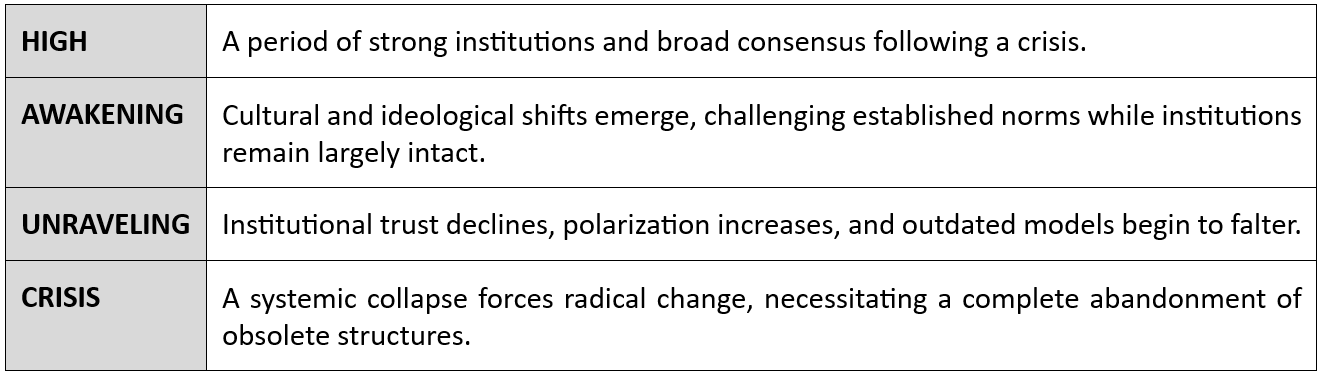
Yet history teaches us that transitioning from Crisis to a new High is not instantaneous. A critical intermediary phase – Reconstruction – emerges, during which society actively experiments with, refines, and ultimately rebuilds its foundations.
THE REFINED MODEL: RECOGNIZING RECONSTRUCTION
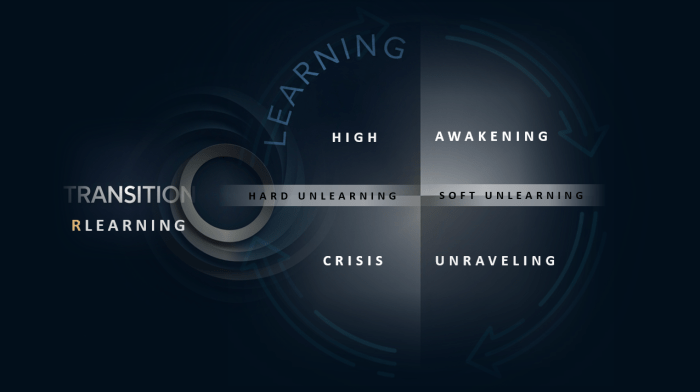
To fully appreciate how learning evolves over time, we can use a matrix that bridges the traditional Four Turnings with Toffler’s cycle:
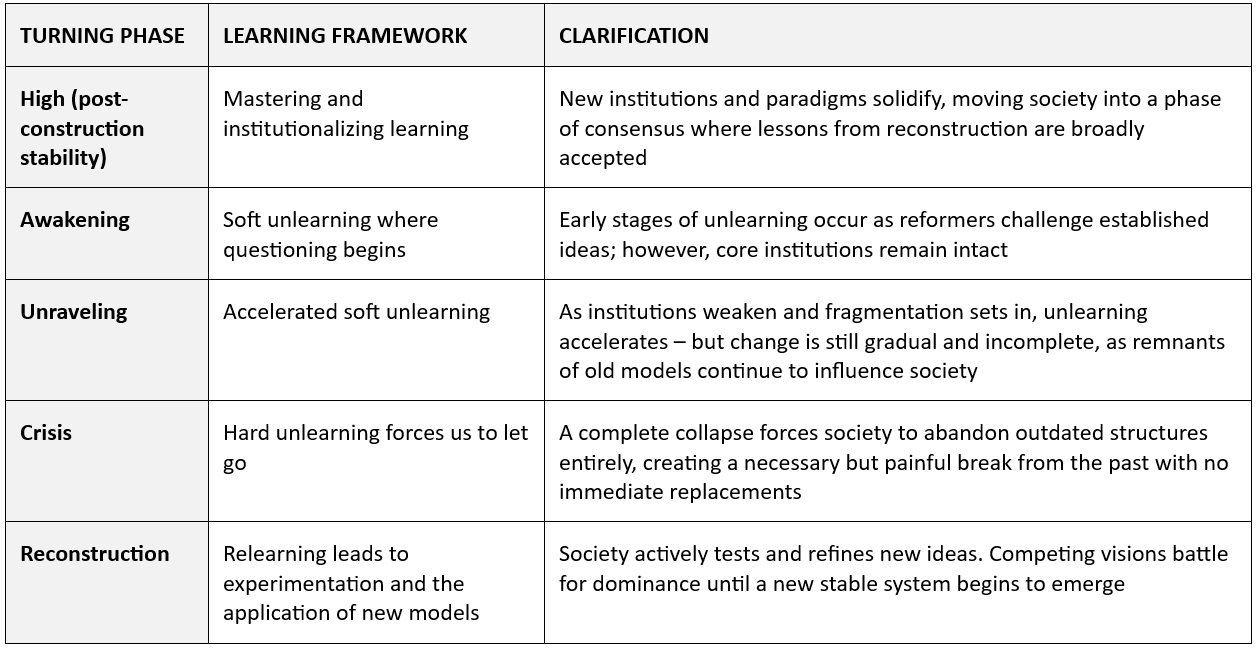
THE ROLE OF SOFT AND HARD UNLEARNING
A crucial refinement to our understanding of unlearning is the distinction between soft unlearning and hard unlearning:
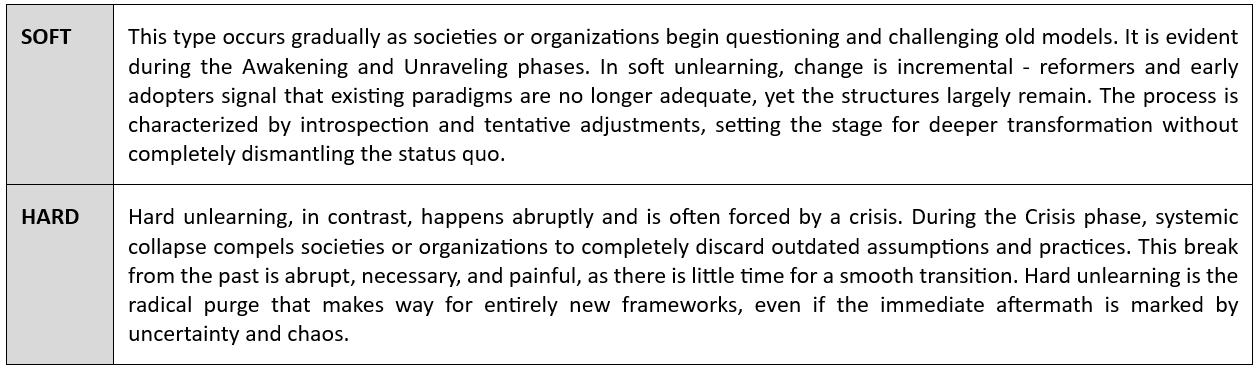
Understanding this distinction helps clarify why some periods of transition are marked by gradual change and internal debate, while others are defined by disruptive, even chaotic, shifts that leave no room for gradual adaptation.
THE FOURTH TURNING IN CONTEXT
According to Strauss and Howe, each phase – High, Awakening, Unraveling, and Crisis – presents its own unique challenges. For example, research from the National Bureau of Economic Research (NBER) on recurring recessions shows that an economic crisis does not immediately restore stability. Instead, crises often lead to a transitional period marked by uncertainty, during which new institutions and policies gradually emerge.
U.S. HISTORICAL EXAMPLES
Reflecting on American history, we see how unlearning has paved the way for transformation:
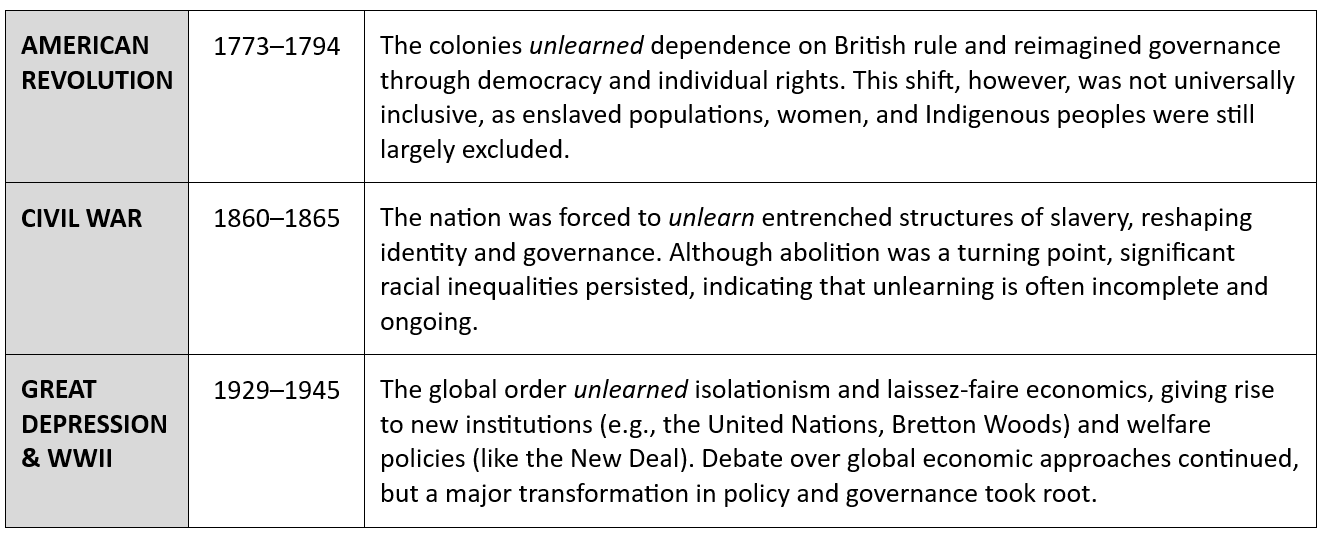
A GLOBAL PERSPECTIVE ON UNLEARNING
While the Fourth Turning framework is often discussed in an Anglo-American context, the pattern of unlearning is a global phenomenon:
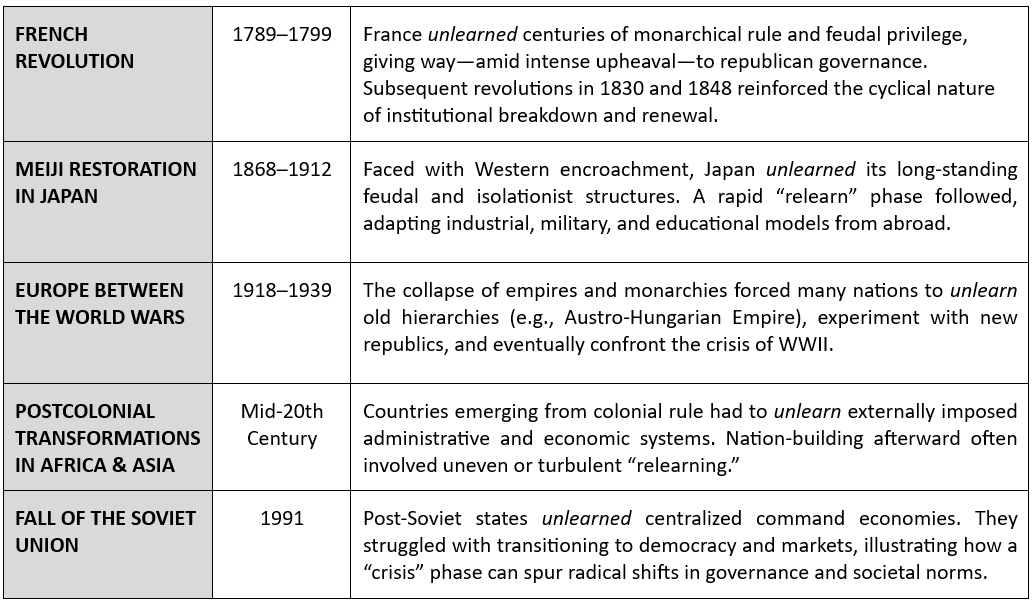
Global unlearning does not occur uniformly; each region experiences its own cycle of upheaval and renewal, influenced by both internal dynamics and interconnected global forces.
TODAY’S UNRAVELING: SIGNS OF A SYSTEM IN CRISIS
In today’s U.S. context, the stress on institutions is evident:
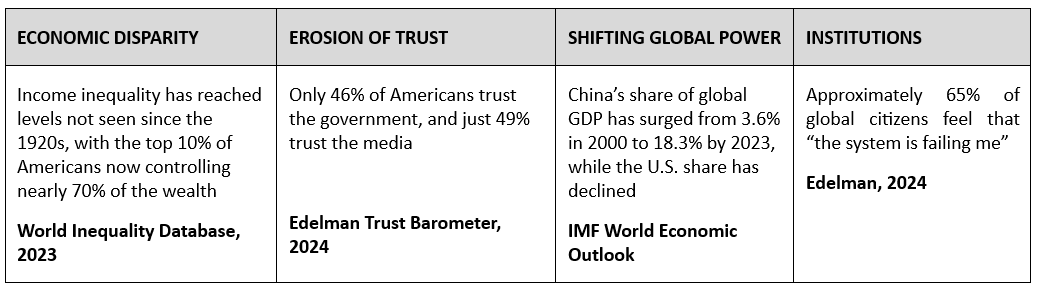
Historians suggest that the U.S. entered the Fourth Turning Crisis phase around 2007 – 2008 with the global financial meltdown. Subsequent events – the 2020 pandemic, social unrest, and geopolitical tensions – have deepened this crisis, marking a critical middle period where proactive unlearning is most urgent.
PROACTIVE VS. REACTIVE UNLEARNING
The choice between proactive and reactive unlearning has profound implications:

Organizations and societies that act early not only avoid the worst shocks but also lay the groundwork for a resilient, innovative future.
ADDRESSING COUNTERARGUMENTS
Of course, any broad historical or organizational framework must reckon with differing perspectives and potential pitfalls. Before fully committing to the idea that cyclical disruptions inevitably spur new models, it’s vital to address legitimate critiques – ranging from concerns about oversimplification to questions about globalization, technology, and uneven societal impacts. These counterarguments help refine our understanding of why unlearning, though essential, is never a one-size-fits-all process.
Over-Simplification: Critics of cyclical models caution against retrofitting events into neat patterns, risking confirmation bias. While each crisis has unique features, consistent patterns of upheaval followed by societal reset appear across eras and cultures.
Globalization and Technology: Some argue that unprecedented forces – digital interconnectedness, artificial intelligence, climate change, and biotechnology – fundamentally alter or even break historical cycles. These technologies operate at scales and speeds unknown in previous turnings, potentially compressing or extending cycle timeframes. Critics suggest that the complexity of globally interconnected systems creates feedback loops that resist historical patterns.
Yet these forces may actually reinforce rather than negate cyclical patterns, albeit with higher stakes. The rapid proliferation of transformative technologies exposes the brittleness of outdated frameworks, creating more abrupt “phase transitions” between stability and crisis. Digital networks amplify both institutional fragility and adaptive capacity, accelerating the need for unlearning while potentially shortening recovery periods. What’s different isn’t the cyclical pattern itself, but the velocity and intensity with which societies move through these phases.
Uneven Impact: Not all groups experience crisis the same way. Socioeconomic, racial, and geopolitical differences shape how burdens are felt and addressed. This complicates the simplicity of a single cyclical timeline but does not negate broader patterns of institutional breakdown and renewal.
UNLEARNING IN ACTION: CONTEMPORARY EXAMPLES
Across industries and communities, unlearning is reshaping our future:
- AI-Driven Automation: Companies investing in reskilling and reimagining workflows are actively unlearning obsolete practices. Those that delay risk facing disruptive, forced changes.
- Decentralized Finance (DeFi): Financial institutions exploring blockchain and digital assets challenge longstanding assumptions about centralized banking.
- Climate Resilience: Nations and corporations shifting toward renewable energy are unlearning fossil fuel dependence, preempting crisis-mode transitions for the unprepared.
CASE STUDY: MICROSOFT’S CLOUD TRANSFORMATION
Microsoft’s pivot from traditional software licensing to cloud services stands as a prime example of proactive unlearning. Under CEO Satya Nadella – who assumed leadership in 2014 – the company recognized that its once-dominant position was eroding in the face of cloud-native competitors and changing customer expectations. This realization pushed Microsoft to intentionally cannibalize its lucrative Windows and Office licensing models, replacing them with subscription-based offerings like Azure and Microsoft 365.
Central to this transformation was a cultural overhaul. For decades, a “Windows-first” mindset prioritized the flagship OS above all else, impeding innovation and collaboration. Nadella dismantled this approach, emphasizing a “growth mindset” where teams were expected to learn from failures and work across silos. The embrace of open source – once viewed as a threat – was equally transformative, repairing the company’s relationship with developers and signaling a departure from its proprietary software heritage.
The payoff has been striking: between 2014 and 2024, Microsoft’s market valuation climbed from roughly $300 billion to over $3 trillion, making it one of the world’s most valuable companies. This dramatic growth shows how consciously discarding outdated practices can fuel resilience and innovation. By preserving technical expertise and customer relationships – while unlearning what no longer served them – Microsoft offers a roadmap for other institutions confronting disruptive forces. Their journey demonstrates that unlearning may be uncomfortable, but it is crucial for sustained success in an era of rapid change.
APPLYING THE FRAMEWORK TO ORGANIZATIONS AND LEADERSHIP
In times of rapid transition, leaders play a pivotal role in guiding teams and institutions through learning, unlearning, and relearning. Those who fail to act early face sharper shocks when crisis hits. Organizations that embrace proactive unlearning can shape the new normal rather than being shaped by it.
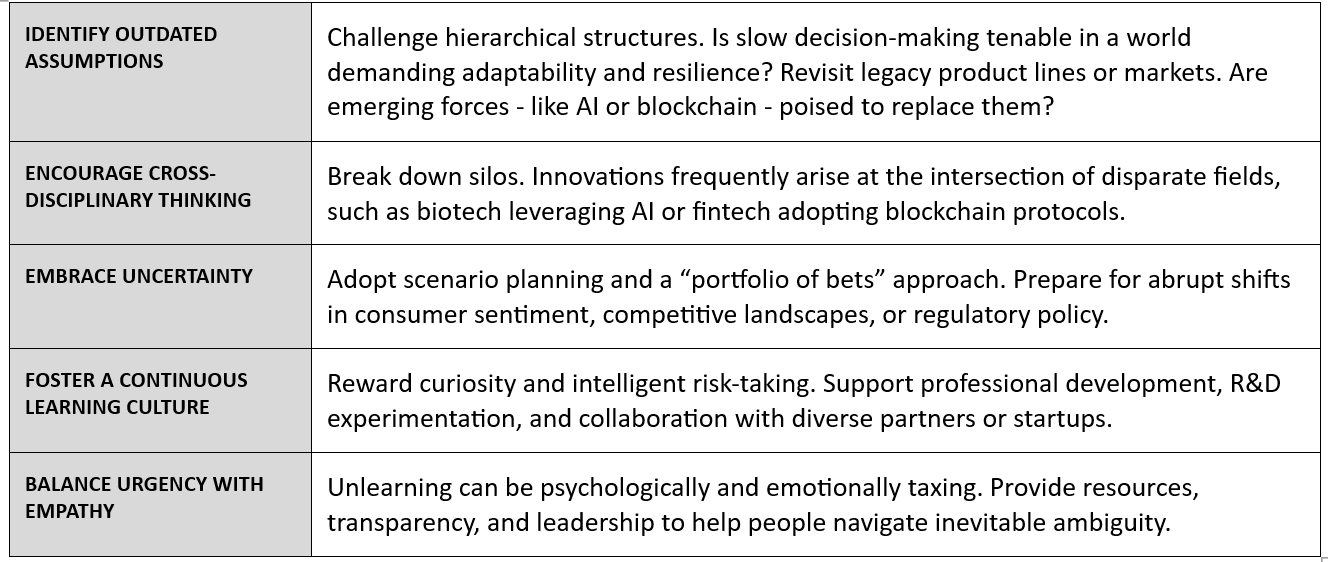
PERSONAL UNLEARNING: NAVIGATING INDIVIDUAL ADAPTATION
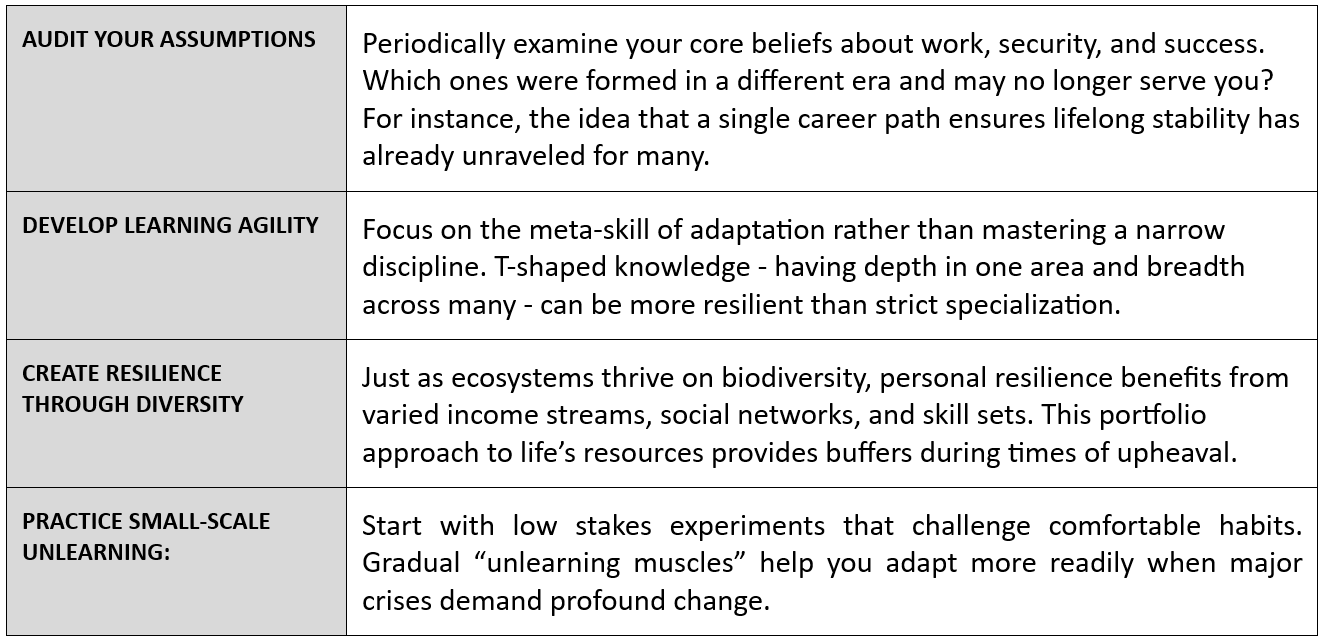
Unlearning isn’t confined to institutions; it is equally vital on a personal level. Those who proactively unlearn outdated personal models are better prepared for external disruptions and often become innovators and stabilizers in their communities.
FINAL THOUGHT: SHAPING THE NEXT HIGH
We stand at a pivotal moment. Amidst a crisis defined by hard unlearning – marked by abrupt, forced changes across economic, political, and cultural domains – the choices we make now will determine the future. The Reconstruction phase that follows this crisis will dictate whether we actively shape a renewed social order or passively accept what emerges. History shows that those who anticipate change by shedding outdated paradigms are best positioned to thrive in the post-crisis world. By embracing proactive unlearning – in government, corporate strategy, and personal life – we lay the groundwork for a future that is more resilient, equitable, and innovative.
CONCLUSION
Our era is defined by the strain of economic inequality, technological disruption, and shifting global power dynamics. Whether one fully endorses Strauss and Howe’s cyclical theory or not, the imperative to adapt – and to unlearn what no longer serves us – is undeniable. Crises have always spurred radical transformation. By aligning Toffler’s Learn-Unlearn-Relearn model with the Four Turnings framework and clearly distinguishing between soft and hard unlearning, we gain a powerful roadmap for navigating upheaval rather than succumbing to it.
Proactive unlearning today sets the stage for the next High – a period of renewed stability and opportunity. The choice is clear: adapt now or face the harsh consequences of reactive change later. This visual captures the concepts.


Leave a comment