The Compressed Present

THE BIO-INTELLIGENT SIGNATURE: A LENS ON THE CURRENT AGE
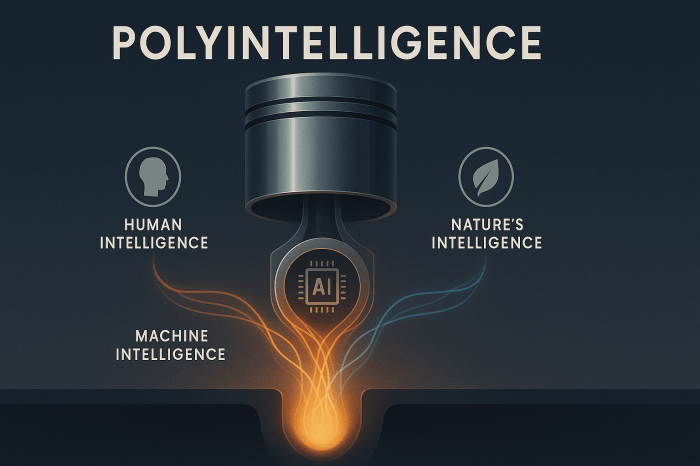
The present moment is shaped by three converging streams of intelligence: machine intelligence, biological intelligence, and planetary intelligence. These are the same sources that form what I have described elsewhere as polyintelligence — cognition distributed across humans, machines, and nature. Each stream is advancing on its own, but their deeper significance appears in how they now influence one another. Artificial intelligence extends cognition beyond the human mind. Synthetic biology brings design and computation into living systems. And the planet — long treated only as a resource base — is increasingly recognized as a source of insight. Through biomimetics, natural systems provide design principles refined through evolution: circularity instead of waste, resilience through diversity, and adaptation through constant sensing and feedback.

Continue reading
Crossing The Threshold

Civilization’s great shifts are the moments when continuity fails and a new order takes shape. Each historical age reached a point where the old logic could no longer hold, and pressures converged into a transformative release. By examining four major transitions – from Hunter–Gatherer to Agricultural, Agricultural to Axial, Axial to Renaissance, and Renaissance to Industrial – we can see how rising Total Systemic Domain Score (TSDS) and changing Activation Dispersion (AD) signaled that a threshold was near. Some transitions unfolded slowly over millennia, while others struck within a few centuries. In each case, the build-up of energy and imbalance hit a critical point, and society crossed into an irreversible new configuration that only in hindsight feels inevitable.

Continue reading

What The Gauges Reveal Across The Ages

Over the first seven posts, we explored the seven domains that shape civilization, the forces that move within them, the thresholds that mark major transitions, and the drivers that push systems toward those turning points. We also built two gauges that help make those movements visible. TSDS shows how much energy sits across the seven domains. AD shows how that energy is arranged. Together, they help us see the internal structure of an age: how active its domains were, how evenly that activity spread, and how tightly the system was coupled. With that groundwork in place, we can now use the gauges to trace the long arc of history and examine how pressure accumulated across major ages of civilization.

Continue reading

How The Gauges Were Built: Making Systemic Pressure Legible

Over the first six posts, I built the foundation needed to understand how civilizations change. I explored the seven domains that shape collective life, the forces that move within them, the thresholds that mark historical turning points, and the three drivers that push systems toward those moments. With that groundwork in place, I introduced a pair of gauges that make those movements easier to see. In this post, I describe the gauges in greater detail. TSDS reflects how much energy sits across the seven domains. AD shows how that energy is arranged. Before we apply these gauges to the long arc of history, we need to explain how they were built. Every measure rests on a set of choices. This post walks through those choices in a way that keeps the gauges intuitive while grounding them in the history they aim to describe.

Continue reading

Reading The Pulse Of A Civilization In Motion

The first five posts laid the foundation for understanding why the world feels dense, fast, and tightly connected. We explored the sense that something in the operating logic of civilzation is shifting. We looked at phase transitions, the four-stage pattern that repeats across history, and the seven domains that structure civilization. The last post introduced the three deep drivers that push civilizations across thresholds: growing convergence, system-shaping technologies, and the acceleration of knowledge. Taken together, they help explain why pressure builds, why systems couple, and why some ages move differently than others.

Continue reading

The Three Drivers That Push Civilizations Across Thresholds


The earlier posts introduced the sense that the world’s operating logic is beginning to shift, explored what compression feels like in daily life, and laid out the four-stage pattern that has shaped every major transition in history. Post Four explained why those transitions do not come from singular breakthroughs but from the interaction of multiple domains moving together. Before we can measure that interaction in today’s world, we need to understand the deeper forces that give convergence its power. These forces have shaped every civilizational transition across the long arc of history. They determine when pressure accumulates, how tightly systems couple, and what pushes society toward a threshold.

Continue reading

How Big Shifts Unfold — And Where We Are Now

RECAP FROM THE SERIES SO FAR

In the first post, I explored why so many parts of life feel unsettled at the same time: all seven domains of civilization are active and amplifying one another. In the second post, I described the tightening that happens before major shifts — the compression that makes events feel more connected, faster, and harder to absorb. This post turns to the deeper structure beneath these shifts. When we look at history, we see a repeating pattern in how civilizations change shape.

Continue reading

When Systems Turn Over

This post marks the beginning of a new series on systemic change — an exploration of how civilizations transform at the deepest level. Over the coming weeks, we’ll trace the rhythm of history, examine the forces that drive reordering, and explore why this moment may be the first time in history when every domain of human life is active at once. Each post will build on the last, revealing how science, technology, society, geopolitics, economics, philosophy, and the environment are converging toward a new operating logic for civilization.

Continue reading

From Campfires To Code: The Systemic Shifts That Shaped Humanity

Human history has been anything but linear. While centuries can pass with relative stability, there are rare moments where everything changes—moments where converging forces across domains give rise to entirely new paradigms. These are not just periods of change. They are systemic transitions that reshape how we live, work, relate, and make sense of the world.

Continue reading

The Next Human Revolution: Will Technology Change Who We Are?

Throughout human history, there have been only a handful of moments so transformative that they redefined what it means to be human. These tipping points were not merely technological breakthroughs or changes in societal norms – they were profound inflection points, moments when the trajectory of civilization bent so sharply that the “before” and the “after” became fundamentally different worlds.

Continue reading

Can Vertical Farming Address Our Food Challenges?

UPDATE: THE LINK TO THE ARTICLE IS NO LONGER AVAILABLE

A recent article seeks to dispute the recent negative press that vertical farming has received. Written by Arama Kukutai, the CEO of a company called Plenty, the article explores the headlines that might have you believe vertical farming is on life support, and provides a closer look that reveals a different story. While climate change, population growth, and soil erosion threaten our global food security, vertical farming offers a beacon of hope. This innovative approach to indoor agriculture boasts significantly higher yields than traditional methods, all while using less land and precious water.

Continue reading

The Journey Of Humanity

Since the dawn of the nineteenth century, a split second compared to the span of human existence, life expectancy has more than doubled, and per capita incomes have soared twenty-fold in the most developed regions of the world, and fourteen-fold on Planet Earth as a whole

Oded Galor – The Journey of Humanity
Continue reading

The Journey: A Growth Of Knowledge

My previous posts launched a series that will tell the full story of my reimagined future. Described as a journey through the looking glass, the story began with a description of the series title and a look backward in time. The series continues, with each post featuring a piece of our journey. We explored the tipping points of history in the last post. In this post, I explore the role that knowledge has played in shaping that history.

Continue reading

Work

Conversations about work take many forms these days. Is remote work here to stay? What will a hybrid work model look like? Will we need to work in the future? In the short term, the pandemic has driven a focus on different models of working. In the long term, the polarized discussion centers on the impact of automation. That discussion is explored in incredible detail in a recent book titled Work: A Deep History, from the Stone Age to the Age of Robots. Anthropologist and author James Suzman sets out to answer several questions. He does so by looking at the history of work and the lessons we can learn.

To answer these questions, James Suzman charts a grand history of “work” from the origins of life on Earth to our ever more automated present, challenging some of our deepest assumptions about who we are. Drawing insights from anthropology, archaeology, evolutionary biology, zoology, physics, and economics, he shows that while we have evolved to find joy meaning and purpose in work, for most of human history our ancestors worked far less and thought very differently about work than we do now.

James Suzman – Work: A Deep History, from the Stone Age to the Age of Robots
Continue reading

Resilience Is Top Of Mind These Days

Resilience is the capacity to recover quickly from difficulties. That word is suddenly in everyone’s vocabulary. Whether it is individual or organizational, resilience helps us withstand adversity and bounce back. The pandemic can be credited for our heightened awareness, but it was just a matter of time before we all got here. The factors described in my Post yesterday describe why: complexity, pace, volatility, unpredictability, and the unexpected. These factors have always been there, but during specific transformative eras throughout human history, they combined in ways that challenged the existing order.

Continue reading

What Does A Recent Trend Study Tells Us About The Future?

Each year the Future Today Institute releases a very comprehensive trend study during SXSW. I just finished getting through this very comprehensive installment. In announcing this year’s report, Founder Amy Webb had this to say:

The cataclysmic events of the past year resulted in a significant number of new signals. As a result, we’ve analyzed nearly 500 tech and science trends across multiple industry sectors. Rather than squeezing the trends into one enormous tome as we usually do, we are instead publishing 12 separate reports with trends grouped by subject. We are including what we’ve called Book Zero, which shows how we did our work. There is also an enormous, 504-page PDF with all content grouped together as one document.

Well, Amy was not kidding, there is quite a bit to digest. The 12 separate reports referenced can be downloaded Here. As I do with each look into the future, I captured some highlights from this year’s trend study. I will start however with an important observation that Amy made in the opening of the report.

Continue reading

The Next Generation Of Farming

As we Rethink Humanity, we appreciate that the next decade represents what is likely the fastest, deepest, most consequential disruption in history. By 2030, much of what we know could be completely reimagined. Something as basic as food and farming could look quite different, as the possibilities cover a wide spectrum. In the short term, we find different ways to farm, optimizing yield and improving our environment. In the long term, we likely witness the complete transformation of farming.

Continue reading

COVID-19 Tuesday Morning News

The COVID-19 crisis is fast-moving with information bombarding us in real-time. On this Tuesday morning, as we awake to more isolation and rising numbers, there is much to consider across every domain. Some like Enrique Dans are writing about the changes coming to Education. Issues like a drop in school attendance, obsolescence of teaching methods, technology barriers of entry to education, and an aversion to face-to-face interaction are likely to change education as we know it. As it is with every domain, institutions, academic directors, teachers or students who are unable to adapt will simply have no place in this new scenario. As a new normal emerges, educators are likely to revise their teaching methods and evaluation approaches, among other things.

Continue reading

The Growth of Knowledge

Knowledge is the engine that drives human development – and it has been throughout history. Knowledge expanded in the hunter-gatherer days with the invention of fire. In those days, a human obtained all its food by foraging. Although the source of food did not change, fire allowed humans to cook food and consume more calories. The human brain expanded with this caloric increase, and soon we invented language – the first in a series of innovations that drove the growth of knowledge.

Continue reading

Cyberwar, De-Extinction, and Precision Agriculture

Click to Enlarge

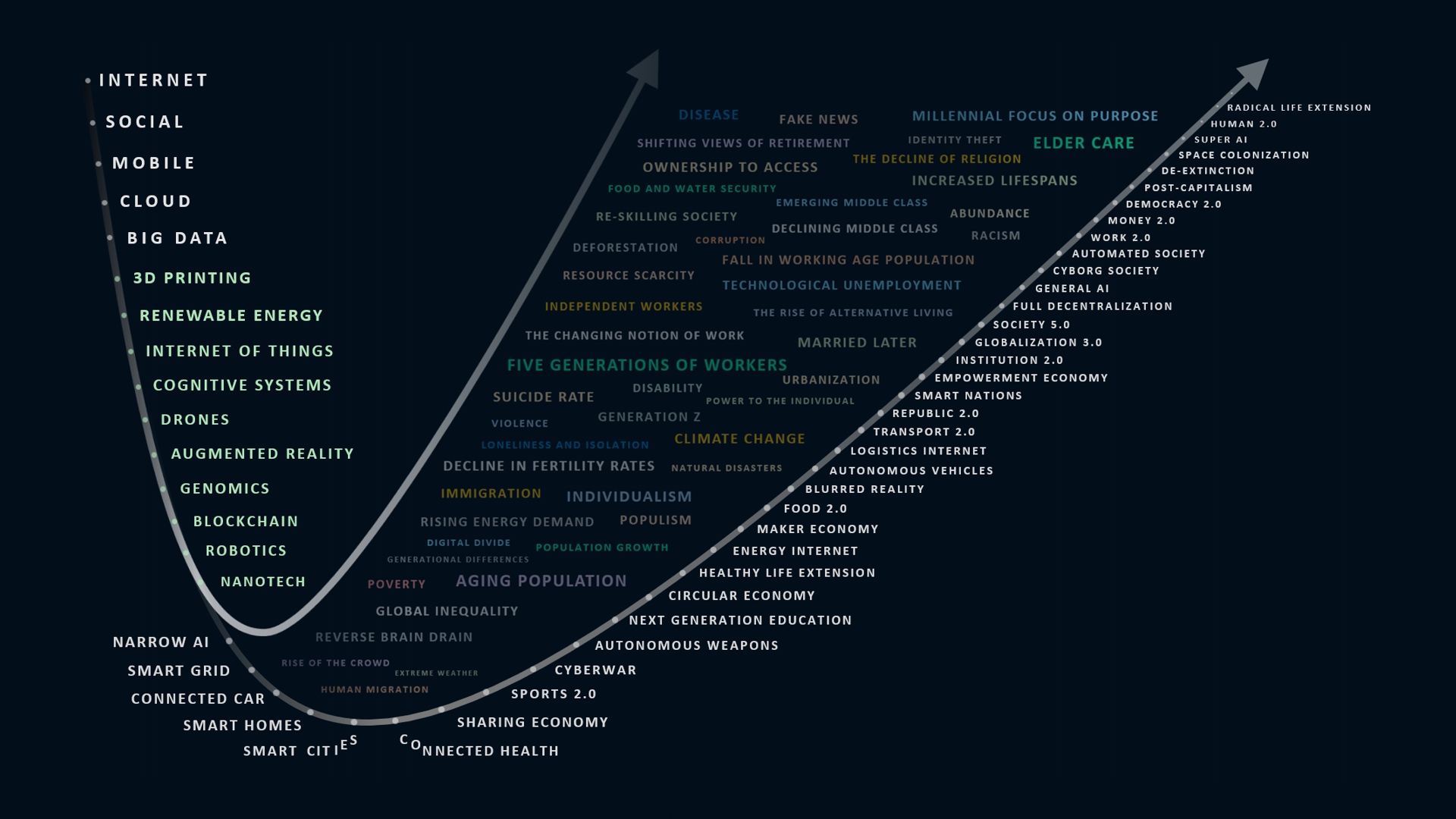
I’m wrapping up another book titled The Industries of the Future. Author Alec Ross explains the advances and stumbling blocks that emerge in the next ten years, and describes a way to navigate them. He is one of America’s leading experts on innovation, serving four years as Senior Advisor for Innovation to Secretary of State Hillary Clinton. Mr. Ross is currently a Distinguished Visiting Fellow at Johns Hopkins University. His book identified three future scenarios that I have added to the visual below. These scenarios are Cyberwar, Precision Agriculture, and De-Extinction.

Continue reading