
In an age of accelerating change and complexity, leadership requires more than traditional planning – it demands a mindset of rehearsal. This principle framed my recent conversation with Mimi Brooks, CEO of Logical Design Solutions, on her Bold Agendas podcast. Our discussion spanned the evolving role of ecosystems, the dual edges of innovation, and the critical importance of adaptability and resilience. Together, we unpacked strategies for thriving in an unpredictable world and explored the transformational shifts leaders must embrace to navigate 2025 and beyond.
Continue readingFuture
Book Review: Genesis: Artificial Intelligence, Hope, and the Human Spirit
Genesis: Artificial Intelligence, Hope, and the Human Spirit is a rare and thought-provoking collaboration among a statesman whose influence has spanned decades, Henry Kissinger, and two technology visionaries, Eric Schmidt and Craig Mundie. Together, they present a sweeping examination of artificial intelligence (AI) – its towering promises, its urgent perils, and its profound implications for human identity, governance, and morality.
Continue readingA Sweeping Narrative Of Human Progress
In How Economics Explains the World: A Short History of Humanity, Andrew Leigh, a Harvard-trained economist, presents a comprehensive and engaging narrative that delves into the profound impact of economic forces on human history. This book, though concise at under 200 pages, spans a vast timeline from the advent of agriculture to the present day, including the era of artificial intelligence.
Continue readingThe Power Of The Network: How Information Shapes Our World
In his latest work, Nexus, Yuval Noah Harari takes us on a thought-provoking journey through the profound interplay between information networks and humanity’s destiny. From the oral traditions that once bound ancient societies to the digital platforms reshaping our global communities today, Harari unveils the transformative power of information networks – how they have built civilizations, redefined power, and molded individual identities.

At its core, an information network is far more than a collection of nodes and links. It is a living ecosystem, continually expanding and contracting as it facilitates the exchange, evolution, and amplification of ideas. Over millennia, these networks have taken countless forms: the passing of legends around a village fire, the delicately inked manuscripts in medieval monasteries, the printing presses that sparked the early modern information revolution, and now the dazzling web of the Internet. These networks are the lifeblood of human progress – driving innovation, enriching cultures through exchange, and catalyzing the growth of economies. They are how we remember the past, navigate the present, and envision the future.
Continue readingNexus: A Deep Dive Into Humanity’s Information Age
In his latest book titled Nexus – A Brief History of Information Networks from the Stone Age to AI, author Yuval Noah Harari describes the role that information networks have played in shaping society. A nexus is a connection or series of connections linking two or more things. It often refers to a central or focal point where multiple elements converge or interact. The term is used in various contexts to describe relationships or linkages within systems, networks, or concepts that are interconnected.
Continue readingReturn On Learning: Pioneering The Future
In the preceding four-part series, I explored the convergence of knowledge, invention, and societal transitions, tracing the democratization of knowledge from the dawn of language to the present day. The series examined how pivotal inventions have expanded human capabilities and transformed civilization, while also considering how today’s accelerating pace of scientific and technological advances is creating an expanding space of opportunities and challenges. As we stand on the threshold of a new age of invention, potentially more profound than past eras, the series emphasized how organizations can adapt, build resilience, and thrive. Building on these key themes, this post shifts focus to Return on Learning (ROL), a crucial concept that equips organizations to navigate this evolving landscape. By prioritizing learning, leaders can proactively shape the future and ensure long-term success in an era of rapid transformation.
Continue readingGenerational Amnesia

In today’s rapidly evolving technological landscape, the concept of generational amnesia is gaining renewed attention. Generational amnesia refers to the phenomenon where each generation retains only a fraction of the knowledge and experiences of prior generations. This can lead to a loss of important historical insights, potentially causing us to repeat the mistakes of the past. As our society continues to advance, especially with the rise of generative AI, this issue becomes increasingly pertinent.
Continue readingA Journey Through The Looking Glass
UPDATE: Given current world events, I feel compelled to share this broad story again.
In the last ten years, as my focus expanded, a story about the future emerged. If I were to write a book to capture that story, I would call it A Journey through the Looking Glass (like the name of the leadership course I developed in 2017). My presentations are the vehicle for this type of storytelling, while my Blog captures the story in pieces. Now, as we find ourselves in the early stages of a transformative decade, I feel compelled to pull the pieces together through the written word as well. My next several posts will be dedicated to telling this story. Here are the other posts in the series to date:
Continue readingRevolutionary Reflections: Harnessing Historical Wisdom
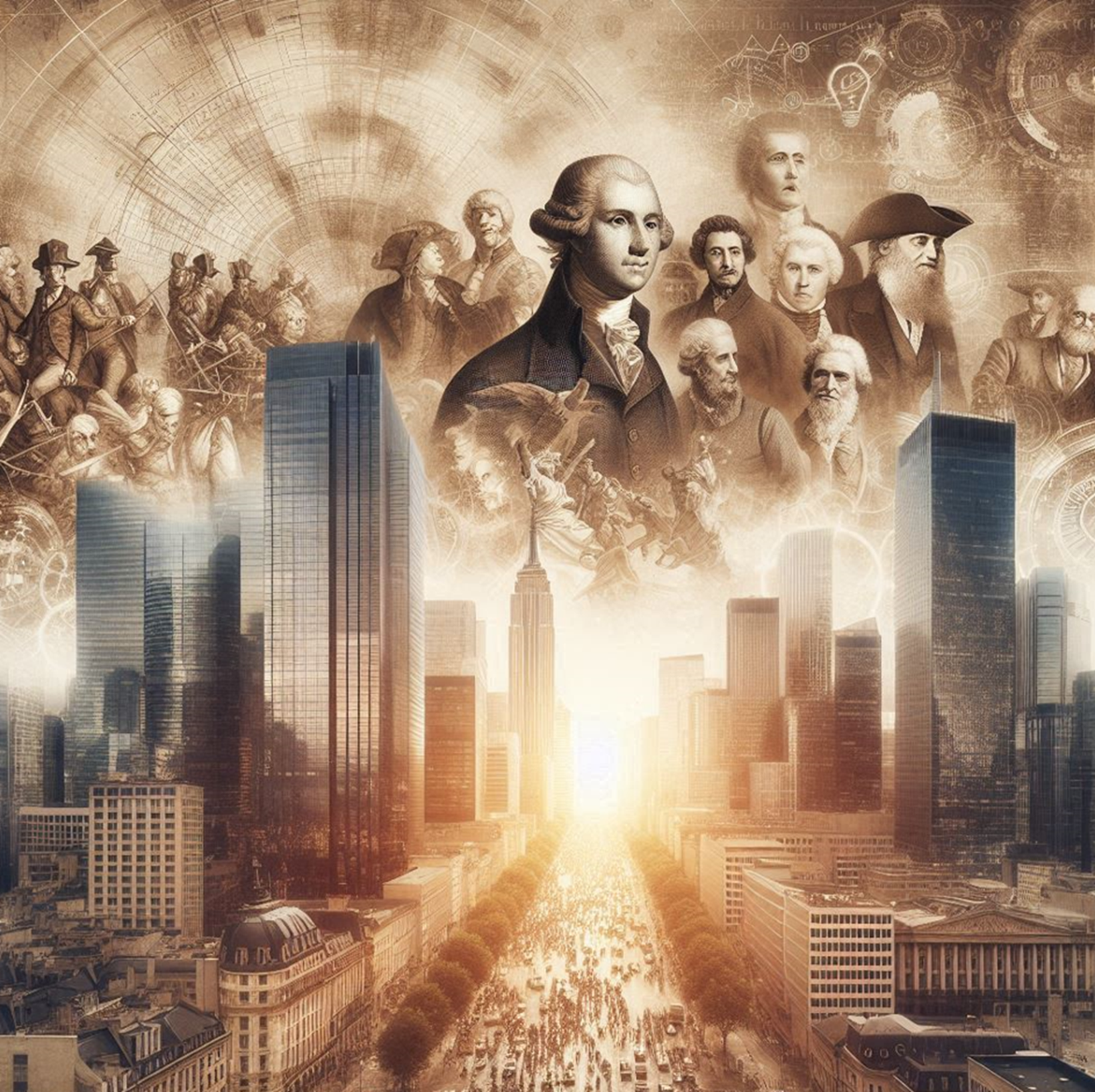
As I described in my recent post, Fareed Zakaria’s recent book, “Age of Revolution,” provides an examination of the forces that shaped our modern world. From the revolutions of the past, Zakaria articulates the seismic shifts that have redefined global dynamics, influenced political landscapes, and reshaped societal structures. In a world that looks eerily like prior periods of revolution, there is much we can learn by analyzing history. However, analysis is meaningless if we do not learn from the past, and historically, we have failed to do so. It was Henry Kissinger that once said: “it is not often that nations learn from the past, even rarer that they draw the correct conclusions from it.” Analyzing periods that look like our current day is the first step, but it’s the application of these lessons to our current context that enables constructive pathways.
Continue readingThe Human Paradox: Resistant Yet Resourceful In The Face Of Change
James Suzman aptly observed: “History reminds us that we are a stubborn species: one that is deeply resistant to making profound changes in our behavior and habits, even when it is clear that we need to do so. But it also reveals that when change is forced upon us, we are astonishingly versatile.”
Continue readingCIODAY 2023
Here is a video of the 15 minute keynote I delivered at the CIODAY 2023 event. A wonderful experience all around – culminated by this very professional video launched on YouTube by ICT Media. I posted a synopsis of the keynote via an article written by Hotze Zijlstra in advance of the event.
Keynote Synopsis
ICT Media hosted CIODAY 2023 in Amsterdam last week – a very professionally run event at an amazing venue. I had the pleasure of providing the opening keynote. In the lead up to the event, they wrote an article which I believe captures the spirit of my presentation better than anything I have seen prior – with one caveat. I am not a big believer in prediction – especially in highly uncertain times like our current era. Instead, I believe in a constant rehearsing of the future, asking the what-if questions to avoid the what-now questions. That caveat aside, a great article that I am sharing here to my Blog audience and providing a Link to original article.
Continue readingWhat History Tells Us About Human Action
Historically, it takes catastrophe to drive humans to act in periods where action is clearly needed. Wars and financial crashes are dominant catalysts throughout history. This poll considers the catalysts that drive humans to act in an era demanding action. Please take a minute to respond below. Pick those catalysts that you feel strongly about – and/or add to the list.
The Catalysts of Change
Two recent books The Fourth Turning is Here and The Coming Wave have each underscored the critical need for human action. But as I described in a post on Learning from History, it takes catalysts to drive actions that ultimately shape our future. A combination of breath-taking innovation, societal forces, depression and war, represent some of the catalysts that established a post-world war II era. As we stare into an uncertain, volatile and complex future, what are the catalysts likely to force human actions? The poll below has been conducted twice, pre-and-post pandemic. However, so much has changed since then. Please help me build on this list and identify the most significant catalysts. Choose all catalysts that you feel will contribute – or add anything that I am missing. For a deeper description of catalysts, please see the lessons from history post.
Continue readingDo Time Horizons Mean The Same As They Used To?
The timing of future scenarios is something I wrote about back in 2017. In that post, I explored the influencers of timing, namely obstacles and accelerants. These markers drive the foresight required to understand the path of possible futures and some indicator of timing. However, timing is therefore dictated by several factors with many unknowns. The pace, complexity, and uncertainty of our world makes timing extremely difficult to understand. That begs the question: should we think about timing the same way? I often hear the following: I don’t want to focus on something that is ten years out. My response is always the same: how do you know it is only ten years out?
Continue readingYour Future In The New Reality Of The Next Thirty Years
You will have the opportunity and the duty to create a decidedly better world. You will need to develop the wisdom to use this expansive power in advance of receiving it. Your success will decide if the future is a new age of enlightenment or darkness. Experience and maturity alone cannot provide the required wisdom fast enough. You will need to maximize your innate potential to accelerate wisdom.
Ben Lytle – The Potentialist I: Your Future in the New Reality of the Next Thirty Years
That quote is from a book I finished reading. Author Ben Lytle envisions the world of the next thirty years through the lens of human potential and opportunity, versus anxiety and fear. One of the most frequently asked questions I receive involves the human role in an increasingly automated future. The book describes what that world may look like in thirty years. With that vision in place, Mr. Lytle explores our human potential with an eye towards, skills, mindset, health, wealth, and success. The book accomplishes two very important things: it frames the forces that shape a very different future, and it describes a roadmap for us to thrive in that future. A very good read that I have added to my library.
Continue readingThe Future-Facing CFO
I recently participated in a CFO and Board retreat hosted by the Criticaleye peer-to-peer Board Community. I opened the session with a keynote and a Q&A session. Dialog from the session was captured in an article that was recently launched. The key points include:
- One of the critical skillsets of a future-facing CFO is an ability to unlearn
- Foresight means nothing if it can’t inform strategies
- The job of leaders is to envision possible futures
- It’s never been more important to take the future seriously in terms of the speed at which its coming towards us
It is encouraging the see the emphasis placed on understanding possible futures. That appreciation was ramping pre-pandemic and has accelerated since.
The Next Decade In Technology
I was recently made aware of a report via OMG Futures on the next decade in technology. Recommended reading for anyone looking to scan the horizon. Thanks to Phil Rowley for making me aware of it. Phil described it this way:
Continue readingFuture Focus: Envisioning The Possibilities Ahead

Every year in October I have the pleasure of participating in the CEO of the Year Gala sponsored by Chief Executive Group. This year’s winner was Marc Benioff, CEO of Salesforce. His acceptance speech was both refreshing and inspiring – as was the moderated discussion he had with last year’s winner, Ken Frazier, former CEO of Merck. As part of the event, I participate in a CEO roundtable discussion with a theme that I help shape. The theme this year was envisioning possible futures. It was a great conversation captured in this article that was just launched by Chief Executive Group. I highly recommend this read. The article provides a view into what CEOs are thinking – with a series of quotes from the session – like the one below.
Continue readingExploring Possible Economic Futures
In the interest of exploring possible economic futures, I have read books on Modern Monetary Theory, Zero Marginal Cost, The Job Guarantee, and several others. Add to the list the most recent book I finished, How Capitalism Ends. Viewed through the lens of property rights, wealth, and the transition from Feudalism to Capitalism, author Steve Paxton uses an effective method of storytelling: start with history and then explore possible futures. The book is setup by two thesis: the development and the primacy thesis. What he describes helps us understand the “why” behind the future that is emerging.
Continue reading Reimagining the Future