
An epoch is a period of time in history or a person’s life, typically one marked by notable events or particular characteristics. Although not officially approved, a working group has proposed that the world entered a new epoch called Anthropocene, or the human epoch. The starting point is still debated, as some believe it started at the beginning of the Agricultural Revolution 12,000–15,000 years ago, and others see it starting as recent as the 1960s. One proposal, based on atmospheric evidence, is to fix the start with the Industrial Revolution circa 1780, with the invention of the steam engine.
Continue readingOur Emerging Future
All aspects of our emerging future
Views On The Role of Business Are Shifting Again
Prior to the 1980s (Specifically the post world war two era), there was a belief that business had a higher purpose than generating profits. This somewhat cyclical debate about the role of business is back again. Business in the post-war era served a broad set of stakeholders, not just the shareholder. Early business corporations formed in the late eighteenth and early nineteenth centuries were created specifically to create roads, canals, railroads, and banks. There was a focus on service, not maximizing investment returns. In these periods, business focused on stakeholder capitalism. Investopedia defines it this way:
Continue readingCOVID-19 And The New Great Depression
In a new book by James Rickards, the author explores both the COVID-19 pandemic and its economic impact. A prolific writer, Economist, and adviser, Mr. Rickards predicts years of economic turbulence ahead. In The New Great Depression, Mr. Rickards sees the pandemic through an historical lens, where crisis presents a gateway between one world and the next. With an eye towards history, he concludes that the Keynes practical definition of a depression fits, and we are now in a new depression that is more far reaching than a mere technical recession. Along the way, the author wades into controversial topics such as China’s role in spreading the virus and the lockdown that ensued (which he calls the biggest policy blunder ever).
Continue readingThe Great Demographic Reversal
Beginning in 1990, several forces converged to shape the global economy. Globalization, demographics, technology, deflation, debt, and interest rates have all played a role. Now, according to a recent book, at least two of those forces are reversing. In The Great Demographic Reversal, authors Charles Goodhart and Manoj Pradhan describe these forces and their influence on the last thirty years of economic activity. With this convergence, the world experienced an extended deflationary period, which per the authors, was driven in part by a labor supply shock. The book said the following:
Continue readingAre We Heading Towards A New World Order?
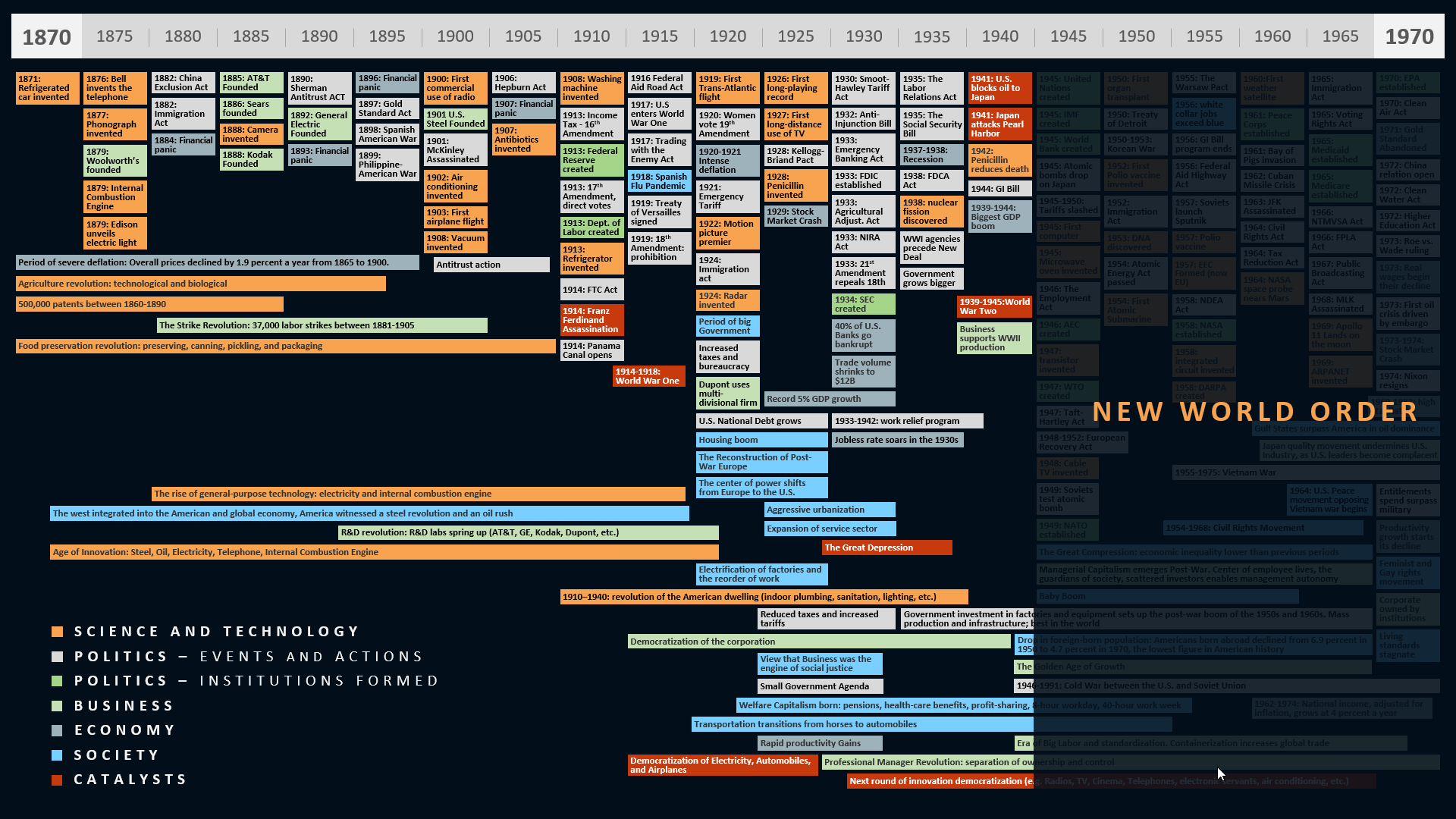
After World War Two, 730 delegates from all 44 Allied nations gathered in the U.S. at the Mount Washington Hotel in Bretton Woods, New Hampshire. The Bretton Woods Conference aimed to regulate the international monetary and financial order after the war ended. Held from July 1 to 22, 1944, agreements were signed and ratified by member governments, establishing the institutions that represented a new world order. This led to what was called the Bretton Woods system for international commercial and financial relations.
Continue readingGlobal Technology Governance
Strawberries. Simple enough for farmers to grow, but can they do better? That is a question that a smart Agriculture Competition in China attempted to answer. Four technology teams competed with farmers over four months to grow strawberries. This Article by Victoria Masterson describes what happened next: data scientists produced 196% more strawberries by weight on average compared with traditional farmers. It is not surprising, given that vertical farming using intelligent sensors and AI have shown the possibilities. As we witness this rapid pace of innovation, we see the potential for human development (in this case food abundance), but also the likely unintended consequences. These Two Paths have historical precedent, as every great period of invention has followed both paths. After all, fire provided light, warmth, and food, but also burned down villages.
Continue readingThe Future Always Follows Two Paths
In a Post from 2016, I explored the balance required when the forces of innovation take hold. The pace of innovation four years ago was already staggering, and the engine that drives it continues unabated. From that post:
Continue readingThe unabated exponential progression of science and technology has driven a staggering pace of innovation. The building blocks are mostly there, allowing creative minds to combine them in ways that attack the world’s most difficult challenges. Additional forces have emerged to position the next two decades as a period that is purpose-focused and transformative. Innovation itself is no longer the sole purview of business, universities, government, and military, as our connected world provides an ideation and innovation engine never seen before.
Are Big Cities In Trouble?
The remote work discussion will not go away. There are no shortages of predictions or perspectives regarding the world of work post-pandemic. I continue to believe that prediction is a fools errand, especially in a world dominated by rapid innovation, uncertainty, and a level of Convergence unseen since the end of World War Two. While we may not predict the future, we can continually look for signals – both weak and strong. The future of both work and cities is intertwined. If remote work becomes the standard practice, it has big implications for cities. A recent Article written by Derek Thompson explores this dynamic. This quote from the article represents a signal:
Continue readingGuarding Against Future Crises In Business
In the early days of 2021, there is still an uneasy feeling involved in any search for a silver lining to the COVID-19 pandemic. Indeed, it may be that this will always remain the case. And yet, without disregarding or minimizing the tragedy that the pandemic has inflicted all across the globe, there are certain potential positives coming to light.
Continue readingAnother Roaring Twenties?
Lost in the focus on life after the pandemic are all the forces that were already shaping our future. I explored many of them in various posts, but none have been as intriguing to me as the forces tied to history. If we look at history and apply it to current day, we can seek out periods that look like ours. This Application of History illuminates possible futures and has the potential to inform our actions. What happened in these similar periods and what can we learn? A recent article posed this question: Will the 2020s Really Become the Next Roaring Twenties? This seemingly simple question is loaded with implications. The article provides several links with great content and I highly recommend it.
Continue readingOrganizing For Future Readiness
Back in 2013, weak signals clearly pointed to a structural change that was desperately needed. In a Post from that year, I described the type of change I envisioned in a world that looked very different than the world where these structures were born. The pandemic, as it has on so many levels, made something lying beneath the surface very visible. What it should also illuminate for leaders is that the future is uncertain, approaching rapidly, and likely to contain regular extreme events. Those factors make future readiness crucial to viability. To be future-ready, and to operate in a world dominated by uncertainty and pace, structures must change. When I say structure, I mean a broad set of things to consider:
Continue readingA Survey Of Runners And A Look Into The Future
As I mentioned in a Post last week, I had the privilege of participating in the Mass Participation World Conference 2020. The theme of the event was “Changing the Narrative: Solutions to help us move from Surviving to Thriving”. The video below captures some highlights from TCS’ This Run Tech Survey , and a look into the future of sports.
Basketball Shooting Robot Sets World Record
One future scenario that I describe is called an Automated Society. There is always much skepticism when the scenario is discussed. Our mind tells us that humans do things that automation simply cannot replace. I use sports as a good way to explore the possibility of automating anything we set our minds to. Take for example a robot sinking a hole in one.
Continue readingEnvisioning The Future Of Sports
Last week, I participated in the Mass Participation World Conference 2020. The theme of the event was “Changing the Narrative: Solutions to help us move from Surviving to Thriving”. We shared the results of a recent survey of runners. The TCS This Run Tech Survey reveals that technology is powering runners through the pandemic. The survey was geared towards uncovering running technology trends amid COVID-19 and helping shape how TCS can best support runners and races in the future. TCS sponsors marathons around the world, including the NYC Marathon.
As a follow up to my presentation on the Future of Sports, this Article envisions the future of athletics and society. Reimagine the future of sports along with us – I’d be interested in your thoughts.
Reimagining The Future Of Sports
This week, I had the pleasure of participating in the Brandweek Sports Marketing Summit. The event, which continues through November 19th, provides an opportunity to hear from leading sports figures on and off the field, court, and track, on how they successfully navigated a very difficult year.
Continue readingExtreme Events And Their Chain Reactions
An event like a pandemic triggers a chain reaction. Like one domino setting the others in motion, COVID-19 is shaping a different future. The links in the chain represent multiple domains, and the reaction spans them all. Our challenge is to understand the Implications of these reactions and the way the World may Respond. I looked at this implication/response Framework in the early days of the pandemic. Now, we see signals that may provide more clarity as to possible paths. One domain where signals are emerging is work.
Continue readingLong-Term Does Not Mean What It Used To
The news cycle these days makes it hard to catch our breath. More importantly, our focus is increasingly on short-term dynamics versus long-term trends. By long-term, I mean a little beyond what is right in front of us. I captured this thought in a Post last year: When someone says to me: “I’m not worried about five years from now”, my reaction is always the same. What looks to be five years out is likely only 18 months away: A phenomenon I describe in this piece on Acceleration.
Continue readingThe Future Of Jobs
Data gathered by LinkedIn, Coursera and the World Economic Forum was captured in a Future of Jobs Report recently published by The World Economic forum (WEF). A good summary is provided by senior writer Kate Whiting in her recent Article on the WEF website. Report content is showing up in varied places, with key finding.
Continue readingThe Workforce of 2025
“According to experts, remote work is here to stay and even when the health crisis ends, a good portion of the workforce will remain working from home”
That’s the sentiment from a recent Article that looks at the workforce of 2025. Author Lori Ioannou explores the challenges of keeping employees connected, innovating and collaborating in a world of virtual organizations. Evidence that remote work is likely to continue keeps mounting. Microsoft told employees that they can Work From Home Permanently. Dropbox recently did the same, announcing on Tuesday that they will stop asking employees to come into its offices and instead make Remote Work The Standard Practice. For employees that need to meet or work together in person, the company is setting up “Dropbox Studios” when it’s safe to do so. In the meantime, the company extended its mandatory work from home policy through June 2021.
Continue readingRethinking Humanity
Last week, I Reacted to an article exploring something that is rapidly approaching: likely the fastest, deepest, most consequential disruption in history. The Article was authored by Tony Seba and James Arbib, founders of RethinkX, an independent think tank that analyzes and forecasts the speed and scale of technology-driven disruption and its implications across society. In the article, they describe a world where our most intractable problems are solved. A book was referenced by the authors titled Rethinking Humanity – which I just finished and added to my Book Library. As an aside, I found two other books while researching their organization: Rethinking Food and Agriculture and Rethinking Transportation. These books are next on my list.
Continue reading Reimagining the Future