
Last week, I had the opportunity to keynote the AI Strategy Forum hosted by C-Level in Zurich – a gathering of senior leaders exploring how artificial intelligence is reshaping business, strategy, and society. It was a timely and important conversation. We are rapidly moving beyond AI as a tool for automation and optimization. What’s emerging is a deeper, more systemic shift – one that challenges the very foundations of how we think about intelligence, work, value creation, and the role of human agency.
Continue readingArtificial Intelligence
Three phases of AI that shape the future: narrow, general, super
When Systems Shift: The Rare Alignment Driving Change Today
History is filled with moments of disruption and reform. But true systemic change – when the very foundations of society are redefined – has been rare. These periods of profound transition are not triggered by short-term trends. They emerge when multiple deep forces move in tandem, setting in motion the restructuring of the societal platform itself.
Continue readingBuilding Possibility Chains: Mapping Disruption Across A Converging World
As I’ve explored in Post One and Post Two of this series, history doesn’t move in straight lines. It moves in cycles of buildup and release – of pressure and systemic change. Across time, humanity has navigated moments when systems fray, institutions falter, and norms break down. These moments are rarely surprises. They’re preceded by converging signs – warning lights blinking across domains that something foundational is under strain. We are in such a moment now.
Continue readingWhen All Domains Move At Once – Understanding The Convergent Instability Of Our Time
In the first post of this series, I explored the expanding possibility space – the widening range of plausible futures shaped by more than 1,700 convergent forces unfolding across time and across domains. That post introduced the structural lens for understanding how pressure builds, how pathways emerge, and how catalysts may eventually reshape the system. This post focuses on what makes that possibility space so expansive in the first place: the simultaneous instability across seven foundational domains. Science, technology, economy, society, geopolitics, philosophy, and environment are not shifting sequentially or in isolation. They are all in motion, at the same time, and in constant interaction.
Continue readingIntroducing the Next Phase: Pressure Points, Catalysts, and the Forces That Shape Them
History doesn’t move in straight lines. It moves in cycles of buildup and release – of pressure and transformation. Across time, humanity has navigated moments when systems fray, institutions falter, and norms break down. These moments are rarely surprises. They are preceded by converging signs – warning lights blinking across domains that something foundational is under strain.
Continue readingRehearsing The Future: Beyond The Fourth Industrial Revolution
As we stand at the threshold of another profound technological shift, many refer to this moment as the “Fourth Industrial Revolution.” Historically, we’ve used the term “industrial” to describe revolutions centered primarily on advances in production, efficiency, and the scaling of physical labor – whether through steam-powered machines, electrical infrastructure, or digital automation. Each industrial revolution significantly reshaped how we lived and worked but always remained anchored in improving productivity and mechanization.
Continue readingBook Review: Technology And The Rise of Great Powers By Jeffrey Ding
Why Diffusion, Not Invention, Determines Who Leads in the Age of Transformative Technologies
In an era obsessed with technological “firsts,” Jeffrey Ding’s Technology and the Rise of Great Powers delivers a counterintuitive revelation: the nations that dominate the future won’t necessarily be those that invent the most, but rather those that diffuse innovations the fastest. By shifting the spotlight from invention to diffusion, Ding fundamentally reframes the debate on global competitiveness – with profound implications for policymakers, businesses, and societies.
Continue readingThe Fastest Tech Transition In History: How Businesses And Governments Can Lead Or Lag
Historically, the diffusion of transformative technologies has been constrained by institutional inertia, workforce adaptation, and the challenge of transferring tacit, hands-on expertise. As a result, decades often separated invention from widespread adoption. Today, however, powerful General Purpose Technologies – artificial intelligence, quantum computing, and synthetic biology – may defy that pattern, diffusing faster than ever. What makes this era different, and how should businesses and governments respond?
Continue readingThe Next Human Revolution: Will Technology Change Who We Are?
Throughout human history, there have been only a handful of moments so transformative that they redefined what it means to be human. These tipping points were not merely technological breakthroughs or changes in societal norms – they were profound inflection points, moments when the trajectory of civilization bent so sharply that the “before” and the “after” became fundamentally different worlds.
Continue readingReimagining Learning In The Age Of Intelligence
In the late 19th century, industrialization compelled the world to reconsider the relevance of its educational systems. Traditional classical education – rooted in Latin, philosophy, and abstract theory – proved inadequate for the practical demands of a rapidly industrializing society. In response, new institutions emerged, including Worcester Polytechnic Institute, Stevens Institute of Technology, and the land-grant colleges established through the Morrill Acts. These institutions championed a radical notion for their time: education should be practice-oriented, embedded in real-world contexts, and designed to prepare individuals not for abstract contemplation, but for active participation in an evolving industrial economy.
Continue readingA Different Kind Of Disruption: Skills, Invention, And The Future Of Work
As the world enters what may be the most transformative period since the dawn of industrialization, comparisons to past eras of great invention are both understandable and necessary. The steam engine, electrification, and mass production systems redefined economies, reshaped societies, and triggered massive employment shifts. Today, artificial intelligence, quantum computing, and synthetic biology are poised to do the same. Yet beneath the surface of these historical parallels lies a crucial divergence – one that could reshape not just work, but the social fabric itself.
Continue readingThe Next Phase Of Power Transitions
My latest series of posts are driven by what I believe are two of the biggest forces that ultimately determine our future: General Purpose Technologies and geopolitical dynamics. In a previous post, I described the role of Necessity, Invention and Convergence in driving the diffusion of general purpose technologies. Necessity drives invention, but true trasitions occur when necessity and invention converge across industries, economies, and societies. However, as technological competition accelerates, particularly in artificial intelligence (AI), a deeper question emerges: What determines the diffusion of transformative technologies, and how does that shape global power dynamics?
Continue readingWill This General Purpose Technology Cycle Accelerate System-Level Change Faster Than Ever?
Throughout history, General Purpose Technologies have reshaped economies, industries, and societies. Steam power, electricity, and computing all followed a familiar trajectory – initial invention, slow diffusion, and eventual transformation that restructured industries and economies. Each of these transitions took decades, often constrained by infrastructure needs, workforce adaptation, and institutional resistance. Yet today, as we stand at the intersection of artificial intelligence, synthetic biology, and quantum computing, the question arises: Will this General Purpose Technology cycle break historical patterns and accelerate system-level change faster than ever before?
Continue readingThe New Era Of General Purpose Technologies: Why Ecosystems, Not Industries, Will Define The Future
Throughout history, General Purpose Technologies (GPTs) have reshaped economies, industries, and societies, driving profound shifts in how value is created and distributed. Yet, while the transformative nature of GPTs is widely acknowledged, the inevitability of ecosystems as the dominant economic structure of the future is not fully appreciated. Traditional industries, once defined by clear boundaries, will slowly be replaced by interconnected ecosystems where businesses, institutions, and governments collaborate to solve challenges that no single entity or sector can address alone. This shift is not merely a byproduct of technological advancement – it is an economic and structural necessity.
Continue readingThe Fork In The Road: Navigating The Future
Throughout history, progress has been shaped by pivotal choices – moments where society stands at a fork in the road, with two distinct paths ahead. One path leads toward advancement, where invention, innovation, and human action address humanity’s most pressing challenges. The other veers toward fragmentation, where barriers to progress emerge, often in the form of resistance, skepticism, or unintended consequences of new technologies.
Continue readingChina’s AI Breakthrough: What Does Manus Really Signal For AI’s Future?
A recent article described the launch of Manus, an autonomous AI agent developed in China. It has generated debate. in some circles. Some label it a leap in self-directed AI, while others see it as building on existing multi-agent frameworks. Speculation abounds about its true capabilities and how much of the attention is genuine progress versus media-driven hype. Throughout history, we have observed similar moments when an emerging technology prompts sweeping claims that may not align with its real-world limitations.
Continue readingWhen General-Purpose Technologies Intersect With Necessity, Invention, And Convergence
History teaches us that transformative technologies do not emerge in isolation, nor do they reshape the world overnight. Instead, they follow a discernible pattern – an evolutionary journey that unfolds in response to human needs. Two phenomena help us understand this journey: the Evolutionary Phases of General-Purpose Technologies (GPTs) and the role of necessity, invention, and convergence (NIC). When viewed together, they provide a powerful lens for understanding not just how technologies evolve, but why they emerge and when they reach their full potential.
Continue readingThe Great AI Shift: Services As Software
I came across a very good article that describes the emerging phenomenon that some have termed Services-as-Software. For decades, businesses have structured their operations around human-driven services – coders developing applications, analysts interpreting data, consultants optimizing workflows. Software has long played a supporting role, but the core work remained in human hands. That paradigm is shifting. Here is a summary of the article.
Artificial intelligence (AI) is transforming the very nature of services. What once required teams of specialists is increasingly being handled by AI-powered systems capable of executing tasks autonomously. This transformation isn’t just about automation – it’s about redefining how businesses consume and deliver services. The emerging model, as mentioned, is often called Services as Software, and it marks a profound departure from the past: software is no longer a tool for human workers; in many cases, it is the worker.
Continue readingThe Persuasion Paradox – Reclaiming Truth In The Age Of Digital Persuasion
At the heart of the Persuasion Paradox lies a profound contradiction between the transformative promise of the Information Age and its unintended consequences. Initially, the internet was envisioned – and widely celebrated – as a revolutionary tool for democratizing knowledge, dismantling barriers to information access, and fostering global understanding. Yet, we now face a reality starkly different from that optimistic vision. The abundance of information, rather than elevating clarity and truth, has birthed a “noise-to-signal” problem, where misinformation, disinformation, and emotionally charged narratives often obscure the truth. This phenomenon resonates deeply with themes I’ve explored previously – the democratization of knowledge and the unintended consequences inherent in rapid technological and societal transitions.
Continue readingThe Converging Forces Of Progress: Necessity, Invention, And Systemic Outcomes
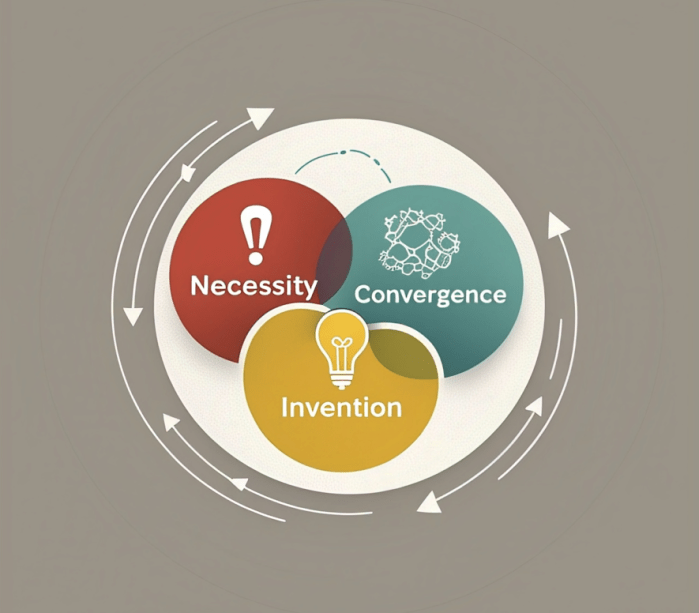
What if the very inventions that propel humanity forward also sow the seeds of our greatest challenges? History shows that progress is rarely a straight line. Instead, it moves in cycles: necessity sparks invention, and inventions converge to reshape society. From the steam engine’s role in the Industrial Revolution to the internet’s impact on globalization, each wave of transformation has brought profound change – economic shifts, new social structures, and unintended consequences. These disruptions, from rising inequalities to environmental crises, often take decades to address. As we stand on the brink of the next great convergence – whether in AI, biotechnology, humanoid robots, cyber, climate or health – we must ask – how can we harness innovation to create a more equitable and sustainable future?
Continue reading Reimagining the Future