
I recently finished reading The Eurasian Century: Hot Wars, Cold Wars, and the Making of the Modern World by Hal Brands, a sweeping historical analysis that illuminates Eurasia’s enduring centrality in global geopolitics. The author convincingly demonstrates how Eurasia’s vast resources, immense population, and strategic location have continuously positioned it as the crucible of global power struggles – from the ideological confrontations of the twentieth century to today’s emerging geopolitical tensions. His narrative offers profound lessons for leaders navigating an increasingly interconnected and uncertain global landscape.
Continue readingMeeting Today’s Grand Challenges – The Next Wave of Convergence
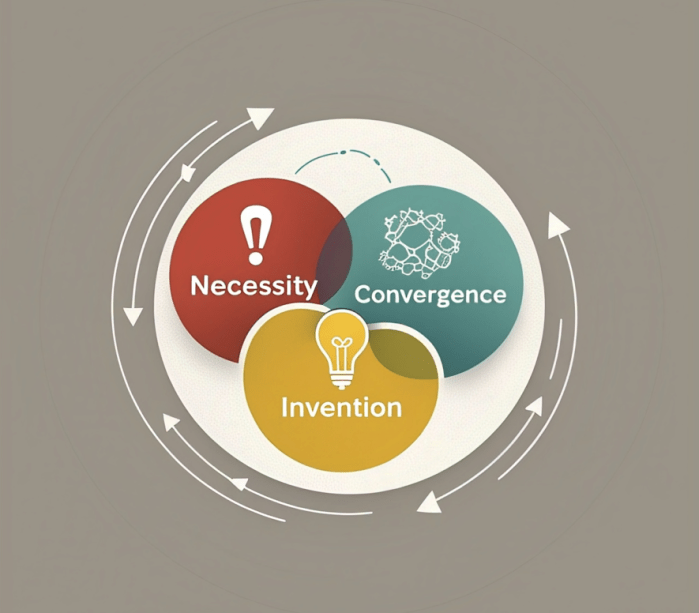
Throughout this four-part series, we’ve seen how necessity sparks invention – and together, they transform our society in profound ways. Today, our world faces an array of urgent challenges, from climate change and demographic shifts to economic and geopolitical instability, cybersecurity threats, and healthcare crises. These pressures are igniting a fresh wave of convergence, where inventive and innovative responses to pressing needs are poised to reshape our future. As we enter this transformative era, the cycle of necessity and invention reminds us that bold, purpose-driven invention and innovation is our best path forward.
Continue readingThe Converging Forces Of Progress: Necessity, Invention, And Systemic Outcomes
What if the very inventions that propel humanity forward also sow the seeds of our greatest challenges? History shows that progress is rarely a straight line. Instead, it moves in cycles: necessity sparks invention, and inventions converge to reshape society. From the steam engine’s role in the Industrial Revolution to the internet’s impact on globalization, each wave of transformation has brought profound change – economic shifts, new social structures, and unintended consequences. These disruptions, from rising inequalities to environmental crises, often take decades to address. As we stand on the brink of the next great convergence – whether in AI, biotechnology, humanoid robots, cyber, climate or health – we must ask – how can we harness innovation to create a more equitable and sustainable future?
Continue readingThe Necessity-Invention-Convergence Framework
The Necessity-Invention-Convergence Framework provides a structured way to analyze the forces that drive human progress. At its core, necessity serves as the fundamental driver of change, arising from pressing challenges, constraints, or demands. Whether economic, social, environmental, or geopolitical, necessity compels action and forces innovation. Throughout history, this dynamic has played out in transformative ways. The Industrial Revolution was fueled by labor shortages and an increasing demand for goods, just as the Digital Revolution emerged in response to the need for faster, decentralized communication. Today, the global energy transition is being shaped by the necessity of addressing climate change and resource limitations.
Continue readingThe Great Convergence: When Necessity Meets Invention and Innovation
History has shown that when necessity, invention and innovation converge, the result is transformative change. From the steam engine to artificial intelligence, periods of economic, societal, and technological strain have consistently pushed invention innovation to new heights. These inflection points – where high-pressure needs meet breakthrough ideas – can drive unprecedented leaps in productivity, reshaping industries, economies, and even entire civilizations.
Continue readingPolyintelligence: The Fusion Of Nature, Human Ingenuity, And AI
In recent discussions across media, business, and academia, much has been said about the convergence of human and artificial intelligence. This powerful combination is already leading to remarkable discoveries. However, there is another form of intelligence that often goes unrecognized – nature’s intelligence.
A recent article I came across highlights this critical dimension, introducing the concept of polyintelligence – an integrated framework of natural, human, and machine intelligence. The notion that nature itself embodies intelligence, with its ability to learn, adapt, and encode knowledge, aligns closely with the interdisciplinary approach I have long advocated. It also reinforces the need for a lateral, ecosystem-driven perspective – one that transcends silos and embraces holistic thinking.
Continue readingGlobal Cooperation At A Crossroads: What Comes Next?
When I am asked if I am optimistic or pessimistic about the future, I respond that I am an optimist by nature. However, this quote captures the pessimism part of my response, fueled by similar sentiments from this World Economic Forum quote in their 2025 global Risks Report:
“Deepening divisions and increasing fragmentation are reshaping international relations and calling into question whether existing structures are equipped to tackle the challenges collectively confronting us. Levels of global cooperation across many areas of geopolitics and humanitarian issues, economic relations, and environmental, societal and technological challenges may reach new lows in the coming years.”
I’ve talked about the catalysts of our past that forced global cooperation. I believe catalysts will emerge again. How about you: are you optimisitic or pessimistic about the future? Let me know via this poll.
2025 Global Risks Report
Every year, the World Economic Forum’s Global Risks Report offers a critical snapshot of the forces shaping our world. The 2025 edition paints a picture of escalating tensions, deepening fractures, and an accelerating transformation of our societal foundations. As we navigate an increasingly complex landscape, the report underscores the necessity of adaptability, resilience, and the capacity to thrive – what I call the ART of navigating uncertainty.
More than ever, this year’s report validates the idea that we are in a period of convergence – where geopolitical instability, technological disruption, societal shifts, economic volatility, environmental stress, and philosophical reorientation are colliding in ways that will redefine our future. Below, I’ve categorized the major risks identified in the report under the seven core convergence domains that I frequently discuss: science, technology, society, geopolitics, economy, environment, and philosophy.
Continue readingThe Fourth Turning: A Prophetic Lens On Our Turbulent Times
UPDATED FEBRUARY 5TH 2025. The Fourth Turning and its sequel have resonated deeply with readers because they offer a framework for understanding the cyclical nature of history, particularly during times of uncertainty. The books propose that history unfolds in repeating patterns, each marked by distinct generational archetypes and societal moods. According to the authors’ model, we entered a “Crisis” period around 2008, marked by economic turmoil and a growing sense of societal unease. Now, over a decade later, many feel that we are approaching a critical juncture, the resolution of this Crisis, though the precise nature of that resolution remains unclear. This sense of approaching a culmination, combined with the current climate of rapid technological change, political polarization, and global instability, makes the framework offered by The Fourth Turning particularly compelling.
Continue readingSensing And Responding: How AI Is Helping Us Navigate An Uncertain World
Over the years, I’ve chronicled how rapid change and pervasive uncertainty have become the hallmarks of our times. In my previous writings, I argued that survival in this dynamic environment depends on a sense and respond approach – rapidly detecting meaningful signals and acting decisively. Today, that vision is evolving into reality. With the convergence of generative and agentic AI, we’re not only theorizing about this paradigm; but moving towards a practical reality that allows us to navigate complexity and turn uncertainty into opportunity.
Continue readingThe Evolution Of AI Perception: From Skepticism To Conviction
In 2021, I conducted a poll to gauge public sentiment on the transformative potential of artificial intelligence. I posed a bold question: Will AI be more impactful than prior general-purpose technologies like fire, the printing press, the steam engine, and electricity? Respondents had three choices: Yes, No, and Too Early to Tell. The results reflected a world still grappling with AI’s potential—40% answered Yes, 26% No, and 34% felt it was Too Early to Tell.
Continue readingRehearsing The Future: Scenario Thinking And Longevity
For years, I’ve championed the power of scenario thinking as a way to “rehearse” the future. In my work, I’ve seen how structured, forward-looking narratives help us move beyond guesswork or simple extrapolation, allowing us to imagine multiple possibilities and develop more resilient strategies. This approach is particularly vital when it comes to the challenges of longevity and the strain on social safety nets like Social Security – areas where demographic shifts, policy decisions, and economic factors converge in ways that few people anticipate. By rehearsing tomorrow’s potential realities today, we equip ourselves with the foresight to adapt, innovate, and thrive no matter which scenario becomes our new normal.
Continue readingRehearsing The Future: Navigating Complexity With Mimi Brooks
In an age of accelerating change and complexity, leadership requires more than traditional planning – it demands a mindset of rehearsal. This principle framed my recent conversation with Mimi Brooks, CEO of Logical Design Solutions, on her Bold Agendas podcast. Our discussion spanned the evolving role of ecosystems, the dual edges of innovation, and the critical importance of adaptability and resilience. Together, we unpacked strategies for thriving in an unpredictable world and explored the transformational shifts leaders must embrace to navigate 2025 and beyond.
Continue readingBeyond The Playbook: How Jayden Daniels Is Bringing Digital Twins Into The NFL Spotlight
According to an article I saw recently, Jayden Daniels, the Washington Commanders quarterback, has been integrating a VR headset developed by a German company to simulate real game scenarios. By customizing AI-driven defensive schemes, he’s able to rack up hundreds of extra mental and physical “reps” without risking injury—far beyond what’s possible in normal on-field practice. According to Daniels, he can now read NFL defenses significantly faster because the simulation lets him face defenders moving at speeds far exceeding typical game conditions. Essentially, he’s getting used to worst-case (or, at least, fastest-case) scenarios in a risk-free environment, so Sunday’s real-life speed feels manageable by comparison.
Continue readingRevisiting Thoughts On The Impact Of AI
Back in 2021, I explored Sundar Pichai’s bold assertion that artificial intelligence could surpass the impact of fire, electricity, and even the Internet. Pichai’s observation, when viewed alongside history’s great technological leaps—from hunter-gatherer to agrarian, and later, agrarian to industrial—may well be on point. AI stands apart by merging the two core drivers of societal transformation: expanding human knowledge and inventions that shape our societies. Now, with AI’s reach expanding across every aspect of daily life, I want to revisit this conversation and am inviting you to participate in a new poll on the impact of AI. So what do you think, will AI be more impactful than prior general purpose technologies like fire, printing press, steam engine and electricity?
The Future Is Not Determined: Lessons from Declining Fertility Rates
Throughout history, demographic trends have shifted in ways that defy prediction. One such phenomenon is the decline in fertility rates, which serves as a powerful reminder that the current state is not the future state. Today, discussions around declining fertility often frame it as a looming crisis, raising fears of aging populations and economic stagnation. Yet, history provides a compelling counter-narrative. The reversal of fertility decline in the mid-20th century, driven by the baby boom, highlights the impossibility of predicting how societal, economic, and geopolitical forces will interact to shape our future.
Continue readingBook Review: “Punishing Putin” By Stephanie Baker
Punishing Putin, by Stephanie Baker, published in September 2024, offers a timely and in-depth examination of the international efforts to hold Russia accountable for its invasion of Ukraine. This isn’t simply a historical recounting of sanctions and diplomatic maneuvers; Baker delves into the complexities, contradictions, and often unintended consequences of the strategies employed by Western nations and their allies.
Continue readingThe Haier Approach: Structurally Aligning Organizations With The Ecosystem Era
A recent article describes an astonishing achievement enabled by an ecosystem mindset. In 2016, Haier, the world’s largest appliance manufacturer headquartered in China, acquired GE Appliances. As author Bill Fotsch states: “What followed was nothing short of astonishing. Market share, which had languished around a mere two percent for the previous four years, skyrocketed to 20 percent. Haier had achieved what GE could not: a resounding success in the appliance market.”
Continue readingThe Demographic Cliff: A Looming Crisis For Higher Education And The Economy
A recent article highlights a force I have written about often: The demographic shifts that will intensify over the latter half of this decade and into the 2030s. A brief summary of the article and issues follows.
The Looming Demographic Cliff and Its Ripple Effect on Higher Education and the Economy
A silent yet profound shift is taking place in the United States (and globally) one that will reshape higher education and have far-reaching economic consequences. The “demographic cliff,” a term used to describe the decline in the number of 18-year-olds available to enter college, has been looming since the Great Recession triggered a drop in birth rates. This decline is expected to manifest significantly by this fall, presenting an existential challenge to colleges and universities and broader implications for the nation’s economy.
Continue readingBook Review: Genesis: Artificial Intelligence, Hope, and the Human Spirit
Genesis: Artificial Intelligence, Hope, and the Human Spirit is a rare and thought-provoking collaboration among a statesman whose influence has spanned decades, Henry Kissinger, and two technology visionaries, Eric Schmidt and Craig Mundie. Together, they present a sweeping examination of artificial intelligence (AI) – its towering promises, its urgent perils, and its profound implications for human identity, governance, and morality.
Continue reading Reimagining the Future