Robert D. Kaplan’s latest book, Waste Land: A World in Permanent Crisis, presents an unsettling yet necessary exploration into our current global predicament. True to Kaplan’s distinguished career, this book expertly connects historical contexts with today’s increasingly complex reality, a practice that resonates deeply with my own work on examining historical lessons to better understand our evolving future.
Continue readingThe Fork In The Road: Navigating The Future
Throughout history, progress has been shaped by pivotal choices – moments where society stands at a fork in the road, with two distinct paths ahead. One path leads toward advancement, where invention, innovation, and human action address humanity’s most pressing challenges. The other veers toward fragmentation, where barriers to progress emerge, often in the form of resistance, skepticism, or unintended consequences of new technologies.
Continue readingChina’s AI Breakthrough: What Does Manus Really Signal For AI’s Future?
A recent article described the launch of Manus, an autonomous AI agent developed in China. It has generated debate. in some circles. Some label it a leap in self-directed AI, while others see it as building on existing multi-agent frameworks. Speculation abounds about its true capabilities and how much of the attention is genuine progress versus media-driven hype. Throughout history, we have observed similar moments when an emerging technology prompts sweeping claims that may not align with its real-world limitations.
Continue readingWhen General-Purpose Technologies Intersect With Necessity, Invention, And Convergence
History teaches us that transformative technologies do not emerge in isolation, nor do they reshape the world overnight. Instead, they follow a discernible pattern – an evolutionary journey that unfolds in response to human needs. Two phenomena help us understand this journey: the Evolutionary Phases of General-Purpose Technologies (GPTs) and the role of necessity, invention, and convergence (NIC). When viewed together, they provide a powerful lens for understanding not just how technologies evolve, but why they emerge and when they reach their full potential.
Continue readingThe Great AI Shift: Services As Software
I came across a very good article that describes the emerging phenomenon that some have termed Services-as-Software. For decades, businesses have structured their operations around human-driven services – coders developing applications, analysts interpreting data, consultants optimizing workflows. Software has long played a supporting role, but the core work remained in human hands. That paradigm is shifting. Here is a summary of the article.
Artificial intelligence (AI) is transforming the very nature of services. What once required teams of specialists is increasingly being handled by AI-powered systems capable of executing tasks autonomously. This transformation isn’t just about automation – it’s about redefining how businesses consume and deliver services. The emerging model, as mentioned, is often called Services as Software, and it marks a profound departure from the past: software is no longer a tool for human workers; in many cases, it is the worker.
Continue readingWhat If Everything We Know Is Holding Us Back?
In a time of unprecedented change, our society finds itself at the crossroads of transition. If we accept that we are in the Crisis phase of what historians William Strauss and Neil Howe term The Fourth Turning – a cyclical theory suggesting that societies repeatedly cycle through periods of stability and upheaval – we must confront a crucial question: Are we choosing to proactively unlearn outdated models, or will we be forced to do so reactively in the wake of crisis?
Continue readingThe Fragile Future: A Deeper Look At 2035
Yesterday, I launched a post titled The Fragile Future, exploring the uncertainty that lies ahead and the forces shaping our world. Today, I came across an article from the Atlantic Council titled Global Foresight 2025, which presents a range of possible futures through a survey of strategists and foresight practitioners. Their findings paint a stark picture of what 2035 might hold—a world teetering between worsening geopolitical conflict and cautious optimism about technology’s role in shaping our collective destiny.
Continue readingThe Fragile Future: Why Stability Is More Uncertain Than Ever
History does not repeat, but it often rhymes. As I read Robert D. Kaplan’s Waste Land: A World in Permanent Crisis, I was struck by his argument that the 20th and early 21st centuries have been especially bloody because the stabilizing force of monarchy has vanished. He suggests that despite our moral progress in areas like human rights and the environment, the world remains tightly wound, vulnerable to clashing interests and aggressive authoritarian states. He draws an analogy to Weimar Germany – a moment of fragile democracy, economic strain, and rising nationalism that ultimately collapsed into war.
Continue readingThe Persuasion Paradox – Reclaiming Truth In The Age Of Digital Persuasion
At the heart of the Persuasion Paradox lies a profound contradiction between the transformative promise of the Information Age and its unintended consequences. Initially, the internet was envisioned – and widely celebrated – as a revolutionary tool for democratizing knowledge, dismantling barriers to information access, and fostering global understanding. Yet, we now face a reality starkly different from that optimistic vision. The abundance of information, rather than elevating clarity and truth, has birthed a “noise-to-signal” problem, where misinformation, disinformation, and emotionally charged narratives often obscure the truth. This phenomenon resonates deeply with themes I’ve explored previously – the democratization of knowledge and the unintended consequences inherent in rapid technological and societal transitions.
Continue readingThe Eurasian Century – Navigating Global Convergence
I recently finished reading The Eurasian Century: Hot Wars, Cold Wars, and the Making of the Modern World by Hal Brands, a sweeping historical analysis that illuminates Eurasia’s enduring centrality in global geopolitics. The author convincingly demonstrates how Eurasia’s vast resources, immense population, and strategic location have continuously positioned it as the crucible of global power struggles – from the ideological confrontations of the twentieth century to today’s emerging geopolitical tensions. His narrative offers profound lessons for leaders navigating an increasingly interconnected and uncertain global landscape.
Continue readingMeeting Today’s Grand Challenges – The Next Wave of Convergence

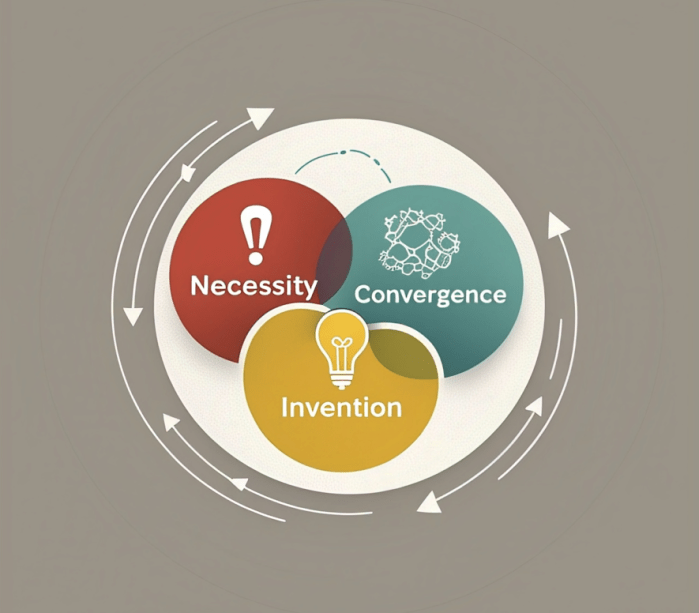
Throughout this four-part series, we’ve seen how necessity sparks invention – and together, they transform our society in profound ways. Today, our world faces an array of urgent challenges, from climate change and demographic shifts to economic and geopolitical instability, cybersecurity threats, and healthcare crises. These pressures are igniting a fresh wave of convergence, where inventive and innovative responses to pressing needs are poised to reshape our future. As we enter this transformative era, the cycle of necessity and invention reminds us that bold, purpose-driven invention and innovation is our best path forward.
Continue readingThe Converging Forces Of Progress: Necessity, Invention, And Systemic Outcomes

What if the very inventions that propel humanity forward also sow the seeds of our greatest challenges? History shows that progress is rarely a straight line. Instead, it moves in cycles: necessity sparks invention, and inventions converge to reshape society. From the steam engine’s role in the Industrial Revolution to the internet’s impact on globalization, each wave of transformation has brought profound change – economic shifts, new social structures, and unintended consequences. These disruptions, from rising inequalities to environmental crises, often take decades to address. As we stand on the brink of the next great convergence – whether in AI, biotechnology, humanoid robots, cyber, climate or health – we must ask – how can we harness innovation to create a more equitable and sustainable future?
Continue readingThe Necessity-Invention-Convergence Framework
The Necessity-Invention-Convergence Framework provides a structured way to analyze the forces that drive human progress. At its core, necessity serves as the fundamental driver of change, arising from pressing challenges, constraints, or demands. Whether economic, social, environmental, or geopolitical, necessity compels action and forces innovation. Throughout history, this dynamic has played out in transformative ways. The Industrial Revolution was fueled by labor shortages and an increasing demand for goods, just as the Digital Revolution emerged in response to the need for faster, decentralized communication. Today, the global energy transition is being shaped by the necessity of addressing climate change and resource limitations.
Continue readingThe Great Convergence: When Necessity Meets Invention and Innovation
History has shown that when necessity, invention and innovation converge, the result is transformative change. From the steam engine to artificial intelligence, periods of economic, societal, and technological strain have consistently pushed invention innovation to new heights. These inflection points – where high-pressure needs meet breakthrough ideas – can drive unprecedented leaps in productivity, reshaping industries, economies, and even entire civilizations.
Continue readingPolyintelligence: The Fusion Of Nature, Human Ingenuity, And AI
In recent discussions across media, business, and academia, much has been said about the convergence of human and artificial intelligence. This powerful combination is already leading to remarkable discoveries. However, there is another form of intelligence that often goes unrecognized – nature’s intelligence.
A recent article I came across highlights this critical dimension, introducing the concept of polyintelligence – an integrated framework of natural, human, and machine intelligence. The notion that nature itself embodies intelligence, with its ability to learn, adapt, and encode knowledge, aligns closely with the interdisciplinary approach I have long advocated. It also reinforces the need for a lateral, ecosystem-driven perspective – one that transcends silos and embraces holistic thinking.
Continue readingGlobal Cooperation At A Crossroads: What Comes Next?
When I am asked if I am optimistic or pessimistic about the future, I respond that I am an optimist by nature. However, this quote captures the pessimism part of my response, fueled by similar sentiments from this World Economic Forum quote in their 2025 global Risks Report:
“Deepening divisions and increasing fragmentation are reshaping international relations and calling into question whether existing structures are equipped to tackle the challenges collectively confronting us. Levels of global cooperation across many areas of geopolitics and humanitarian issues, economic relations, and environmental, societal and technological challenges may reach new lows in the coming years.”
I’ve talked about the catalysts of our past that forced global cooperation. I believe catalysts will emerge again. How about you: are you optimisitic or pessimistic about the future? Let me know via this poll.
2025 Global Risks Report
Every year, the World Economic Forum’s Global Risks Report offers a critical snapshot of the forces shaping our world. The 2025 edition paints a picture of escalating tensions, deepening fractures, and an accelerating transformation of our societal foundations. As we navigate an increasingly complex landscape, the report underscores the necessity of adaptability, resilience, and the capacity to thrive – what I call the ART of navigating uncertainty.
More than ever, this year’s report validates the idea that we are in a period of convergence – where geopolitical instability, technological disruption, societal shifts, economic volatility, environmental stress, and philosophical reorientation are colliding in ways that will redefine our future. Below, I’ve categorized the major risks identified in the report under the seven core convergence domains that I frequently discuss: science, technology, society, geopolitics, economy, environment, and philosophy.
Continue readingThe Fourth Turning: A Prophetic Lens On Our Turbulent Times
UPDATED FEBRUARY 5TH 2025. The Fourth Turning and its sequel have resonated deeply with readers because they offer a framework for understanding the cyclical nature of history, particularly during times of uncertainty. The books propose that history unfolds in repeating patterns, each marked by distinct generational archetypes and societal moods. According to the authors’ model, we entered a “Crisis” period around 2008, marked by economic turmoil and a growing sense of societal unease. Now, over a decade later, many feel that we are approaching a critical juncture, the resolution of this Crisis, though the precise nature of that resolution remains unclear. This sense of approaching a culmination, combined with the current climate of rapid technological change, political polarization, and global instability, makes the framework offered by The Fourth Turning particularly compelling.
Continue readingSensing And Responding: How AI Is Helping Us Navigate An Uncertain World
Over the years, I’ve chronicled how rapid change and pervasive uncertainty have become the hallmarks of our times. In my previous writings, I argued that survival in this dynamic environment depends on a sense and respond approach – rapidly detecting meaningful signals and acting decisively. Today, that vision is evolving into reality. With the convergence of generative and agentic AI, we’re not only theorizing about this paradigm; but moving towards a practical reality that allows us to navigate complexity and turn uncertainty into opportunity.
Continue readingThe Evolution Of AI Perception: From Skepticism To Conviction
In 2021, I conducted a poll to gauge public sentiment on the transformative potential of artificial intelligence. I posed a bold question: Will AI be more impactful than prior general-purpose technologies like fire, the printing press, the steam engine, and electricity? Respondents had three choices: Yes, No, and Too Early to Tell. The results reflected a world still grappling with AI’s potential—40% answered Yes, 26% No, and 34% felt it was Too Early to Tell.
Continue reading