
Can we ever go back to the way things were? That’s the question Manon DeFelice asks in a recent Article that explores the return to the office. The article provides some interesting insights. For instance, about 62% of Americans say they have worked from home during the COVID-19 pandemic, according to a recent Gallup Poll. A majority (59%) of those individuals say that remote work would be welcome post-pandemic. One of the concerns often stated about remote work is the impact on productivity. Well, Ms. DeFelice shares results from a YouGov Survey that found 54% of professionals ages 18-74 felt that working from home has had a positive impact on their productivity.
Author: Frank Diana
A Job Guarantee
As I continue to research the societal factors that influence our future, I’ve explored broad topics from Government Deficits to Modern Monetary Theory.  Most recently, I’ve looked into something that lies at the heart of many societal ills; unemployment and underemployment. That journey led me to my most recent book titled: A Job Guarantee. I just added a book – written by Pavlina R. Tcherneva – to my Book Library. Ms. Tcherneva is an American economist of Bulgarian descent, working as associate professor and director of the Economics program at Bard College.
Robots And The Future Of Work
The phrase “The robots are coming” is often repeated these days. What does their arrival mean for the future of work? That question has short term implications, and the potential for profound long-term impacts. Ask around and you get vastly different perspectives on the question. We seem as polarized on the topic as we are about anything these days. A very good perspective was provided recently in an Article authored by Daphne Leprince-Ringuet. The article explores the possible changes to work as robots become a common feature in the work environment.
Tectonic Shifts Expected As Digital Expands
Prognosticators continue to point to massive shifts in the aftermath of COVID-19. In this recent Article, author Bhaskar Majumdar explores an aggressive convergence of the physical and digital worlds. Pointing to the domains that have already converged – education and entertainment – Mr. Majumdar sees this phenomenon overwhelming all aspects of our lives. In the near future, he sees it impacting banking, medicine, trade, shopping, dining and sports. As we come to terms with social distancing in a post-COVID world, some level of change is inevitable.
Can Technology Address The Racism Problem?
I recently received a note from one of my readers regarding racism. As someone who has leveraged my anchor visual, he recognized racism as a societal issue in the middle of it. As depicted, societal issues create tension that drives the progression of two curves: the science and technology foundation, and the future scenarios spawned by convergence across the visual. This tension happens in both directions, as the curves also impact the path of society. This individual explored one of those tensions, namely, the use of technology to address systemic racism. In his words: “I find the problem to be one of the most difficult to solve through just laws and politics. I really think that technology can help.”
Can We Fund Solutions to Education, Healthcare, and Climate Issues?
Last week. I posted about modern monetary theory (MMT) and how it challenges conventional wisdom regarding deficits.  In her recent book titled The Deficit Myth , Author Stephanie Kelton – Professor of Economics and Public Policy at Stony Brook University – explores the tenets of the theory and its implications to government spending. Progressive agendas aimed at solving the challenges of education, healthcare, climate change and others look at modern monetary theory as a possible solution. In contrast to borrowing money or raising taxes, the monetisation of government expenditure (its financing by the central bank’s creation of money) is costless, in that the government does not have to pay interest on cash.
The attention garnered by MMT has drawn its share of critics. In the interest of understanding both sides of this debate, I read a book titled Modern Monetary Theory and its Critics. The book is a series of essays edited by Edward Fullbrook and Jamie Morgan. As the authors state: in the wake of the decade of fiscal austerity following the Global Financial Crisis, and the apparent exhaustion of standard monetary policy strategies and the ever-increasing income disparity, interest in MMT has grown beyond academia. The skeptics provide a different point of view. As we search for answers to our pressing issues and strive to think differently, it’s prudent that we keep an open mind to these new ways of thinking, while at the same time, understanding their limitations. I recommend the book, which I have added to my Book Library.
COVID-19 Is Not Slowing Artificial Intelligence Down
A recent Report on artificial intelligence (AI) suggests that COVID-19 is not likely to slow the path of AI. Per the report: nearly three-quarters of businesses now consider AI critical to their success, as it continues to grow in importance across companies of various sizes and industries, according to a new report. Appen Limited’s 2020 State of AI Report indicates that two-thirds of respondents do not expect any negative impact from the COVID-19 pandemic on their AI strategies.
Technology Pioneers Describe How the World Will Change By 2025
In a recent Article via the World Economic forum, author Saemoon Yoon identified 17 ways that technology could change the world by 2025. While the current pandemic exposed our vulnerabilities, it also shows what is achievable through collaboration. While efforts to collaborate globally must improve, a heightened visibility to the issues combined with an appreciation for the power of science and technology is a step in the right Direction. Here are snippets from the article that captures insight from 17 experts related to the world of 2025.
The Deficit Myth
I wrapped up another great book. This one focused on government deficits as viewed through the lens of Modern Monetary Theory. Author Stephanie Kelton addresses the topic in her recent book titled The Deficit Myth. In this best seller, Ms. Kelton – Professor of Economics and Public Policy at Stony Brook University – explores the role of currency issuers (U.S., Japan, U.K., Australia, etc.) versus currency users. From the book:
“The distinction between currency users and the currency issuer lies at the heart of Modern Monetary Theory. And as we will see in the pages ahead, it has profound implications for some of the most important policy debates of our time, such as health care, climate change, Social Security, international trade, and inequality.”
What History Tells Us About Deglobalization
In looking at a Post Pandemic Society, I took a Journey to the 1920s and 1930s to understand what history might tell us about our emerging future. I have been amazed at the eerie similarities between our present day and that period a century ago (see visual below). If anyone is interested in exploring the cycles of history, I highly recommend the book The Fourth Turning. In the meantime, this recent Article explores a similar comparison to that time in history with a focus on deglobalization. Per the article:
“The post-pandemic world economy seems likely to be a far less globalized economy, with political leaders and the public rejecting openness in a manner unlike anything seen since the tariff wars and competitive devaluations of the 1930s.”
The Augmented Age: An Accelerated Path
In a post from the summer of 2019, I explored the notion of an Augmented Age: a future where our natural human capabilities are radically augmented in three ways: Computational systems will help us think. Robotic systems will help us make. And a digital nervous system will connect us to the world far beyond what our natural nervous system can offer. Fast-forward to a world altered by COVID-19: Are we on an accelerated path to augmentation and automation? This recent Forbes Article takes an interesting look at the question from the perspective of lights out factories.
The Personalized Health Ecosystem
A recent article on the Future of Medicine explores the emerging Wellness Ecosystem and the impact that COVID-19 is likely to have on its path. The key message from the article and associated video below is that Connected Health has a greater opportunity for realization. The pandemic has proven that virtual ways of working and telemedicine can work. The video examines the role of artificial intelligence, 5G, Sensors, and data in the progression towards a personalized health ecosystem.
Aftershocks and Opportunities: Scenarios For A Post-Pandemic Future
I just finished a new book released by Fast Future. The book is a compilation of post-pandemic scenarios authored by Futurists around the world.  Aftershocks and Opportunities: Scenarios for a Post-Pandemic Future takes a look at both the challenges and opportunities introduced by COVID-19. Due to the number of responses from global futurists, a second book is in the works. I’ve added this one to my Book Library. An abstract is included below.
The Emergence Of New Commerce Centers And More
I had the opportunity to join the Dan Proft Show this week for a wide ranging discussion that covered the pandemic impacts on urbanization, immigration, inequality, retired workers, and the emergence of new commerce centers. Listen to our short interview.
A Discussion With The Society For Information Management
I had the pleasure of speaking at a virtual event organized by The Society For Information Management – Philadelphia Chapter. The topic was a look into a post-pandemic future. We used polls to explore the sentiment of the group. The video captures the session and polls.
The Rise Of Digital Currency
I just finished another great book: Beyond Blockchain: The Death of the Dollar and the Rise of Digital Currency.  I just added it to my Book Library and highly recommend the read. Author Erik Townsend has a great blend of financial and software expertise, making him uniquely qualified to talk on the topic. He explores a wide range of topics from the basics of money to global scale digital currencies.
Although launched in early 2019, the book is very timely given the current geopolitical environment. Mr. Townsend does a great job of describing various aspects of our financial system, thereby building a foundation of knowledge that makes the discussion of digital currency more impactful. Although a big proponent of cryptocurrencies and the values and motivations of the original inventors, he is a pragmatist and practical thinker – which I found very refreshing.
Some Job Opportunities Likely To Expand
Much has been said about the shift to remote work. The permanence of the shift remains to be seen, let’s assume however that this forced experiment has been successful enough to warrant an increase in remote work percentages. What are the implications of this shift? This recent Article authored by Patrick Gray explores two possible implications.
The Far Reaching Implications Of A Shifting Work Dynamic
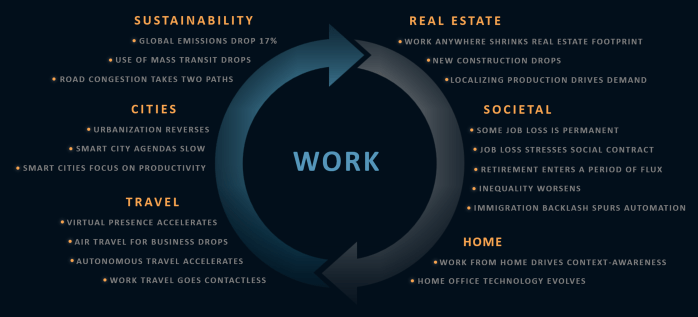
In an earlier Post, I explored the possible implications of COVID-19. As with any look into the future, we know a series of dots will connect to shape it. Looking at the pieces in isolation fails to identify the potential paths. The world of work is a great example. Whatever happens in the context of work has an obvious ripple effect into multiple domains. The visual below captures some of that those ripples:
Reflect, Reimagine, and Reset
“The pandemic represents a rare but narrow window of opportunity to reflect, reimagine, and reset our world.” Klaus Schwab – Founder and Executive Chairman, World Economic Forum
Way back in 2010 when I launched this Blog, its purpose was to focus on reimagining. What will the world look like in twenty years? Ten years into that journey, the word reimagine seems like the right choice. The quote above from Klaus Schwab captures it well. While the pandemic may indeed serve as a catalyst for reflection, reimagining, and an ultimate reset, we have been here before – only to return to the status quo.
Human Behavior Determines The Path
How can we find the signal when there is so much noise? We don’t have an effective way to predict what will happen next, history tells us that. We do have a way to understand what happened when crisis has occurred in the past. In a piece titled A Post Pandemic Society, I explored the somewhat scary similarities between modern day and the world of a century ago. In a recent Article authored by Robert Shiller, Sterling Professor of Economics at Yale University, he takes a similar look at two events during that period.
 Reimagining the Future