Possibilities

As I reflected on my Thoughts for 2019, three themes stood out. I’ve already written about Convergence and Acceleration, so this post will focus on possibilities. As described recently, I believe the world will experience a Burst of Possibilities enabled by the forces of convergence and acceleration. We should expect these possibilities to multiply in 2019, but realization depends upon multiple factors. One of these factors is a true focus on purpose, posing this question for humanity: how do we harness these possibilities to bring about a better world?

Fourth Revolution Innovation WheelIn arguing the case for purpose-orientation and possibilities, I created this visual that maps future advancements to our areas of well-being (click on visuals to enlarge them). I could create a different one that shows how these same advancements can be used to diminish our well-being. That’s why convergence is the most critical theme among the three. An effective way to think about purpose and possibilities is via the United Nations Sustainable Development Goals. These are among the best-known and most frequently cited societal challenges. I believe we are entering a period of astounding innovation – advancements that have the potential to address these goals.
Continue reading

Convergence

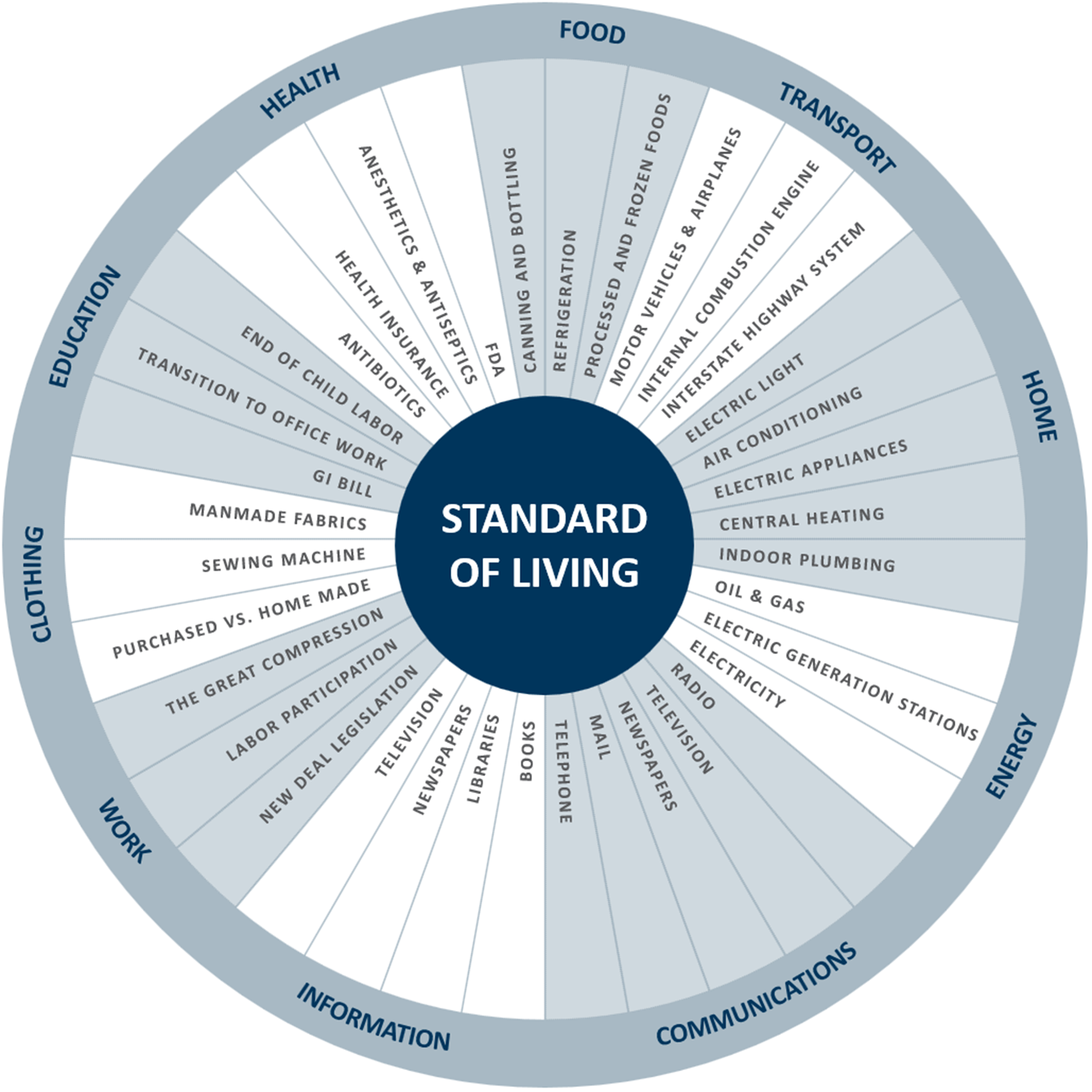
As I described in my Thoughts on 2019 post, convergence is one of the key dynamics I expect/hope to see more of this year. A century ago, a convergence across domains ushered in unprecedented advancements in human development. As Robert J. Gordon describes, the special century (1870 – 1970) that followed the Civil War was made possible by a unique clustering of what Mr. Gordon calls the great inventions. The great inventions of the second industrial revolution significantly improved our well-being. In his view, the economic revolution of 1870-1970 was unique in human history, unrepeatable because many of its achievements could only happen once. What makes this century so special, is that these inventions altered what until then, was a life lived in misery. I captured the advancements made during that period using an Innovation Wheel to map them to our areas of well-being (click on visuals in this post to open in a separate window).

Second Revolution Innovation Wheel

A look at history is very instructive, as several dynamics from that period have the potential to emerge once again – the biggest being the opportunity for convergence. In this context, convergence refers to a virtuous cycle where events in one domain spur action in another. The great inventions (electricity, telephone, and internal combustion engine) were clustered together at the end of the 19th century, forming a virtuous cycle that drove a period of astounding innovation. This innovation cycle continued well into the 20th century – a dynamic that could be emerging again. Yet, science and technology are simply two domains that converged during the special century. The others were the economy, business, politics, and a broader set of societal issues. What enabled this convergence and created the most dramatic improvement in human development? There were several key catalysts.

Continue reading

Visualizing Our Emerging Future – Revised

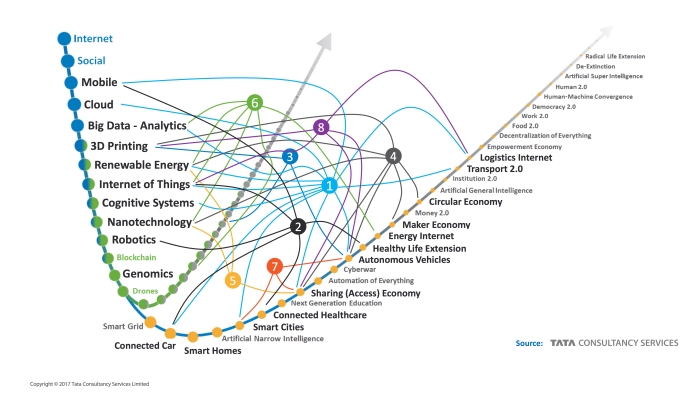
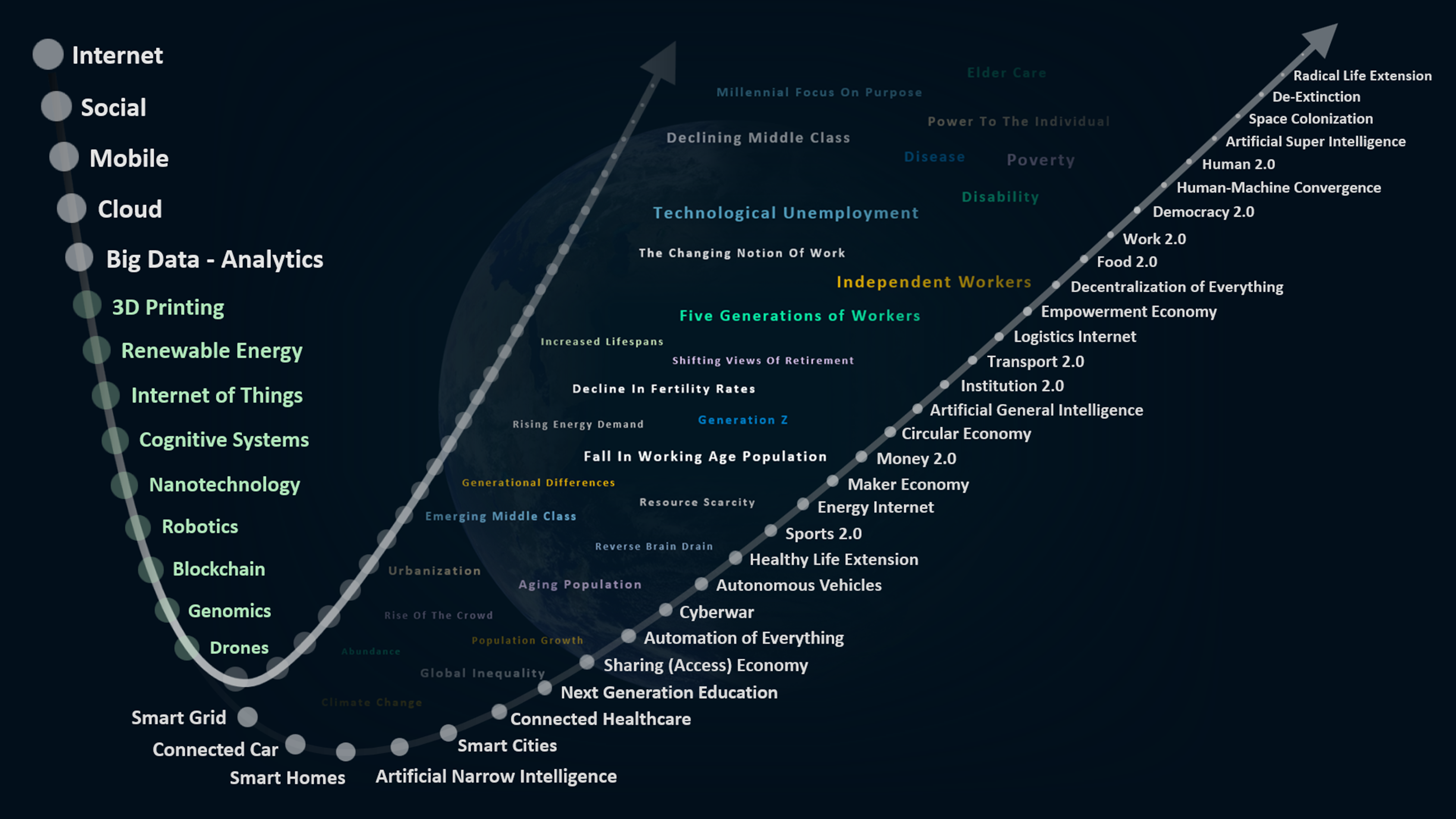
As our emerging future shifts continuously, our challenge is to shift with it. The number of building blocks that combine continues to explode, challenging our ability to track its complexity. I’ve used a visual representation of this challenge – and I see older versions floating around – so I am updating it via this post. When I use the visual in presentations, I build towards it to avoid its overwhelming nature (which I believe accurately reflects the overwhelming nature of the challenge). I will replicate the approach here by building towards the full visual.

Convergence across aspects of science, technology, economic forces, politics, society, our environment, and a growing conversation around ethics, is creating a highly uncertain world. At the heart of the pace dynamic is the exponential progression of science and technology – reflected in the first piece of the visual.

Science and Technology Curve

Continue reading

YouTube Channel Launch

YouTube Channel

The journey to the future is gaining more attention for both the opportunity it presents, and the fear of unintended consequences. Dialog and proactive action are critical to shaping this emerging future in human-centric ways – a story line that is nicely articulated in a new book titled Shaping the Fourth Industrial Revolution. I am a firm believer that shaping the future requires a different mindset. As stated in the book, we must all adopt a zoom-in and zoom-out strategy: zooming in to acquire an understanding of the characteristics and potential disruptions of specific advances in science and technology; and zoom out to see the patterns and combinations that emerge.

Continue reading

Harness All Possibilities

I had the pleasure of presenting at a recent function sponsored by Harness All Possibilities (HAP). The organization Founder – Rhonda Eldridge – has embarked on the following mission:

The fast pace of innovation, technology, geopolitics, socio-economics and demographic factors is driving disruption in industry – for both the employer and the employee. HAP’s purpose is to build a sense of connectedness while you embrace a transformational shift of your awareness and skill sets to prepare for 21st century engagement.

Continue reading

An Uncertain Future

I have used this Emerging Future visual to demonstrate the overwhelming number of combinations that will conspire to create our future. The science and technology foundation converges with societal, political, economic, and environmental forces to build towards a very uncertain future. A future that I believe represents the third massive tipping point in human history.

This very short animated video describes the visual.

A Future Thinking Canvas

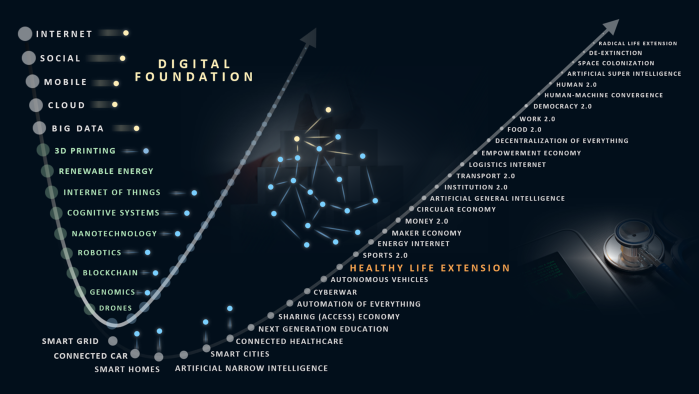
Our exponential pace is due in part to the overwhelming number of building blocks available to innovate. Understanding how these building blocks combine provides a glimpse into possible futures. In this visual, dots connect to portray the building blocks that are likely to extend our healthy lives – a key emerging future scenario.

Healthy Life Extension - Combinatorial

Continue reading

What are your thoughts about the Future?

I had the pleasure of developing an online thought leadership course focused on our emerging future back in May of this year. I had the added pleasure of working with futurists Gerd Leonhard, Gray Scott, and Chunka Mui, along with several industry leaders. The free Thought Leadership Course is available through May of next year. The course has been invaluable to me, as it provided a platform for dialog about our emerging future. I was thrilled with the thought provoking dialog that occurred through our moderated forum. For all those that participated thank you.

During the two week course, several poll questions were positioned to help us understand how the community is feeling about critical topics like ethics, our economy, and the likely transformative period that lies ahead. Here are the questions and their responses. There is plenty of time to take the course and add your voice to the conversation.

Continue reading

The Timing of Future Scenarios

Timing. It’s one of the most difficult facets to consider when thinking about the future. We know that convergence across societal, political, economic, science and technological forces is creating many future scenarios. We also know that enablement is happening at an exponential pace. Some believe (present company included) that the coming macro-level tipping point is likely to impact humanity on a scale only experienced twice in human history (hunter-gatherer to agriculture and agriculture to industrial). There will be many micro-level tipping points on the journey towards an automated society – and the timing of those tipping points is impossible to predict.

Continue reading

Reimagining the Future: Week Two of the Online Course Launched

Week two of Reimagining the Future has just launched! Week one drew a large audience and generated great dialog. A big thank you to those who have participated so far. As discussed in the course, we must collectively take control of creating our future. Our hope is this course and related dialog are just one small step on that journey. There is still plenty of time to take the full course, you can enroll here.

Continue reading

Reimagining the Future – A Journey Through the Looking Glass

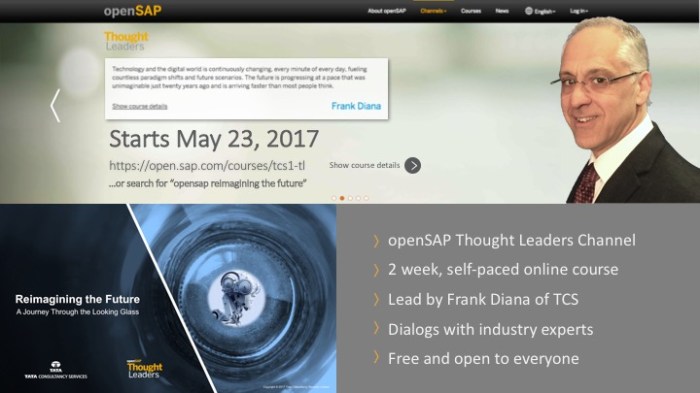
openSAP Promo Slide

I have spent the better part of two months filming an online thought leadership course focused on our emerging future. The free course will be available starting May 23rd. I had the pleasure of working with futurists Gerd Leonhard, Gray Scott, and Chunka Mui. In addition, I was joined by Element Fleet Management executive Michele Cunningham, as well as TCS CTO Ananth Krishnan, and BRP CIO Hassan El Bouhali.

A video promo of the course along with the course description are available here. I hope you take the time to journey with me through the looking glass. course summary and bios for my guests are also included below.

Continue reading

See the Future, Rehearse it and Adapt to the Inevitable Shifts

In my last post, I described a Sense and Respond model that sits at the heart of several activities, including scenario, opportunity, and risk analysis. As complexity and pace continue to intensify, uncertainty increases. To survive in this Emerging Future, we must embrace a framework for future thinking,  and an organization that can adapt as it shifts. In essence, we must see the future, rehearse it, continuously monitor for shifts, and adapt as the shifts occur. A sense and respond model sits at the core of the framework – but represents the biggest cultural challenge.

Continue reading

Visualizing our Emerging Future

As the pace of science, technology, and societal change accelerates, a vision of our future is emerging. Many future scenarios are viewed as science fiction, or thought to have timelines that are too far into the future to worry about. I hold a firm belief that these timelines are collapsing and future scenario analysis is critical both at a business and societal level.

I have used this visual as a driver of future scenario analysis. It has been captured and utilized in workshop and events. It is described in a post on Connecting Dots, which I view as a critical leadership trait.

emerging-future

Connecting Dots

I participated in a radio show yesterday brought to you by Coffee Break with Game Changers. The show was hosted by Bonnie D. Graham and is now available on-demand here. When asked about a leadership trait required to effectively navigate our exponential future, I echoed something I have positioned many times via this Blog: Connecting Dots. The speed dimension that has accelerated our pace will put those dots in constant motion – so it’s a continuous state of connecting that makes this more challenging than our forward looking efforts of the past. The foundation for this argument was positioned in my post describing how Disruptive Power Lies at the Intersections. This visual from that post leverages my anchor visual on our emerging future.disruptive-power

Continue reading

Our Emerging Future

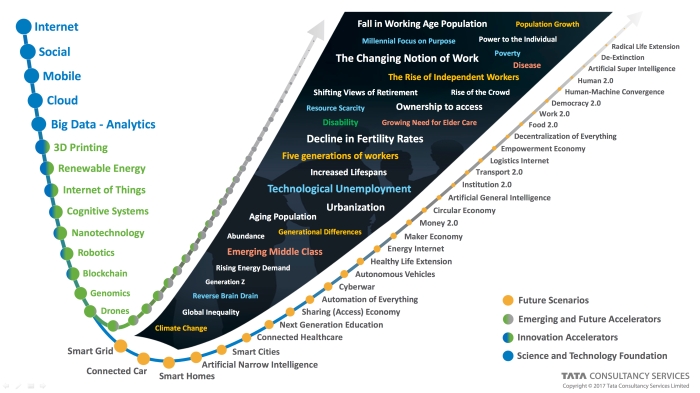
In my last post, I added more future scenarios to this visual describing the complexity and impact of our emerging future. The one piece left unfinished was the expansion of innovation accelerators to include emerging and future accelerators. With input from TCS CTO Ananth Krishnan, I have added a number of accelerators to the visual.

emerging-and-future-accelerators

Continue reading

Anticipating 2025 – Part One

I spent time over the Christmas holiday reading a book titled Anticipating 2025. Forward looking analysis that connects leaders with disruptive scenarios and their implications are invaluable, and books like this provide tremendous support. In my next series of Blog posts, I will summarize the salient points from a number of futurists who authored this work. As described in the books opening, futurists are concerned with highlighting a whole range of possible futures, not necessarily pinpointing exactly when something will happen. From the book:

“Futurists seek to draw people’s attention to forthcoming threats, before these threats become too damaging, and to forthcoming opportunities, before these opportunities slip outside of our collective grasp due to inaction on our part”

The book is divided into five sections:

  1. Setting the scene
  2. Re-designing medicine and healthcare
  3. Re-designing artificial intelligence
  4. Re-designing society
  5. Redesigning humanity

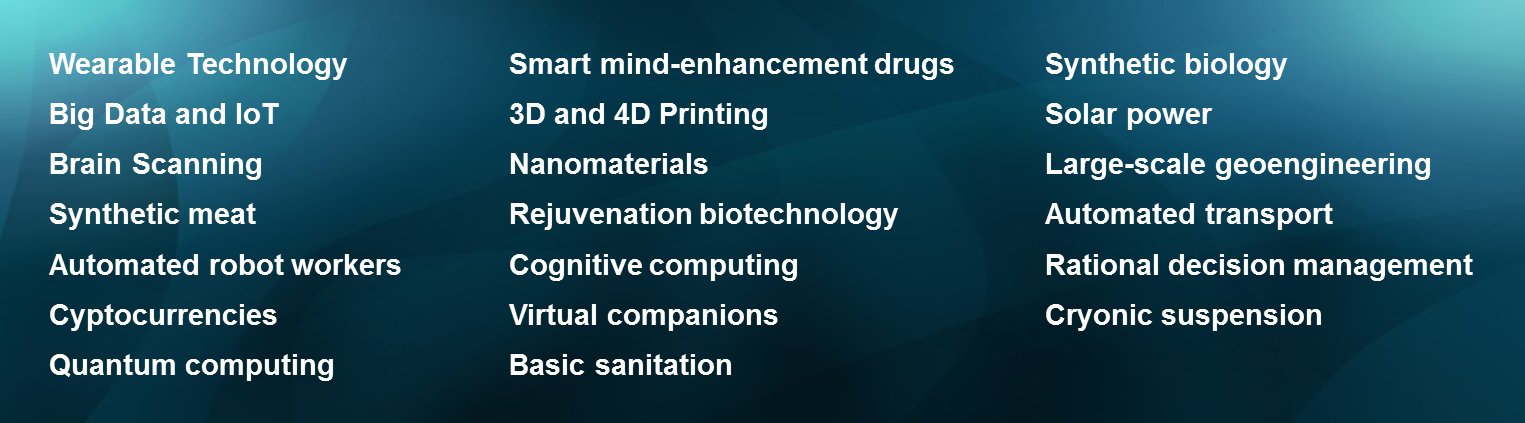
Part one of this Blog series will set the scene. In the book’s first section, the authors focus on driving forces, big shifts, and roadblocks. It is believed that if developed and deployed wisely, technology could provide a great future of unprecedented abundance, health, and vitality. But there is much uncertainty and a number of obstacles to overcome. In setting the scene, twenty technology areas where wide-ranging developments are 50% likely between now and 2025 are identified:

25 Technology Areas

Continue reading

An Interview with Futurist Thornton May

I thought it would be interesting to get a slightly different perspective on the questions that I posed to Futurist Gerd Leonhard in our recent interview. So I reached out to IT Futurist Thornton May. Thornton and I have interacted on a number of occasions at various events. His bio describes him as a futurist, educator and author. His extensive experience researching and consulting on the role and behaviors of C-level executives in creating value with information technology has won him an unquestioned place on the short list of serious thinkers on this topic. Thornton moderates the nationally recognized CIO Solutions Gallery program, intended for executives and senior leaders in the technology and operations communities.

With that background, I was excited to explore these broad topics with Thornton. His perspective follows.

Continue reading