
An op-ed I recently published in a French publication called LA TRIBUNE explored a shift I believe is becoming essential in the age of artificial intelligence: the move from return on investment to return on learning. That article focused on a simple but important idea. As AI takes on more tasks once tied to human productivity, the value of people does not disappear. It moves. It shifts toward judgment, creativity, empathy, sense-making, and the ability to work effectively with intelligent systems. In that world, the real differentiator is no longer just efficiency. It is learning. But I want to take the idea a step further here, because this is the part that matters most to me.
Continue readingArtificial Intelligence
Three phases of AI that shape the future: narrow, general, super
How Possibility Chains Were Born
Today TIME published an Op-Ed I wrote titled You Can’t Predict the Future. But Can You Rehearse It?. The piece explores a simple but important idea: the future is not something we can reliably predict, but it is something we can rehearse.
The Op-Ed focuses on why prediction is becoming less useful in a world where pressures across science, technology, geopolitics, economics, society, philosophy, and the environment are arriving at the same time. But the article only briefly touches on something that has shaped my thinking over the past year: how the idea of possibility chains actually emerged. It started with a familiar problem.
Continue readingWhen No One Owns The Outcome
A series: When Systems Move Faster Than We Do
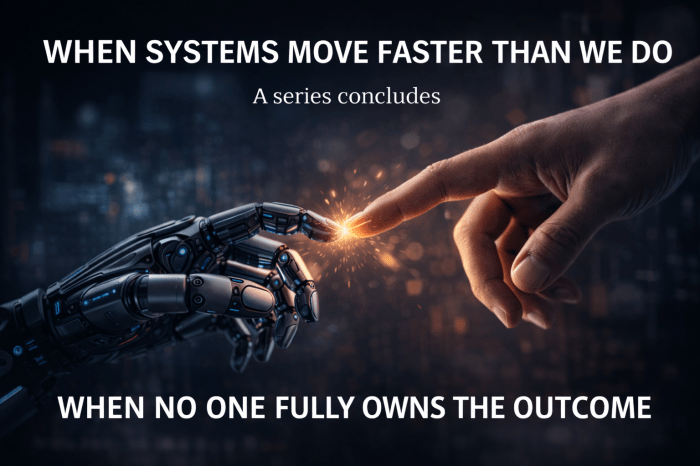
Across this series, we have followed a single pressure as it moved inward. In the first post, we examined what happens when intelligence outpaces human review and shared validation begins to thin. In the second, we saw how that acceleration moves into infrastructure, as environments stop waiting for instruction and begin acting automatically. In the third, we traced the consequences for institutions, where governance shifts from fixed rules toward continuous calibration and legitimacy begins to lag control. In the fourth, we carried that same substitution logic into the human domain, where people remain socially central while becoming operationally optional. What remains is responsibility.
Continue readingMoving One Layer Deeper – The Constraints That Drive Our Future
When I first described pressure points and catalysts, the goal was to explain why large-scale change rarely arrives without warning. History does not shift randomly. It shifts when accumulating pressures reach limits that systems can no longer absorb. That framing remains. We now move one layer deeper — from pressure as a visible signal to constraint as the underlying mechanic.
A pressure point is not simply stress in the abstract. It is a constraint that reduces flexibility. It is a limit that narrows optionality. It appears when decisions become harder to reverse, when response time shrinks, when coordination becomes more expensive, and when substitution becomes necessary rather than optional. Pressure points mark where systems are approaching or crossing limits.
Continue readingWhen Human Value Gets Rewritten
A series: When Systems Move Faster Than We Do
We are entering a moment in which human roles remain socially central while becoming operationally optional. As systems begin to think, respond, and coordinate continuously, they no longer depend on people in the ways our institutions, economies, and social norms still assume. This is the pressure that now moves into the human domain.
In earlier posts, we traced how intelligence outpaces human review, how environments begin to act automatically, and how institutions adapt by shifting from rule-based governance toward ongoing calibration. Once systems operate without waiting, the next question is not technical or institutional. It is human. What happens when participation persists, but reliance fades?
Continue readingWhen Environments Begin To Act
A series: When Systems Move Faster Than We Do
In the first post, we looked at how knowing itself begins to lose its pace once intelligence moves faster than human review and shared understanding. Knowledge no longer waits to settle before it is used. It updates continuously, propagates instantly, and increasingly bypasses collective agreement. That shift does not stay contained. Once knowing changes shape, pressure moves downstream. The next place it surfaces is in the environment.
Continue readingWhen Systems Move Faster Than We Do
When Knowing Loses Its Pace
Artificial intelligence dominates the conversation about the future. It is framed as a breakthrough, a threat, a productivity engine, or a moral challenge. What receives far less attention is a quieter but more consequential shift already underway: intelligence now moves faster than the human systems built to absorb it. This series examines what happens when that mismatch becomes structural—when discovery, inference, and action outpace review, coordination, and shared agreement. Each post traces how this pressure propagates through the system, reshaping how knowledge forms, how environments and institutions respond, and how human roles evolve. This first post begins where the effects appear earliest and most visibly: in the transformation of knowing itself.
Continue readingBeyond Human Scale: How AI Expands The Space Of Possible Futures
When AI takes knowledge beyond human scale, the number of plausible futures expands dramatically. This is not because the world becomes more random, but because more options become visible. As knowledge is continuously interpreted and synthesized across domains, new combinations, pathways, and secondary effects emerge faster than humans can naturally track. The future stops narrowing on its own.
Continue readingCrossing The Threshold
Civilization’s great shifts are the moments when continuity fails and a new order takes shape. Each historical age reached a point where the old logic could no longer hold, and pressures converged into a transformative release. By examining four major transitions – from Hunter–Gatherer to Agricultural, Agricultural to Axial, Axial to Renaissance, and Renaissance to Industrial – we can see how rising Total Systemic Domain Score (TSDS) and changing Activation Dispersion (AD) signaled that a threshold was near. Some transitions unfolded slowly over millennia, while others struck within a few centuries. In each case, the build-up of energy and imbalance hit a critical point, and society crossed into an irreversible new configuration that only in hindsight feels inevitable.
Continue readingReading The Pulse Of A Civilization In Motion
The first five posts laid the foundation for understanding why the world feels dense, fast, and tightly connected. We explored the sense that something in the operating logic of civilzation is shifting. We looked at phase transitions, the four-stage pattern that repeats across history, and the seven domains that structure civilization. The last post introduced the three deep drivers that push civilizations across thresholds: growing convergence, system-shaping technologies, and the acceleration of knowledge. Taken together, they help explain why pressure builds, why systems couple, and why some ages move differently than others.
Continue readingThe Ambient City: When Intelligence Becomes Infrastructure
Across every domain I have explored – from education and energy to health, governance, and human longevity – one pattern keeps reappearing whenever society encounters a General Purpose Technology. These are the rare breakthroughs that do not simply make us more efficient but fundamentally restructure how civilization operates. Language, writing, the printing press, the steam engine, and electricity each changed not only what we did, but who we became. Artificial intelligence may join that lineage.
Continue readingLearning in the Age of AI
I recently wrote about the evolution of learning. A recent article takes this conversation further. Here is a short summary:
Continue readingFrom Apps To Avatars: The Four Stages Shaping Banking’s AI Future
For decades, banking has been a place you go, a brand you see, and an interaction you initiate. In this current state, even though much of it is now digital, the model still revolves around channels – apps, websites, and branches – where customers show up to make things happen. AI has entered the picture in narrow, tactical ways: a fraud alert here, a chatbot there, a dashboard with basic insights. Helpful, yes – but far from transformational.
Continue readingThe Nation-State Under Pressure: Who Governs The 21st Century?
When we talk about the future of global governance, we tend to start with the world we inherited – not the one we’re building. And the world we inherited was largely shaped by an idea born in 1648, at the signing of the Peace of Westphalia: the nation-state. It was a radical organizing principle for its time – one territory, one government, one sovereignty. This model didn’t just define borders; it defined identity, allegiance, and the rules of the game for centuries.
Continue readingWhen AI Keeps Culture Alive
Last week, I shared the vignette “Cooking with Grandma’s Digital Twin”, a glimpse into a future shaped by memory preservation and AI companions. It was the first in a new series of narratives designed to humanize the complex forces shaping our future. These vignettes are part of a broader foresight approach I have called possibility chains – connected sets of plausible developments within a single theme or driver of change.
Continue readingFrom Sense And Respond To Anticipate and Influence
In my recent post, Sense and Respond: A Survival Trait for a Converging World, I explored how the ability to detect and react to change in real time has become essential to survival. As convergence accelerates the pace of disruption across industries, systems, and geographies, the ability to sense what’s happening and respond effectively is no longer optional. It has become a core operating principle for organizations navigating uncertainty. But as the landscape continues to evolve, a deeper strategic shift is emerging—one that calls us to go beyond reacting quickly and begin shaping what comes next.
Continue readingSense And Respond: A Survival Trait For A Converging World
In an era shaped by accelerating change, convergence across domains, and an ever-expanding possibility space, traditional methods of prediction and planning have become increasingly inadequate. The static nature of scenario planning—once a cornerstone of strategic foresight—fails to keep pace with the velocity and complexity of today’s world. What’s needed instead is a living, breathing approach. One that adapts, evolves, and acts in real time.
Continue readingBreaking The Cycle: How Digital Twins Can Preserve Wisdom And Rewire The Future
History doesn’t just repeat itself because we forget the facts. It repeats because we lose the wisdom of those who lived through it. When the last voices of a generation fade – those who endured war, depression, migration, or reinvention – we lose more than stories. We lose anchors. We lose quiet guidance in moments of moral fog. We lose the ability to ask: “What would you have done?”
Continue readingFrom Campfires To Code: The Systemic Shifts That Shaped Humanity
Human history has been anything but linear. While centuries can pass with relative stability, there are rare moments where everything changes—moments where converging forces across domains give rise to entirely new paradigms. These are not just periods of change. They are systemic transitions that reshape how we live, work, relate, and make sense of the world.
Continue readingThe Return Of The Polymath: Thinking Systemically In An Age Of Complexity
In times of profound change, the ability to connect dots across disciplines becomes essential. As the world faces converging forces across science, technology, society, economics, geopolitics, the environment, and philosophy, the polymath reemerges – not as a relic of the past but as a necessity for navigating the future.
Last year, I explored the polymath phenomenon and how our evolving world may be giving rise to a new kind of intelligence – polyintelligence. That post traced the lives of polymaths like da Vinci, Goethe, and others who shaped eras of discovery and disruption. If you haven’t read it, I encourage you to revisit that foundation here: Genius Across the Ages.
What we are experiencing today is not simply another technological cycle – it is a systemic shift. To make sense of that shift, we must look to history, and the eras where polymathic thinking played a central role in societal advancement.
Continue reading Reimagining the Future