
In an age of accelerating change and complexity, leadership requires more than traditional planning – it demands a mindset of rehearsal. This principle framed my recent conversation with Mimi Brooks, CEO of Logical Design Solutions, on her Bold Agendas podcast. Our discussion spanned the evolving role of ecosystems, the dual edges of innovation, and the critical importance of adaptability and resilience. Together, we unpacked strategies for thriving in an unpredictable world and explored the transformational shifts leaders must embrace to navigate 2025 and beyond.
Continue readingOur Emerging Future
All aspects of our emerging future
Beyond The Playbook: How Jayden Daniels Is Bringing Digital Twins Into The NFL Spotlight
According to an article I saw recently, Jayden Daniels, the Washington Commanders quarterback, has been integrating a VR headset developed by a German company to simulate real game scenarios. By customizing AI-driven defensive schemes, he’s able to rack up hundreds of extra mental and physical “reps” without risking injury—far beyond what’s possible in normal on-field practice. According to Daniels, he can now read NFL defenses significantly faster because the simulation lets him face defenders moving at speeds far exceeding typical game conditions. Essentially, he’s getting used to worst-case (or, at least, fastest-case) scenarios in a risk-free environment, so Sunday’s real-life speed feels manageable by comparison.
Continue readingBook Review: “Punishing Putin” By Stephanie Baker
Punishing Putin, by Stephanie Baker, published in September 2024, offers a timely and in-depth examination of the international efforts to hold Russia accountable for its invasion of Ukraine. This isn’t simply a historical recounting of sanctions and diplomatic maneuvers; Baker delves into the complexities, contradictions, and often unintended consequences of the strategies employed by Western nations and their allies.
Continue readingThe General-Purpose Technology Evolution Framework
General purpose technologies, from the steam engine to electricity, have historically followed a predictable evolutionary path. Each GPT begins at the status quo, disrupting established ways of operating. Next, it moves to point solutions, where its application enhances specific areas without fundamentally transforming broader systems. Over time, these point solutions give way to broader applications, where the technology begins to reshape processes on a larger scale. Finally, the journey culminates in system-level change, where the technology redefines the way society, industries, and systems function as a whole.
Continue readingA Vast Possibility Space
The concept of a “possibility space” in this new era of great invention represents the expanding landscape of opportunities, challenges, and uncertainties that emerge with each new breakthrough. As technological advancements accelerate, we find ourselves surrounded by an increasingly complex and dynamic array of potential futures. Innovations in artificial intelligence, biotechnology, energy, and communication have transformed what is possible, widening the range of scenarios we can imagine and pursue. This broadening of the possibility space means that, for every exciting new capability, there exists an accompanying set of risks and ethical dilemmas, creating a dual path forward that must be navigated with care.
Continue readingBridging The Global Trust Deficit: A Call For Centrist Collaboration

In today’s interconnected world, the necessity for global cooperation has never been more critical. Yet, paradoxically, we are witnessing a decline in collaborative efforts, replaced by rising competition and confrontation. A recent article via the World Economic Forum explores the growing trust deficit in international mechanisms, highlighting the challenges and opportunities of fostering centrist geopolitics. By examining historical precedents and modern examples, it offers insights into how practical, purpose-driven partnerships can restore global trust and address the compounding crises of our time.
Continue readingRevolutionary Reflections: Harnessing Historical Wisdom

As I described in my recent post, Fareed Zakaria’s recent book, “Age of Revolution,” provides an examination of the forces that shaped our modern world. From the revolutions of the past, Zakaria articulates the seismic shifts that have redefined global dynamics, influenced political landscapes, and reshaped societal structures. In a world that looks eerily like prior periods of revolution, there is much we can learn by analyzing history. However, analysis is meaningless if we do not learn from the past, and historically, we have failed to do so. It was Henry Kissinger that once said: “it is not often that nations learn from the past, even rarer that they draw the correct conclusions from it.” Analyzing periods that look like our current day is the first step, but it’s the application of these lessons to our current context that enables constructive pathways.
Continue readingThe War Below – A Look At The Future Of Our Energy Landscape
I finished reading my most recent book titled The War below. In the book, Ernest Scheyder sheds light on the often-overlooked world of rare earth metals, exposing the intense global struggle to extract the vital resources that power our modern lives. From the smartphones in our pockets to the electric cars on our roads, lithium, copper, and other critical minerals have become the backbone of our technology-driven society. But at what cost?
Continue readingThe Great Wealth Transfer: Fact Or Fiction?
In a post from 2019, I described what some were calling the greatest wealth transfer in history. I pointed to an Article that positioned the next two decades in the United States as an unprecedented shift of demographics and finances. Baby Boomers were born between 1944 and 1964, and according to that article, this generation is expected to transfer $30 trillion in wealth to younger generations over the next many years: what some have called the “great wealth transfer.”
Continue readingThe Human Paradox: Resistant Yet Resourceful In The Face Of Change
James Suzman aptly observed: “History reminds us that we are a stubborn species: one that is deeply resistant to making profound changes in our behavior and habits, even when it is clear that we need to do so. But it also reveals that when change is forced upon us, we are astonishingly versatile.”
Continue readingEducation: The Bridge To A New Era
Throughout history, education has been the bridge between eras. Whether it was learning for factory work during the first industrial revolution, or the high school enabled office work of the second, education has played a role in managing the transition. If we assume that we are in the early days of a new era driven by staggering scientific and technological invention, what does education need to do to provide that bridge?
Continue readingNext Generation Productivity
I believe the notion of a next generation of productivity is about to ramp…sharing again

In a recent post, I focused on a series of emerging shifts and the transformation pillars that enable a re-imagined future. In this post, I will dive into one of those pillars: next generation productivity. According to Wikipedia, productivity is an average measure of the efficiency of production. It can be expressed as the ratio of output to inputs used in the production process. In a recent Citi Report, they describe the significant slowing of labor productivity growth, which drives a focus on next generation gains. But In spite of technological progress and innovation, measured productivity growth is low by historical comparison. They cite these growth statistics across advanced economies.
Continue readingNavigating The Horizons Of 2024: Thoughts Across Diverse Fields
As we stand on the precipice of 2024, a year brimming with potential and uncertainty, experts across various domains will offer their insights into the shape of things to come. From scientific breakthroughs to geopolitical shifts, from societal transformations to environmental challenges, these insights paint a multifaceted portrait of the year ahead. I’ll add my thoughts to the conversation. The uncertainty that exists across these domains adds to the difficulty in understanding possible futures. It is convergence that occurs across them that illuminates the possibilities.
Continue readingThe Forces Driving Our Economic Future
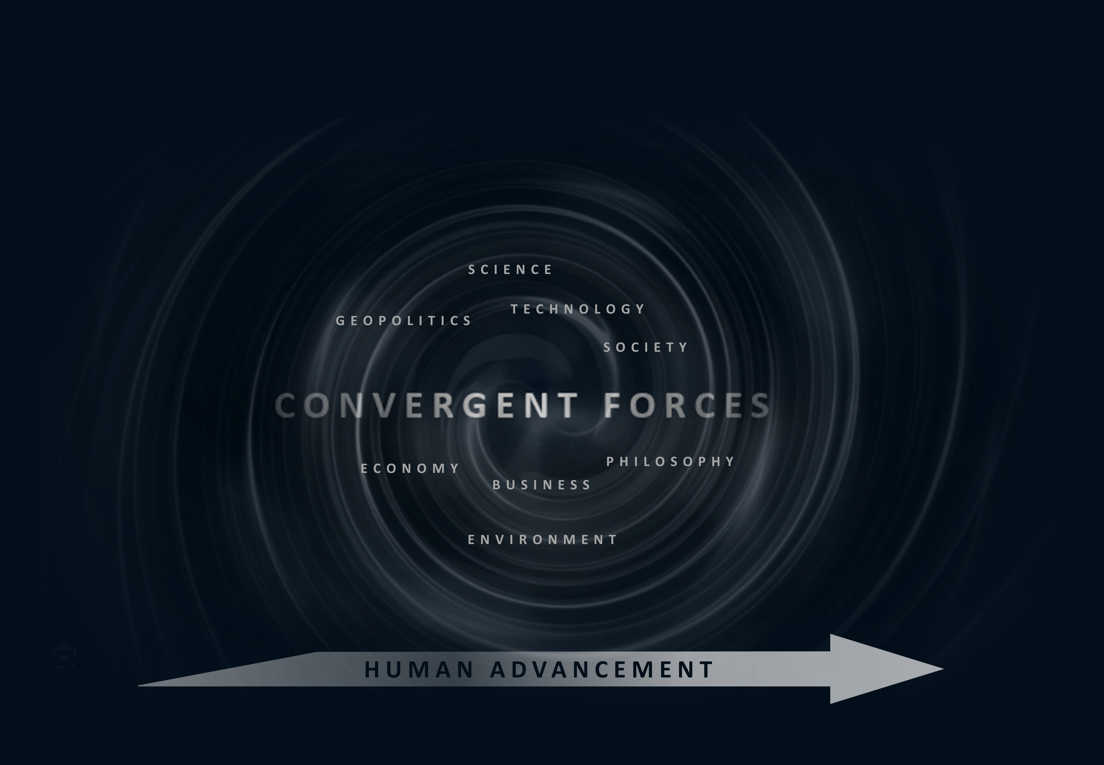
At the heart of our uncertain times lies an astounding level of convergence, with historical precedent dating back to the second industrial revolution and the decades that followed. It was Robert J. Gordon in his brilliant journey through the economic history of the western world that illuminated this convergence. In The Rise and Fall of American Growth, Gordon focused on a revolutionary century that impacted the modern standard of living more than any period before or after. It was also Gordon that concluded the world will never see a period like that again. It was his conclusion that prompted my development of a future innovation visual that sought to dispute it. While technology has driven human advancement for centuries, it has not done so in isolation. In periods like the one described by Gordon; other domains play a role in determining where technology takes us. This quote says it best:
Continue readingInnovation And Human Development
Seven years have passed since I first developed this innovation wheel. In that time, the possibility space is more visible to a larger audience. The conclusion originally drawn by Robert J. Gordon – that we have taken the standard of living as far as it will go – is still suspect to me. In light of the rapid advancements we are seeing, I am re-posting this seven years later.
In a brilliant journey through the economic history of the western world, author Robert J. Gordon looks at The Rise and Fall of American Growth. This recent book focuses on a revolutionary century that impacted the American standard of living more than any period before or after. Our standard of living is typically viewed as the ratio of total production of goods and services (real GDP) per member of the population. But this measure fails to truly capture enhancements to our well-being. Human well-being is influenced by advances in the areas of food, clothing, shelter, energy, transport, education, health, work, information, entertainment, and communications. The special century (1870 – 1970) that followed the Civil War was made possible by a unique clustering of what the author calls the great inventions. Clearly – as the visual I developed depicts – the great inventions of the second industrial revolution significantly improved our well-being:
Continue readingGlobal Economic Prospects
The prospects for the global economy are a function of convergence. While geopolitics drives economic volatility, societal shifts create uncertainty, and science and technology lead us down divergent paths. The World Economic Forum provided their thoughts in a recent article that looked at global economic prospects.
Continue readingHow Do You Feel About Our Emerging Future?
As the media obsesses over artificial intelligence with no shortage of opinions, it made me think about a post from 2016 on techno-optimism versus techno-pessimism. In that post, I defined the terms as follows:
Continue readingFuturistic Technology And The London Marathon
The Daily Mail just launched an article describing futuristic technologies and their role in improving performance and recovery. Reporter Fiona Jackson does a great job of describing various technologies and their impact. I had the pleasure of participating in the article. The article explores:
Continue readingDo Time Horizons Mean The Same As They Used To?
The timing of future scenarios is something I wrote about back in 2017. In that post, I explored the influencers of timing, namely obstacles and accelerants. These markers drive the foresight required to understand the path of possible futures and some indicator of timing. However, timing is therefore dictated by several factors with many unknowns. The pace, complexity, and uncertainty of our world makes timing extremely difficult to understand. That begs the question: should we think about timing the same way? I often hear the following: I don’t want to focus on something that is ten years out. My response is always the same: how do you know it is only ten years out?
Continue readingGlobal Foresight 2033
Alexandra Whittington is a fellow Futurist that recently participated in the Atlantic Council’s Scowcroft Center for Strategy and Security survey of the future. The survey asked leading global strategists and foresight practitioners around the world to answer burning questions about the biggest drivers of change over the next ten years. Over 160 experts participated in a survey that covered the following:
Continue reading Reimagining the Future