
An op-ed I recently published in a French publication called LA TRIBUNE explored a shift I believe is becoming essential in the age of artificial intelligence: the move from return on investment to return on learning. That article focused on a simple but important idea. As AI takes on more tasks once tied to human productivity, the value of people does not disappear. It moves. It shifts toward judgment, creativity, empathy, sense-making, and the ability to work effectively with intelligent systems. In that world, the real differentiator is no longer just efficiency. It is learning. But I want to take the idea a step further here, because this is the part that matters most to me.
Continue readingTechnology
How Possibility Chains Were Born
Today TIME published an Op-Ed I wrote titled You Can’t Predict the Future. But Can You Rehearse It?. The piece explores a simple but important idea: the future is not something we can reliably predict, but it is something we can rehearse.
The Op-Ed focuses on why prediction is becoming less useful in a world where pressures across science, technology, geopolitics, economics, society, philosophy, and the environment are arriving at the same time. But the article only briefly touches on something that has shaped my thinking over the past year: how the idea of possibility chains actually emerged. It started with a familiar problem.
Continue readingGuest Post: Surviving Speed And Complexity
Over the years, I’ve had the opportunity to work alongside leaders who think deeply about the structural forces shaping our future. Michael Wright is one of them. I had the pleasure of keynoting his Biomimetics conference in Minnesota — an event grounded in the idea that nature’s architectures still hold lessons for navigating modern complexity. That experience left me with a deep appreciation for Michael’s ability to connect technology, governance, human behavior, and leadership into a single systemic frame.
In my recent systemic change series, I explored how convergence across foundational domains — science, technology, economics, geopolitics, society, environment, and philosophy — is creating new forms of acceleration. We examined how tightening feedback loops, compressed response times, and institutional lag generate what I’ve described as coordination strain. The system is not just moving faster; it is reorganizing itself under pressure.
Continue readingWhen No One Owns The Outcome
A series: When Systems Move Faster Than We Do
Across this series, we have followed a single pressure as it moved inward. In the first post, we examined what happens when intelligence outpaces human review and shared validation begins to thin. In the second, we saw how that acceleration moves into infrastructure, as environments stop waiting for instruction and begin acting automatically. In the third, we traced the consequences for institutions, where governance shifts from fixed rules toward continuous calibration and legitimacy begins to lag control. In the fourth, we carried that same substitution logic into the human domain, where people remain socially central while becoming operationally optional. What remains is responsibility.
Continue readingMoving One Layer Deeper – The Constraints That Drive Our Future
When I first described pressure points and catalysts, the goal was to explain why large-scale change rarely arrives without warning. History does not shift randomly. It shifts when accumulating pressures reach limits that systems can no longer absorb. That framing remains. We now move one layer deeper — from pressure as a visible signal to constraint as the underlying mechanic.
A pressure point is not simply stress in the abstract. It is a constraint that reduces flexibility. It is a limit that narrows optionality. It appears when decisions become harder to reverse, when response time shrinks, when coordination becomes more expensive, and when substitution becomes necessary rather than optional. Pressure points mark where systems are approaching or crossing limits.
Continue readingWhen Human Value Gets Rewritten
A series: When Systems Move Faster Than We Do
We are entering a moment in which human roles remain socially central while becoming operationally optional. As systems begin to think, respond, and coordinate continuously, they no longer depend on people in the ways our institutions, economies, and social norms still assume. This is the pressure that now moves into the human domain.
In earlier posts, we traced how intelligence outpaces human review, how environments begin to act automatically, and how institutions adapt by shifting from rule-based governance toward ongoing calibration. Once systems operate without waiting, the next question is not technical or institutional. It is human. What happens when participation persists, but reliance fades?
Continue readingWhen Systems Move Faster Than We Do
When Knowing Loses Its Pace
Artificial intelligence dominates the conversation about the future. It is framed as a breakthrough, a threat, a productivity engine, or a moral challenge. What receives far less attention is a quieter but more consequential shift already underway: intelligence now moves faster than the human systems built to absorb it. This series examines what happens when that mismatch becomes structural—when discovery, inference, and action outpace review, coordination, and shared agreement. Each post traces how this pressure propagates through the system, reshaping how knowledge forms, how environments and institutions respond, and how human roles evolve. This first post begins where the effects appear earliest and most visibly: in the transformation of knowing itself.
Continue readingThe Compressed Present
THE BIO-INTELLIGENT SIGNATURE: A LENS ON THE CURRENT AGE
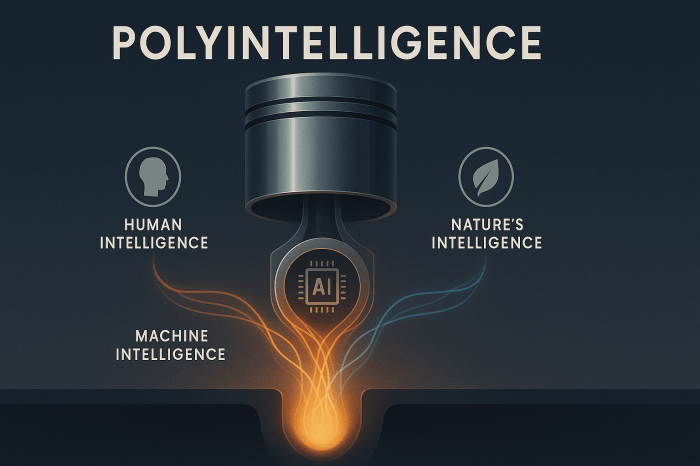
The present moment is shaped by three converging streams of intelligence: machine intelligence, biological intelligence, and planetary intelligence. These are the same sources that form what I have described elsewhere as polyintelligence — cognition distributed across humans, machines, and nature. Each stream is advancing on its own, but their deeper significance appears in how they now influence one another. Artificial intelligence extends cognition beyond the human mind. Synthetic biology brings design and computation into living systems. And the planet — long treated only as a resource base — is increasingly recognized as a source of insight. Through biomimetics, natural systems provide design principles refined through evolution: circularity instead of waste, resilience through diversity, and adaptation through constant sensing and feedback.
Continue readingCrossing The Threshold
Civilization’s great shifts are the moments when continuity fails and a new order takes shape. Each historical age reached a point where the old logic could no longer hold, and pressures converged into a transformative release. By examining four major transitions – from Hunter–Gatherer to Agricultural, Agricultural to Axial, Axial to Renaissance, and Renaissance to Industrial – we can see how rising Total Systemic Domain Score (TSDS) and changing Activation Dispersion (AD) signaled that a threshold was near. Some transitions unfolded slowly over millennia, while others struck within a few centuries. In each case, the build-up of energy and imbalance hit a critical point, and society crossed into an irreversible new configuration that only in hindsight feels inevitable.
Continue readingWhat The Gauges Reveal Across The Ages
Over the first seven posts, we explored the seven domains that shape civilization, the forces that move within them, the thresholds that mark major transitions, and the drivers that push systems toward those turning points. We also built two gauges that help make those movements visible. TSDS shows how much energy sits across the seven domains. AD shows how that energy is arranged. Together, they help us see the internal structure of an age: how active its domains were, how evenly that activity spread, and how tightly the system was coupled. With that groundwork in place, we can now use the gauges to trace the long arc of history and examine how pressure accumulated across major ages of civilization.
Continue readingHow The Gauges Were Built: Making Systemic Pressure Legible
Over the first six posts, I built the foundation needed to understand how civilizations change. I explored the seven domains that shape collective life, the forces that move within them, the thresholds that mark historical turning points, and the three drivers that push systems toward those moments. With that groundwork in place, I introduced a pair of gauges that make those movements easier to see. In this post, I describe the gauges in greater detail. TSDS reflects how much energy sits across the seven domains. AD shows how that energy is arranged. Before we apply these gauges to the long arc of history, we need to explain how they were built. Every measure rests on a set of choices. This post walks through those choices in a way that keeps the gauges intuitive while grounding them in the history they aim to describe.
Continue readingReading The Pulse Of A Civilization In Motion
The first five posts laid the foundation for understanding why the world feels dense, fast, and tightly connected. We explored the sense that something in the operating logic of civilzation is shifting. We looked at phase transitions, the four-stage pattern that repeats across history, and the seven domains that structure civilization. The last post introduced the three deep drivers that push civilizations across thresholds: growing convergence, system-shaping technologies, and the acceleration of knowledge. Taken together, they help explain why pressure builds, why systems couple, and why some ages move differently than others.
Continue readingThe Three Drivers That Push Civilizations Across Thresholds
The earlier posts introduced the sense that the world’s operating logic is beginning to shift, explored what compression feels like in daily life, and laid out the four-stage pattern that has shaped every major transition in history. Post Four explained why those transitions do not come from singular breakthroughs but from the interaction of multiple domains moving together. Before we can measure that interaction in today’s world, we need to understand the deeper forces that give convergence its power. These forces have shaped every civilizational transition across the long arc of history. They determine when pressure accumulates, how tightly systems couple, and what pushes society toward a threshold.
Why No Single Force Changes The World
RECAP FROM THE SERIES SO FAR
In the first post, I described the sense that the world’s operating logic is turning over. In the second, I explored what that feels like in daily life — the tightening, the pressure, the sense that everything is connected. The third post revealed the pattern beneath these moments: a four-stage rhythm of accumulation, compression, instability, and reordering that has shaped every major transition in history.
This post turns to a deeper question. If these shifts are so powerful, what triggers them? The answer is rarely what we expect.
Continue readingThe Ambient City: When Intelligence Becomes Infrastructure
Across every domain I have explored – from education and energy to health, governance, and human longevity – one pattern keeps reappearing whenever society encounters a General Purpose Technology. These are the rare breakthroughs that do not simply make us more efficient but fundamentally restructure how civilization operates. Language, writing, the printing press, the steam engine, and electricity each changed not only what we did, but who we became. Artificial intelligence may join that lineage.
Continue readingThe Evolution Of Learning: From Vertical To Horizontal To Ambient
For most of human history, learning was vertical. Knowledge flowed downward, generation to generation, through families and traditions. A farmer taught his child the rhythms of the land, a craftsperson trained an apprentice at the workbench, a parent passed on rituals of faith and culture. The family was the classroom, and survival depended on what could be remembered and repeated.
Continue readingFrom Apps To Avatars: The Four Stages Shaping Banking’s AI Future
For decades, banking has been a place you go, a brand you see, and an interaction you initiate. In this current state, even though much of it is now digital, the model still revolves around channels – apps, websites, and branches – where customers show up to make things happen. AI has entered the picture in narrow, tactical ways: a fraud alert here, a chatbot there, a dashboard with basic insights. Helpful, yes – but far from transformational.
Continue readingThe Nation-State Under Pressure: Who Governs The 21st Century?
When we talk about the future of global governance, we tend to start with the world we inherited – not the one we’re building. And the world we inherited was largely shaped by an idea born in 1648, at the signing of the Peace of Westphalia: the nation-state. It was a radical organizing principle for its time – one territory, one government, one sovereignty. This model didn’t just define borders; it defined identity, allegiance, and the rules of the game for centuries.
Continue readingBot Shoppers Are Coming — And They’ll Rewrite the Rules
I had a great conversation with Evan Schuman, author of a recent article on bot shoppers. As the article describes, bots are autonomous AI agents that compare, select, and buy on behalf of people – are expected to become common within 2–3 years. The piece argues most retailers aren’t ready and will need to redesign the full buying journey for machines: product data, pricing, promotion, checkout, returns, and post‑purchase support. Key challenges flagged include returns at “bot scale,” who earns loyalty points, and new fraud/liability norms (analogous to early e‑commerce’s “Zero Liability” programs).
Continue readingFrom Sense And Respond To Anticipate and Influence
In my recent post, Sense and Respond: A Survival Trait for a Converging World, I explored how the ability to detect and react to change in real time has become essential to survival. As convergence accelerates the pace of disruption across industries, systems, and geographies, the ability to sense what’s happening and respond effectively is no longer optional. It has become a core operating principle for organizations navigating uncertainty. But as the landscape continues to evolve, a deeper strategic shift is emerging—one that calls us to go beyond reacting quickly and begin shaping what comes next.
Continue reading Reimagining the Future