The Compressed Present

THE BIO-INTELLIGENT SIGNATURE: A LENS ON THE CURRENT AGE

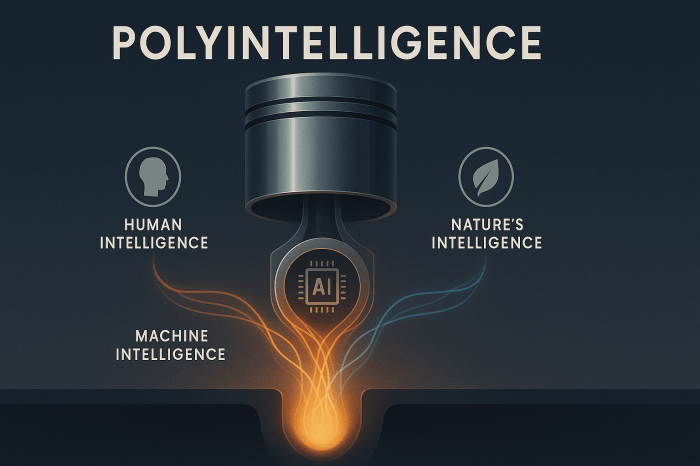
The present moment is shaped by three converging streams of intelligence: machine intelligence, biological intelligence, and planetary intelligence. These are the same sources that form what I have described elsewhere as polyintelligence — cognition distributed across humans, machines, and nature. Each stream is advancing on its own, but their deeper significance appears in how they now influence one another. Artificial intelligence extends cognition beyond the human mind. Synthetic biology brings design and computation into living systems. And the planet — long treated only as a resource base — is increasingly recognized as a source of insight. Through biomimetics, natural systems provide design principles refined through evolution: circularity instead of waste, resilience through diversity, and adaptation through constant sensing and feedback.

Continue reading

Crossing The Threshold

Civilization’s great shifts are the moments when continuity fails and a new order takes shape. Each historical age reached a point where the old logic could no longer hold, and pressures converged into a transformative release. By examining four major transitions – from Hunter–Gatherer to Agricultural, Agricultural to Axial, Axial to Renaissance, and Renaissance to Industrial – we can see how rising Total Systemic Domain Score (TSDS) and changing Activation Dispersion (AD) signaled that a threshold was near. Some transitions unfolded slowly over millennia, while others struck within a few centuries. In each case, the build-up of energy and imbalance hit a critical point, and society crossed into an irreversible new configuration that only in hindsight feels inevitable.

Continue reading

What The Gauges Reveal Across The Ages

Over the first seven posts, we explored the seven domains that shape civilization, the forces that move within them, the thresholds that mark major transitions, and the drivers that push systems toward those turning points. We also built two gauges that help make those movements visible. TSDS shows how much energy sits across the seven domains. AD shows how that energy is arranged. Together, they help us see the internal structure of an age: how active its domains were, how evenly that activity spread, and how tightly the system was coupled. With that groundwork in place, we can now use the gauges to trace the long arc of history and examine how pressure accumulated across major ages of civilization.

Continue reading

How The Gauges Were Built: Making Systemic Pressure Legible

Over the first six posts, I built the foundation needed to understand how civilizations change. I explored the seven domains that shape collective life, the forces that move within them, the thresholds that mark historical turning points, and the three drivers that push systems toward those moments. With that groundwork in place, I introduced a pair of gauges that make those movements easier to see. In this post, I describe the gauges in greater detail. TSDS reflects how much energy sits across the seven domains. AD shows how that energy is arranged. Before we apply these gauges to the long arc of history, we need to explain how they were built. Every measure rests on a set of choices. This post walks through those choices in a way that keeps the gauges intuitive while grounding them in the history they aim to describe.

Continue reading

Reading The Pulse Of A Civilization In Motion

The first five posts laid the foundation for understanding why the world feels dense, fast, and tightly connected. We explored the sense that something in the operating logic of civilzation is shifting. We looked at phase transitions, the four-stage pattern that repeats across history, and the seven domains that structure civilization. The last post introduced the three deep drivers that push civilizations across thresholds: growing convergence, system-shaping technologies, and the acceleration of knowledge. Taken together, they help explain why pressure builds, why systems couple, and why some ages move differently than others.

Continue reading

When Systems Shift: The Rare Alignment Driving Change Today

History is filled with moments of disruption and reform. But true systemic change – when the very foundations of society are redefined – has been rare. These periods of profound transition are not triggered by short-term trends. They emerge when multiple deep forces move in tandem, setting in motion the restructuring of the societal platform itself.

Continue reading

Pressure Points And Catalysts: Shaping Our World

I introduced the notion of pressure points and catalysts in an earlier post. Here are the results of my analysis.

Introduction

The trajectory of human civilization is not merely a linear progression but a complex interplay of forces that build, converge, and occasionally erupt into periods of profound transformation. Understanding these dynamics requires a framework centered on Pressure Points and Catalysts – concepts crucial to comprehending how global systems evolve and redefine themselves.

Continue reading

Building Possibility Chains: Mapping Disruption Across A Converging World

As I’ve explored in Post One and Post Two of this series, history doesn’t move in straight lines. It moves in cycles of buildup and release – of pressure and systemic change. Across time, humanity has navigated moments when systems fray, institutions falter, and norms break down. These moments are rarely surprises. They’re preceded by converging signs – warning lights blinking across domains that something foundational is under strain. We are in such a moment now.

Continue reading

When All Domains Move At Once – Understanding The Convergent Instability Of Our Time

In the first post of this series, I explored the expanding possibility space – the widening range of plausible futures shaped by more than 1,700 convergent forces unfolding across time and across domains. That post introduced the structural lens for understanding how pressure builds, how pathways emerge, and how catalysts may eventually reshape the system. This post focuses on what makes that possibility space so expansive in the first place: the simultaneous instability across seven foundational domains. Science, technology, economy, society, geopolitics, philosophy, and environment are not shifting sequentially or in isolation. They are all in motion, at the same time, and in constant interaction.

Continue reading

Meeting Today’s Grand Challenges – The Next Wave of Convergence

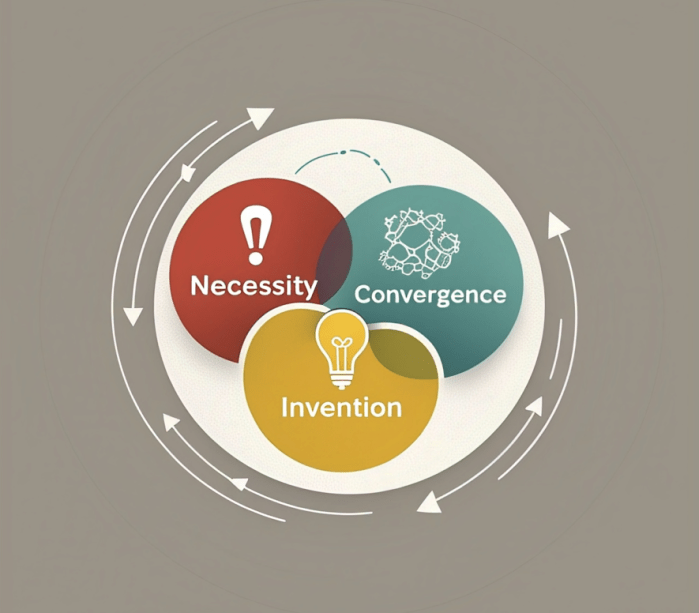
Throughout this four-part series, we’ve seen how necessity sparks invention – and together, they transform our society in profound ways. Today, our world faces an array of urgent challenges, from climate change and demographic shifts to economic and geopolitical instability, cybersecurity threats, and healthcare crises. These pressures are igniting a fresh wave of convergence, where inventive and innovative responses to pressing needs are poised to reshape our future. As we enter this transformative era, the cycle of necessity and invention reminds us that bold, purpose-driven invention and innovation is our best path forward.

Continue reading

2025 Global Risks Report

Every year, the World Economic Forum’s Global Risks Report offers a critical snapshot of the forces shaping our world. The 2025 edition paints a picture of escalating tensions, deepening fractures, and an accelerating transformation of our societal foundations. As we navigate an increasingly complex landscape, the report underscores the necessity of adaptability, resilience, and the capacity to thrive – what I call the ART of navigating uncertainty.

More than ever, this year’s report validates the idea that we are in a period of convergence – where geopolitical instability, technological disruption, societal shifts, economic volatility, environmental stress, and philosophical reorientation are colliding in ways that will redefine our future. Below, I’ve categorized the major risks identified in the report under the seven core convergence domains that I frequently discuss: science, technology, society, geopolitics, economy, environment, and philosophy.

Continue reading

Navigating The Horizons Of 2024: Thoughts Across Diverse Fields

As we stand on the precipice of 2024, a year brimming with potential and uncertainty, experts across various domains will offer their insights into the shape of things to come. From scientific breakthroughs to geopolitical shifts, from societal transformations to environmental challenges, these insights paint a multifaceted portrait of the year ahead. I’ll add my thoughts to the conversation. The uncertainty that exists across these domains adds to the difficulty in understanding possible futures. It is convergence that occurs across them that illuminates the possibilities.

Continue reading

The Precipice

I just finished another good book. Tony Orb takes us to the precipice in a new book that explores existential risk. He looks at natural risks like asteroids, comets, supervolcanic eruptions, stellar explosions, brightening of our sun, and orbital dynamics. He then explores those risks stemming from human activity (anthropogenic). These include nuclear weapons, climate change, environmental damage, pandemics, unaligned artificial intelligence, nanotechnology, biotechnology, and back contamination (from space microbes). The remainder of the book focuses on quantifying risks and safeguarding humanity. I highly recommend the book for those looking well into the future and focused on humanity. I have added the book to my library. Here is the Amazon abstract.

Continue reading

Wall Street Is Going Green

Wildfires burned nearly 10.4m acres across the US last year. The most costly thunderstorm in US history caused $7.5bn in damage across Illinois, Iowa, Nebraska and South Dakota. As the climate crisis swept the globe on a biblical scale it left in its wake a record number of billion-dollar disasters.

Dominic Rushe – Reading the writing on the wall: why Wall Street is acting on the climate crisis
Continue reading

Less Is More

An epoch is a period of time in history or a person’s life, typically one marked by notable events or particular characteristics. Although not officially approved, a working group has proposed that the world entered a new epoch called Anthropocene, or the human epoch. The starting point is still debated, as some believe it started at the beginning of the Agricultural Revolution 12,000–15,000 years ago, and others see it starting as recent as the 1960s. One proposal, based on atmospheric evidence, is to fix the start with the Industrial Revolution circa 1780, with the invention of the steam engine.

Continue reading

Materials Play A Big Role In The Next Phase Of Human Development

When looking at possible futures, one domain seems to intersect with them all. Whether we are discussing the environment, food, mobility, or energy, one common denominator is materials science. Wikipedia Defines it as an interdisciplinary field focused on the design and discovery of new materials, particularly solids. Materials science incorporates elements of physics, chemistry, and engineering. The Wikipedia page reflects on why it intersects with so much:

Many of the most pressing scientific problems humans currently face are due to the limits of available materials and how they are used. Thus, breakthroughs in materials science are likely to affect the future of technology significantly.”

Continue reading

Societal Impact of the Millennial Generation

A changing of the guard has been in motion for some time. In 2020, Millennials will be the dominant workforce on the planet. The five generations in our workforce introduce a leadership challenge, alongside disruptive forces swirling around society. Five GenerationsThe truth is that millennials are likely the generation tasked with solving this broad set of societal challenges. This recent Forbes Article says it well. The challenges likely facing this generation include: technologies like AI, shifting business models, the implications of near zero marginal cost, the resources of the planet, the nature of house ownership, transportation, healthcare, work, education and families.

Fundamental questions about Why and how we Educate will have to be addressed for the first time since the introduction of high school. Additionally, this generation will have to deal with an Aging Society. As Michael Gale – the author of the above article – describes, one in four millennials are already directly managing a parents’ ill health on a daily basis. The added burden of college debt could create additional obstacles to success.

There has been a negative stigma associated with this generation. However, they are not the problem but part of the solution. As 72% of the Global 2000 continue their digital transformation journey, millennials offer a perspective that helps realize intended outcomes. The Forbes Article describes five things that you can do to enable this –  take a look.

The Convergence of Science and Technology

In looking at transformative periods throughout history, it is apparent that Convergence was a critical driver of change. While I am still hopeful of the ultimate convergence across societal, political, environmental, philosophic, economic, and business domains, it is clear that convergence is already occurring in the science and technology domains. This synergistic relationship where advances in one domain fuels rapid advances in the other is the force behind our rapid pace. As we saw in the Poll that looked at the catalysts that drive convergence, it is this rapid pace of innovation that many believe will ultimately drive it. This initial convergence is altering long-held Beliefs and Intuitions – eventually forcing convergence across the other domains.

Continue reading

The Ready Room

I had the recent pleasure of talking with Richard Frederick about a number of topics regarding the future. Richard runs a Podcast called The Ready Room; an idea driven by his concern over the decline of civil discourse and the ideological barricades with which so many have surrounded themselves. In his words: “If only we could come out from behind our political fortresses and talk openly with one another and truly seek to open our minds to change, we could regain a shared civic trust.”

The Ready Room is Richard’s way of reaching out to others to begin this discourse. I was happy to be included in this process. You can listen to our discussion below.

Catalyst Poll Results

Updated results: April 9th, 2019. The response has been great, but I’d like to capture more voices. Please consider taking this very short Poll.


In a recent post on What to Expect in 2019, I launched three focus areas for the coming year. This focus attempts to identify the key drivers of change and the outcomes they enable. The three areas are:

  1. Convergence is one of the key dynamics I expect/hope to see more of this year. A century ago, convergence across multiple domains ushered in unprecedented advancements in human development. Multiple forces will drive a similar level of convergence in the coming decade.
  2. The pace of innovation and change is often cited as a key difference between the next revolution and prior ones. This is one of the key catalysts driving change, and I expect it to Accelerate.
  3. I believe the world will experience a burst of Possibilities enabled by these forces of convergence and acceleration

Continue reading