Visualizing Our Emerging Future – Revised

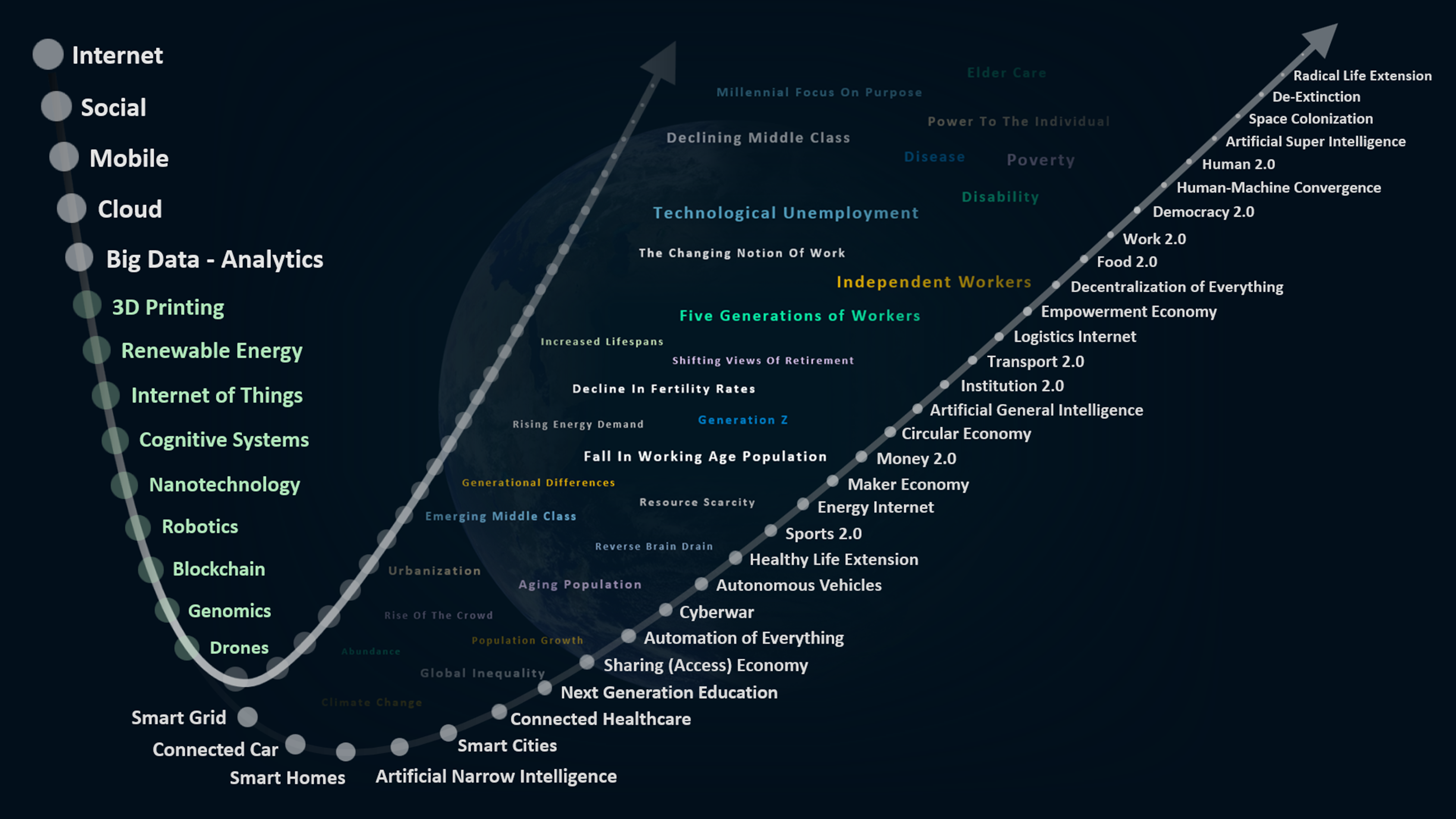
As our emerging future shifts continuously, our challenge is to shift with it. The number of building blocks that combine continues to explode, challenging our ability to track its complexity. I’ve used a visual representation of this challenge – and I see older versions floating around – so I am updating it via this post. When I use the visual in presentations, I build towards it to avoid its overwhelming nature (which I believe accurately reflects the overwhelming nature of the challenge). I will replicate the approach here by building towards the full visual.

Convergence across aspects of science, technology, economic forces, politics, society, our environment, and a growing conversation around ethics, is creating a highly uncertain world. At the heart of the pace dynamic is the exponential progression of science and technology – reflected in the first piece of the visual.

Science and Technology Curve

Continue reading

The Turbulent 2020s and what it Means for 2030 and Beyond

In a recent insights report, authors Karen Harris, Austin Kimson and Andrew Schwedel look at macroeconomic forces and their impact on labor in 2030. The Collision of Demographics, Automation and Inequality will shape the 2020s – a collision that is already in motion. By 2030, the authors see a global economy wrestling with a major transformation, dominated by an unusual level of volatility. Here’s a summary of these three forces:

AN AGING WORKFORCE

As the global workforce ages rapidly, our authors forecast a slowing of U.S. labor force growth to 0.4% per year in the 2020s, thereby bringing an end to the abundance of labor that has fueled economic growth since the 1970s. Even as longer, healthier lives allow us to work into our sixties and beyond, it is not likely to offset the negative effects of aging populations. This labor force stagnation will slow economic growth, with negative side effects including surging healthcare costs, old-age pensions and high debt levels. On the positive side, supply and demand dynamics could benefit lagging wages for mid-to-lower skilled workers in advanced economies through the simple economics of greater demand and lesser supply – but that leads to their second major force: automation.

Continue reading

Can Society Adapt to an Accelerating Pace of Change?

Updated December 15, 2017

Thanks to Parthasarathi V for his thought provoking comment on LinkedIn, and a link to a relevant article from Clay Shirky on the Collapse of Complex Business Models. His comment:

“We are having super abundance of everything – capital, talent, resources. The previously known scarce resources (e.g physical world scarcity, natural resources) are also abundant now thanks to technology. With every abundance there will be new scarcity that will be the point of friction. With every node of regulation we remove to promote innovation, new set of problems will emerge that needs to be regulated otherwise system will collapse.”

Continue reading

An Uncertain Future

I have used this Emerging Future visual to demonstrate the overwhelming number of combinations that will conspire to create our future. The science and technology foundation converges with societal, political, economic, and environmental forces to build towards a very uncertain future. A future that I believe represents the third massive tipping point in human history.

This very short animated video describes the visual.

What are your thoughts about the Future?

I had the pleasure of developing an online thought leadership course focused on our emerging future back in May of this year. I had the added pleasure of working with futurists Gerd Leonhard, Gray Scott, and Chunka Mui, along with several industry leaders. The free Thought Leadership Course is available through May of next year. The course has been invaluable to me, as it provided a platform for dialog about our emerging future. I was thrilled with the thought provoking dialog that occurred through our moderated forum. For all those that participated thank you.

During the two week course, several poll questions were positioned to help us understand how the community is feeling about critical topics like ethics, our economy, and the likely transformative period that lies ahead. Here are the questions and their responses. There is plenty of time to take the course and add your voice to the conversation.

Continue reading

The Timing of Future Scenarios

Timing. It’s one of the most difficult facets to consider when thinking about the future. We know that convergence across societal, political, economic, science and technological forces is creating many future scenarios. We also know that enablement is happening at an exponential pace. Some believe (present company included) that the coming macro-level tipping point is likely to impact humanity on a scale only experienced twice in human history (hunter-gatherer to agriculture and agriculture to industrial). There will be many micro-level tipping points on the journey towards an automated society – and the timing of those tipping points is impossible to predict.

Continue reading

Reimagining the Future: Week Two of the Online Course Launched

Week two of Reimagining the Future has just launched! Week one drew a large audience and generated great dialog. A big thank you to those who have participated so far. As discussed in the course, we must collectively take control of creating our future. Our hope is this course and related dialog are just one small step on that journey. There is still plenty of time to take the full course, you can enroll here.

Continue reading

Reimagining the Future

The future is arriving faster than most people think.

When we look around us, we see a world in which digital is now woven into the fabric of our lives. Where convergence of paradigm shifts is now the new norm and the pace of change is accelerating exponentially. We are now living in a looking-glass world; where everything we think we know is being challenged, including our long-held notions of success and failure. At the same time it’s a world where we can imagine, create and enable like never before.

Continue reading

An Interview with Futurist Thornton May

I thought it would be interesting to get a slightly different perspective on the questions that I posed to Futurist Gerd Leonhard in our recent interview. So I reached out to IT Futurist Thornton May. Thornton and I have interacted on a number of occasions at various events. His bio describes him as a futurist, educator and author. His extensive experience researching and consulting on the role and behaviors of C-level executives in creating value with information technology has won him an unquestioned place on the short list of serious thinkers on this topic. Thornton moderates the nationally recognized CIO Solutions Gallery program, intended for executives and senior leaders in the technology and operations communities.

With that background, I was excited to explore these broad topics with Thornton. His perspective follows.

Continue reading

A New Economic Paradigm?

Does the combination of emerging disruptive scenarios create a new economic paradigm? In The Zero Marginal Cost Society, Jeremy Rifkin describes a world where nearly free goods and services are enabled by the Internet of Things to drive a new paradigm that eclipses capitalism – the Collaborative Commons. It seems the exponential curve of technology is pushing the operating logic of Capitalism – which focuses on driving ever increasing levels of productivity – towards an extreme level of productivity. Its success could therefore be its undoing. I am a firm believer that this emerging period will ultimately be viewed as the most transformative of all time – but I must admit – I did not make this leap. While reading, I found myself focused on business model questions facing every industry – and through that lens, the story resonated with me. It prompted me to revise the anchor visual that I have used throughout this look at disruptive scenarios. I posed this simple question: does combinatorial innovation create a third curve?

Continue reading

Autonomous Vehicles: The Automotive Ecosystem

This post continues the disruption scenario discussion initiated by my earlier Insurance Industry Case Study. I’ve been using the autonomous vehicle (AV) as an example of a disruptive scenario with potential societal, economical, and environmental impact. In this post, the focus shifts to the scenario’s possible effect on the automotive ecosystem.

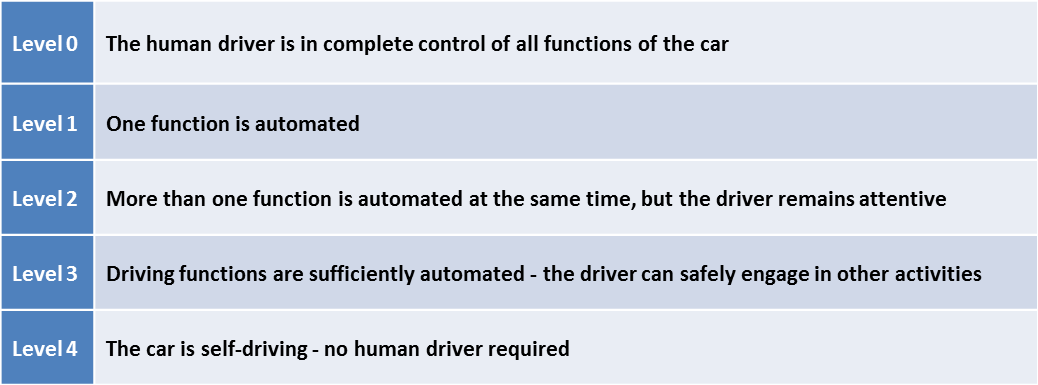
Autonomous vehicle technology can be viewed using a five-part continuum suggested by the National Highway Traffic Safety Administration (NHTSA), with different benefits realized at different levels of automation:

Driverless Car Continuum

Last month, an IHS Automotive study predicted the world will have nearly 54 million self-driving cars by 2035. The study also predicts that nearly all vehicles in use are likely to be self-driving cars or self-driving commercial vehicles sometime after 2050. Meanwhile, automakers and others are unveiling both their plans for – and introduction of – automated features: 

Continue reading

Why Focus on Disruption?

My post on the disruptive implications of the Autonomous Vehicle generated dialog that has been very insightful and provocative. Before posting additional analysis of the societal, economical, and environmental impact of emerging disruptive scenarios, I wanted to restate my reason for doing so, and share some great perspective from leaders that engaged in this recent dialog. I launched this last series to support the growing belief that: 1) we are entering what is likely the most transformative period in history, and 2) this should drive a sense of urgency for leaders everywhere. This coming period brings with it many possible disruptive scenarios, each with its own set of consequences. In my experience, leaders view these scenarios as too far off into the future to warrant their time – we’ve been conditioned to think short term. In their new book The Second Machine Age, Andrew McAfee and Erik Brynjolfsson provide their perspective on why the time to focus on the future is now. The three forces they describe (exponential, digital, and combinatorial) are perhaps the best description of the drivers behind the accelerating effect of disruption.

Continue reading

The Second Machine Age and Business Evolution

I just finished reading a new book titled The Second Machine Age written by Andrew McAfee and Erik Brynjolfsson – both from MIT. The book is a must read for leaders everywhere. Its journey offers a view into the potential societal, economic, and business impact of technological advancement in the digital age. Although I am fascinated by each of these, my interest in summarizing this book is to connect their perspective to the future of business. Consistent with my recent disruption theme, the question is: how does the world that the authors envision impact the future of business?

Continue reading