Meeting Today’s Grand Challenges – The Next Wave of Convergence

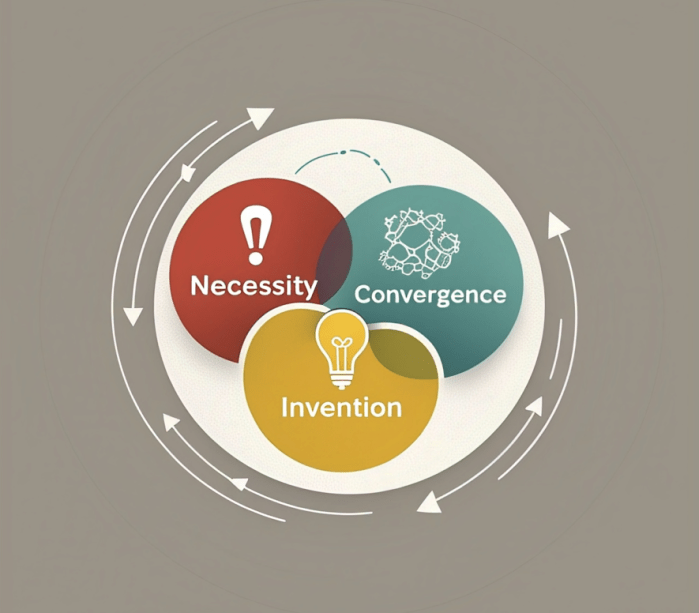
Throughout this four-part series, we’ve seen how necessity sparks invention – and together, they transform our society in profound ways. Today, our world faces an array of urgent challenges, from climate change and demographic shifts to economic and geopolitical instability, cybersecurity threats, and healthcare crises. These pressures are igniting a fresh wave of convergence, where inventive and innovative responses to pressing needs are poised to reshape our future. As we enter this transformative era, the cycle of necessity and invention reminds us that bold, purpose-driven invention and innovation is our best path forward.

Continue reading

ChatGPT Makes Chilling Predictions For 2025

This recent article describes a conversation with ChatGPT. The article highlights ChatGPT’s predictions for 2025, warning of potential global disasters if certain crises escalate. The chatbot identifies several major risks:

  1. Climate Crisis Escalation: Increased natural disasters could lead to widespread displacement, food shortages, and economic impacts.
  2. Geopolitical Tensions: Heightened conflicts, especially involving major powers, may cause global instability and humanitarian crises.
  3. Pandemic Resurgence: New or returning infectious diseases could overwhelm healthcare systems and disrupt societies.
  4. Technological Risks: Misuse of AI and cyberattacks could threaten critical infrastructure and national security.
  5. Economic Collapse: A severe global recession could emerge due to trade disputes, inflation, and unemployment.
  6. Social Unrest: Growing dissatisfaction with economic inequality and political systems could lead to protests and social fragmentation.

The chatbot stresses the importance of taking proactive measures to address these looming global challenges.

Unlocking Human Potential – The Emergence Of Scientific Revolution 2.0

In Part Two of this series, I discussed an age of invention. As we approach the third decade of the 21st century, we stand on the brink of a transformative era in human history – an era that not only rivals the original Scientific Revolution but, in many ways, surpasses it. In this third part of the series, I look at this new paradigm shift, aptly named Scientific Revolution 2.0, which is poised to reshape our world with profound and far-reaching impacts.

Continue reading

Transforming Energy With Artificial Intelligence

A recent report offers a comprehensive strategy for expediting the deployment of clean energy while mitigating risks and costs amidst the climate crisis. In a collaborative effort, 100 experts in clean energy and artificial intelligence convened at Argonne National Laboratory to devise a plan for ensuring America’s energy future. The AI for Energy report captures their collective vision.

Continue reading

Bridging The Global Trust Deficit: A Call For Centrist Collaboration

In today’s interconnected world, the necessity for global cooperation has never been more critical. Yet, paradoxically, we are witnessing a decline in collaborative efforts, replaced by rising competition and confrontation. A recent article via the World Economic Forum explores the growing trust deficit in international mechanisms, highlighting the challenges and opportunities of fostering centrist geopolitics. By examining historical precedents and modern examples, it offers insights into how practical, purpose-driven partnerships can restore global trust and address the compounding crises of our time.

Continue reading

Innovation: Boom Or Bust? Two Books Offer Divergent Views Of The Future

I finished reading another book.

Vaclav Smil’s 2023 book, Invention and Innovation: A Brief History of Hype and Failure, takes a critical look at our fascination with innovation. Smil argues that we often confuse invention, the creation of something new, with innovation, the successful implementation and adoption of that invention. My focus on this book comes right after finishing a somewhat similar book titled The Conservatist Futurist. Similar, in that the books both focus on innovation. However, they diverge on the topic of optimism versus pessimism.

Continue reading

What History Tells Us About Human Action

Historically, it takes catastrophe to drive humans to act in periods where action is clearly needed. Wars and financial crashes are dominant catalysts throughout history. This poll considers the catalysts that drive humans to act in an era demanding action. Please take a minute to respond below. Pick those catalysts that you feel strongly about – and/or add to the list.

The Catalysts of Change

Two recent books The Fourth Turning is Here and The Coming Wave have each underscored the critical need for human action. But as I described in a post on Learning from History, it takes catalysts to drive actions that ultimately shape our future. A combination of breath-taking innovation, societal forces, depression and war, represent some of the catalysts that established a post-world war II era. As we stare into an uncertain, volatile and complex future, what are the catalysts likely to force human actions? The poll below has been conducted twice, pre-and-post pandemic. However, so much has changed since then. Please help me build on this list and identify the most significant catalysts. Choose all catalysts that you feel will contribute – or add anything that I am missing. For a deeper description of catalysts, please see the lessons from history post.

Continue reading

A Global Drop In Life Expectancy

Two future scenarios that I have tracked are healthy life extension and radical life extension. To extend our heathy lives is to ensure that we not only live longer, but we do so in a healthy and productive way. The implications of healthy life extension are wide reaching. When combined with several other societal shifts, we find ourselves moving from a four-segment life cycle to a five-segment life cycle.

Continue reading

Governments Need A “Digital Twin Division”

I wrote about the expanding possibility space for digital twins earlier this month. One domain that stands to benefit from the use of digital twins is the public domain. Government use of digital twins in the coming years, if pursued, can help leaders prepare for disruptions and disasters. This article – which I authored – was just published by Government Technology Insider. Several scenarios are described, with a vision towards a specific division focused on the possibility space.

The Expanding Possibility Space For Digital Twins

I have spent the last several months focused on all aspects of digital twins. The maturing of foundational building blocks has expanded their possibility space. Industrial applications are familiar to many, but the breadth of applications are now more visible. If we view digital twins through the lens of possibilities, we can apply them to the various challenges that continue to impact society. Using some of the UN sustainability goals as a guide, and with the help of ChatGPT via a question and answer session, let’s explore the possibilities:

Continue reading

Is There A Future That Does Not Include Us?

I finished reading another book titled the Revolt Against Humanity. It explores two strands of thinking – each of which alters the human species. Anthropocene antihumanism considers the end of our species due to climate destruction, while Transhumanism believes that we will birth a new species that is superior to humans. In either scenario, it represents the end of life as we know it. A short read that shines a light on a revolt against humanity that the author claims has already spread beyond the fringes. The Amazon abstract is included below. I have added it to my library.

Continue reading

What Do Patents Tell Us About AI In 2023?

Foresight is all about signals and they come from various sources. History provides us with an incredible number of signals, with other sources including venture data, market research, academia, analysts, think tanks, and experimentation. One critical source of foresight is patents. This recent article provides an example of patent data as a source of foresight – in this case, focused on artificial intelligence (AI).

Continue reading

Purpose Plus Profit

I just finished reading my latest book titled Purpose + Profit. The book was written by Harvard professor George Serafeim. Being purpose-driven is no longer a brand or marketing gimmick, but a sea change driven by multiple forces. The book provides data to support the coexistence of both purpose and profit. In fact, it makes the case that purpose-driven companies have better outcomes. In 2017, I spoke about the need for a hybrid of purpose and profit. It is refreshing to read the many examples of how that exact scenario is playing out. Even more encouraging is the advancement in available data that allows us to measure impact – something the author calls impact weighted accounting. I recommend the book and have added it to my library. The Amazon abstract is included below.

Continue reading

Relocalization

Are there other forces lurking that could indeed lead to relocalization? Might a world where our food, energy, and products are created locally drive deglobalization? An open question with massive implications. Relocalization is a geopolitical building block – one of many that contribute to future thinking exercises.

Continue reading

Resistance To Renewable Energy Is Similar To The Early Rejection Of Coal

Without good stories to help us envision something very different from the present, we humans are easily stuck in our conventional mental programming

Per Espen Stoknes

I was reminded of the above quote when I came across this recent article about America’s early rejection of coal. With cheap wood available and houses having wood fireplaces, not many saw the wisdom of shifting to coal. As the article states, our current societal struggle with renewable energy has a long history. Coal itself faced a similar pushback in the early 19th century when the power source promised to solve many of the country’s problems.

Continue reading

Living An Extra One Hundred Years

One of the future scenarios that I have focused on for some time is healthy life extension. When I mention to an audience that the first person to live to 200 has already been born – it gets quite the reaction. That scenario is not as far-fetched as people believe. This recent article explored research in the field of senolytics – drugs that work to eliminate cells that degrade tissue function. The drugs are already showing promising results and could become available on the market within the next decade.

Continue reading

Climate Investing 2.0

According to this recent article, there is a surge in environmental, social, and corporate governance (ESG) investing, which is attracting record amounts of capital and bringing shareholder activism to the forefront. In contrast to the first wave of climate investing, this second wave will benefit from a more established ecosystem. In 2021, global venture capital funding for clean technology hit $43 billion, which was more than double the $20 billion invested in 2020. Experts believe that the trend is just getting started.

Continue reading

Norway Embarks On A Floating Highway Project

The Norwegian Public Roads Administration is determined to create the world’s first floating highway. Coastal Highway Route E39 is projected to cut the 21 hour travel time between Norwegian cities by at least half through the elimination of seven different ferry crossings. The historic roadway project will cost more than $47 billion. The video below describes this ambitious project. 

Astounding Levels Of Innovation: Energy

As we move aggressively into this period of great invention, we will increasingly marvel at astounding levels of innovation. Every domain will experience this phenomenon…and it is accelerating. The articles below make the point very clear. The most encouraging piece of these breakthroughs is growing evidence that our world of extraction is shifting ever so slightly to one of creation. Advances in materials science are critical to solving some of the worlds greatest challenges. The energy transition is underway.

Tesla aims to release $25,000 electric car in 2023, likely will not have a steering wheel

This wildly reinvented wind turbine generates five times more energy than its competitors

Experimental chlorine battery holds 6 times more charge than lithium-ion

What if walking around on your wood floors powered your home?

Hydrogen in aviation: how close is it?

Graphene innovation opens doors to low cost, sustainable, sodium-ion batteries