Superbloom – Nicholas Carr

In Superbloom, Nicholas Carr offers a piercing meditation on one of the great paradoxes of our era: the more connected we become, the more fragmented we feel. Published in early 2025, the book lands at a time when digital platforms dominate our institutions, AI shapes our attention, and trust—once the connective tissue of society—is visibly eroding.

Carr’s thesis is clear: technologies designed to bring us closer—social networks, real-time communication, algorithmic personalization—are fraying the very bonds they claim to strengthen. But his brilliance lies not only in the critique, but in the way he examines the deeper human and societal costs of hyperconnection. He speaks to a civilization immersed in stimulation, yet starved for meaning.

Continue reading

Navigating A World Of Permanent Crisis: A Review Of Robert D. Kaplan’s Waste Land

Robert D. Kaplan’s latest book, Waste Land: A World in Permanent Crisis, presents an unsettling yet necessary exploration into our current global predicament. True to Kaplan’s distinguished career, this book expertly connects historical contexts with today’s increasingly complex reality, a practice that resonates deeply with my own work on examining historical lessons to better understand our evolving future.

Continue reading

What If Everything We Know Is Holding Us Back?

In a time of unprecedented change, our society finds itself at the crossroads of transition. If we accept that we are in the Crisis phase of what historians William Strauss and Neil Howe term The Fourth Turning – a cyclical theory suggesting that societies repeatedly cycle through periods of stability and upheaval – we must confront a crucial question: Are we choosing to proactively unlearn outdated models, or will we be forced to do so reactively in the wake of crisis?

Continue reading

The Fourth Turning: A Prophetic Lens On Our Turbulent Times

UPDATED FEBRUARY 5TH 2025. The Fourth Turning and its sequel have resonated deeply with readers because they offer a framework for understanding the cyclical nature of history, particularly during times of uncertainty. The books propose that history unfolds in repeating patterns, each marked by distinct generational archetypes and societal moods. According to the authors’ model, we entered a “Crisis” period around 2008, marked by economic turmoil and a growing sense of societal unease. Now, over a decade later, many feel that we are approaching a critical juncture, the resolution of this Crisis, though the precise nature of that resolution remains unclear. This sense of approaching a culmination, combined with the current climate of rapid technological change, political polarization, and global instability, makes the framework offered by The Fourth Turning particularly compelling.

Continue reading

Brave New Words: Unleashing The Potential Of AI-Driven Education

I just finished reading my most recent book titled Brave New Words, written by renowned education innovator and entrepreneur Salman Khan. In “Brave New Words”, Salman Khan explores the transformative potential of artificial intelligence in education. With his signature clarity and vision, Khan outlines a future where AI-powered learning systems enhance human teaching, increase accessibility, and foster a more equitable education system. This book offers a roadmap for educators, policymakers, and learners to navigate the AI revolution in education and unlock the full potential of humanity. I highly recommend it and have added the book to my Library.

Continue reading

Revolutionary Reflections: Harnessing Historical Wisdom

As I described in my recent post, Fareed Zakaria’s recent book, “Age of Revolution,” provides an examination of the forces that shaped our modern world. From the revolutions of the past, Zakaria articulates the seismic shifts that have redefined global dynamics, influenced political landscapes, and reshaped societal structures. In a world that looks eerily like prior periods of revolution, there is much we can learn by analyzing history. However, analysis is meaningless if we do not learn from the past, and historically, we have failed to do so. It was Henry Kissinger that once said: “it is not often that nations learn from the past, even rarer that they draw the correct conclusions from it.” Analyzing periods that look like our current day is the first step, but it’s the application of these lessons to our current context that enables constructive pathways.

Continue reading

Age Of Revolutions

Another book hits my library. “Age of Revolutions: Progress and Backlash From 1600 to the Present” by Fareed Zakaria is a thought-provoking exploration of the upheavals, breakthroughs, backlashes, and transformations that shaped Western liberalism and industrial modernity. It’s the signals of history that illuminate possible futures – and Mr. Zakaria’s book is loaded with signals, Here are the key points:

Continue reading

Permacrisis – A Plan To Fix A Fractured World

I finished reading my most recent book titled Permacrisis, authored by Gordon Brown, Mohamad A. El-Erian, and Michael Spence. The book was recommended by Mimi Brooks, who did a review of it here. This was a very impactful book written by three of the most internationally respected and experienced thinkers of our time. As described by the Amazon abstract, the book focused on a cascade of crises: sputtering growth, surging inflation, poor policy responses, an escalating climate emergency, worsening inequality, increasing nationalism and a decline in global co-operation. While they do a great job of identifying the challenges, they also prescribe solutions. Given their experience base, we should pay very close attention to both sides of this story. I have added the book to my library and provide a brief summary below.

The world is undergoing a profound transformation marked by multifaceted economic, social, and technological shifts, altering the familiar landscape of the past three decades. This book delves into key messages regarding the challenges and opportunities presented by these changes, emphasizing the importance of understanding evolving dynamics.

Continue reading

The Fourth Turning Is Here

Update July 19, 2024: since I posted this last year, the number of visits to this post and the original post has ramped considerably, signaling a resonance with the books message. As a result, I recently posted additional thoughts on the topic here.

I first read the book The Fourth Turning in 2019. I was struck by compelling evidence that describes the cycles of history, each lasting the length of human life. The cycle is made up of four turnings, each 20-25 years in duration. First comes a High, a period of confident expansion as a new order takes root after the old has been swept away. Next comes an Awakening, a time of spiritual exploration and rebellion against the now-established order. Then comes an Unraveling, an increasingly troubled era in which individualism triumphs over crumbling institutions. Last comes a Crisis—the Fourth Turning – when society passes through a great and perilous gate in history. Together, the four turnings comprise history’s seasonal rhythm of growth, maturation, entropy, and rebirth.

Continue reading

Possible Futures Over One Hundred Years

I just finished another book titled Future Stories authored by David Christian and have added it to my book library. The book focuses on future thinking, exploring the various ways that experts, plants, animals, and even cells manage the future. This visual from the book provides a glimpse of the possible futures explored.

Continue reading

The Genesis Machine

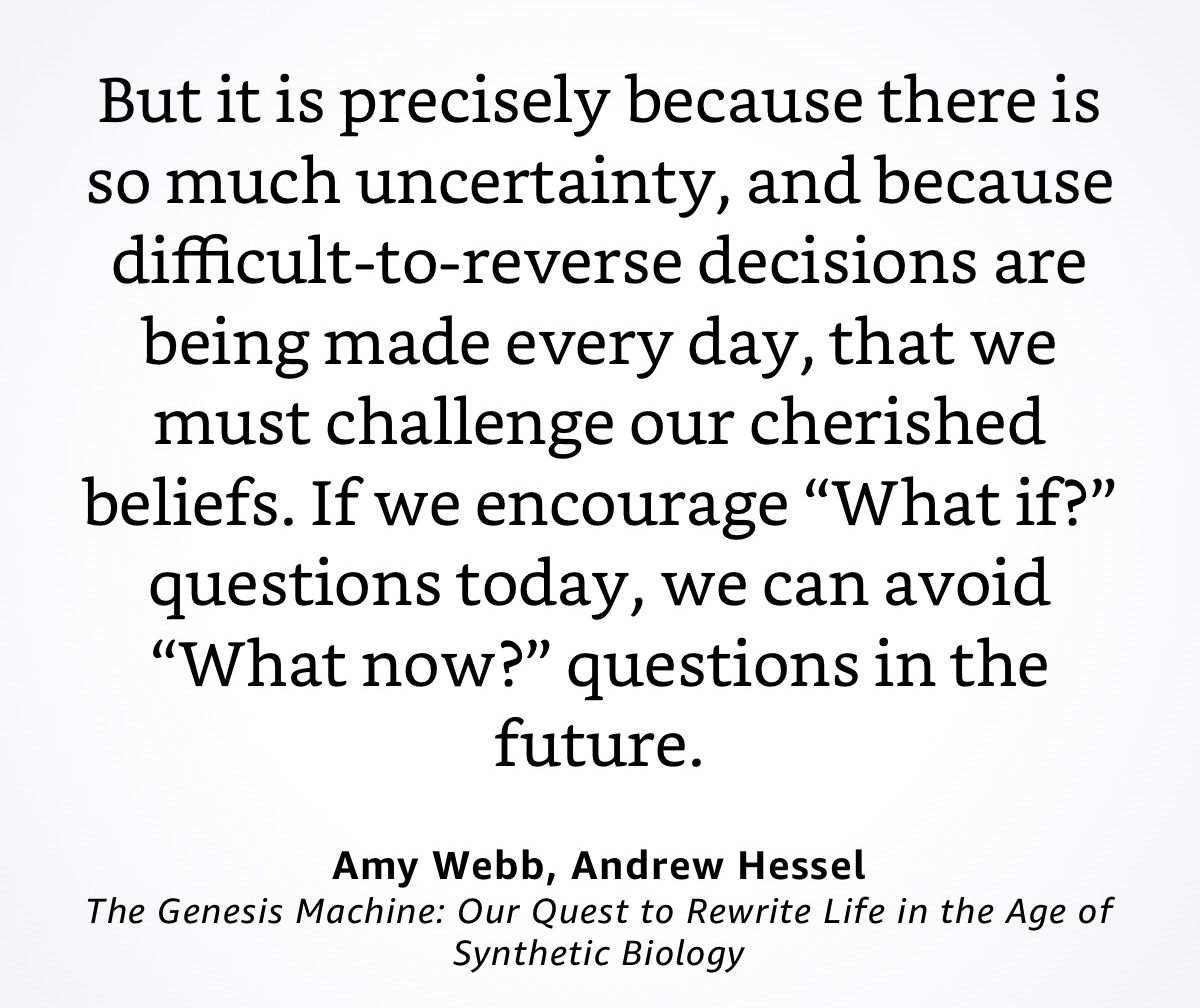
I just finished reading my latest book titled The Genesis Machine, in which authors Amy Webb and Andrew Hessel explore the world of synthetic biology. Although not as widely discussed as AI, Blockchain and others, it is perhaps the best example of why the future may look very different than the past. I have argued that the world is in the early stages of a phase transition. The content of the book represents a clear reason why.

The authors provide a riveting look into the world of synthetic biology. The book focuses initially on its origins, shifts to the here and now, and then pivots to a glimpse of the future. They provide several scenarios that help the reader envision that future, and in so doing, allow us to see both the potential for human development, as well as the possibility of several destructive paths. The book closes with a discussion on our way forward. As a world-renowned Futurist, Amy knows how to tell a story, and it is through storytelling that individuals can see the possibilities along both paths. The authors define synthetic biology as:

Continue reading

Innovation At Scale

The world is experiencing another period of great invention. We have the building blocks of the future, but to drive human advancement, the resulting innovation needs to scale. Organizations are getting better at experimenting, prototyping, and delivering minimum viable products. But scaling innovation remains a challenging endeavor. As the organizing system of our world changes, structural shifts will follow. One such shift involves the way we create and capture value, which increasingly takes the form of ecosystems. These emerging ecosystems complicate our scaling efforts.

In a recent book titled The Voltage Effect, author John A. List shares his perspective on how to make good ideas great and great ideas scale. He provides a number of examples that describe why some ideas are built to fail, while others are built to scale. Given the importance of the topic, I highly recommend the book and have added it to my library. The Amazon abstract is provided below.

Continue reading

Ecosystem Business Strategy

I recently added a book to my library titled Winning the Right Game. I then had the pleasure of talking to the book’s author, Dr. Ron Adner. He was gracious enough to sit for an interview, which you can view below. This ecosystem topic is growing in importance, but success in a growing ecosystem world is not easy. Dr. Adner provides his thoughts on what it takes to succeed. Anyone exploring ecosystem business strategies will benefit from his advice.

AI 2041: Ten Visions For Our Future

In a recent post on quantum computing, I referenced a new book (published in September 2021) that I recently added to my library. The book titled AI 2041: Ten Visions for Our Future was authored by Kai-Fu Lee  and Chen Qiufan. The authors use highly effective approach that combined fiction with expert analysis to help the reader imagine possible futures. The storytelling was brilliant (my compliments Chen Qiufan), and Kai-Fu Lee provides analysis after each story, showcasing his grasp of AI and its possible applications.

Continue reading

The Exponential Era

Much of what is driving our emerging future is the exponential pace of science and technology. When combined with the Convergence of building blocks that span multiple domains, it becomes easy to see why the world seems to be moving so quickly. In a recent book titled “The Exponential Era”, authors David Espindola and Michael Wright explore this phenomenon and present an approach for surviving in a future that is moving so fast. This story is about an overwhelming number of building blocks and the rate at which they are converging. As this happens, long-standing beliefs and institutions are rendered obsolete. I had the honor of providing a quote for the book jacket:

Continue reading

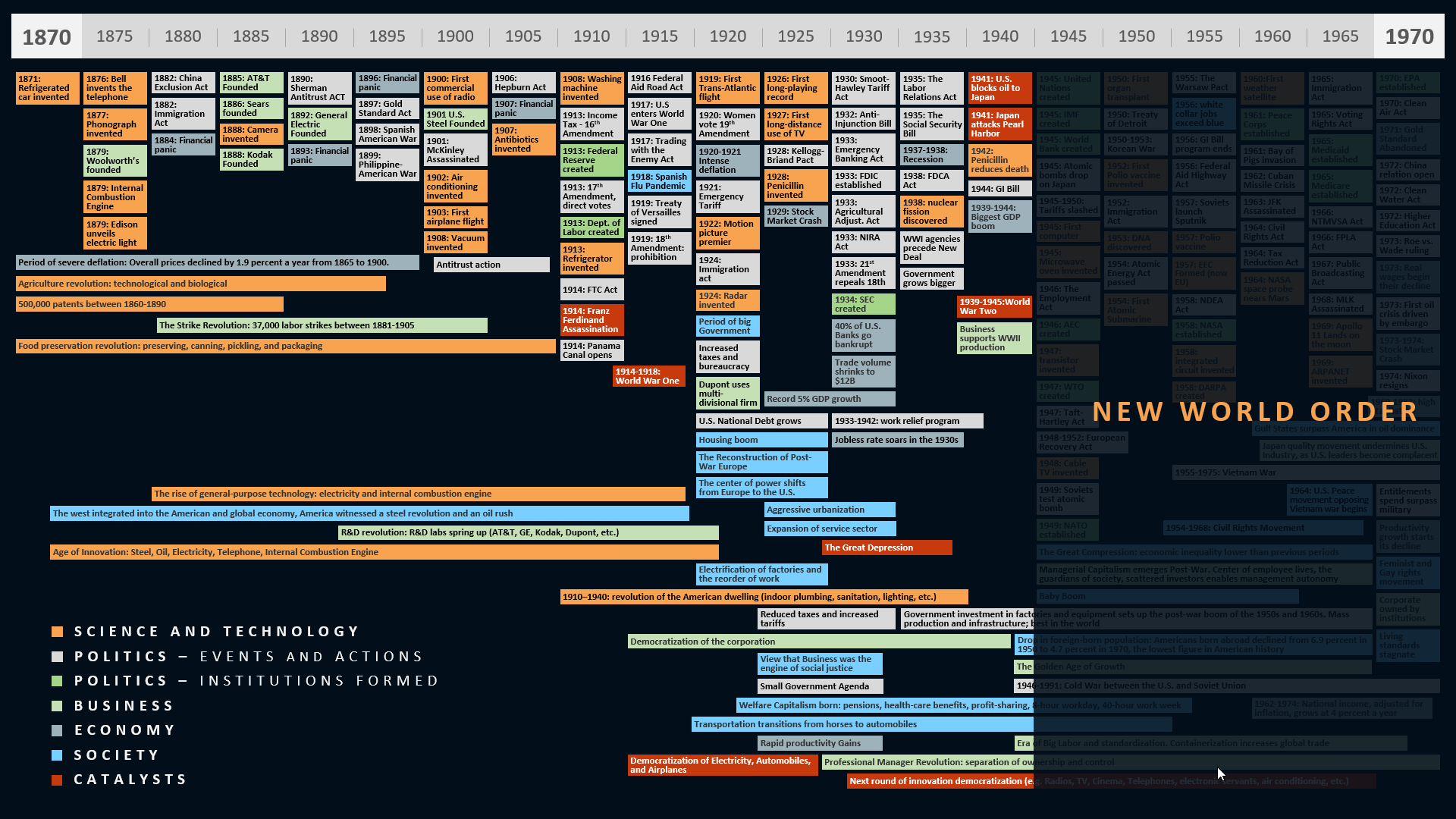
Are We Heading Towards A New World Order?

After World War Two, 730 delegates from all 44 Allied nations gathered in the U.S. at the Mount Washington Hotel in Bretton Woods, New Hampshire. The Bretton Woods Conference aimed to regulate the international monetary and financial order after the war ended. Held from July 1 to 22, 1944, agreements were signed and ratified by member governments, establishing the institutions that represented a new world order. This led to what was called the Bretton Woods system for international commercial and financial relations.

Continue reading