
In my post yesterday, I mentioned that post-pandemic perspectives are emerging for every domain. These signals help us evaluate what world emerges after the crisis. I referenced using an implication and response framework to rehearse this emerging future. In looking at future scenarios, I have found this Rehearsing to be very instructive. When I speak of rehearsing, I am talking about understanding possible futures. Rehearsing allows us to analyze the implications of scenarios and their potential paths. The figure below demonstrates an exercise focused on assessing the implications of the autonomous vehicle scenario. Rehearsing allows us to look at the breadth and depth of a scenario – and in most cases, the implications are broader and deeper than we realize.
Possible Futures Emerging Across Multiple Domains
It has been my desire to tell stories; to paint pictures of possible futures. Any story-teller would marvel at the amount of possible futures evolving from the current crisis. I have been a fan of the book the Fourth Turning because of the compelling journey through history that the book takes you on. Stories of crisis that emerged every 80 to 100 years like clockwork; and the reshaping of the social order that followed. It has been a little over 80 years since the last world altering crisis emerged. World War Two qualifies as an event that reshaped the social order when it was done.
More Thought Leaders Weigh In On A Post Pandemic Future
As I’ve said in an earlier post, predicting life after pandemics has been a fools errand. Futurist Amy Webb described it this way: “Any time a new change is foisted upon us, very quickly there is a bias to thinking that the new present is the future. That is almost universally never the case.” Many Futurists and other thought leaders are providing their thoughts on what this post-pandemic world might look like. In an article focused on The Unexpected Consequences of the Pandemic, author Bryan Walsh says that we know COVID-19 will fundamentally alter the world, but those changes may not be the ones you expect.
COVID-19: Both Accelerant And Obstacle
As we peer into the Looking Glass, we know that uncertainty is staring back. Our exponential world and all its building blocks and scenarios has created this looking glass phenomenon – something I explored in this Leadership Course back in 2017. COVID-19 underscores this uncertainty, serving as both an accelerant and an obstacle. A good example is explored in this Article on automation. 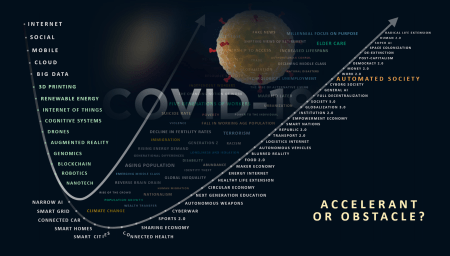 Will the pandemic serve as an automation accelerant, as businesses replace laid off employees via automation? Or is it an obstacle to the capital investment required to enable automation?
Futurist Gerd Leonhard Looks Back From The Near Future
In a recent Post Gerd Leonhard explores the great transformation catalyzed by COVID-19. He uses this quote from Milton Friedman to focus on the need to think differently.
“Only a crisis – actual or perceived – produces real change. When that crisis occurs, the actions that are taken depend on the ideas that are lying around. That, I believe, is our basic function: to develop alternatives to existing policies, to keep them alive and available until the politically impossible becomes the politically inevitable”
Assessing A Post Pandemic Future: A Video
What might a post-pandemic society look like? In a Recent Post, I attempted to address that question by taking a journey backward to a similar time; exactly a century ago. What does a backward journey have to do with a post-pandemic society? The answer lies in a famous quote:
“The further backward you look, the further forward you can see” Winston Churchill
My colleagues (Kevin Mulcahy, Rose Rodriguez, and April Harris) created a video that captures the Blog Content: A journey to the past, and then a look ahead. You can find other videos that focus on a reimagined future on this YouTube Channel.
Coronavirus: Permanent Change? 34 Big Thinkers Explore the Possibilities
While the immediate focus of our global health crisis remains on the present, as we approach the other side, many will focus on a post-pandemic future. Painting pictures of possible futures was already critical in this time of rapid change; the pandemic elevates the urgency. I have been sharing the perspectives of many global thinkers in the interest of providing foresight to those who will need it when the focus shifts. A virtual session focused on a post-pandemic society is being planned, and I will likely participate. In discussing that possibility, I was presented with this Article.
Discussing A Post-Pandemic Society on Salem Radio Network
I was honored to appear on a segment of the Don Proft radio show earlier this morning. The show is a part of the Salem Radio Network. The topic was what America will look like post-pandemic. My piece of the segment begins around the 5:25 mark. As always, all views expressed are my own.
The COVID-19 Economic Impact On China and a Glimpse Of The Future
COVID-19 has had a dramatic impact on China’s economy. Jenna Ross at Visual Capitalist describes how the effects on their economy could foreshadow what the rest of the world can expect. While China turns the corner on the health side of the story, the economic side is telling its story. This Article via the World Economic Forum uses visualization to tell this economic story. Countries in the early stages of the outbreak should take notice. Continue reading
Anatomy Of An Outbreak
The Advisory Board Company released some great information about the current pandemic. This Webinar provides a great deal of statistics and content in the area of strategies and impact. The content from the webinar is also available via PDF. They address the top questions Here on their website. In a Must Read section, they provide additional information.
This is some of the most comprehensive content I have found to date on COVID-19. I highly recommend it.
COVID-19 Monday Morning News
The COVID-19 crisis is fast-moving with information bombarding us in real-time. On this Monday morning, as we awake to more isolation and rising numbers, there is much to consider. In this Article, the author focuses on three economic scenarios: Easter: an optimistic scenario (25% likely) where isolation leads to a slow return to normal by late April; Summer: the main scenario (55%) where improvements begin in mid-summer; and Winter: the pessimistic scenario (20%) where impact lasts into the winter. Given the expansion of isolation through April in the U.S., the optimistic scenario is all but eliminated from consideration.
Discussion On The Mid-Pandemic Impact on Supply Chains
TCS Colleague Kevin Benedict recently interviewed expert Joe Carson, CEO of Spend Strategies LLC, (former Chief Procurement Officer of both Micron Technologies and Lucent) to further explore how the pandemic is impacting global supply chains and risk management strategies today and in the future. The interview can be found Here. I wanted to make my Blog audience aware of this insightful conversation. They explore the following questions:
Post COVID-19 Economic Recovery Scenarios
This Analysis by the Conference Board underscores how the trajectory of COVID-19 and the economic response over the next few months are uncertain. They developed three scenarios for the course of the US economy for the remainder of 2020. Focusing on future scenarios was already a critical imperative given the pace of change; the current pandemic just underscores the point. The analysis authors from the Conference Board are: Bart van Ark, Executive Vice President & Chief Economist, and Erik Lundh, Senior Economist. Here is an executive summary from the report:
The Emerging Future of Education
I had the pleasure of discussing the future of education recently with Nick Burnett, Co-Founder of LearnTech Lab. Their mission is focused on a topic that I find critical to the future of society. From their website:
OUR MISSION IS TO CONNECT THE IDEAS, PEOPLE AND BUSINESSES WITH THE SCHOOLS WHO ARE REIMAGINING THE FUTURE OF EDUCATION.
They describe the challenge this way: education is entering a period of exponential change where there is a great need for learners, teachers and leaders to learn, unlearn and relearn faster than ever before. Traditional approaches to learning and teaching are no longer sufficient in the new era. Technology and Learning combined stand to have the boldest impact on deepening and accelerating learning, teaching and leading in schools. We invite you to come and join us on the journey.
Here is a video of our discussion.
Is The Canary Dead?
In 2018 I shared a video that I use in presentations titled The Great Reset. The video features economist Tyler Cowen as he describes our current trajectory and the possibility of a great reset. He has talked about strong indicators that this great reset is already underway – and that was before the world began to envision A Post Pandemic Society. Mr. Cowen thinks about these indicators as canaries in the coal mine. As he describes it, miners used to take canaries with them to provide an alarm when levels of toxic gases were too high. The birds were much more susceptible to the gases and would show signs of distress – or even die – before the miners were in grave danger.
How Will COVID-19 Impact Globalization?
UPDATED 3:00 March 19th: one of my Blog readers pointed me to this article titled Whatever the virus kills, it won’t be globalism. Since I am a big believer that Predictions are a fools errand, this walk through the bold post-pandemic predictions of our past is instructive. This point of view says that sounding the alarm on the death of globalization may be a bit premature.
There are many questions that require answers as we look towards a new normal post the current pandemic. One such question centers on supply chains and the globalization phenomenon of the past three decades. Multiple forces were already threatening the globalist agenda. From the rise of populism and associated tariff wars, to the advancement of automation and other innovations, the move towards localization seems inevitable.
The Corona Virus Serves As A Catalyst For Change
I’ve talked about the Catalysts of a different era. These horrific events of our past were catalysts towards a better future. This horrific event – the Corona Virus – will shine a light on education, health, work, and other aspects of our well-being, while exposing underlying weaknesses. Responding as a global community to these types of events is hard. I’ve asked the question about the catalysts of our future in a recent Poll – please participate and add your thoughts.
The Future Today Institute – 2020 Tech Trends Report
 Last year I was introduced to the Future Today Institute Tech Trends Report. The free report provided a great view into 315 different trends. The 2020 Version was just released, tracking 406 strategic technology trends. As their website describes, a broad view of these trends is the best way to see around corners and spot emerging disruption. Amy Webb and her team provide one of the best reports of its kind. The link above provides access and the download page provides the following additional highlights:
The Digital-First Enterprise
This week I attended the Annual Directions Conference held by research firm IDC. Because of the coronavirus, the conference was held online. Here are some of the key messages – a deeper analysis is provided by Michael J. Miller, chief information officer at Ziff Brothers Investments and can be found Here.
Family Life In 2025
The Fast Future team continues to provide foresight in various areas. In this recent Article they explore what family life may look like in 2025. The possible future they describe is built on a foundation of multi-sensory immersive experiences, while distance is eliminated. We will no longer miss family celebrations and story-telling rises to new levels. Imagine a grandparent telling stories from their past, brought to life in ways that stimulate our emotional sensations.
 Reimagining the Future