A Post Pandemic Society

Updated December 16, 2025: Five Years Later

I am resurfacing this post because it captures a moment when convergence became impossible to ignore. Long before the pandemic, my work focused on how multiple domains — science, technology, society, economics, geopolitics, philosophy, and environment — were beginning to move together, creating conditions where change felt faster, more uneven, and harder to predict. COVID-19 did not initiate that convergence, but it revealed it in compressed form. The systemic change series builds on this longer arc of thinking, extending beyond the pandemic to examine how these forces continue to interact and reinforce one another today. This post remains relevant not as a historical artifact, but as an early, real-time glimpse into dynamics that are still unfolding.

Continue reading
When Systems Turn Over

This post marks the beginning of a new series on systemic change — an exploration of how civilizations transform at the deepest level. Over the coming weeks, we’ll trace the rhythm of history, examine the forces that drive reordering, and explore why this moment may be the first time in history when every domain of human life is active at once. Each post will build on the last, revealing how science, technology, society, geopolitics, economics, philosophy, and the environment are converging toward a new operating logic for civilization.

Continue reading

The Evolution Of Political Order — And What Might Come Next

Every society invents new ways to organize power. Each system begins as an answer to the limits of the one before it – and eventually becomes the next problem to solve. As our world grows more interconnected, the frameworks that once defined legitimacy and belonging are starting to crack. Something new is forming in the spaces between.

Continue reading

Book Review: How Countries Go Broke: The Big Cycle By Ray Dalio

Ray Dalio has long been a student of cycles – economic, financial, and societal. His latest book, How Countries Go Broke: The Big Cycle, is a sweeping examination of how nations rise, peak, and decline, often repeating the same mistakes across history. For anyone trying to make sense of today’s turbulent geopolitical and economic environment, Dalio’s work is both a warning and a guide.

Continue reading

The Nation-State Under Pressure: Who Governs The 21st Century?

When we talk about the future of global governance, we tend to start with the world we inherited – not the one we’re building. And the world we inherited was largely shaped by an idea born in 1648, at the signing of the Peace of Westphalia: the nation-state. It was a radical organizing principle for its time – one territory, one government, one sovereignty. This model didn’t just define borders; it defined identity, allegiance, and the rules of the game for centuries.

Continue reading

Introducing the Next Phase: Pressure Points, Catalysts, and the Forces That Shape Them

History doesn’t move in straight lines. It moves in cycles of buildup and release – of pressure and transformation. Across time, humanity has navigated moments when systems fray, institutions falter, and norms break down. These moments are rarely surprises. They are preceded by converging signs – warning lights blinking across domains that something foundational is under strain.

Continue reading

Rehearsing The Future: Beyond The Fourth Industrial Revolution

As we stand at the threshold of another profound technological shift, many refer to this moment as the “Fourth Industrial Revolution.” Historically, we’ve used the term “industrial” to describe revolutions centered primarily on advances in production, efficiency, and the scaling of physical labor – whether through steam-powered machines, electrical infrastructure, or digital automation. Each industrial revolution significantly reshaped how we lived and worked but always remained anchored in improving productivity and mechanization.

Continue reading

The Fastest Tech Transition In History: How Businesses And Governments Can Lead Or Lag

Historically, the diffusion of transformative technologies has been constrained by institutional inertia, workforce adaptation, and the challenge of transferring tacit, hands-on expertise. As a result, decades often separated invention from widespread adoption. Today, however, powerful General Purpose Technologies – artificial intelligence, quantum computing, and synthetic biology – may defy that pattern, diffusing faster than ever. What makes this era different, and how should businesses and governments respond?

Continue reading

Reimagining Learning In The Age Of Intelligence

In the late 19th century, industrialization compelled the world to reconsider the relevance of its educational systems. Traditional classical education – rooted in Latin, philosophy, and abstract theory – proved inadequate for the practical demands of a rapidly industrializing society. In response, new institutions emerged, including Worcester Polytechnic Institute, Stevens Institute of Technology, and the land-grant colleges established through the Morrill Acts. These institutions championed a radical notion for their time: education should be practice-oriented, embedded in real-world contexts, and designed to prepare individuals not for abstract contemplation, but for active participation in an evolving industrial economy.

Continue reading

A Different Kind Of Disruption: Skills, Invention, And The Future Of Work

As the world enters what may be the most transformative period since the dawn of industrialization, comparisons to past eras of great invention are both understandable and necessary. The steam engine, electrification, and mass production systems redefined economies, reshaped societies, and triggered massive employment shifts. Today, artificial intelligence, quantum computing, and synthetic biology are poised to do the same. Yet beneath the surface of these historical parallels lies a crucial divergence – one that could reshape not just work, but the social fabric itself.

Continue reading

The Fork In The Road: Navigating The Future

Throughout history, progress has been shaped by pivotal choices – moments where society stands at a fork in the road, with two distinct paths ahead. One path leads toward advancement, where invention, innovation, and human action address humanity’s most pressing challenges. The other veers toward fragmentation, where barriers to progress emerge, often in the form of resistance, skepticism, or unintended consequences of new technologies.

Continue reading

When General-Purpose Technologies Intersect With Necessity, Invention, And Convergence

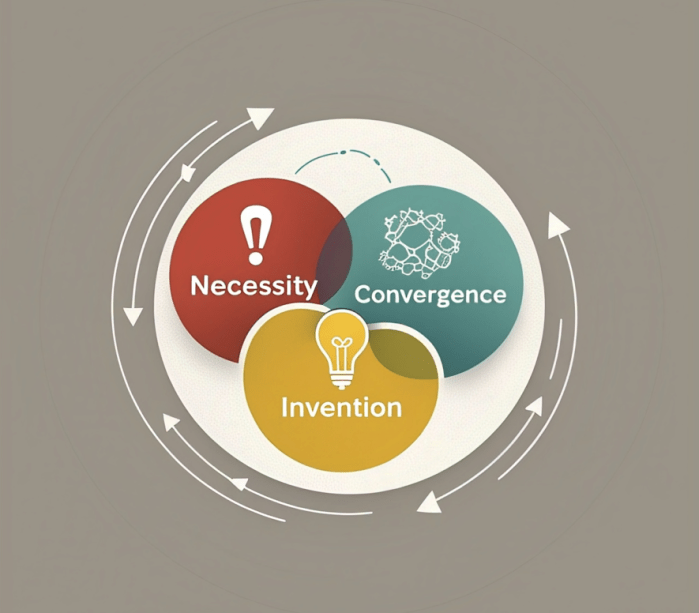
History teaches us that transformative technologies do not emerge in isolation, nor do they reshape the world overnight. Instead, they follow a discernible pattern – an evolutionary journey that unfolds in response to human needs. Two phenomena help us understand this journey: the Evolutionary Phases of General-Purpose Technologies (GPTs) and the role of necessity, invention, and convergence (NIC). When viewed together, they provide a powerful lens for understanding not just how technologies evolve, but why they emerge and when they reach their full potential.

Continue reading

The Fragile Future: A Deeper Look At 2035

Yesterday, I launched a post titled The Fragile Future, exploring the uncertainty that lies ahead and the forces shaping our world. Today, I came across an article from the Atlantic Council titled Global Foresight 2025, which presents a range of possible futures through a survey of strategists and foresight practitioners. Their findings paint a stark picture of what 2035 might hold—a world teetering between worsening geopolitical conflict and cautious optimism about technology’s role in shaping our collective destiny.

Continue reading

The Fragile Future: Why Stability Is More Uncertain Than Ever

History does not repeat, but it often rhymes. As I read Robert D. Kaplan’s Waste Land: A World in Permanent Crisis, I was struck by his argument that the 20th and early 21st centuries have been especially bloody because the stabilizing force of monarchy has vanished. He suggests that despite our moral progress in areas like human rights and the environment, the world remains tightly wound, vulnerable to clashing interests and aggressive authoritarian states. He draws an analogy to Weimar Germany – a moment of fragile democracy, economic strain, and rising nationalism that ultimately collapsed into war.

Continue reading

The Eurasian Century – Navigating Global Convergence

I recently finished reading The Eurasian Century: Hot Wars, Cold Wars, and the Making of the Modern World by Hal Brands, a sweeping historical analysis that illuminates Eurasia’s enduring centrality in global geopolitics. The author convincingly demonstrates how Eurasia’s vast resources, immense population, and strategic location have continuously positioned it as the crucible of global power struggles – from the ideological confrontations of the twentieth century to today’s emerging geopolitical tensions. His narrative offers profound lessons for leaders navigating an increasingly interconnected and uncertain global landscape.

Continue reading

Meeting Today’s Grand Challenges – The Next Wave of Convergence

Throughout this four-part series, we’ve seen how necessity sparks invention – and together, they transform our society in profound ways. Today, our world faces an array of urgent challenges, from climate change and demographic shifts to economic and geopolitical instability, cybersecurity threats, and healthcare crises. These pressures are igniting a fresh wave of convergence, where inventive and innovative responses to pressing needs are poised to reshape our future. As we enter this transformative era, the cycle of necessity and invention reminds us that bold, purpose-driven invention and innovation is our best path forward.

Continue reading

The Converging Forces Of Progress: Necessity, Invention, And Systemic Outcomes

What if the very inventions that propel humanity forward also sow the seeds of our greatest challenges? History shows that progress is rarely a straight line. Instead, it moves in cycles: necessity sparks invention, and inventions converge to reshape society. From the steam engine’s role in the Industrial Revolution to the internet’s impact on globalization, each wave of transformation has brought profound change – economic shifts, new social structures, and unintended consequences. These disruptions, from rising inequalities to environmental crises, often take decades to address. As we stand on the brink of the next great convergence – whether in AI, biotechnology, humanoid robots, cyber, climate or health – we must ask – how can we harness innovation to create a more equitable and sustainable future?

Continue reading

The Necessity-Invention-Convergence Framework

The Necessity-Invention-Convergence Framework provides a structured way to analyze the forces that drive human progress. At its core, necessity serves as the fundamental driver of change, arising from pressing challenges, constraints, or demands. Whether economic, social, environmental, or geopolitical, necessity compels action and forces innovation. Throughout history, this dynamic has played out in transformative ways. The Industrial Revolution was fueled by labor shortages and an increasing demand for goods, just as the Digital Revolution emerged in response to the need for faster, decentralized communication. Today, the global energy transition is being shaped by the necessity of addressing climate change and resource limitations.

Continue reading

The Great Convergence: When Necessity Meets Invention and Innovation

History has shown that when necessity, invention and innovation converge, the result is transformative change. From the steam engine to artificial intelligence, periods of economic, societal, and technological strain have consistently pushed invention innovation to new heights. These inflection points – where high-pressure needs meet breakthrough ideas – can drive unprecedented leaps in productivity, reshaping industries, economies, and even entire civilizations.

Continue reading

2025 Global Risks Report

Every year, the World Economic Forum’s Global Risks Report offers a critical snapshot of the forces shaping our world. The 2025 edition paints a picture of escalating tensions, deepening fractures, and an accelerating transformation of our societal foundations. As we navigate an increasingly complex landscape, the report underscores the necessity of adaptability, resilience, and the capacity to thrive – what I call the ART of navigating uncertainty.

More than ever, this year’s report validates the idea that we are in a period of convergence – where geopolitical instability, technological disruption, societal shifts, economic volatility, environmental stress, and philosophical reorientation are colliding in ways that will redefine our future. Below, I’ve categorized the major risks identified in the report under the seven core convergence domains that I frequently discuss: science, technology, society, geopolitics, economy, environment, and philosophy.

Continue reading