Robert D. Kaplan’s latest book, Waste Land: A World in Permanent Crisis, presents an unsettling yet necessary exploration into our current global predicament. True to Kaplan’s distinguished career, this book expertly connects historical contexts with today’s increasingly complex reality, a practice that resonates deeply with my own work on examining historical lessons to better understand our evolving future.
Continue readingHistory
When General-Purpose Technologies Intersect With Necessity, Invention, And Convergence
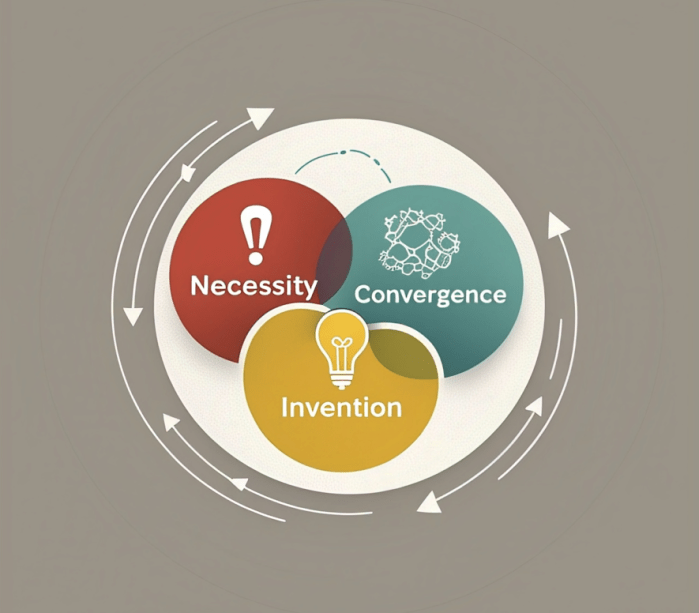
History teaches us that transformative technologies do not emerge in isolation, nor do they reshape the world overnight. Instead, they follow a discernible pattern – an evolutionary journey that unfolds in response to human needs. Two phenomena help us understand this journey: the Evolutionary Phases of General-Purpose Technologies (GPTs) and the role of necessity, invention, and convergence (NIC). When viewed together, they provide a powerful lens for understanding not just how technologies evolve, but why they emerge and when they reach their full potential.
Continue readingThe Fragile Future: Why Stability Is More Uncertain Than Ever
History does not repeat, but it often rhymes. As I read Robert D. Kaplan’s Waste Land: A World in Permanent Crisis, I was struck by his argument that the 20th and early 21st centuries have been especially bloody because the stabilizing force of monarchy has vanished. He suggests that despite our moral progress in areas like human rights and the environment, the world remains tightly wound, vulnerable to clashing interests and aggressive authoritarian states. He draws an analogy to Weimar Germany – a moment of fragile democracy, economic strain, and rising nationalism that ultimately collapsed into war.
Continue readingThe Eurasian Century – Navigating Global Convergence
I recently finished reading The Eurasian Century: Hot Wars, Cold Wars, and the Making of the Modern World by Hal Brands, a sweeping historical analysis that illuminates Eurasia’s enduring centrality in global geopolitics. The author convincingly demonstrates how Eurasia’s vast resources, immense population, and strategic location have continuously positioned it as the crucible of global power struggles – from the ideological confrontations of the twentieth century to today’s emerging geopolitical tensions. His narrative offers profound lessons for leaders navigating an increasingly interconnected and uncertain global landscape.
Continue readingMeeting Today’s Grand Challenges – The Next Wave of Convergence

Throughout this four-part series, we’ve seen how necessity sparks invention – and together, they transform our society in profound ways. Today, our world faces an array of urgent challenges, from climate change and demographic shifts to economic and geopolitical instability, cybersecurity threats, and healthcare crises. These pressures are igniting a fresh wave of convergence, where inventive and innovative responses to pressing needs are poised to reshape our future. As we enter this transformative era, the cycle of necessity and invention reminds us that bold, purpose-driven invention and innovation is our best path forward.
Continue readingThe Converging Forces Of Progress: Necessity, Invention, And Systemic Outcomes

What if the very inventions that propel humanity forward also sow the seeds of our greatest challenges? History shows that progress is rarely a straight line. Instead, it moves in cycles: necessity sparks invention, and inventions converge to reshape society. From the steam engine’s role in the Industrial Revolution to the internet’s impact on globalization, each wave of transformation has brought profound change – economic shifts, new social structures, and unintended consequences. These disruptions, from rising inequalities to environmental crises, often take decades to address. As we stand on the brink of the next great convergence – whether in AI, biotechnology, humanoid robots, cyber, climate or health – we must ask – how can we harness innovation to create a more equitable and sustainable future?
Continue readingThe Necessity-Invention-Convergence Framework
The Necessity-Invention-Convergence Framework provides a structured way to analyze the forces that drive human progress. At its core, necessity serves as the fundamental driver of change, arising from pressing challenges, constraints, or demands. Whether economic, social, environmental, or geopolitical, necessity compels action and forces innovation. Throughout history, this dynamic has played out in transformative ways. The Industrial Revolution was fueled by labor shortages and an increasing demand for goods, just as the Digital Revolution emerged in response to the need for faster, decentralized communication. Today, the global energy transition is being shaped by the necessity of addressing climate change and resource limitations.
Continue readingThe Great Convergence: When Necessity Meets Invention and Innovation
History has shown that when necessity, invention and innovation converge, the result is transformative change. From the steam engine to artificial intelligence, periods of economic, societal, and technological strain have consistently pushed invention innovation to new heights. These inflection points – where high-pressure needs meet breakthrough ideas – can drive unprecedented leaps in productivity, reshaping industries, economies, and even entire civilizations.
Continue readingThe Evolution Of AI Perception: From Skepticism To Conviction
In 2021, I conducted a poll to gauge public sentiment on the transformative potential of artificial intelligence. I posed a bold question: Will AI be more impactful than prior general-purpose technologies like fire, the printing press, the steam engine, and electricity? Respondents had three choices: Yes, No, and Too Early to Tell. The results reflected a world still grappling with AI’s potential—40% answered Yes, 26% No, and 34% felt it was Too Early to Tell.
Continue readingRehearsing The Future: Navigating Complexity With Mimi Brooks
In an age of accelerating change and complexity, leadership requires more than traditional planning – it demands a mindset of rehearsal. This principle framed my recent conversation with Mimi Brooks, CEO of Logical Design Solutions, on her Bold Agendas podcast. Our discussion spanned the evolving role of ecosystems, the dual edges of innovation, and the critical importance of adaptability and resilience. Together, we unpacked strategies for thriving in an unpredictable world and explored the transformational shifts leaders must embrace to navigate 2025 and beyond.
Continue readingBook Review: Genesis: Artificial Intelligence, Hope, and the Human Spirit
Genesis: Artificial Intelligence, Hope, and the Human Spirit is a rare and thought-provoking collaboration among a statesman whose influence has spanned decades, Henry Kissinger, and two technology visionaries, Eric Schmidt and Craig Mundie. Together, they present a sweeping examination of artificial intelligence (AI) – its towering promises, its urgent perils, and its profound implications for human identity, governance, and morality.
Continue readingGenius Across The Ages: From Renaissance Icons To AI
In his final book, Genesis: Artificial Intelligence, Hope, and the Human Spirit, Henry Kissinger reflects on the historical significance of polymaths – those extraordinary individuals whose mastery spans multiple disciplines – and their profound role in shaping human civilization. He argues that polymaths, with their expansive intellectual reach, have served as essential engines of progress and innovation, continually moving humanity forward.
Continue readingA Sweeping Narrative Of Human Progress
In How Economics Explains the World: A Short History of Humanity, Andrew Leigh, a Harvard-trained economist, presents a comprehensive and engaging narrative that delves into the profound impact of economic forces on human history. This book, though concise at under 200 pages, spans a vast timeline from the advent of agriculture to the present day, including the era of artificial intelligence.
Continue readingThe Power Of The Network: How Information Shapes Our World
In his latest work, Nexus, Yuval Noah Harari takes us on a thought-provoking journey through the profound interplay between information networks and humanity’s destiny. From the oral traditions that once bound ancient societies to the digital platforms reshaping our global communities today, Harari unveils the transformative power of information networks – how they have built civilizations, redefined power, and molded individual identities.

At its core, an information network is far more than a collection of nodes and links. It is a living ecosystem, continually expanding and contracting as it facilitates the exchange, evolution, and amplification of ideas. Over millennia, these networks have taken countless forms: the passing of legends around a village fire, the delicately inked manuscripts in medieval monasteries, the printing presses that sparked the early modern information revolution, and now the dazzling web of the Internet. These networks are the lifeblood of human progress – driving innovation, enriching cultures through exchange, and catalyzing the growth of economies. They are how we remember the past, navigate the present, and envision the future.
Continue readingNexus: A Deep Dive Into Humanity’s Information Age
In his latest book titled Nexus – A Brief History of Information Networks from the Stone Age to AI, author Yuval Noah Harari describes the role that information networks have played in shaping society. A nexus is a connection or series of connections linking two or more things. It often refers to a central or focal point where multiple elements converge or interact. The term is used in various contexts to describe relationships or linkages within systems, networks, or concepts that are interconnected.
Continue readingThe Second Gilded Age
ANALYSIS OF KEY POINTS:
A recent article discusses the resurgence of “robber barons” in the modern era, particularly highlighted by the 2024 U.S. election. It draws parallels between the industrial magnates of the late 19th and early 20th centuries – such as Cornelius Vanderbilt, John D. Rockefeller, and Andrew Carnegie – and today’s tech billionaires like Elon Musk, Jeff Bezos, and Mark Zuckerberg. The core argument is that these contemporary titans wield immense economic and political power, much like their predecessors, and have significant influence over markets, governments, and even the media.
Continue readingLearning From The Past: Unlearning For The Future
In an era of rapid change, the traditional understanding of literacy has become increasingly insufficient. Historically, literacy was defined simply as the ability to read and write – fundamental skills that enabled individuals to participate in society. However, as Alvin Toffler wisely pointed out, the definition of literacy in the 21st century has expanded far beyond these basic abilities. Today, true literacy encompasses the capacity to continuously learn new skills, let go of outdated knowledge, and acquire fresh perspectives. This shift reflects the profound changes in our world, where scientific and technological advancements, societal shifts, geopolitical tensions, and economic uncertainty are constantly reshaping the demands placed on individuals.
Continue readingGenerational Amnesia

In today’s rapidly evolving technological landscape, the concept of generational amnesia is gaining renewed attention. Generational amnesia refers to the phenomenon where each generation retains only a fraction of the knowledge and experiences of prior generations. This can lead to a loss of important historical insights, potentially causing us to repeat the mistakes of the past. As our society continues to advance, especially with the rise of generative AI, this issue becomes increasingly pertinent.
Continue readingA Journey Through The Looking Glass
UPDATE: Given current world events, I feel compelled to share this broad story again.
In the last ten years, as my focus expanded, a story about the future emerged. If I were to write a book to capture that story, I would call it A Journey through the Looking Glass (like the name of the leadership course I developed in 2017). My presentations are the vehicle for this type of storytelling, while my Blog captures the story in pieces. Now, as we find ourselves in the early stages of a transformative decade, I feel compelled to pull the pieces together through the written word as well. My next several posts will be dedicated to telling this story. Here are the other posts in the series to date:
Continue readingRevolutionary Reflections: Harnessing Historical Wisdom

As I described in my recent post, Fareed Zakaria’s recent book, “Age of Revolution,” provides an examination of the forces that shaped our modern world. From the revolutions of the past, Zakaria articulates the seismic shifts that have redefined global dynamics, influenced political landscapes, and reshaped societal structures. In a world that looks eerily like prior periods of revolution, there is much we can learn by analyzing history. However, analysis is meaningless if we do not learn from the past, and historically, we have failed to do so. It was Henry Kissinger that once said: “it is not often that nations learn from the past, even rarer that they draw the correct conclusions from it.” Analyzing periods that look like our current day is the first step, but it’s the application of these lessons to our current context that enables constructive pathways.
Continue reading