Technology vs Humanity – The Future is already here

In a recently released video, Futurist Gerd Leonhard delivers his key messages in a powerful and passionate plea for balance between technology and humanity. This five minute video is a must see. Some of his key messages are:

Sector after sector, industry after industry, we are waking up to the fact that the future is already here. My note: after struggling to drive a level of urgency regarding the speed at which the future is approaching, leaders are now beginning to embrace a future-back mentality.

Continue reading

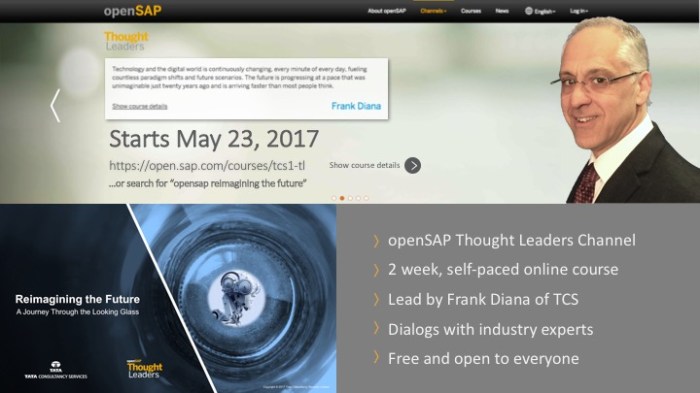
Reimagining the Future – A Journey Through the Looking Glass

openSAP Promo Slide

I have spent the better part of two months filming an online thought leadership course focused on our emerging future. The free course will be available starting May 23rd. I had the pleasure of working with futurists Gerd Leonhard, Gray Scott, and Chunka Mui. In addition, I was joined by Element Fleet Management executive Michele Cunningham, as well as TCS CTO Ananth Krishnan, and BRP CIO Hassan El Bouhali.

A video promo of the course along with the course description are available here. I hope you take the time to journey with me through the looking glass. course summary and bios for my guests are also included below.

Continue reading

See the Future, Rehearse it and Adapt to the Inevitable Shifts

In my last post, I described a Sense and Respond model that sits at the heart of several activities, including scenario, opportunity, and risk analysis. As complexity and pace continue to intensify, uncertainty increases. To survive in this Emerging Future, we must embrace a framework for future thinking,  and an organization that can adapt as it shifts. In essence, we must see the future, rehearse it, continuously monitor for shifts, and adapt as the shifts occur. A sense and respond model sits at the core of the framework – but represents the biggest cultural challenge.

Continue reading

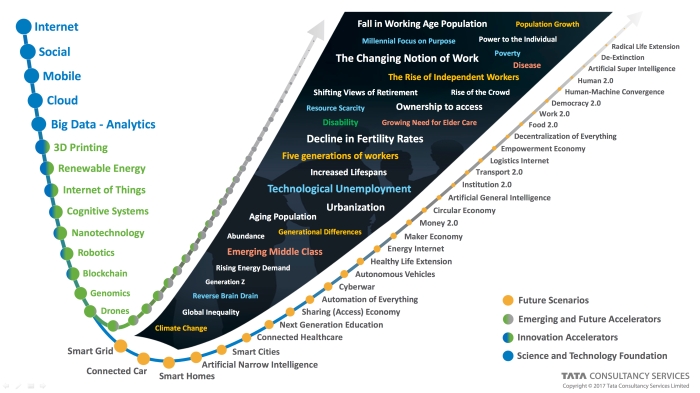
Visualizing our Emerging Future

As the pace of science, technology, and societal change accelerates, a vision of our future is emerging. Many future scenarios are viewed as science fiction, or thought to have timelines that are too far into the future to worry about. I hold a firm belief that these timelines are collapsing and future scenario analysis is critical both at a business and societal level.

I have used this visual as a driver of future scenario analysis. It has been captured and utilized in workshop and events. It is described in a post on Connecting Dots, which I view as a critical leadership trait.

emerging-future

Coffee Break with Game Changers: An Innovation Explosion

On November 30th, I had the pleasure of participating in another Game Changers show. I was joined by Futurist Gerd Leonhard and SAP Innovation executive Timo Elliott. The show was expertly moderated by Bonnie D. Graham, starting with her positioning of the topic: “Impossible is not a fact. It is an opinion” (Muhammad Ali). A unique clustering of inventions in the century after the U.S. Civil War improved the American and European standard of living – human well-being – more than any period before or after, with advances in everything from food and energy to health and work. Can our current innovation explosion have a similar impact despite unintended consequences? 

Continue reading

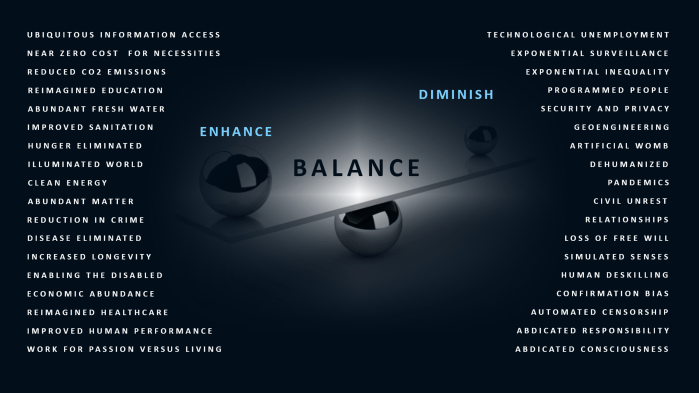
Balancing the Opposing Forces of Innovation

Balance the Opposing Forces of Innovation

The unabated exponential progression of science and technology has driven a staggering pace of innovation. The building blocks are mostly there, allowing creative minds to combine them in ways that attack the world’s most difficult challenges.

Continue reading

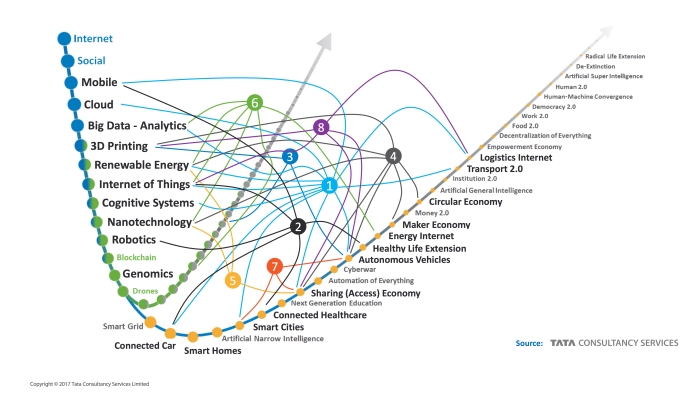
Connecting Dots

I participated in a radio show yesterday brought to you by Coffee Break with Game Changers. The show was hosted by Bonnie D. Graham and is now available on-demand here. When asked about a leadership trait required to effectively navigate our exponential future, I echoed something I have positioned many times via this Blog: Connecting Dots. The speed dimension that has accelerated our pace will put those dots in constant motion – so it’s a continuous state of connecting that makes this more challenging than our forward looking efforts of the past. The foundation for this argument was positioned in my post describing how Disruptive Power Lies at the Intersections. This visual from that post leverages my anchor visual on our emerging future.disruptive-power

Continue reading

Technology and Ethics

Some in the Futurist community are focused on technology and ethics. Gerd Leonhard has been particularly vocal on the topic. I’ve dedicated a section of my keynote to what I believe will be a growing dialog. I use this slide to pose a question to the audience:

Technology and Ethics

The example provided above comes from Ray Kurzweil, famous Futurist, Inventor and author. In an appearance at last years Exponential Finance conference, Kurzweil said this:

“Our thinking will be a hybrid of biological and non-biological thinking. We’re going to gradually merge and enhance ourselves. In my view, that’s the nature of being human – we transcend our limitations. We’ll be able to extend (our limitations) and think in the cloud. We’re going to put gateways to the cloud in our brains.”

Continue reading

Our Emerging Future

In my last post, I added more future scenarios to this visual describing the complexity and impact of our emerging future. The one piece left unfinished was the expansion of innovation accelerators to include emerging and future accelerators. With input from TCS CTO Ananth Krishnan, I have added a number of accelerators to the visual.

emerging-and-future-accelerators

Continue reading

Technology versus Humans

Futurist Gerd Leonhard recently released a new short 3 minute film titled Technology versus Humans. Here is an excerpt from his Blog announcing the video:

“I am very excited to announce the release of my new short film “Technology versus Humanity”. This film marks the beginning of a new period for me, with much of my future work focusing on the topic of how exponential technological changes are changing what and who we are, as humans, where this is going in the next 15 years, and what we need to do, TODAY, to make sure that these changes will indeed be beneficial to us.

For this film, I was very fortunate to be able to team up with Story7 and Jean Francois Cardella as producer and director, and Jeremy Joly as DOP. They made this film very special – thanks!  We shot most of the footage in Cannes and the surrounding area – see some of the pics below.  If you like this movie, please share it and spread the word, or submit a comment below and let me know what you think.  Thanks!  New hashtag as of today:  #techversushuman

Gerd was kind enough to do an interview with me back in January. You can read that here. Enjoy the film

Anticipating 2025 – Part One

I spent time over the Christmas holiday reading a book titled Anticipating 2025. Forward looking analysis that connects leaders with disruptive scenarios and their implications are invaluable, and books like this provide tremendous support. In my next series of Blog posts, I will summarize the salient points from a number of futurists who authored this work. As described in the books opening, futurists are concerned with highlighting a whole range of possible futures, not necessarily pinpointing exactly when something will happen. From the book:

“Futurists seek to draw people’s attention to forthcoming threats, before these threats become too damaging, and to forthcoming opportunities, before these opportunities slip outside of our collective grasp due to inaction on our part”

The book is divided into five sections:

  1. Setting the scene
  2. Re-designing medicine and healthcare
  3. Re-designing artificial intelligence
  4. Re-designing society
  5. Redesigning humanity

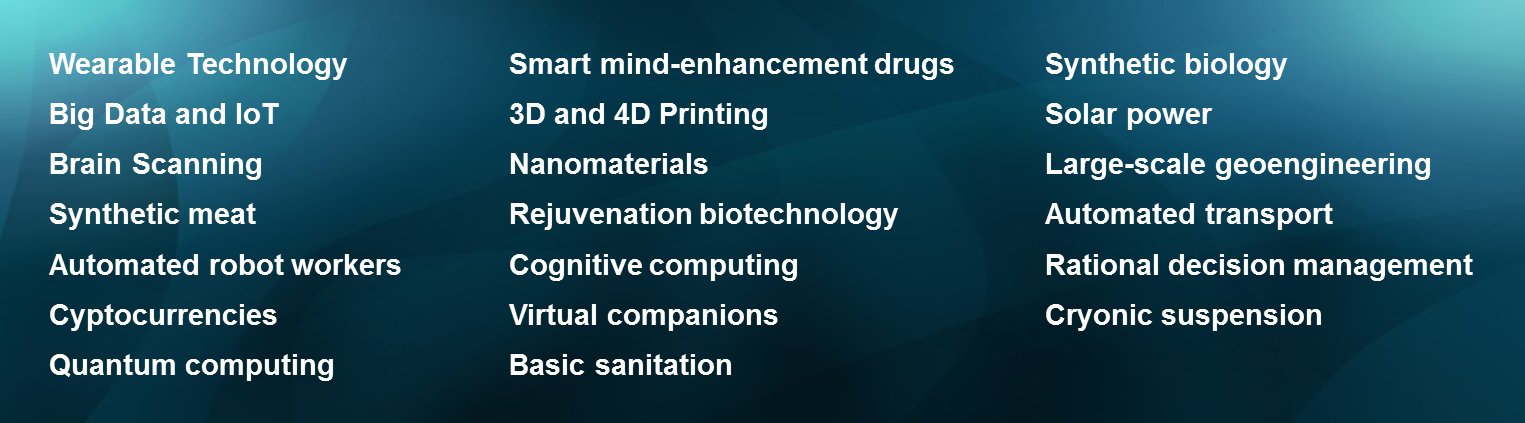
Part one of this Blog series will set the scene. In the book’s first section, the authors focus on driving forces, big shifts, and roadblocks. It is believed that if developed and deployed wisely, technology could provide a great future of unprecedented abundance, health, and vitality. But there is much uncertainty and a number of obstacles to overcome. In setting the scene, twenty technology areas where wide-ranging developments are 50% likely between now and 2025 are identified:

25 Technology Areas

Continue reading

An Interview with Futurist Thornton May

I thought it would be interesting to get a slightly different perspective on the questions that I posed to Futurist Gerd Leonhard in our recent interview. So I reached out to IT Futurist Thornton May. Thornton and I have interacted on a number of occasions at various events. His bio describes him as a futurist, educator and author. His extensive experience researching and consulting on the role and behaviors of C-level executives in creating value with information technology has won him an unquestioned place on the short list of serious thinkers on this topic. Thornton moderates the nationally recognized CIO Solutions Gallery program, intended for executives and senior leaders in the technology and operations communities.

With that background, I was excited to explore these broad topics with Thornton. His perspective follows.

Continue reading

Business Evolution

This Presentation tells the full business evolution story articulated below.

Several key drivers have positioned the next two decades to deliver a staggering – perhaps unprecedented – amount of change. The accelerating pace of business, the growing impact of digital, and several other major indicators suggest that a next generation enterprise is on the horizon. The first of these indicators is the level of societal change impacting everything from business to war. In the business world, the implications of this change can be seen in our employees, where for the first time in history, four generations of workers are in our work force. The associated challenges are coming into focus, as some of these workers are digital natives, but the vast majorities are digital immigrants. With customers, the shift of power to the individual has changed their role forever and placed them at the center of the company ecosystem. Other indicators include an intense focus on growth, which increasingly requires collaboration within and outside the four walls of the Enterprise. This growth agenda drives a new type of value ecosystem, enabling growth that in many cases is outside a company’s traditional business.

Continue reading

Autonomous Vehicles: The Automotive Ecosystem

This post continues the disruption scenario discussion initiated by my earlier Insurance Industry Case Study. I’ve been using the autonomous vehicle (AV) as an example of a disruptive scenario with potential societal, economical, and environmental impact. In this post, the focus shifts to the scenario’s possible effect on the automotive ecosystem.

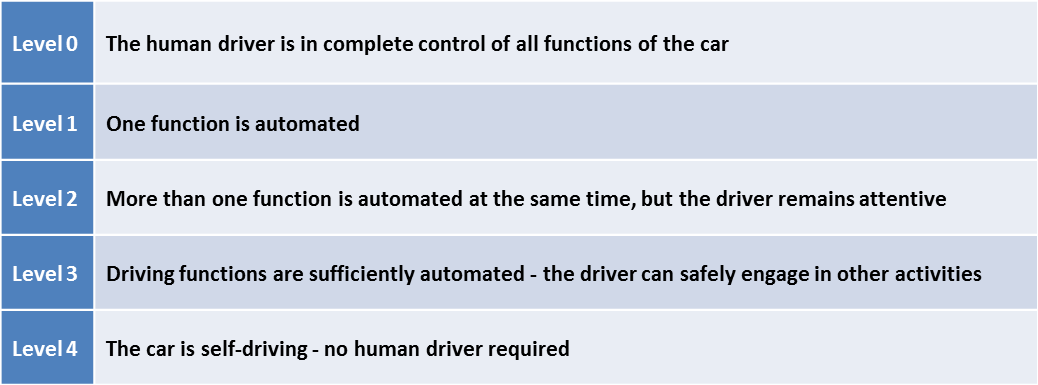
Autonomous vehicle technology can be viewed using a five-part continuum suggested by the National Highway Traffic Safety Administration (NHTSA), with different benefits realized at different levels of automation:

Driverless Car Continuum

Last month, an IHS Automotive study predicted the world will have nearly 54 million self-driving cars by 2035. The study also predicts that nearly all vehicles in use are likely to be self-driving cars or self-driving commercial vehicles sometime after 2050. Meanwhile, automakers and others are unveiling both their plans for – and introduction of – automated features: 

Continue reading

A Closer Look at Transformation: Differentiation

Continuing with this closer look at transformation, part three focuses on differentiation; the fourth forcing function. Differentiation is a process that showcases the differences between products and services. It looks to make an offering more attractive by contrasting its unique qualities with other competing offerings. Successful differentiation should create competitive advantage, as customers view these offerings as unique or superior. In his piece on The Future of Enterprise IT, Geoffrey Moore, famous author of “Crossing the Chasm” describes the global business dynamics (Slide 10) that places differentiation at the center of a virtuous (perhaps vicious) cycle. His key message is that globalization and rapid commoditization are placing greater emphasis on differentiation, especially in developed economies.

Continue reading

A Closer Look at Transformation: Effectiveness & Efficiency

In part two of this closer look at transformation, we will focus on two forcing functions: effectiveness and next generation efficiency. As a reminder, forcing functions are those things that force the enterprise to invest in a future state. In the case of efficiency, the next phase in the search for gains is upon us, as companies have hit the efficiency wall. But something bigger is happening, as the pace of business will increasingly demand that we are not just efficient – but effective. Whereas the past was about re-engineering, the future is about re-imagining.

Continue reading