The Strategic Foundation

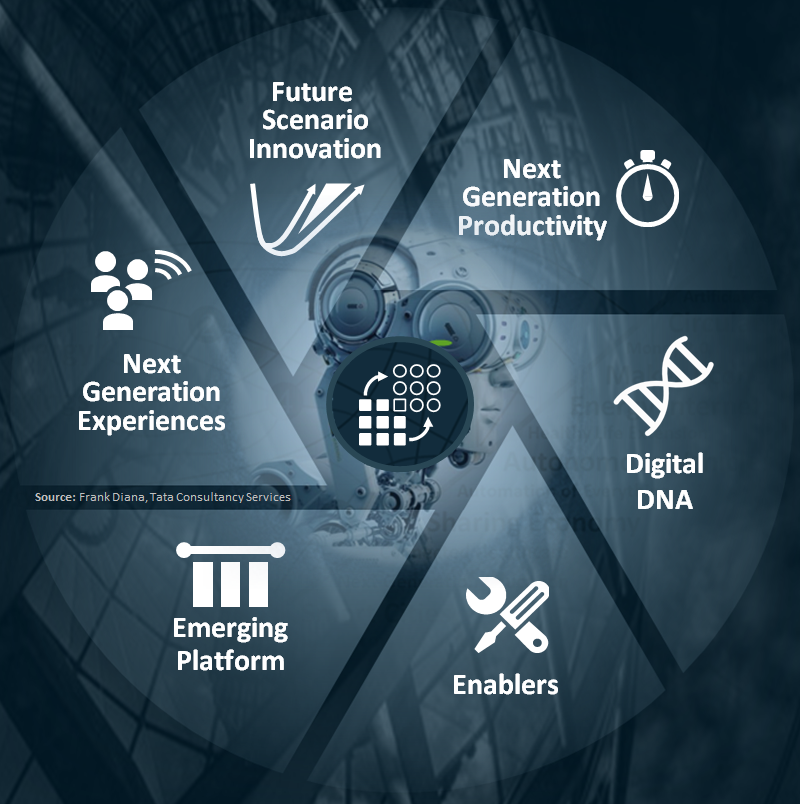
In my last post, I explored the evolution of business in the industrial age. This Fourth Iteration of Business establishes resilience on a foundation of automation and intelligence. Resilience may be more important than the productivity gains that are sure to be realized as we progress towards Business 4.0, providing the capacity to recover quickly as the pace of shifts accelerates. This visual represents a strategic foundation for Business 4.0.

The Strategic Foundation

Continue reading

At the Heart of Digital Transformation

Creating a strategic foundation

To transform is to change in form, appearance, structure, condition, nature, or character. It is an overly used word that can be made to fit several narratives. Yet, given its definition, the dynamics of what is sure to be a volatile and complex future should compel us all to transform. I believe however, that the narrative must change. This is not a technology discussion, and it is not a digital discussion (although digital is the reason we are here). Rather, it is discussion of likely structural shifts that alter our beliefs and intuitions. These shifts will fundamentally change the way we think about organizations.

Continue reading

A Dialog with The Center of Digital Intelligence

I had the pleasure of doing a video interview with Kevin Benedict today, where we discussed a number of topics, including the recent book Machine, Platform, Crowd: Harnessing Our Digital Future. Kevin is from the The Center of Digital Intelligence. Our wide ranging discussion can be viewed here.

Machines, Platforms, and Crowds

Andrew McAfee and Erik Brynjolfsson – Authors of The Second Machine Age – wrote a new book which they launched in the middle of this year. Machine, Platform, Crowd: Harnessing Our Digital Future builds upon their first book, exploring three big trends that are reshaping the business world:

  1. The rapidly increasing and expanding capabilities of machines
  1. The large and influential young companies (Platforms) that bear little resemblance to the established incumbents in their industries, yet are deeply disrupting them
  1. The emergence of the crowd: the large amount of human knowledge, expertise, and enthusiasm distributed all over the world and now available

Continue reading

Transforming for the Digital Age

Digital transformation means different things to different people. As I strive to change mindsets, I am sensitive to these distinct perspectives and the individual filters applied to terms like digital and transformation. In my view, Digital has been more narrow than holistic, while in some organizations ERP implementations are considered transformation. So, does digital transformation represent the narrow use of digital technology to improve some aspect of our organization? Or, is it the wholesale change of a set of structures, institutions and paradigms built for a different era? Although I have mostly abandoned the phrase, when I do use it, I mean the latter.

Let’s call it what it is, starting with the term transformation. To truly transform means to change from one nature, substance, form, or condition into another. I’d maintain that the pace of change has made the archaic nature of our industrial era structures, institutions, and management paradigms very apparent. Therefore, to transform in this sense means to change from the nature, form and substance of our industrial past, to a state that is viable for our digital future. Digital is foundational: the building block for which this future state is built upon. Therefore, for clarity sake, a better way to describe digital transformation is:

TRANSFORMATION FOR THE DIGITAL AGE: a change in the nature, substance, and form of our industrial past, to a future state that allows us to thrive in our emerging digital future.

Continue reading

Privacy and Corporate Responsibility

coffee-break-with-game-changers

I joined another episode of Coffee Break with Game Changers on Wednesday of this week. A very good discussion on privacy and data. Here is a brief abstract.


The buzz: “You already have zero privacy – get over it” (Scott McNealy). We as individuals have welcomed Internet-connected, mobile devices to help us make daily decisions. But when we share data with companies, and they share it with their business partners, are their built-in and bolted-on data security capabilities enough to protect our personal information?

Continue reading

Digital: We’ve Only Just Begun

“Digitization has barely started, and so has the accompanying upheaval”

Jacques Bughin, Mckinsey

That’s a scary thought – but accurate. That thought comes from a recent Mckinsey Insights post titled: Think digital is a big deal? You ain’t seen nothing yet. Thanks to Heidi Schwende for sharing this article.

Their research finds that digital technologies and processes have penetrated only about 35% of an average industry, which says that a third of the products and operations that could be digitized have been. Yet this is more than thinking about digitizing the other 65% – it’s a moving target. The phrase “You ain’t seen nothing yet” captures that well. As the innovation accelerators that I describe in my Anchor Visual accelerate, digital is merely the foundation. A reimagined world is built on that foundation – and without it, organizations cannot participate in Reimagination. Here are other key insights from the Mckinsey post:

Continue reading

See the Future, Rehearse it and Adapt to the Inevitable Shifts

In my last post, I described a Sense and Respond model that sits at the heart of several activities, including scenario, opportunity, and risk analysis. As complexity and pace continue to intensify, uncertainty increases. To survive in this Emerging Future, we must embrace a framework for future thinking,  and an organization that can adapt as it shifts. In essence, we must see the future, rehearse it, continuously monitor for shifts, and adapt as the shifts occur. A sense and respond model sits at the core of the framework – but represents the biggest cultural challenge.

Continue reading

Uncertainty Drives the need to Sense and Respond

“The rhythm of technology is changing the rhythm of business, and we’re all going to need to adapt”Jeff Gothelf and Josh Seiden, Authors of Sense and Respond

Back in 2013, in a post on sense and respond systems, I talked about the drivers that would push organizations towards a sense and respond paradigm. There are no bigger drivers than volatility and uncertainty, and nearly four years since that post, that fact is becoming clearer. In a recent book by Jeff Gothelf and Josh Seiden, they elevate sense and respond to a position that is core to achieving an adaptive enterprise. They see feedback loops and a movement away from command and control as the enabling mechanisms that allow us to thrive in the digital age.

Continue reading

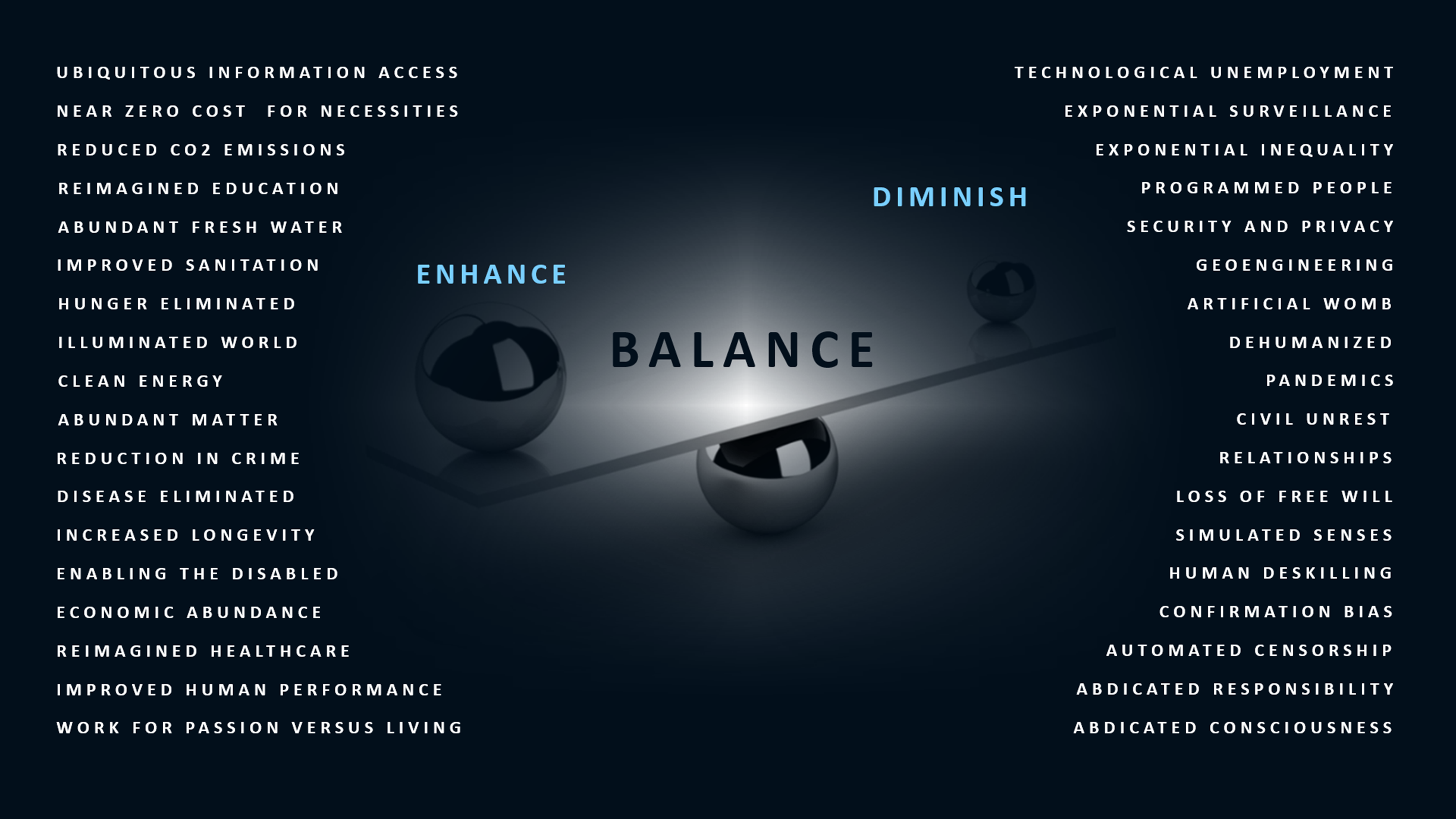
Balancing the Opposing Forces of Innovation

Balance the Opposing Forces of Innovation

The unabated exponential progression of science and technology has driven a staggering pace of innovation. The building blocks are mostly there, allowing creative minds to combine them in ways that attack the world’s most difficult challenges.

Continue reading

The Year of Shifts

The year of shifts is upon us. 2016 will ultimately be viewed as the bridge to a different future; a year where our intuition and beliefs will be reset. Accelerating advancements across science and technology have set the foundation for these shifts. Driven by societal and economic challenges, we will leverage this foundation to change current institutions and build new ones. To succeed, organizations of all types must view transformation through a different lens; one that enables their role in this future. In my current series, I am focusing on the thirteen (13) key enablers of future viability. The first post explored Structural Change. In this post, I will look closer at the pillars of transformation, and delve into the second enabler: a holistic digital foundation.

the-pillars-of-transformation

Continue reading

A Report on Creative Disruption

A recent report by Bank of America Merrill Lynch sheds more light on our future focus. The authors see cyclical and secular trends transforming the world at a rapid and meaningful pace. They find a common denominator in the form of three Ecosystems of Creative Disruption, and see them reducing barriers to entry for new businesses. These ecosystems allow companies to improve productivity and time-to-market while allowing broader customer reach. In a big shift, the ecosystems redefine competitive advantage by leveling the playing field between large and small companies.  Success is therefore dictated by imagination and ability to maximize the ecosystem. The three ecosystems are:

Continue reading

World Economic Forum – Deep Shift

A must read on six mega-trends, their tipping points and societal impacts. I recommend this for anyone with interest in where the world is heading, and/or tasked with future thinking in the context of strategy. I commend the World Economic Forum for their efforts here, as education is likely to spur action. The six mega-trends are:

  1. People and the internet
  2. Computing, communications and storage everywhere
  3. The Internet of Things
  4. Artificial intelligence (AI) and big data
  5. The sharing economy and distributed trust
  6. The digitization of matter

Here is a tipping point timeline from the report:

Many leaders are struggling with the sheer number of future scenarios and some indication of when the tipping point may arrive. This material provides critical input into the scenario and response analysis process. Enjoy the read.

IDC Predicts a DX Economy

IDC today announced its worldwide information technology (IT) industry predictions for 2016 and beyond. The predictions were published in a new IDC FutureScape report. As we embrace the notion of Future Thinking

This forward looking guidance is critical. Here is a snippet from the report:

“The disruptive impact of digital transformation is about to be felt in every industry as enterprises ‘flip the switch’ and massively scale up their DX initiatives to secure a leadership role in the DX economy,” said Frank Gens, Senior Vice President and Chief Analyst at IDC. “In the next two years, two-thirds of Global 2000 CEOs will put DX at the center of their growth and profitability strategies. By the end of this decade, IDC predicts that the percentage of enterprises with advanced DX strategies and implementations will more than double.”

IDC predicts that the scale-up of digital business strategies will drive more than half of enterprise IT spending within the next 24 months, rising to 60% by 2020. Mastery of 3rd Platform technologies will be table stakes for successfully executing DX business initiatives and “Cloud First” will become the new mantra for enterprise IT. Virtually none of the other 3rd Platform technologies or major DX initiatives is possible in scaled-up implementations without the Cloud as the foundation. By 2020, IDC predicts that enterprise spending on cloud services, the hardware and software to support cloud services, and the services for implementing and managing cloud services will exceed $500 billion, more than three times what it is today.

Source: FutureScape

Additional predictions were provided:

  1. By the End of 2017, Two-Thirds of the CEOs of the G2000 Will Have Digital Transformation at the Center of Their Corporate Strategy
  2. By 2017, 60% Companies with a DX Strategy Will Deem It Too Critical for Any One Functional Area and Create an Independent Corporate Executive Position to Oversee the Implementation
  3. By 2018, 80% of B2C Companies Will Have Created Immersive, Authentic Omni-Experiences for Customers, Partners, and Employees; 60% of B2B-Centric Companies Will Have Done the Same
  4. The Top New Investment Areas Through 2017 Will Be Contextual Understanding and Automated Next Best Action Capabilities
  5. In 2016, 65% of Large Enterprises Will Have Committed to Become Information-Based Companies, Shifting the Organizational Focus to Relationships, People, and Intangible Capital
  6. By 2018, 75% of the G2000 Will Have Deployed Full, Information-Based, and Economic Models or “Digital Twins” of Their Products/Services, Supply Network, Sales Channels, and Operations
  7. By 2020, 60% of the G2000 Will Have Doubled Their Productivity by Digitally Transforming Many Processes from Human-Based to Software-Based Delivery
  8. In 2016, the Level of Connectivity Related to Products, Assets, and Processes Will Increase 50% for All Industry Value Chains
  9. The Sharing Economy Will Give Rise to the Networked Free Agent and Skill-Based Marketplaces, Resulting in More than 10% of Work Being Sourced in this Fashion in Mature Economies by 2019
  10. By 2018, at Least 20% of All Workers Will Use Automated Assistance Technologies to Make Decisions and Get Work Done

Digital Transformation of Business and Society

At a recent KPMG Robotic Innovations event, Futurist and friend Gerd Leonhard delivered a keynote titled “The Digital Transformation of Business and Society: Challenges and Opportunities by 2020”. I highly recommend viewing the Video of his presentation. As Gerd describes, he is a Futurist focused on foresight and observations – not predicting the future. We are at a point in history where every company needs a Gerd Leonhard. For many of the reasons presented in the video, future thinking is rapidly growing in importance. As Gerd so rightly points out, we are still vastly under-estimating the sheer velocity of change.

With regard to future thinking, Gerd used my future scenario slide to describe both the exponential and combinatorial nature of future scenarios – not only do we need to think exponentially, but we also need to think in a combinatorial manner. Gerd mentioned Tesla as a company that really knows how to do this.

Continue reading

Anticipating 2025 – Part One

I spent time over the Christmas holiday reading a book titled Anticipating 2025. Forward looking analysis that connects leaders with disruptive scenarios and their implications are invaluable, and books like this provide tremendous support. In my next series of Blog posts, I will summarize the salient points from a number of futurists who authored this work. As described in the books opening, futurists are concerned with highlighting a whole range of possible futures, not necessarily pinpointing exactly when something will happen. From the book:

“Futurists seek to draw people’s attention to forthcoming threats, before these threats become too damaging, and to forthcoming opportunities, before these opportunities slip outside of our collective grasp due to inaction on our part”

The book is divided into five sections:

  1. Setting the scene
  2. Re-designing medicine and healthcare
  3. Re-designing artificial intelligence
  4. Re-designing society
  5. Redesigning humanity

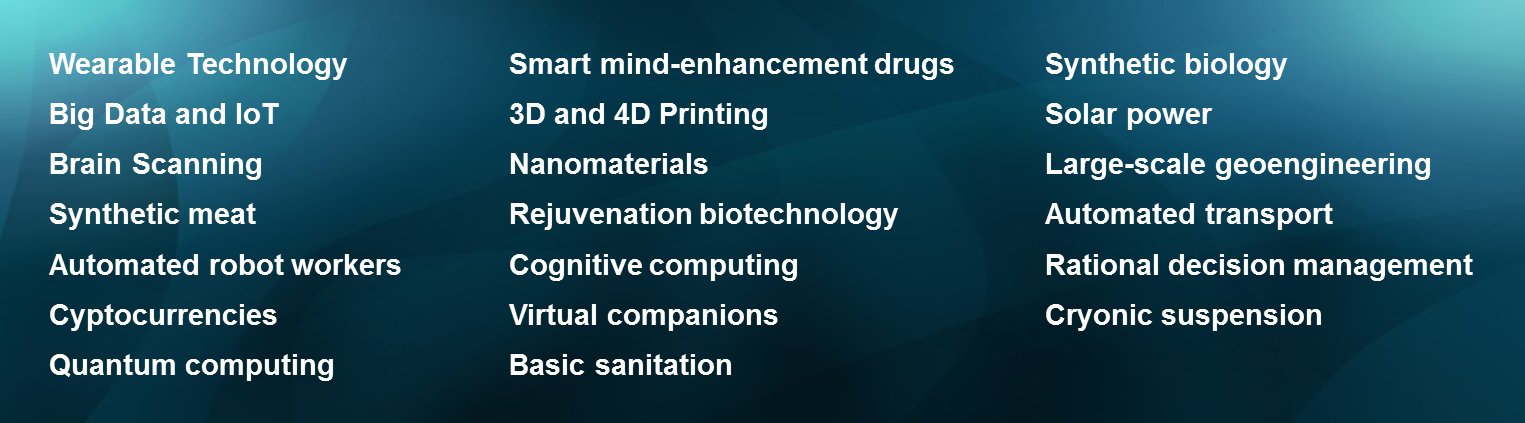
Part one of this Blog series will set the scene. In the book’s first section, the authors focus on driving forces, big shifts, and roadblocks. It is believed that if developed and deployed wisely, technology could provide a great future of unprecedented abundance, health, and vitality. But there is much uncertainty and a number of obstacles to overcome. In setting the scene, twenty technology areas where wide-ranging developments are 50% likely between now and 2025 are identified:

25 Technology Areas

Continue reading

Business Evolution

This Presentation tells the full business evolution story articulated below.

Several key drivers have positioned the next two decades to deliver a staggering – perhaps unprecedented – amount of change. The accelerating pace of business, the growing impact of digital, and several other major indicators suggest that a next generation enterprise is on the horizon. The first of these indicators is the level of societal change impacting everything from business to war. In the business world, the implications of this change can be seen in our employees, where for the first time in history, four generations of workers are in our work force. The associated challenges are coming into focus, as some of these workers are digital natives, but the vast majorities are digital immigrants. With customers, the shift of power to the individual has changed their role forever and placed them at the center of the company ecosystem. Other indicators include an intense focus on growth, which increasingly requires collaboration within and outside the four walls of the Enterprise. This growth agenda drives a new type of value ecosystem, enabling growth that in many cases is outside a company’s traditional business.

Continue reading

The Sharing Economy

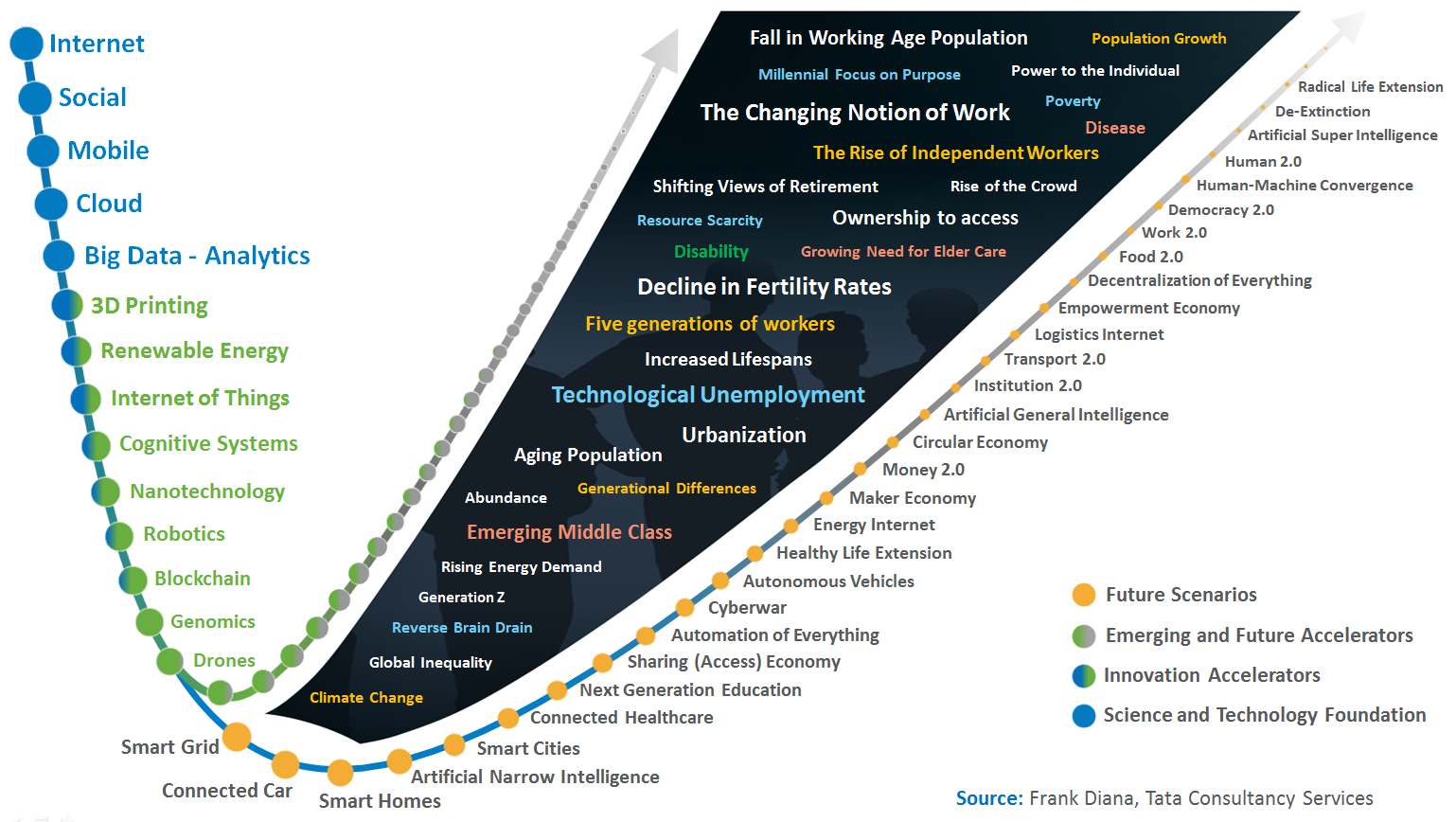
Something Economy: seems like a popular trend – stick a word in front of economy and use it to describe the next big thing. Some of these words are: Peer, Maker, Sharing, Gig, Collaborative, Green, Circular, Mesh, Digital, Innovation, semantic, and more. This combining of words speaks to the truly disruptive nature of the early 21st century. As part of my focus on business evolution and the inevitable move towards digital enterprises, I have analyzed a number of disruptive scenarios and their implications to traditional companies. This visual describes a combinatorial innovation dynamic that spawns disruptive scenarios:

emerging-future
Continue reading

Ecosystem Thinking

The notion of value creation and capture is a core component of business and the models that drive it. While historically viewed with a traditional product mindset, several emerging forces will alter this basic tenet of business. At its core, the way businesses create and capture value will change – the degree of change ranges from transformative to historical. The last several posts focused on the historical – namely Jeremy Rifkin’s view that we are heading towards A New Economic Paradigm. The foundation of Mr. Rifkin’s argument is a Third Industrial Revolution (TIR) platform that takes the marginal cost of production to near zero. Enabled by the Internet of Things, this General Purpose Technology (GPT) Platform could alter our landscape more dramatically than previous GPTs (steam-locomotive-printing press, electricity-auto-telephone). What happens to value creation and capture in a near zero marginal cost scenario?

Continue reading

Connected Health

In my continued look at disruptive scenarios, the focus shifts to Connected Health. In a recent White Paper, the term is used as an umbrella description that covers digital health, eHealth, mHealth, telecare, telehealth, and telemedicine. Analyst firm IDC defines it as “a broad spectrum of technologies that use telecommunications to facilitate the exchange of health information and delivery of care across a geographic distance as well as manage chronic conditions and promote health and wellness.”

There are several drivers that make this both a viable and desperately needed scenario. According to the IBM Institute for Business Value, inefficiency in the Healthcare ecosystem wastes over 2 trillion USD per year. According to the popular Internet Trends Study produced by Mary Meeker each year, healthcare costs have reached 17% of the U.S. GDP and 27% of health spending is wasted. The same study found that over 25% of family income is likely to go to health spending in 2015, and 50% of bankruptcies are driven by health costs.

Continue reading