The notion of value creation and capture is a core component of business and the models that drive it. While historically viewed with a traditional product mindset, several emerging forces will alter this basic tenet of business. At its core, the way businesses create and capture value will change – the degree of change ranges from transformative to historical. The last several posts focused on the historical – namely Jeremy Rifkin’s view that we are heading towards A New Economic Paradigm. The foundation of Mr. Rifkin’s argument is a Third Industrial Revolution (TIR) platform that takes the marginal cost of production to near zero. Enabled by the Internet of Things, this General Purpose Technology (GPT) Platform could alter our landscape more dramatically than previous GPTs (steam-locomotive-printing press, electricity-auto-telephone). What happens to value creation and capture in a near zero marginal cost scenario?
Tag: Digital
-
Connected Health
In my continued look at disruptive scenarios, the focus shifts to Connected Health. In a recent White Paper, the term is used as an umbrella description that covers digital health, eHealth, mHealth, telecare, telehealth, and telemedicine. Analyst firm IDC defines it as “a broad spectrum of technologies that use telecommunications to facilitate the exchange of health information and delivery of care across a geographic distance as well as manage chronic conditions and promote health and wellness.”
There are several drivers that make this both a viable and desperately needed scenario. According to the IBM Institute for Business Value, inefficiency in the Healthcare ecosystem wastes over 2 trillion USD per year. According to the popular Internet Trends Study produced by Mary Meeker each year, healthcare costs have reached 17% of the U.S. GDP and 27% of health spending is wasted. The same study found that over 25% of family income is likely to go to health spending in 2015, and 50% of bankruptcies are driven by health costs.
-
The Smart Home
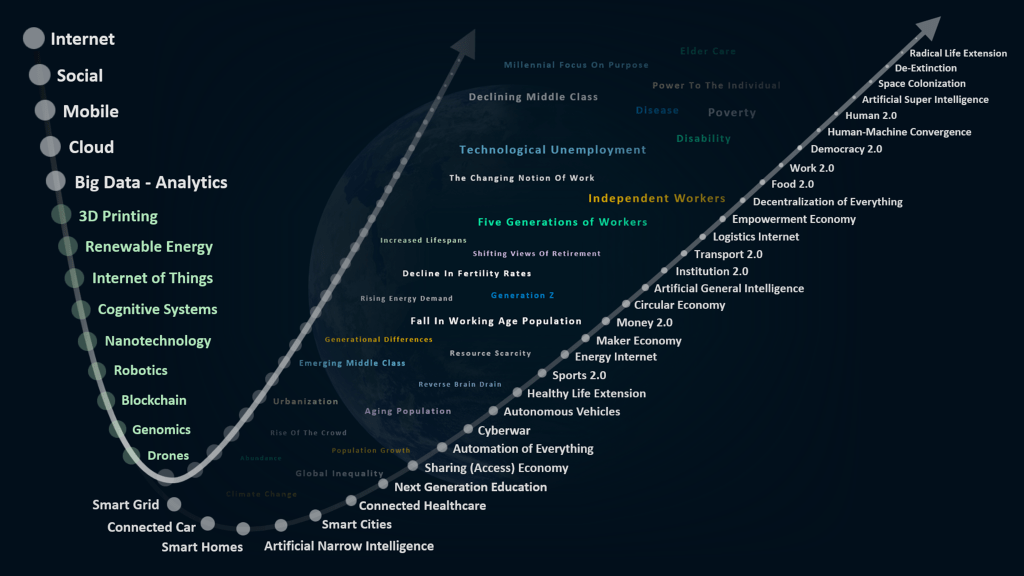
This post continues a disruptive scenario analysis focused on assessing the transformative environment that faces companies, Industries, Governments, and society as a whole. Much attention is paid to several digital forces (e.g. Mobile, Social, Cloud, Big Data, The Internet of Things, AI, Robotics), but for the most part, the focus is isolated in nature. As described in The Second Machine Age, the combinatorial effect of these forces enables disruptive scenarios at an unprecedented pace. While some of these forces and their combinations are growing more visible, many are far off on the horizon, and countless scenarios are not yet visible. The visual below depicts this phenomenon, underscoring the difficulty of responding to the forces in our line of sight – and the near insurmountable task of responding to those further on the horizon. At its furthest point, lack of visibility to future combinatorial innovation drives a high degree of uncertainty.
-
A Closer Look at Transformation: Descriptive to Prescriptive
Next up in this transformation series is the eighth enabler: the evolution from descriptive to predictive analytics. At the heart of future success lies the ability to leverage insight for competitive advantage. Yet, analytic capability and data driven cultures are lacking in most organizations, and most executives when assessing their positioning on a descriptive-to-prescriptive scale answer level one. The table below defines each level:
-
A Closer Look at Transformation: Collective Intelligence
Next up in this transformation series is the seventh enabler: Collective Intelligence. One of the key themes throughout this transformation series is the clear movement from an enterprise entity to an extended enterprise of stakeholders. This extended enterprise – or what I alternatively call value ecosystem – increases complexity and requires a new management approach to be effective. I use the term collective intelligence as an umbrella phrase that combines the critical need for both collaboration and analytic excellence. This includes other forces like crowd computing, crowdsourcing, co-creation, and wisdom of the crowd – all of which stem from the connectedness of our world, and the growing realization that value creation requires a broader community.
-
A Closer Look at Transformation: Sense and Respond Systems
Next up in this transformations series is the sixth enabler: sense and respond systems. These systems are critical to the transformation agenda, as most of the disruptive technologies likely to impact the enterprise in the next decade have data at its core. The resulting data explosion promises to complicate information management for most companies. As the speed of business accelerates and the amount of data flowing through company ecosystems expands, the need to sense stimuli and enable a real time response intensifies. Fortunately, rapid advancements in the price and performance of technology make realizing this sense and respond paradigm achievable and economical for a wide range of use cases – but this is arguably one of the most difficult components of transformation road maps.
-
A Closer Look at Transformation: Value Ecosystems
The next focus of this transformation series shifts to the emergence of value ecosystems and their role in driving the Enterprise of 2020. As we look at the Apple ecosystem and offerings like the connected car, mobile commerce, energy efficiency, electric cars, eHealthcare, and energy performance contracts, we can see the lines between industries blurring. Some even question the relevance of Industry constructs in the future. As this phenomenon accelerates, more and more companies must identify the relevant ecosystem(s) that enable their growth strategies. These value ecosystems are complex and relationship-oriented, representing future growth opportunities that are increasingly outside a company’s traditional business.
-
A Closer Look at Transformation: Edge-Driven Design
Next up in this transformation series is edge-driven design, the second enabler. This key enabler is growing in importance as developed economies are moving away from command and control models and towards edge interaction that is value-based. The design principles of our past where the core (Systems of record) drove design and the edge adapted do not support this shift. This future state requires the edge to drive design from the outside-in and a core that is adaptive. This reversal in design principles supports two future dynamics: 1) Value is increasingly created by an ability to connect capabilities across organizations within an ecosystem of services, and 2) The shift from a transactional paradigm to an experiential one. An edge-driven design addresses both of these dynamics and begins to instill a fast, iterative and responsive culture.
-
The New Machine Age
I recently participated in a panel discussion at an MIT CIO Symposium and had the pleasure of hearing Andrew McAfee talk about the book he co-authored with Erik Brynjolfsson titled Race against the Machine. Mr. McAfee has talked at length about the digital revolution and its impact on the workforce. He talked about the dawn of a new machine age, where the focus is on idea production versus physical production, and knowledge work versus manual labor. He focused on the most impactful period in human history – the advent of the steam engine that ushered in the first industrial revolution. A lengthy period that followed the first machine age was transformative and disruptive. We are on the verge of something that history may someday view as more transformative and disruptive. A quote from Mr. McAfee summed up his thoughts:
“Digital will make a mockery of everything that came before it”.
-
Digital Enterprise Characteristics
In the past two months, interest in the characteristics of a digital enterprise is accelerating. I believe increasingly, traditional companies understand that viability in the next decade drives the need to evolve. The list of characteristics has been refined through ongoing dialog and now looks like this:

