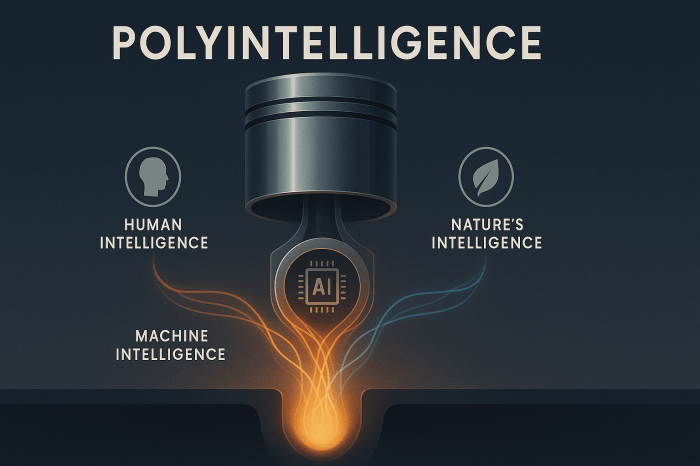
The Compressed Present

THE BIO-INTELLIGENT SIGNATURE: A LENS ON THE CURRENT AGE

The present moment is shaped by three converging streams of intelligence: machine intelligence, biological intelligence, and planetary intelligence. These are the same sources that form what I have described elsewhere as polyintelligence — cognition distributed across humans, machines, and nature. Each stream is advancing on its own, but their deeper significance appears in how they now influence one another. Artificial intelligence extends cognition beyond the human mind. Synthetic biology brings design and computation into living systems. And the planet — long treated only as a resource base — is increasingly recognized as a source of insight. Through biomimetics, natural systems provide design principles refined through evolution: circularity instead of waste, resilience through diversity, and adaptation through constant sensing and feedback.

Continue reading

Crossing The Threshold

Civilization’s great shifts are the moments when continuity fails and a new order takes shape. Each historical age reached a point where the old logic could no longer hold, and pressures converged into a transformative release. By examining four major transitions – from Hunter–Gatherer to Agricultural, Agricultural to Axial, Axial to Renaissance, and Renaissance to Industrial – we can see how rising Total Systemic Domain Score (TSDS) and changing Activation Dispersion (AD) signaled that a threshold was near. Some transitions unfolded slowly over millennia, while others struck within a few centuries. In each case, the build-up of energy and imbalance hit a critical point, and society crossed into an irreversible new configuration that only in hindsight feels inevitable.

Continue reading

What The Gauges Reveal Across The Ages

Over the first seven posts, we explored the seven domains that shape civilization, the forces that move within them, the thresholds that mark major transitions, and the drivers that push systems toward those turning points. We also built two gauges that help make those movements visible. TSDS shows how much energy sits across the seven domains. AD shows how that energy is arranged. Together, they help us see the internal structure of an age: how active its domains were, how evenly that activity spread, and how tightly the system was coupled. With that groundwork in place, we can now use the gauges to trace the long arc of history and examine how pressure accumulated across major ages of civilization.

Continue reading

How The Gauges Were Built: Making Systemic Pressure Legible

Over the first six posts, I built the foundation needed to understand how civilizations change. I explored the seven domains that shape collective life, the forces that move within them, the thresholds that mark historical turning points, and the three drivers that push systems toward those moments. With that groundwork in place, I introduced a pair of gauges that make those movements easier to see. In this post, I describe the gauges in greater detail. TSDS reflects how much energy sits across the seven domains. AD shows how that energy is arranged. Before we apply these gauges to the long arc of history, we need to explain how they were built. Every measure rests on a set of choices. This post walks through those choices in a way that keeps the gauges intuitive while grounding them in the history they aim to describe.

Continue reading

Reading The Pulse Of A Civilization In Motion

The first five posts laid the foundation for understanding why the world feels dense, fast, and tightly connected. We explored the sense that something in the operating logic of civilzation is shifting. We looked at phase transitions, the four-stage pattern that repeats across history, and the seven domains that structure civilization. The last post introduced the three deep drivers that push civilizations across thresholds: growing convergence, system-shaping technologies, and the acceleration of knowledge. Taken together, they help explain why pressure builds, why systems couple, and why some ages move differently than others.

Continue reading

Book Review: How Countries Go Broke: The Big Cycle By Ray Dalio

Ray Dalio has long been a student of cycles – economic, financial, and societal. His latest book, How Countries Go Broke: The Big Cycle, is a sweeping examination of how nations rise, peak, and decline, often repeating the same mistakes across history. For anyone trying to make sense of today’s turbulent geopolitical and economic environment, Dalio’s work is both a warning and a guide.

Continue reading

When Systems Shift: The Rare Alignment Driving Change Today

History is filled with moments of disruption and reform. But true systemic change – when the very foundations of society are redefined – has been rare. These periods of profound transition are not triggered by short-term trends. They emerge when multiple deep forces move in tandem, setting in motion the restructuring of the societal platform itself.

Continue reading

The Fragile Future: Why Stability Is More Uncertain Than Ever

History does not repeat, but it often rhymes. As I read Robert D. Kaplan’s Waste Land: A World in Permanent Crisis, I was struck by his argument that the 20th and early 21st centuries have been especially bloody because the stabilizing force of monarchy has vanished. He suggests that despite our moral progress in areas like human rights and the environment, the world remains tightly wound, vulnerable to clashing interests and aggressive authoritarian states. He draws an analogy to Weimar Germany – a moment of fragile democracy, economic strain, and rising nationalism that ultimately collapsed into war.

Continue reading

Book Review: “Punishing Putin” By Stephanie Baker

Punishing Putin, by Stephanie Baker, published in September 2024, offers a timely and in-depth examination of the international efforts to hold Russia accountable for its invasion of Ukraine. This isn’t simply a historical recounting of sanctions and diplomatic maneuvers; Baker delves into the complexities, contradictions, and often unintended consequences of the strategies employed by Western nations and their allies.

Continue reading

A Sweeping Narrative Of Human Progress

In How Economics Explains the World: A Short History of Humanity, Andrew Leigh, a Harvard-trained economist, presents a comprehensive and engaging narrative that delves into the profound impact of economic forces on human history. This book, though concise at under 200 pages, spans a vast timeline from the advent of agriculture to the present day, including the era of artificial intelligence.

Continue reading

The Second Gilded Age

ANALYSIS OF KEY POINTS:

A recent article discusses the resurgence of “robber barons” in the modern era, particularly highlighted by the 2024 U.S. election. It draws parallels between the industrial magnates of the late 19th and early 20th centuries – such as Cornelius Vanderbilt, John D. Rockefeller, and Andrew Carnegie – and today’s tech billionaires like Elon Musk, Jeff Bezos, and Mark Zuckerberg. The core argument is that these contemporary titans wield immense economic and political power, much like their predecessors, and have significant influence over markets, governments, and even the media.

Continue reading

Permacrisis – A Plan To Fix A Fractured World

I finished reading my most recent book titled Permacrisis, authored by Gordon Brown, Mohamad A. El-Erian, and Michael Spence. The book was recommended by Mimi Brooks, who did a review of it here. This was a very impactful book written by three of the most internationally respected and experienced thinkers of our time. As described by the Amazon abstract, the book focused on a cascade of crises: sputtering growth, surging inflation, poor policy responses, an escalating climate emergency, worsening inequality, increasing nationalism and a decline in global co-operation. While they do a great job of identifying the challenges, they also prescribe solutions. Given their experience base, we should pay very close attention to both sides of this story. I have added the book to my library and provide a brief summary below.

The world is undergoing a profound transformation marked by multifaceted economic, social, and technological shifts, altering the familiar landscape of the past three decades. This book delves into key messages regarding the challenges and opportunities presented by these changes, emphasizing the importance of understanding evolving dynamics.

Continue reading

Soulful: You In The Future Of Artificial Intelligence

I recently had the opportunity to read a pre-release version of a new book by David Espindola. The timely book – due to launch on May 29 – is titled Soulful: You in the Future of Artificial Intelligence. With the introduction of ChatGPT a few months ago, artificial intelligence is now top of mind. A day doesn’t pass where countless articles explore various aspects of Generative AI. My interaction at events and leadership forums is dominated by the topic. Among the noise are thoughtful voices that provide new insights. David investigates the topic through the lens of multiple domains, including technology, neuroscience, social psychology, economics, philosophy, and theology. I’ve included the book abstract below. You can preorder the book on Amazon. I highly recommend it and have added it to my library.

Continue reading

Exploring Possible Economic Futures

In the interest of exploring possible economic futures, I have read books on Modern Monetary Theory, Zero Marginal Cost, The Job Guarantee, and several others. Add to the list the most recent book I finished, How Capitalism Ends. Viewed through the lens of property rights, wealth, and the transition from Feudalism to Capitalism, author Steve Paxton uses an effective method of storytelling: start with history and then explore possible futures. The book is setup by two thesis: the development and the primacy thesis. What he describes helps us understand the “why” behind the future that is emerging.

Continue reading

A Look At Economic History

The “free market” is perhaps the most familiar of economic bywords. Since at least the Great Depression, the term has been a staple of the nation’s political discourse, used both to praise and to criticize policy. An economic philosophy intertwined with a number of powerful political ideologies

Jacob Soll – Free Market, The History of an Idea
Continue reading

Economic Headwinds Highlight Uncertainty Across Multiple Domains

The International Monetary Fund (IMF) has lowered its economic predictions for 2022 and beyond. The IMF predicts that global GDP growth will slow from 6.1% in 2021 to 3.6% in 2022 and 2023

Jenna Ross – Mapped: Economic Predictions for 2022 and Beyond

This recent article maps economic predictions for 2022 and 2023. Those predictions are presented in two very effective visuals via Visual Capitalist provided in this post. The article provides commentary on the headwinds that global economies face. As mentioned in my post yesterday, sustained economic growth dating back over 200 years was the engine for standard of living improvement. Managing these headwinds along with other forces across multiple domains is critical to enabling ongoing human development.

The Economy Is A Critical Area Of Convergence

Much is said about the critical role that science and technology play in shaping the future. This area of convergence continues to have a profound impact on that future. I have described the importance of convergence in various posts in the past, highlighting the impact of other domains like geopolitics, philosophy, and society. Another key domain is the economy. Understanding the global economy is critical to illuminating possible futures. The role of Central Banks has been instrumental in navigating extreme events like COVID-19, as well as the various boom and bust financial cycles of the past.

Continue reading

A Growing Number Of Building Blocks Make Prediction Impossible

I have been of the opinion that the number of building blocks across multiple domains makes prediction impossible. As a result, understanding the future is about rehearsing it versus predicting it. That ambiguity makes many uncomfortable. Humans like certainty, but we live in a world that is very uncertain. Many will argue that this has always been the case. But it should be increasingly clear that periods like this emerging phase transition have only occurred a handful of times in human history. We want to rely on methods that have proven effective in the past. We find comfort in applying those methods to drive a degree of certainty. One need only look at these building blocks to see rehearsal is the only way to identify possible futures.

Continue reading

The Profit Paradox

I finished another book and added it to my book library. The Profit Paradox was written by economist Jan Eeckhout and focuses on the decline of competition in the market. This decline, and the resulting dominance of large firms, has contributed to inequality, reduced innovation, and dropped the labor share of the economy.

Continue reading

COVID-19 And The New Great Depression

In a new book by James Rickards, the author explores both the COVID-19 pandemic and its economic impact. A prolific writer, Economist, and adviser, Mr. Rickards predicts years of economic turbulence ahead. In The New Great Depression, Mr. Rickards sees the pandemic through an historical lens, where crisis presents a gateway between one world and the next. With an eye towards history, he concludes that the Keynes practical definition of a depression fits, and we are now in a new depression that is more far reaching than a mere technical recession. Along the way, the author wades into controversial topics such as China’s role in spreading the virus and the lockdown that ensued (which he calls the biggest policy blunder ever).

Continue reading