
As we look toward 2025, artificial intelligence is poised to bring transformative changes across various industries. A recent article by Julian Horsey highlights how advancements in AI technologies like ChatGPT are set to redefine software development, education, creative fields, and more. I summarize the article below and offer my perspective on how these changes might impact us, exploring their implications and discussing the challenges we need to address to fully realize AI’s potential.
Continue readingAI
Learning From The Past: Unlearning For The Future
In an era of rapid change, the traditional understanding of literacy has become increasingly insufficient. Historically, literacy was defined simply as the ability to read and write – fundamental skills that enabled individuals to participate in society. However, as Alvin Toffler wisely pointed out, the definition of literacy in the 21st century has expanded far beyond these basic abilities. Today, true literacy encompasses the capacity to continuously learn new skills, let go of outdated knowledge, and acquire fresh perspectives. This shift reflects the profound changes in our world, where scientific and technological advancements, societal shifts, geopolitical tensions, and economic uncertainty are constantly reshaping the demands placed on individuals.
Continue readingA Vast Possibility Space
The concept of a “possibility space” in this new era of great invention represents the expanding landscape of opportunities, challenges, and uncertainties that emerge with each new breakthrough. As technological advancements accelerate, we find ourselves surrounded by an increasingly complex and dynamic array of potential futures. Innovations in artificial intelligence, biotechnology, energy, and communication have transformed what is possible, widening the range of scenarios we can imagine and pursue. This broadening of the possibility space means that, for every exciting new capability, there exists an accompanying set of risks and ethical dilemmas, creating a dual path forward that must be navigated with care.
Continue readingLarge Behavior Models: A New Frontier In AI
Large Behavior Models (LBMs) are emerging as a powerful new tool in AI, offering profound insights into complex human, social, and even organizational behaviors. By processing and learning from enormous datasets—ranging from individual actions to societal trends—LBMs can generate nuanced and adaptive responses, enabling machines to interact with humans in ways that feel natural, responsive, and contextually aware. This capability opens a world of transformative possibilities, blurring the lines between human and machine interaction and reshaping how we experience the digital world.
Continue readingUnleashing Artificial Intelligence As A General-Purpose Technology

In our era of rapid technological transformation, Artificial Intelligence (AI) stands on the brink of becoming a powerful general-purpose technology (GPT) akin to electricity or the steam engine. These foundational technologies fundamentally reshape industries and redefine society by following an evolutionary trajectory that moves from small improvements to system-level change. History shows us that realizing the full potential of GPTs demands both an understanding of their progressive phases and a forward-thinking mindset, especially to avoid the productivity lags that have plagued previous technological revolutions.
Continue readingUnlocking Human Potential – The Emergence Of Scientific Revolution 2.0
In Part Two of this series, I discussed an age of invention. As we approach the third decade of the 21st century, we stand on the brink of a transformative era in human history – an era that not only rivals the original Scientific Revolution but, in many ways, surpasses it. In this third part of the series, I look at this new paradigm shift, aptly named Scientific Revolution 2.0, which is poised to reshape our world with profound and far-reaching impacts.
Continue readingUnlocking Human Potential – A New Age Of Invention
Having traced the evolution of knowledge democratization in part one, Let’s explore how this phenomenon ushers in a new age of invention with potentially transformative implications. As we venture further into the 21st century, we find ourselves on the cusp of breathtaking advances, exhibiting striking similarities to past periods of transformative change while presenting unique opportunities and challenges. To understand the significance of this moment, it’s crucial to distinguish between invention and innovation.
Continue readingUnlocking Human Potential – The Democratization Of Knowledge
I launched this series earlier with a description here. To begin this analysis, let’s examine how the democratization of knowledge has shaped human progress throughout history, setting the stage for our current era of rapid advancement. The democratization of knowledge has been the driving force behind humanity’s greatest leaps forward. As knowledge becomes more accessible and widely shared, it expands human capabilities and allows societies to break free from previous limitations. This journey of knowledge democratization has been marked by pivotal inventions that have revolutionized how we communicate, learn, and innovate.
Continue readingDisrupt With Impact
I had the pleasure of reviewing an early copy of a book authored by Roger Spitz. The book titled Disrupt with Impact is scheduled to launch on September 24, 2024. Roger Spitz is a futurist, author, and President of Techistential, a foresight strategy consultancy. He also chairs the Disruptive Futures Institute, a global education hub which empowers organizations and entrepreneurs. His work has been featured in numerous media outlets, such as Fast Company, WIRED, and MIT Technology Review. He is based in San Francisco, USA.
As a futurist, I find the book to be a compelling and timely exploration of the challenges and opportunities facing leaders in our rapidly evolving world. Spitz masterfully weaves together insights on technological convergence, artificial intelligence, and the blurring of industry boundaries to paint a vivid picture of the disruptive landscape we must navigate. His concept of UN-VICE (Unknown, Volatile, Intersecting, Complex, and Exponential) resonates strongly, effectively capturing the essence of our current era and the imperative for new approaches to leadership and decision-making.
Continue readingThe Future of Robotics in Manufacturing: BMW and Figure’s Humanoid Collaboration
In a foreshadowing move for the robotics and automotive industries, BMW has partnered with California-based robotics firm Figure to deploy their advanced humanoid robot, Figure 01, at the automaker’s Spartanburg, South Carolina, facility. This collaboration marks a significant step toward integrating humanoid robots into complex manufacturing processes. Figure recently showcased a video of the 01 humanoid robot participating in vehicle assembly, demonstrating its autonomy and precision. The robot’s capabilities are driven by sophisticated neural networks that map visual data directly to actions. These neural networks enable the humanoid to perform various tasks, like handling sheet metal, working in the body shop, and managing warehouse operations.
Continue readingGenerational Amnesia
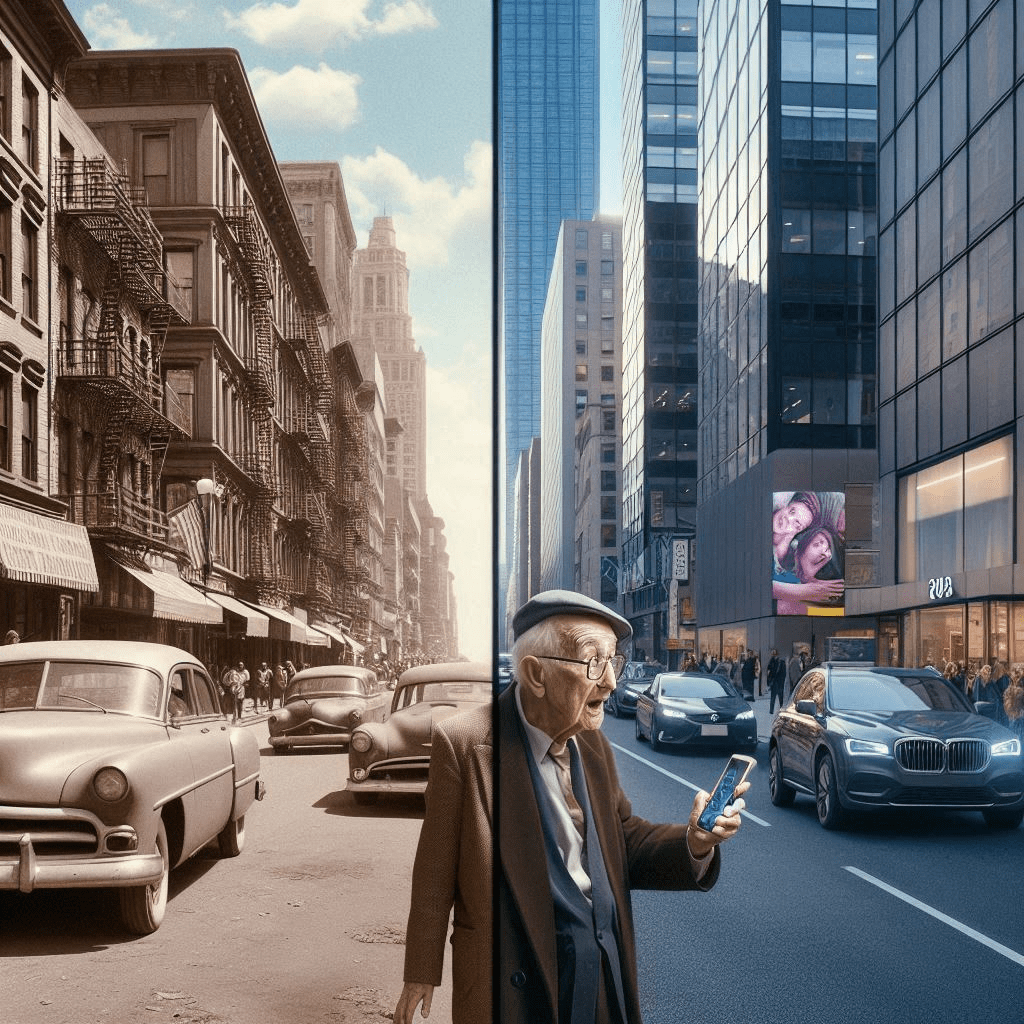
In today’s rapidly evolving technological landscape, the concept of generational amnesia is gaining renewed attention. Generational amnesia refers to the phenomenon where each generation retains only a fraction of the knowledge and experiences of prior generations. This can lead to a loss of important historical insights, potentially causing us to repeat the mistakes of the past. As our society continues to advance, especially with the rise of generative AI, this issue becomes increasingly pertinent.
Continue readingThe Catalyst Effect: How Transformative Inventions Shape Humanity’s Future
Throughout history, catalysts—key events and turning points—have ignited profound shifts in human behavior and societal evolution. From conflicts like World War II to scientific breakthroughs such as the discovery of electricity, each milestone has propelled us into new realms of possibility and understanding. Today, as we stand on the precipice of a technological revolution driven by artificial intelligence (AI), humanoid robots, quantum computing, synthetic biology, and space technology, it is crucial to reflect on how these transformative developments will reshape our future. I have viewed this emerging period as a looking glass moment.
Continue readingReframing The AI Narrative
The unease is still palpable. Artificial intelligence, a fledgling giant, casts a long shadow. Headlines continue to blare warnings of robot domination and technological apocalypse. We teeter on the precipice of a future painted in dystopian hues. But a counter-narrative is making its way into the discourse. Let’s reclaim the narrative. Let’s transform the ubiquitous AI assistants from harbingers of isolation to tools that empower us to focus on the things that truly breathe life into our existence. The conversation needs to shift. Not a passive acceptance of a preordained future, but an active shaping of our shared narrative. We must chart a course, not simply brace for impact. We stand at the precipice, but instead of staring down into the abyss, let’s turn our gaze skyward, towards the boundless possibilities that lie before us. The future is not a pre-written script, but a blank canvas. The question isn’t a resigned “will AI replace us?” but a rousing call to action: “What wonders can we co-create?”
Continue readingTransforming Energy With Artificial Intelligence
A recent report offers a comprehensive strategy for expediting the deployment of clean energy while mitigating risks and costs amidst the climate crisis. In a collaborative effort, 100 experts in clean energy and artificial intelligence convened at Argonne National Laboratory to devise a plan for ensuring America’s energy future. The AI for Energy report captures their collective vision.
Continue readingThe Innovation Vortex: How Emerging Tech Will Reshape Business Models Across Industries
The rise of generative AI is sparking discussions about its potential impact on various industries, with SaaS being a prime example. The traditional per-seat subscription model, a cornerstone of many SaaS businesses, might be vulnerable as AI automates tasks and potentially reduces the need for human users. Here’s a breakdown of the conversation:
Challenge: Generative AI’s ability to automate tasks could lead to fewer human employees needing SaaS applications, impacting per-seat subscription revenue.
Nuance: The impact might not be a complete disruption. While some user seats might decrease, AI could also create new functionalities and workflows requiring additional subscriptions.
For your blog post, consider this summary:
The Rapid Evolution Of Humanoid Robots
The rapid advancement of humanoid robots is revolutionizing technology at an unprecedented pace. In just a few years, we’ve seen leaps in capabilities, from performing complex tasks with human-like intelligence to drastically reducing the time needed to learn new functions. This progress not only highlights the incredible innovation in robotics but also points towards a future where these machines can seamlessly integrate into various aspects of our lives.
Examples are all around us, and this article describes one such example. In less than a year since debuting its 6th-generation general-purpose humanoid robot, Canada’s Sanctuary AI has now introduced the next iteration of Phoenix. Sanctuary AI has been dedicated to developing a versatile humanoid robot capable of performing various tasks, such as labeling boxes, bagging groceries, moving packages, scanning products, and soldering. Initially, these robots are teleoperated to teach them how to execute these tasks effectively.
Continue readingGenerative AI: Thoughts From A Recent Book
I just finished reading a book titled Generative Artificial Intelligence: What Everyone Needs to Know. Author Jerry Kaplan offers a thought-provoking exploration of Generative AI (GAI), a revolutionary technology poised to reshape our world. Delving into its potential to transform everything from healthcare to creative arts, the book also tackles the ethical considerations and challenges that come with this powerful new tool.
Artificial intelligence (AI) has become an undeniable force in our lives. From virtual assistants like Siri to self-driving car technology, AI is rapidly transforming the landscape. However, as Kaplan states, a new wave of AI is poised to make even greater strides: Generative AI (GAI).
Continue readingBrave New Words: Unleashing The Potential Of AI-Driven Education
I just finished reading my most recent book titled Brave New Words, written by renowned education innovator and entrepreneur Salman Khan. In “Brave New Words”, Salman Khan explores the transformative potential of artificial intelligence in education. With his signature clarity and vision, Khan outlines a future where AI-powered learning systems enhance human teaching, increase accessibility, and foster a more equitable education system. This book offers a roadmap for educators, policymakers, and learners to navigate the AI revolution in education and unlock the full potential of humanity. I highly recommend it and have added the book to my Library.
Continue readingNavigating The Uncharted: Embracing AI’s Uncertain Future
I really enjoyed a recent article written by Steve Andriole. I enjoyed it because it appreciates the uncertainty of our times and questions the AI predictions flowing from all corners. As readers of my Blog know, I don’t believe in prediction. Mr. Andriole reflects on a number of failed predictions that underscore the point. Instead, I believe in rehearsing the future.
Continue readingExploring The Potential Of AI Avatars: Reid Hoffman’s Experiment With Digital Twins
LinkedIn co-founder Reid Hoffman recently delved into the realm of AI avatars by engaging in a video interview with a remarkably human-like digital clone of himself. Developed by Hour One and featuring voice cloning by 11ElevenLabs, this AI replica not only mimicked Hoffman’s knowledge and voice but also exhibited nuanced body language, actively nodding, smiling, and shrugging in sync with the real-world counterpart.
Continue reading Reimagining the Future