
Add Singapore to the list of Nations establishing a Smart Nation agenda. In a recent Article authored by Eileen Yu, she describes the launch of Singapore’s national artificial intelligence (AI) strategy. The Singapore government aims to drive AI adoption to generate economic value and provide a global platform on which to develop and test AI applications. As future scenarios go, Smart Nations represent a complex intersection of multiple ecosystems – broader than similar complexities associated with the Smart City scenario.
Humanity
The future of humanity
The Economists’ Hour
I just added another fascinating book to my Book Library titled The Economist’s Hour authored by Binyamin Appelbaum. Mr. Appelbaum is the lead writer on economics and business for The New York Times Editorial Board. From 2010 to 2019, he was a Washington correspondent for the Times, covering economic policy.
I find every journey to the past instructive,  and my hope is we can Learn from History. This book chronicles the role of the Economist, their foray into political waters, and their societal impact. Looking back in time can be surprising, as core beliefs are challenged. What can we learn from this look back? What do we do differently as a result? This is a fascinating journey that I highly recommend. The book abstract from Amazon is included below. The author’s conclusion?
Their fundamental belief? That government should stop trying to manage the economy. Their guiding principle? That markets would deliver steady growth, and ensure that all Americans shared in the benefits. But the Economists’ Hour failed to deliver on its promise of broad prosperity. And the single-minded embrace of markets has come at the expense of economic equality, the health of liberal democracy, and future generations.
The Next 50 Years of Digital Life
Dr. Micah Altman – Director of Research, Center for Research in Equitable and Open Scholarship (CREOS) at MIT – recently made me aware of a Survey that probed several questions about the future of our Digital world. The survey was conducted by Elon University and the Pew Research Internet and Technology Project to imagine social and technological evolution over the next 50 years. The respondents were technologists, scholars, practitioners, strategic thinkers and others.
Reimagining the Future: Revised
Our world certainly has a way of moving quickly. Keeping pace with a myriad of advancements and scenarios is a full-time job. I have spent the better part of one year focused on History – as I look for evidence of similar periods in the past. That work has been very instructive. The results of that analysis – along with an ever changing view of the future – have been incorporated into the latest version of my presentation. You can view or download the current version Here.
Futuristic Developments in the next Ten Years
“When considering potential risks from future technology, one should not be content with merely analyzing what’s likely to happen—instead, one should look at what’s possible, even if unlikely.” – Jaan Tallinn, founding member of Skype, and co-founder of the Centre for the Study of Existential Risk
Continue readingSociety 5.0
I found a very refreshing Article today describing Japan’s vision for the fifth iteration of society. Our hunter-gatherer days represent the first iteration, with agriculture coming in as number two and the industrial and information revolutions rounding out the next two. I’ve written about the Tipping Points in human history – and this vision of a future society is aligned with my point of view on the next tipping point. With each tip, we have experienced Unintended Consequences. Big visions such as these would be wise to ensure a balancing of the Opposing forces of Innovation.
UPS gets FAA clearance to roll out a fleet of delivery drones
For the first time, the Federal Aviation Administration (FAA) has given broad permission to create a fleet of drones to deliver packages with very few limitations on Tuesday – the first time it’s given such broad permission to a delivery company. The delivery program is described in this Article.
Listen to UPS Chairman and CEO describe the Drone Airline that UPS is now going to build out.
Just another example of how the Mobility Ecosystem is evolving rapidly, and the stakeholders within the ecosystem continue to shift. Who will be the dominant players in the ecosystem? One thing is certain: as mobility experiences are altered, traditional companies and their role within the ecosystem will shift – or their roles will be diminished.
The Education Ecosystem
I had a call a while back with education entrepreneur Nick Burnett. Nick shares my passion for rethinking a learning paradigm that was built in a different era. In this world of rapid change, where information is abundant and the shelf-life of skills is short, learning is central to our quest for improved well-being.
During the first revolution, it was education that finally shifted the plight of the working class. In the early days of mass production, it was the introduction of high school that allowed workers to meet the skill set demands of new roles on assembly lines and in the office. This time around, the challenge is greater. The speed dimension promises to complicate the re-skilling requirements of an automated future. It will indeed take an education ecosystem to meet the challenge. In his latest article, Nick focuses on this education ecosystem – well worth the quick read.
Technology Trap
I recently added a fascinating book titled Technology Trap to my Book Library. Author Carl Benedikt Frey has done some important work in partnership with Michael A. Osborne evaluating the impact of automation on the Future of Work. In this new work of applied history, Frey draws on past revolutions to look at possible corollaries. It was Winston Churchill that said: The further Backward you Look, the Further Forward you can See. That quote has stuck with me, prompting my Looking back to see Ahead. Here is the book abstract:
Strategic M&A in an Era of Ecosystem-Driven Collaboration
In July I facilitated a CEO round table discussion focused on Ecosystems, collaboration, and the role of strategic Mergers and Acquisitions. It was a fascinating discussion captured in this Post-Session Article.
Competing in the Age of Ecosystems
I recently partnered with colleagues Bill Quinn, Kevin Mulcahy, and Rose Castellon-Rodriguez on an article for TCS Perspectives. You can Download the Article or view it Here.
The Augmented Age
Maurice Conti is the Chief Innovation Officer at Alpha focused on what he calls the Augmented Age. He talks about it this way: We’re heading for a future where our natural human capabilities are going to be radically augmented in three ways: Computational systems will help us think. Robotic systems will help us make. And a digital nervous system will connect us to the world far beyond what our natural nervous system can offer.
Rehearsing the Future
 I had the pleasure of participating on a radio show titled Geeks, Geezers, and Googlization. Hosts Ira Wolfe and Keith Campagna did a great job of facilitating our discussion about the future. Check out their Summary of our conversation, and/or listen to our conversation via this rebroadcast.
Looking Back to See Ahead
The further Backward you Look, the Further Forward you can See – Winston Churchill
I really like this quote from Winston Churchill. In a previous post on Learning from History, I was trying to say the same thing. One of the key learnings in looking back at our most transformative period (late nineteenth, early twentieth century), was the Convergence that occurred across multiple domains. I had developed a visual to capture a convergence phenomenon that took place over a one hundred year period – some have called this a Special Century. I updated the visual with new content (click the visual to expand). The color scheme shows the convergence that occurred across the business, science, technology, political, societal and economic domains. The red boxes represent the Catalysts that drove this convergence.
Embracing the Collaborative Nature of Ecosystems
Thoughts I shared at this years TCS Innovation Forum in New York City.
Optimist or Pessimist?
In late 2016, having just finished reading The Rise and Fall of American Growth, I was thinking about an underlying theme of the book – the views of techno-optimists versus those of techno-pessimist. In the context of the books narrative, the techno-optimist believes that future innovations will indeed drive a resurgence of growth – albeit at the expense of jobs. The pessimist sees no return to growth and believes our best innovations are behind us. Two years ago, I posed a question via a Post: Are you a techno-optimist or techno-pessimist?
Game Changers: Designing the Future of Humanity
Today on Coffee Break with Game Changers, Bonnie D. Graham hosted a show focused on designing the future of humanity. You can listen to the rebroadcast here. The session abstract is included below, as well as a Twitter stream that provides insight into the topic and our discussion. The show participants included: Bonnie, Masha Krol, Ian Gertler, Maricel Cabahug and myself.
The Great Reset
We face the task of understanding and governing 21st-century technologies with a 20th-century mindset and 19th-century institutions – Klaus Schwab: Shaping the Fourth Industrial Revolution.
In a video titled “The Great Reset”, economist Tyler Cowen uses a great metaphor of canaries in coal mines to describe the warning signals that seem like local events – but actually represent greater and broader stress. He uses several recent examples to highlight the growing stress in the system and the potential for a great reset in the future. Regardless of your belief system – it is hard to argue with the underlying logic. Whether we view this as the Fourth Age in human history, a third major Tipping Point, or a Great Reset, structural change is inevitable. This short seven minute video drives this point home.
The Fourth Age
Byron Reese recently authored a book titled The Fourth Age. I thoroughly enjoyed this fascinating look at history, and the focus on possible futures. In looking at the future, Mr. Reese explores the reasons that experts disagree on the path of these possible futures. He asks: why do Elon Musk, Stephen Hawking, and Bill Gates fear artificial intelligence (AI) and express concern that it may be a threat to humanity’s survival; and yet, why do an equally illustrious group, including Mark Zuckerberg, Andrew Ng, and Pedro Domingos, find this viewpoint so far-fetched as to be hardly even worth a rebuttal? The answer as described by the author lies not in what we know – but what we individually belief. This theme throughout the book is an interesting piece of self-reflection. See how you would answer the questions posed by the author.
Visualizing Our Emerging Future – Revised
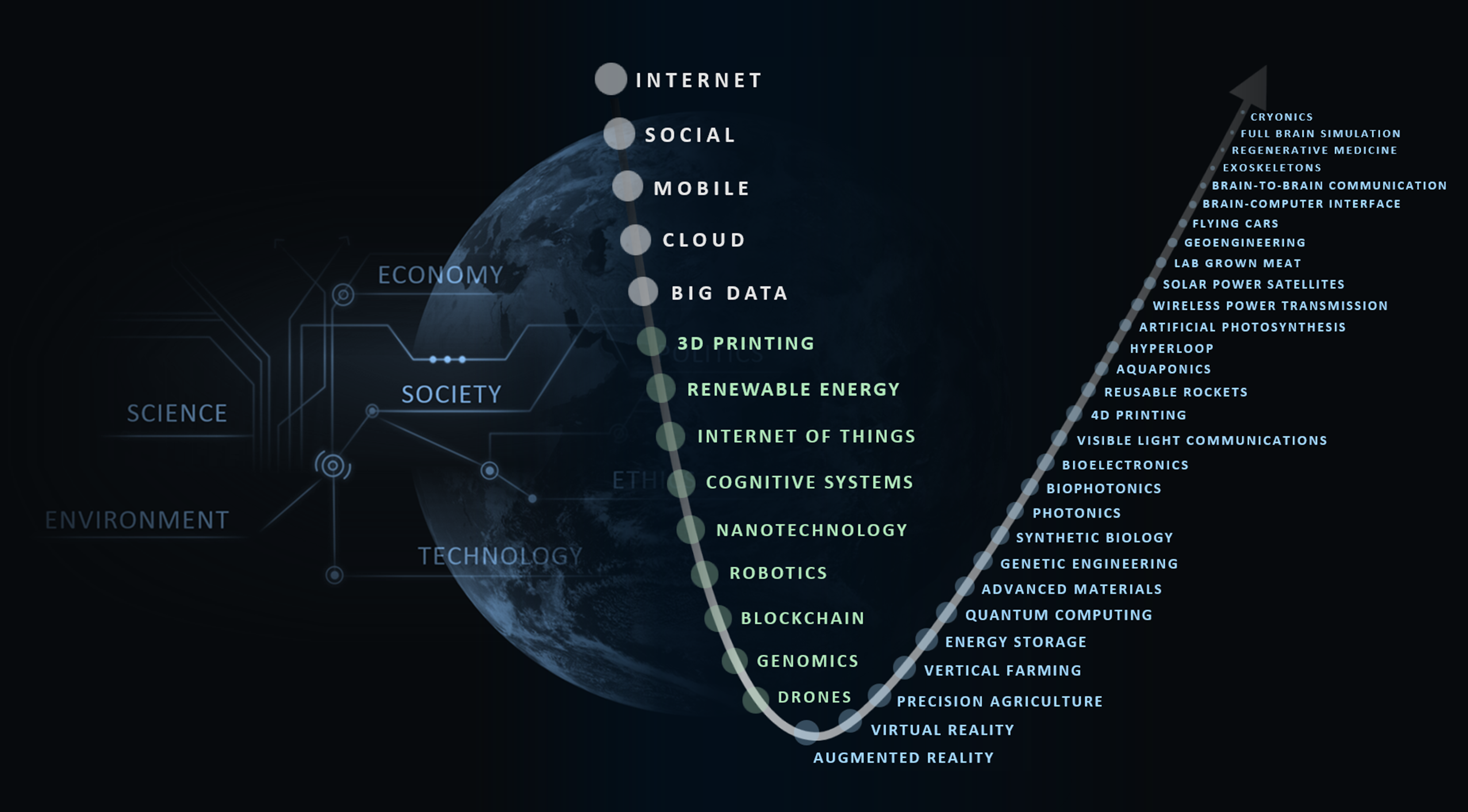
As our emerging future shifts continuously, our challenge is to shift with it. The number of building blocks that combine continues to explode, challenging our ability to track its complexity. I’ve used a visual representation of this challenge – and I see older versions floating around – so I am updating it via this post. When I use the visual in presentations, I build towards it to avoid its overwhelming nature (which I believe accurately reflects the overwhelming nature of the challenge). I will replicate the approach here by building towards the full visual.
Convergence across aspects of science, technology, economic forces, politics, society, our environment, and a growing conversation around ethics, is creating a highly uncertain world. At the heart of the pace dynamic is the exponential progression of science and technology – reflected in the first piece of the visual.
 Reimagining the Future