
On November 30th, I had the pleasure of participating in another Game Changers show. I was joined by Futurist Gerd Leonhard and SAP Innovation executive Timo Elliott. The show was expertly moderated by Bonnie D. Graham, starting with her positioning of the topic: “Impossible is not a fact. It is an opinion” (Muhammad Ali). A unique clustering of inventions in the century after the U.S. Civil War improved the American and European standard of living – human well-being – more than any period before or after, with advances in everything from food and energy to health and work. Can our current innovation explosion have a similar impact despite unintended consequences?
Year: 2016
Reimagining the Future
The future is arriving faster than most people think.
When we look around us, we see a world in which digital is now woven into the fabric of our lives. Where convergence of paradigm shifts is now the new norm and the pace of change is accelerating exponentially. We are now living in a looking-glass world; where everything we think we know is being challenged, including our long-held notions of success and failure. At the same time it’s a world where we can imagine, create and enable like never before.
Revolution and the Innovation wheel
In a brilliant journey through the economic history of the western world, author Robert J. Gordon looks at The Rise and Fall of American Growth. This recent book focuses on a revolutionary century that impacted the American standard of living more than any period before or after. Our standard of living is typically viewed as the ratio of total production of goods and services (real GDP) per member of the population. But this measure fails to truly capture enhancements to our well-being. Human well-being is influenced by advances in the areas of food, clothing, shelter, energy, transport, education, health, work, information, entertainment, and communications. The special century (1870 – 1970) that followed the Civil War was made possible by a unique clustering of what the author calls the great inventions. Clearly – as the visual I developed depicts – the great inventions of the second industrial revolution significantly improved our well-being:

Techno-Optimist or Techno-Pessimist?

A recent book by Robert J. Gordon titled The Rise and Fall of American Growth shines a light on technological innovation and its past and future impact on growth. The premise of the book is that the innovations of the special century (1870 – 1970) cannot be replicated. As such, the author does not envision a return to growth for America (hence the title). The book is very well written, and I will touch on aspects of it in future posts. For this post, I’d like to gauge the reader’s level of optimism or pessimism.
Balancing the Opposing Forces of Innovation
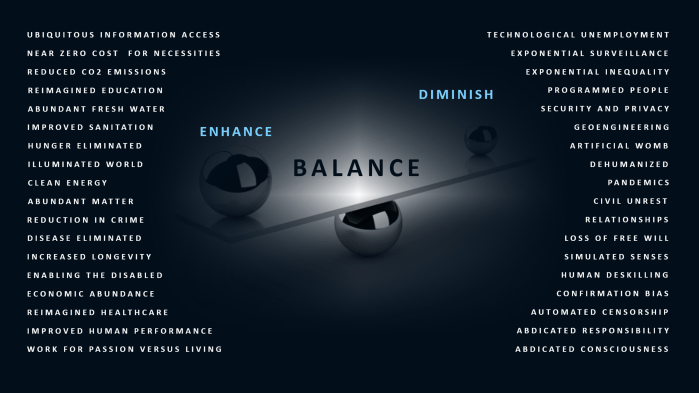
The unabated exponential progression of science and technology has driven a staggering pace of innovation. The building blocks are mostly there, allowing creative minds to combine them in ways that attack the world’s most difficult challenges.
Innovation Killer Organization Chart
Heidi Schwende recently shared a picture on LinkedIn that perfectly captures the challenges facing large traditional companies. Exponential progression, the pace it is driving, and the capacity of companies native to digital to innovate put the traditional company at a severe disadvantage.
Artificial Intelligence Intersects with Social Media
In his fifteenth post in the series, Marshall Kirkpatrick focuses on the intersection between artificial intelligence and social media. By way of reminder, Marshall launched a 30 day series that explores the intersection between AI and the various innovation components on my emerging futures visual.
Artificial Intelligence Intersects with Smart Cities
In his fourteenth post in the series, Marshall Kirkpatrick focuses on the intersection between artificial intelligence and smart cities. By way of reminder, Marshall launched a 30 day series that explores the intersection between AI and the various innovation components on my emerging futures visual.
Artificial Intelligence Intersects with Drones
In his thirteenth post in the series, Marshall Kirkpatrick focuses on the intersection between artificial intelligence and drones. By way of reminder, Marshall launched a 30 day series that explores the intersection between AI and the various innovation components on my emerging futures visual.
Artificial Intelligence Intersects with Robotics
In his twelfth post in the series, Marshall Kirkpatrick focuses on the intersection between artificial intelligence and robotics. By way of reminder, Marshall launched a 30 day series that explores the intersection between AI and the various innovation components on my emerging futures visual.
Artificial Intelligence Intersects with Nanotechnology
In his eleventh post in the series, Marshall Kirkpatrick focuses on the intersection between artificial intelligence and nanotechnology. By way of reminder, Marshall launched a 30 day series that explores the intersection between AI and the various innovation components on my emerging futures visual.
Artificial Intelligence Intersects with Autonomous Vehicles
In his tenth post in the series, Marshall Kirkpatrick focuses on the intersection between artificial intelligence and autonomous vehicles. By way of reminder, Marshall launched a 30 day series that explores the intersection between AI and the various innovation components on my emerging futures visual.
Artificial Intelligence Intersects With the Internet of Things
In his ninth post in the series, Marshall Kirkpatrick focuses on the intersection between artificial intelligence and the Internet of Things. By way of reminder, Marshall launched a 30 day series that explores the intersection between AI and the various innovation components on my emerging futures visual.
Artificial Intelligence Intersects with Blockchain
In his eight post in the series, Marshall Kirkpatrick focuses on the intersection between artificial intelligence and blockchain. By way of reminder, Marshall launched a 30 day series that explores the intersection between AI and the various innovation components on my emerging futures visual.
Artificial Intelligence Intersects with Genomics
In his seventh post in the series, Marshall Kirkpatrick focuses on the intersection between artificial intelligence and genomics. By way of reminder, Marshall launched a 30 day series that explores the intersection between AI and the various innovation components on my emerging futures visual.
Artificial Intelligence Intersects with Renewable Energy
In his sixth post in the series, Marshall Kirkpatrick focuses on the intersection between artificial intelligence and renewable energy. By way of reminder, Marshall launched a 30 day series that explores the intersection between AI and the various innovation components on my emerging futures visual.
Artificial Intelligence Intersects with Mobile and Cloud
In his fourth post in the series, Marshall Kirkpatrick focuses on the intersection between artificial intelligence and Mobile, and in the fifth he focuses on cloud. By way of reminder, Marshall launched a 30 day series that explores the intersection between AI and the various innovation components on my emerging futures visual.
Artificial Intelligence Intersects with Fintech
In his third post in the series, Marshall Kirkpatrick focuses on the intersection between artificial intelligence and Fintech. By way of reminder, Marshall launched a 30 day series that explores the intersection between AI and various future scenarios anchored by my emerging futures visual.
Artificial Intelligence Intersects with 3D Printing
In his second post in the series, Marshall Kirkpatrick focuses on the intersection between artificial intelligence and 3D Printing. By way of reminder, Marshall launched a 30 day series that explores the intersection between AI and various future scenarios anchored by my emerging futures visual.
Artificial Intelligence and Future Scenarios
I had the pleasure of talking to Marshall Kirkpatrick recently about his work at Little Bird and a new series on artificial intelligence that he just launched. Marshall has leveraged my emerging futures visual in the past, and is using it to steer the direction of his series. The first article focuses on How Artificial Intelligence Could Change the Future of Food.
 Reimagining the Future
