The Compressed Present

THE BIO-INTELLIGENT SIGNATURE: A LENS ON THE CURRENT AGE

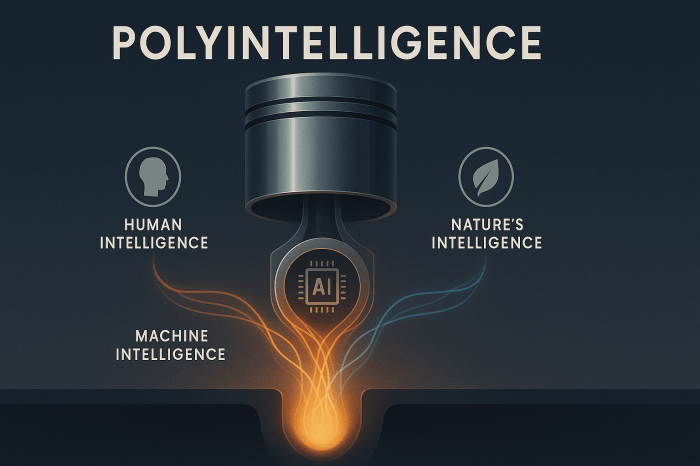
The present moment is shaped by three converging streams of intelligence: machine intelligence, biological intelligence, and planetary intelligence. These are the same sources that form what I have described elsewhere as polyintelligence — cognition distributed across humans, machines, and nature. Each stream is advancing on its own, but their deeper significance appears in how they now influence one another. Artificial intelligence extends cognition beyond the human mind. Synthetic biology brings design and computation into living systems. And the planet — long treated only as a resource base — is increasingly recognized as a source of insight. Through biomimetics, natural systems provide design principles refined through evolution: circularity instead of waste, resilience through diversity, and adaptation through constant sensing and feedback.

Continue reading

Crossing The Threshold

Civilization’s great shifts are the moments when continuity fails and a new order takes shape. Each historical age reached a point where the old logic could no longer hold, and pressures converged into a transformative release. By examining four major transitions – from Hunter–Gatherer to Agricultural, Agricultural to Axial, Axial to Renaissance, and Renaissance to Industrial – we can see how rising Total Systemic Domain Score (TSDS) and changing Activation Dispersion (AD) signaled that a threshold was near. Some transitions unfolded slowly over millennia, while others struck within a few centuries. In each case, the build-up of energy and imbalance hit a critical point, and society crossed into an irreversible new configuration that only in hindsight feels inevitable.

Continue reading

What The Gauges Reveal Across The Ages

Over the first seven posts, we explored the seven domains that shape civilization, the forces that move within them, the thresholds that mark major transitions, and the drivers that push systems toward those turning points. We also built two gauges that help make those movements visible. TSDS shows how much energy sits across the seven domains. AD shows how that energy is arranged. Together, they help us see the internal structure of an age: how active its domains were, how evenly that activity spread, and how tightly the system was coupled. With that groundwork in place, we can now use the gauges to trace the long arc of history and examine how pressure accumulated across major ages of civilization.

Continue reading

How The Gauges Were Built: Making Systemic Pressure Legible

Over the first six posts, I built the foundation needed to understand how civilizations change. I explored the seven domains that shape collective life, the forces that move within them, the thresholds that mark historical turning points, and the three drivers that push systems toward those moments. With that groundwork in place, I introduced a pair of gauges that make those movements easier to see. In this post, I describe the gauges in greater detail. TSDS reflects how much energy sits across the seven domains. AD shows how that energy is arranged. Before we apply these gauges to the long arc of history, we need to explain how they were built. Every measure rests on a set of choices. This post walks through those choices in a way that keeps the gauges intuitive while grounding them in the history they aim to describe.

Continue reading

Reading The Pulse Of A Civilization In Motion

The first five posts laid the foundation for understanding why the world feels dense, fast, and tightly connected. We explored the sense that something in the operating logic of civilzation is shifting. We looked at phase transitions, the four-stage pattern that repeats across history, and the seven domains that structure civilization. The last post introduced the three deep drivers that push civilizations across thresholds: growing convergence, system-shaping technologies, and the acceleration of knowledge. Taken together, they help explain why pressure builds, why systems couple, and why some ages move differently than others.

Continue reading

Why Everything Feels Like It’s Changing At Once

Recap from Last Post

I opened this series by exploring why the world feels unsettled in ways that don’t fit the usual explanations. I introduced the idea of systemic change: moments when multiple parts of civilization become active at the same time, pushing and amplifying one another. I described today as a phase of compression, where pressures build across domains faster than old structures can absorb them. This post will bring that idea down to everyday experience. What do phase transitions feel like in normal life?

Continue reading

When Systems Shift: The Rare Alignment Driving Change Today

History is filled with moments of disruption and reform. But true systemic change – when the very foundations of society are redefined – has been rare. These periods of profound transition are not triggered by short-term trends. They emerge when multiple deep forces move in tandem, setting in motion the restructuring of the societal platform itself.

Continue reading

Pressure Points And Catalysts: Shaping Our World

I introduced the notion of pressure points and catalysts in an earlier post. Here are the results of my analysis.

Introduction

The trajectory of human civilization is not merely a linear progression but a complex interplay of forces that build, converge, and occasionally erupt into periods of profound transformation. Understanding these dynamics requires a framework centered on Pressure Points and Catalysts – concepts crucial to comprehending how global systems evolve and redefine themselves.

Continue reading

Building Possibility Chains: Mapping Disruption Across A Converging World

As I’ve explored in Post One and Post Two of this series, history doesn’t move in straight lines. It moves in cycles of buildup and release – of pressure and systemic change. Across time, humanity has navigated moments when systems fray, institutions falter, and norms break down. These moments are rarely surprises. They’re preceded by converging signs – warning lights blinking across domains that something foundational is under strain. We are in such a moment now.

Continue reading

When All Domains Move At Once – Understanding The Convergent Instability Of Our Time

In the first post of this series, I explored the expanding possibility space – the widening range of plausible futures shaped by more than 1,700 convergent forces unfolding across time and across domains. That post introduced the structural lens for understanding how pressure builds, how pathways emerge, and how catalysts may eventually reshape the system. This post focuses on what makes that possibility space so expansive in the first place: the simultaneous instability across seven foundational domains. Science, technology, economy, society, geopolitics, philosophy, and environment are not shifting sequentially or in isolation. They are all in motion, at the same time, and in constant interaction.

Continue reading

Meeting Today’s Grand Challenges – The Next Wave of Convergence

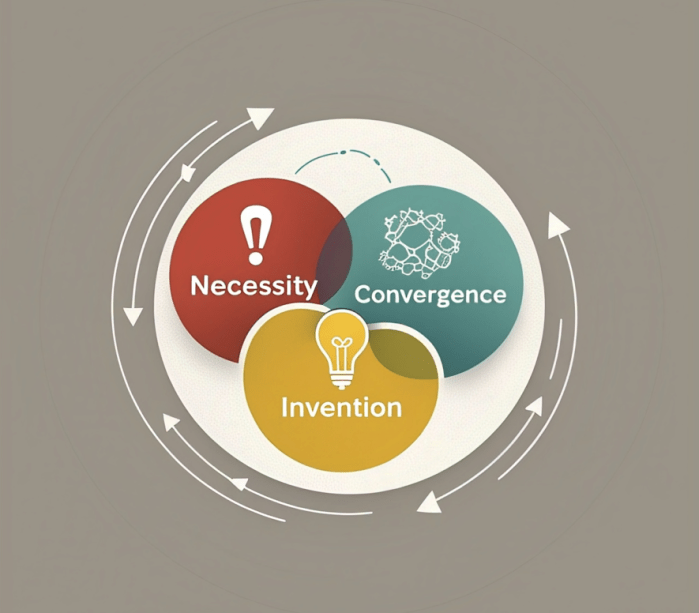
Throughout this four-part series, we’ve seen how necessity sparks invention – and together, they transform our society in profound ways. Today, our world faces an array of urgent challenges, from climate change and demographic shifts to economic and geopolitical instability, cybersecurity threats, and healthcare crises. These pressures are igniting a fresh wave of convergence, where inventive and innovative responses to pressing needs are poised to reshape our future. As we enter this transformative era, the cycle of necessity and invention reminds us that bold, purpose-driven invention and innovation is our best path forward.

Continue reading

The Necessity-Invention-Convergence Framework

The Necessity-Invention-Convergence Framework provides a structured way to analyze the forces that drive human progress. At its core, necessity serves as the fundamental driver of change, arising from pressing challenges, constraints, or demands. Whether economic, social, environmental, or geopolitical, necessity compels action and forces innovation. Throughout history, this dynamic has played out in transformative ways. The Industrial Revolution was fueled by labor shortages and an increasing demand for goods, just as the Digital Revolution emerged in response to the need for faster, decentralized communication. Today, the global energy transition is being shaped by the necessity of addressing climate change and resource limitations.

Continue reading

2025 Global Risks Report

Every year, the World Economic Forum’s Global Risks Report offers a critical snapshot of the forces shaping our world. The 2025 edition paints a picture of escalating tensions, deepening fractures, and an accelerating transformation of our societal foundations. As we navigate an increasingly complex landscape, the report underscores the necessity of adaptability, resilience, and the capacity to thrive – what I call the ART of navigating uncertainty.

More than ever, this year’s report validates the idea that we are in a period of convergence – where geopolitical instability, technological disruption, societal shifts, economic volatility, environmental stress, and philosophical reorientation are colliding in ways that will redefine our future. Below, I’ve categorized the major risks identified in the report under the seven core convergence domains that I frequently discuss: science, technology, society, geopolitics, economy, environment, and philosophy.

Continue reading

Nexus: A Deep Dive Into Humanity’s Information Age

In his latest book titled Nexus – A Brief History of Information Networks from the Stone Age to AI, author Yuval Noah Harari describes the role that information networks have played in shaping society. A nexus is a connection or series of connections linking two or more things. It often refers to a central or focal point where multiple elements converge or interact. The term is used in various contexts to describe relationships or linkages within systems, networks, or concepts that are interconnected.

Continue reading

Learning From The Past: Unlearning For The Future

In an era of rapid change, the traditional understanding of literacy has become increasingly insufficient. Historically, literacy was defined simply as the ability to read and write – fundamental skills that enabled individuals to participate in society. However, as Alvin Toffler wisely pointed out, the definition of literacy in the 21st century has expanded far beyond these basic abilities. Today, true literacy encompasses the capacity to continuously learn new skills, let go of outdated knowledge, and acquire fresh perspectives. This shift reflects the profound changes in our world, where scientific and technological advancements, societal shifts, geopolitical tensions, and economic uncertainty are constantly reshaping the demands placed on individuals.

Continue reading

2024 Consensus Predictions

In a recent article the team from Visual Capitalist put together a listing of the most common predictions, from over 700 analysts, as to what they believe we’ll see in the next 12 months. In this now fifth year of Prediction Consensus they summarized 25 of the most common predictions and forecasts by experts into a single visual of what’s expected to happen in 2024. The visual below and article referenced above offer an overview of the most cited trends and opportunities that experts are watching for the rest of the year. Have a look.

Navigating The Horizons Of 2024: Thoughts Across Diverse Fields

As we stand on the precipice of 2024, a year brimming with potential and uncertainty, experts across various domains will offer their insights into the shape of things to come. From scientific breakthroughs to geopolitical shifts, from societal transformations to environmental challenges, these insights paint a multifaceted portrait of the year ahead. I’ll add my thoughts to the conversation. The uncertainty that exists across these domains adds to the difficulty in understanding possible futures. It is convergence that occurs across them that illuminates the possibilities.

Continue reading

The Journey: The Building Blocks Of The Future

My previous posts launched a series that will tell the full story of a reimagined future. Described as a journey through the looking glass, the story began with a series description and a look back in time. The series continues, with each post featuring a piece of our journey. We explored the extreme uncertainty of the future in the last post. In this post, I will now dive deeper into the building blocks of the future.

Continue reading

A Growing Number Of Building Blocks Make Prediction Impossible

I have been of the opinion that the number of building blocks across multiple domains makes prediction impossible. As a result, understanding the future is about rehearsing it versus predicting it. That ambiguity makes many uncomfortable. Humans like certainty, but we live in a world that is very uncertain. Many will argue that this has always been the case. But it should be increasingly clear that periods like this emerging phase transition have only occurred a handful of times in human history. We want to rely on methods that have proven effective in the past. We find comfort in applying those methods to drive a degree of certainty. One need only look at these building blocks to see rehearsal is the only way to identify possible futures.

Continue reading

Is The Digital Era Over?

I had a discussion last week that focused on a post-digital world. It was an open question about the state of digital and the related transformation journey. Although the digital maturity of organizations is not where I envisioned it – and Covid-19 underscored the point – digital should be a foundational piece of a bigger story. The continued digital discussion ignores the bigger contributions of science and the boardroom conversations around purpose and innovation. A recent article goes one step further in declaring that the digital era is over, and we are in a New Era of Innovation. In it, Greg Satell makes the exact argument I made above.

Continue reading