
Across every domain I have explored – from education and energy to health, governance, and human longevity – one pattern keeps reappearing whenever society encounters a General Purpose Technology. These are the rare breakthroughs that do not simply make us more efficient but fundamentally restructure how civilization operates. Language, writing, the printing press, the steam engine, and electricity each changed not only what we did, but who we became. Artificial intelligence may join that lineage.
Continue readingSmart City
Urbanization And The Rise Of Megacities
By 2050 it’s predicted that 68% of the world’s population will live in a major city — that’s 2 in 3 people. According to this recent article, less than 10% of people lived in urban areas in 1800. Today, more than 4.3 billion people or 55% of the world’s population live in urban settings.
This macro-level societal force will converge with forces from other domains to shape an uncertain future. One such domain is technology, where the rise of smart cities will coincide with the rise of megacities. What is a megacity?
Continue readingFuturistic New Cities
I believe the smart city represents the intersection of multiple emerging ecosystems. Energy, transport, water, food, health, and more, could come together to create a more equitable and sustainable future. At least that’s the mission of Telosa. A recent article via Oscar Holland describes the vision of billionaire Marc Lore:
The cleanliness of Tokyo, the diversity of New York and the social services of Stockholm: Billionaire Marc Lore has outlined his vision for a 5-million-person “new city in America” and appointed a world-famous architect to design it.
Oscar Holland – Plans for $400-billion new city in the American desert unveiled
Per the article, the 150,000-acre proposal promises eco-friendly architecture, sustainable energy production and a purportedly drought-resistant water system. It embraces a “15-minute city design” that allows residents to access their workplaces, schools and amenities within a quarter-hour commute of their homes. The brief video describes the vision.
Revisiting the Intersections That Shape Our Future
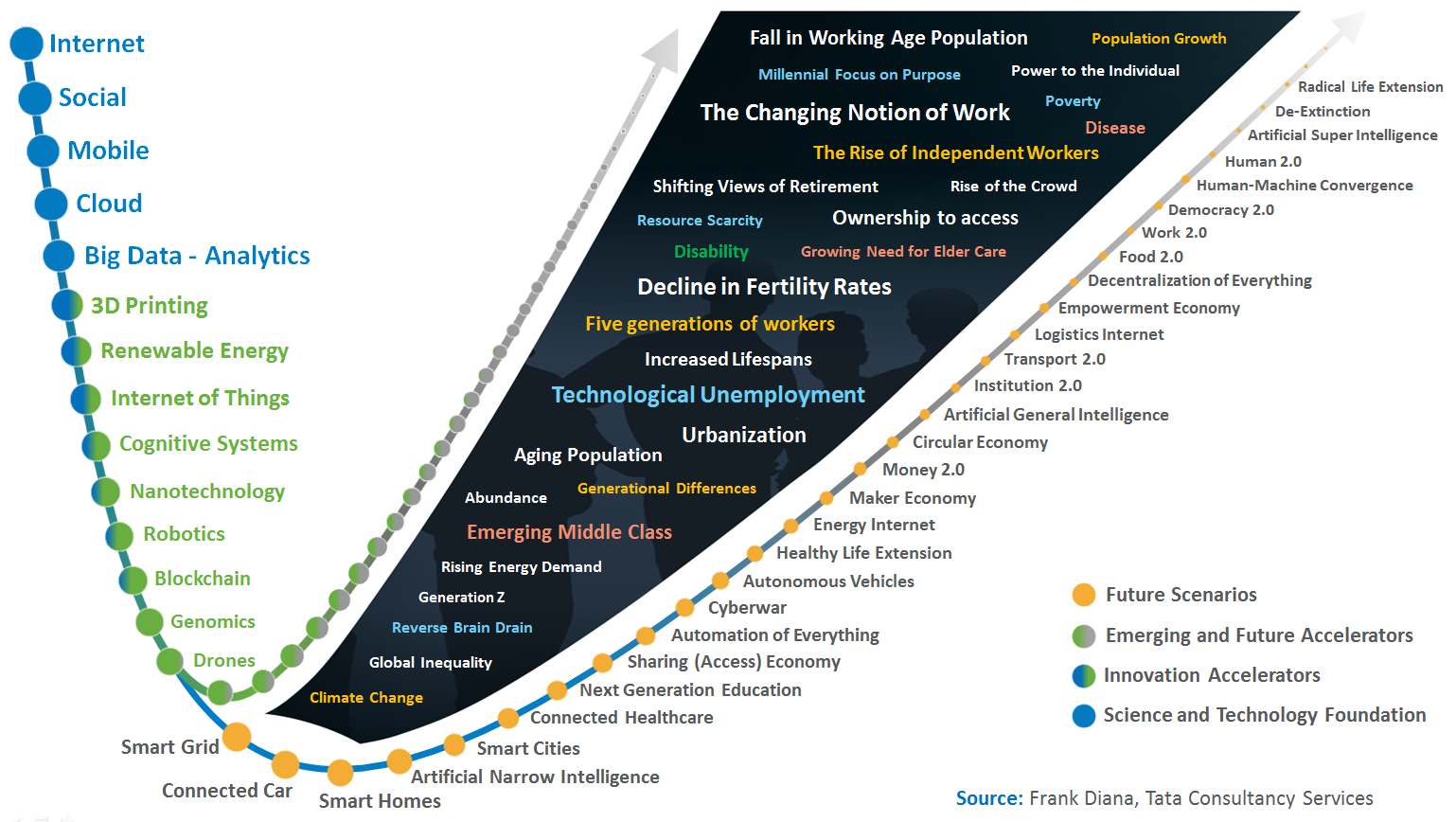
The building blocks of our future are numerous, and they are intersecting in ways that drive rapid shifts. I Visualized this phenomenon a while back, trying to depict the complexity of our world and the challenges it represents. It was Futurist Gerd Leonhard that gave me the idea. As someone who used my Anchor Visual in keynotes, he reflected on how impactful it might be to demonstrate the convergence that was occurring across the visual.
Can Technology Address The Racism Problem?
I recently received a note from one of my readers regarding racism. As someone who has leveraged my anchor visual, he recognized racism as a societal issue in the middle of it. As depicted, societal issues create tension that drives the progression of two curves: the science and technology foundation, and the future scenarios spawned by convergence across the visual. This tension happens in both directions, as the curves also impact the path of society. This individual explored one of those tensions, namely, the use of technology to address systemic racism. In his words: “I find the problem to be one of the most difficult to solve through just laws and politics. I really think that technology can help.”
The Rise Of the Smart City
In my ongoing search for signals that point to potential futures, I both stumble upon great insight, or am made aware of it. When it’s the latter, I wrestle with how much to share. I use the value of the insight as my decision criteria, and in the case of this smart city infographic, I am compelled to share. However, this insight (and all other signals) must be viewed through the lens of the current pandemic. What, if anything, is impacted as a result of changes in human behavior? For example, will the projections of mass urbanization hold, or will fear of living in dense areas reverse that trend – essentially serving as an obstacle? Does the city revenue shortfall accelerate the march towards a Next Generation of Productivity? Does a growing appreciation for science shine a light on climate change, thereby accelerating the focus on sustainability?
Computing on the Edge
Multiple changes to our compute paradigm are required to realize the disruptive and humanitarian advances promised by rapid innovation; whether it is the continued advancement of Moore’s law through new methods, or a complete replacement of the compute platform (e.g. Quantum Computing). One of those near-term changes is set to hit wireless networking, and 2020 could be the turning point. As described in this Article, A trio of new technologies is set to redefine wireless networking. That, in turn, could change the way enterprises think about building applications, managing data, distributing computing resources and deploying robots and factory floor machinery.
Bursts of Possibility
Fast Future Research provides a glimpse into possible futures through a series of recently published books that focus on our Our Emerging Future and accelerate our learning and dialog. As with his previous books, Rohit Talwar enlists several authors in a new book just launched titled A Very Human future. An abstract for the book reads as follows:
As society enters the fourth industrial revolution, a major question arises—can we harness intense technological bursts of possibility to bring about a better world? A Very Human Future illustrates how the evolution of society, cities, people, businesses, industries, nations, and governments are being unexpectedly entangled by exponential technological disruption. This is not a book about technology but an exploration of how we make it serve humanity’s highest needs and ambitions.
Monetization Strategies in Emerging Ecosystems
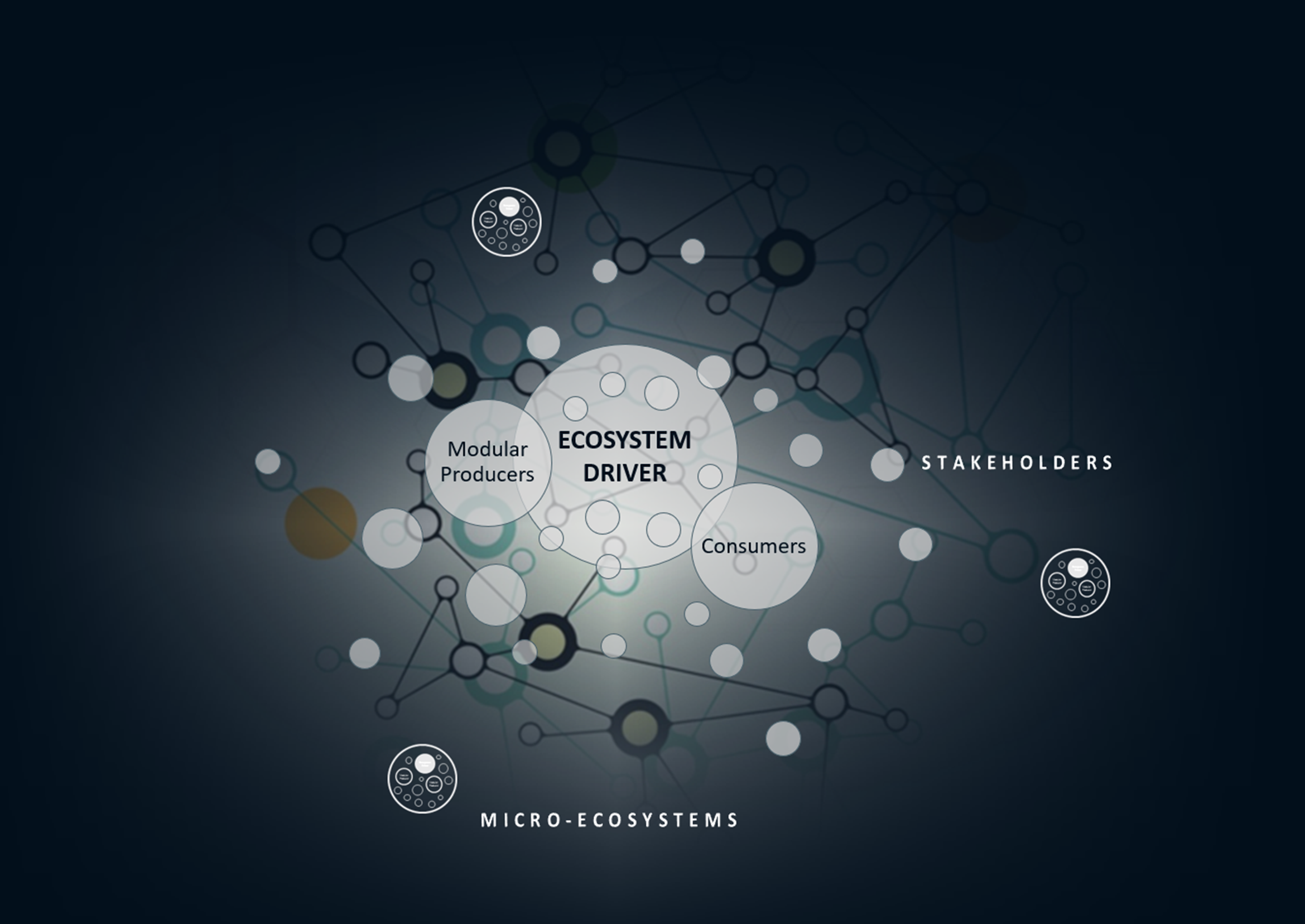
As horizontal ecosystems become the primary means of value creation and capture, organizations will embrace various monetization strategies. Given the proven growth potential of platforms (the foundation of ecosystems) and the increasing collapse of Industry boundaries, the urgency to understand ecosystem dynamics is growing. Ecosystems enable producers and consumers to interact in ways that create shared value. In many cases, stakeholders will play either role at any given time – a phenomenon some have called side switching.
The Ripple Effect
In segment three of my interview with Chunka Mui, we discussed the ripple effect that occurs with emerging scenarios, in this case, the driverless car. Chunka Mui is the managing director of the Devil’s Advocate Group, a consulting team that helps organizations design and stress test their innovation strategies. Mr. Mui published a popular book titled The New Killer Apps.
What fascinates me about these scenarios is the sheer breadth and depth of societal impact. In this segment, Chunka Mui does a great job of describing this impact. Here is a seven minute animated version of our discussion that picks up where segment two left off:
Artificial Intelligence Intersects with Smart Cities
In his fourteenth post in the series, Marshall Kirkpatrick focuses on the intersection between artificial intelligence and smart cities. By way of reminder, Marshall launched a 30 day series that explores the intersection between AI and the various innovation components on my emerging futures visual.
The Disruptive Role of Near Field Communications
Over the last several years, the big four technologies of the third platform (Social, Mobile, Big Data, and Cloud) have received the lion share of attention, and an emerging class of innovation accelerators like The Internet of Things will capture attention in the coming years. But there are also a number of supporting technologies that serve as enabling components of multiple disruptive scenarios. In some recent presentation preparation work, I focused on technologies like Near Field Communications (NFC) and iBeacon. It was fascinating to find broad applicability across many of the disruptive scenarios on the visual I have used to describe the coming paradigm shift.
The Smart City
Next up in this ongoing look at disruptive scenarios is the Smart City. For the first time in history, more than 50% of the world’s population lives in cities, and that percentage moves to 70% by 2050.
 Reimagining the Future
