
Dan Wang’s Breakneck: China’s Quest to Engineer the Future is not just a book about China. It is a book about what happens when a society decides that building matters more than debating, that execution matters more than process, and that national ambition should show up in steel, concrete, factories, power systems, and supply chains. Wang’s central argument is memorable because it is so simple: China operates as an engineering state, while the United States has drifted into what he calls a lawyerly society. In his framing, China’s governing class tends to think like builders, while America’s elite class increasingly thinks like litigators, gatekeepers, and procedural managers. The result is not merely a difference in politics. It is a difference in what each society can actually get done.
Continue readingPolitics
The Real Demographic Crisis Is Institutional
A recent article by Dan Pontefract uses Japan as a warning about demographic decline, pension strain, and government inaction. That framing is useful, but I believe the bigger story sits beneath it. Japan is not just a country in trouble. It is an early stress test for a much larger structural problem now moving across the developed world.
We often talk about demographics as if they were simply about aging, retirement, or falling birth rates. They are much more than that. Demographic change is a slow systems disruption. It gradually weakens the assumptions that modern economies were built on: a growing workforce, a stable ratio between workers and retirees, predictable career paths, and public systems designed for shorter lifespans and larger families. Once those assumptions begin to break, the pressure does not stay contained. It moves through the labor market, economic growth, healthcare systems, pension models, public finance, and the basic design of work itself.
Continue readingWhen No One Owns The Outcome
A series: When Systems Move Faster Than We Do
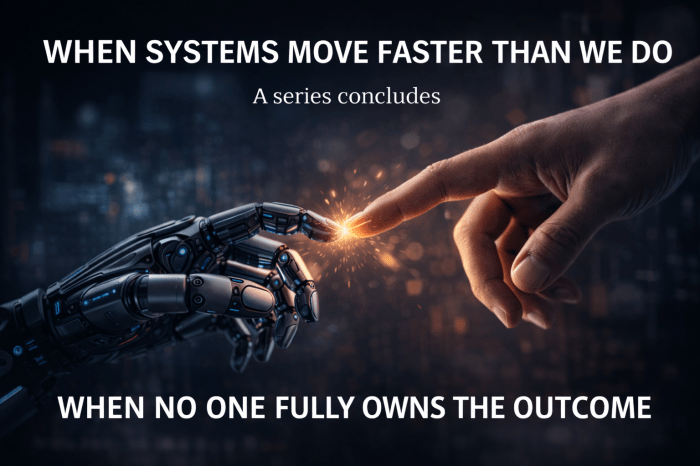
Across this series, we have followed a single pressure as it moved inward. In the first post, we examined what happens when intelligence outpaces human review and shared validation begins to thin. In the second, we saw how that acceleration moves into infrastructure, as environments stop waiting for instruction and begin acting automatically. In the third, we traced the consequences for institutions, where governance shifts from fixed rules toward continuous calibration and legitimacy begins to lag control. In the fourth, we carried that same substitution logic into the human domain, where people remain socially central while becoming operationally optional. What remains is responsibility.
Continue readingMoving One Layer Deeper – The Constraints That Drive Our Future
When I first described pressure points and catalysts, the goal was to explain why large-scale change rarely arrives without warning. History does not shift randomly. It shifts when accumulating pressures reach limits that systems can no longer absorb. That framing remains. We now move one layer deeper — from pressure as a visible signal to constraint as the underlying mechanic.
A pressure point is not simply stress in the abstract. It is a constraint that reduces flexibility. It is a limit that narrows optionality. It appears when decisions become harder to reverse, when response time shrinks, when coordination becomes more expensive, and when substitution becomes necessary rather than optional. Pressure points mark where systems are approaching or crossing limits.
Continue readingWhen Institutions Lose Fixed Authority
A series: When Systems Move Faster Than We Do
In the first two posts in this series, we examined how intelligence is outpacing human review and how environments are beginning to act automatically in response. Once systems operate continuously rather than episodically, that pressure does not stop at knowledge or infrastructure. It reaches the institutions responsible for maintaining order, legitimacy, and collective trust.
Continue readingWhy No Single Force Changes The World
RECAP FROM THE SERIES SO FAR
In the first post, I described the sense that the world’s operating logic is turning over. In the second, I explored what that feels like in daily life — the tightening, the pressure, the sense that everything is connected. The third post revealed the pattern beneath these moments: a four-stage rhythm of accumulation, compression, instability, and reordering that has shaped every major transition in history.
This post turns to a deeper question. If these shifts are so powerful, what triggers them? The answer is rarely what we expect.
Continue readingWhy Everything Feels Like It’s Changing At Once
Recap from Last Post
I opened this series by exploring why the world feels unsettled in ways that don’t fit the usual explanations. I introduced the idea of systemic change: moments when multiple parts of civilization become active at the same time, pushing and amplifying one another. I described today as a phase of compression, where pressures build across domains faster than old structures can absorb them. This post will bring that idea down to everyday experience. What do phase transitions feel like in normal life?
Continue readingWhen Systems Turn Over
This post marks the beginning of a new series on systemic change — an exploration of how civilizations transform at the deepest level. Over the coming weeks, we’ll trace the rhythm of history, examine the forces that drive reordering, and explore why this moment may be the first time in history when every domain of human life is active at once. Each post will build on the last, revealing how science, technology, society, geopolitics, economics, philosophy, and the environment are converging toward a new operating logic for civilization.
Continue readingThe Evolution Of Political Order — And What Might Come Next
Every society invents new ways to organize power. Each system begins as an answer to the limits of the one before it – and eventually becomes the next problem to solve. As our world grows more interconnected, the frameworks that once defined legitimacy and belonging are starting to crack. Something new is forming in the spaces between.
Continue readingBook Review: How Countries Go Broke: The Big Cycle By Ray Dalio
Ray Dalio has long been a student of cycles – economic, financial, and societal. His latest book, How Countries Go Broke: The Big Cycle, is a sweeping examination of how nations rise, peak, and decline, often repeating the same mistakes across history. For anyone trying to make sense of today’s turbulent geopolitical and economic environment, Dalio’s work is both a warning and a guide.
Continue readingPressure Points And Catalysts: Shaping Our World
I introduced the notion of pressure points and catalysts in an earlier post. Here are the results of my analysis.
Introduction
The trajectory of human civilization is not merely a linear progression but a complex interplay of forces that build, converge, and occasionally erupt into periods of profound transformation. Understanding these dynamics requires a framework centered on Pressure Points and Catalysts – concepts crucial to comprehending how global systems evolve and redefine themselves.
Continue readingBuilding Possibility Chains: Mapping Disruption Across A Converging World
As I’ve explored in Post One and Post Two of this series, history doesn’t move in straight lines. It moves in cycles of buildup and release – of pressure and systemic change. Across time, humanity has navigated moments when systems fray, institutions falter, and norms break down. These moments are rarely surprises. They’re preceded by converging signs – warning lights blinking across domains that something foundational is under strain. We are in such a moment now.
Continue readingNavigating A World Of Permanent Crisis: A Review Of Robert D. Kaplan’s Waste Land
Robert D. Kaplan’s latest book, Waste Land: A World in Permanent Crisis, presents an unsettling yet necessary exploration into our current global predicament. True to Kaplan’s distinguished career, this book expertly connects historical contexts with today’s increasingly complex reality, a practice that resonates deeply with my own work on examining historical lessons to better understand our evolving future.
Continue readingThe Fragile Future: A Deeper Look At 2035
Yesterday, I launched a post titled The Fragile Future, exploring the uncertainty that lies ahead and the forces shaping our world. Today, I came across an article from the Atlantic Council titled Global Foresight 2025, which presents a range of possible futures through a survey of strategists and foresight practitioners. Their findings paint a stark picture of what 2035 might hold—a world teetering between worsening geopolitical conflict and cautious optimism about technology’s role in shaping our collective destiny.
Continue readingThe Fragile Future: Why Stability Is More Uncertain Than Ever
History does not repeat, but it often rhymes. As I read Robert D. Kaplan’s Waste Land: A World in Permanent Crisis, I was struck by his argument that the 20th and early 21st centuries have been especially bloody because the stabilizing force of monarchy has vanished. He suggests that despite our moral progress in areas like human rights and the environment, the world remains tightly wound, vulnerable to clashing interests and aggressive authoritarian states. He draws an analogy to Weimar Germany – a moment of fragile democracy, economic strain, and rising nationalism that ultimately collapsed into war.
Continue readingThe Persuasion Paradox – Reclaiming Truth In The Age Of Digital Persuasion
At the heart of the Persuasion Paradox lies a profound contradiction between the transformative promise of the Information Age and its unintended consequences. Initially, the internet was envisioned – and widely celebrated – as a revolutionary tool for democratizing knowledge, dismantling barriers to information access, and fostering global understanding. Yet, we now face a reality starkly different from that optimistic vision. The abundance of information, rather than elevating clarity and truth, has birthed a “noise-to-signal” problem, where misinformation, disinformation, and emotionally charged narratives often obscure the truth. This phenomenon resonates deeply with themes I’ve explored previously – the democratization of knowledge and the unintended consequences inherent in rapid technological and societal transitions.
Continue readingThe Eurasian Century – Navigating Global Convergence
I recently finished reading The Eurasian Century: Hot Wars, Cold Wars, and the Making of the Modern World by Hal Brands, a sweeping historical analysis that illuminates Eurasia’s enduring centrality in global geopolitics. The author convincingly demonstrates how Eurasia’s vast resources, immense population, and strategic location have continuously positioned it as the crucible of global power struggles – from the ideological confrontations of the twentieth century to today’s emerging geopolitical tensions. His narrative offers profound lessons for leaders navigating an increasingly interconnected and uncertain global landscape.
Continue reading2025 Global Risks Report
Every year, the World Economic Forum’s Global Risks Report offers a critical snapshot of the forces shaping our world. The 2025 edition paints a picture of escalating tensions, deepening fractures, and an accelerating transformation of our societal foundations. As we navigate an increasingly complex landscape, the report underscores the necessity of adaptability, resilience, and the capacity to thrive – what I call the ART of navigating uncertainty.
More than ever, this year’s report validates the idea that we are in a period of convergence – where geopolitical instability, technological disruption, societal shifts, economic volatility, environmental stress, and philosophical reorientation are colliding in ways that will redefine our future. Below, I’ve categorized the major risks identified in the report under the seven core convergence domains that I frequently discuss: science, technology, society, geopolitics, economy, environment, and philosophy.
Continue readingBook Review: “Punishing Putin” By Stephanie Baker
Punishing Putin, by Stephanie Baker, published in September 2024, offers a timely and in-depth examination of the international efforts to hold Russia accountable for its invasion of Ukraine. This isn’t simply a historical recounting of sanctions and diplomatic maneuvers; Baker delves into the complexities, contradictions, and often unintended consequences of the strategies employed by Western nations and their allies.
Continue readingA Sweeping Narrative Of Human Progress
In How Economics Explains the World: A Short History of Humanity, Andrew Leigh, a Harvard-trained economist, presents a comprehensive and engaging narrative that delves into the profound impact of economic forces on human history. This book, though concise at under 200 pages, spans a vast timeline from the advent of agriculture to the present day, including the era of artificial intelligence.
Continue reading Reimagining the Future