
Dan Wang’s Breakneck: China’s Quest to Engineer the Future is not just a book about China. It is a book about what happens when a society decides that building matters more than debating, that execution matters more than process, and that national ambition should show up in steel, concrete, factories, power systems, and supply chains. Wang’s central argument is memorable because it is so simple: China operates as an engineering state, while the United States has drifted into what he calls a lawyerly society. In his framing, China’s governing class tends to think like builders, while America’s elite class increasingly thinks like litigators, gatekeepers, and procedural managers. The result is not merely a difference in politics. It is a difference in what each society can actually get done.
Continue readingEconomy
The Real Demographic Crisis Is Institutional
A recent article by Dan Pontefract uses Japan as a warning about demographic decline, pension strain, and government inaction. That framing is useful, but I believe the bigger story sits beneath it. Japan is not just a country in trouble. It is an early stress test for a much larger structural problem now moving across the developed world.
We often talk about demographics as if they were simply about aging, retirement, or falling birth rates. They are much more than that. Demographic change is a slow systems disruption. It gradually weakens the assumptions that modern economies were built on: a growing workforce, a stable ratio between workers and retirees, predictable career paths, and public systems designed for shorter lifespans and larger families. Once those assumptions begin to break, the pressure does not stay contained. It moves through the labor market, economic growth, healthcare systems, pension models, public finance, and the basic design of work itself.
Continue readingBook Review: How Countries Go Broke: The Big Cycle By Ray Dalio
Ray Dalio has long been a student of cycles – economic, financial, and societal. His latest book, How Countries Go Broke: The Big Cycle, is a sweeping examination of how nations rise, peak, and decline, often repeating the same mistakes across history. For anyone trying to make sense of today’s turbulent geopolitical and economic environment, Dalio’s work is both a warning and a guide.
Continue readingWhat Happens When the World Stops Trusting the Dollar?
If you’ve followed my work, you know I don’t do panic. I look for patterns—quiet shifts beneath the noise. Kenneth Rogoff’s new book, Our Dollar, Your Problem, is one of those rare signals that cuts through. It’s not about predicting collapse. It’s about asking: What happens when the system we all rely on gets stretched too far?
Continue readingPressure Points And Catalysts: Shaping Our World
I introduced the notion of pressure points and catalysts in an earlier post. Here are the results of my analysis.
Introduction
The trajectory of human civilization is not merely a linear progression but a complex interplay of forces that build, converge, and occasionally erupt into periods of profound transformation. Understanding these dynamics requires a framework centered on Pressure Points and Catalysts – concepts crucial to comprehending how global systems evolve and redefine themselves.
Continue readingBuilding Possibility Chains: Mapping Disruption Across A Converging World
As I’ve explored in Post One and Post Two of this series, history doesn’t move in straight lines. It moves in cycles of buildup and release – of pressure and systemic change. Across time, humanity has navigated moments when systems fray, institutions falter, and norms break down. These moments are rarely surprises. They’re preceded by converging signs – warning lights blinking across domains that something foundational is under strain. We are in such a moment now.
Continue readingWhen All Domains Move At Once – Understanding The Convergent Instability Of Our Time
In the first post of this series, I explored the expanding possibility space – the widening range of plausible futures shaped by more than 1,700 convergent forces unfolding across time and across domains. That post introduced the structural lens for understanding how pressure builds, how pathways emerge, and how catalysts may eventually reshape the system. This post focuses on what makes that possibility space so expansive in the first place: the simultaneous instability across seven foundational domains. Science, technology, economy, society, geopolitics, philosophy, and environment are not shifting sequentially or in isolation. They are all in motion, at the same time, and in constant interaction.
Continue readingThe Eurasian Century – Navigating Global Convergence
I recently finished reading The Eurasian Century: Hot Wars, Cold Wars, and the Making of the Modern World by Hal Brands, a sweeping historical analysis that illuminates Eurasia’s enduring centrality in global geopolitics. The author convincingly demonstrates how Eurasia’s vast resources, immense population, and strategic location have continuously positioned it as the crucible of global power struggles – from the ideological confrontations of the twentieth century to today’s emerging geopolitical tensions. His narrative offers profound lessons for leaders navigating an increasingly interconnected and uncertain global landscape.
Continue readingMeeting Today’s Grand Challenges – The Next Wave of Convergence
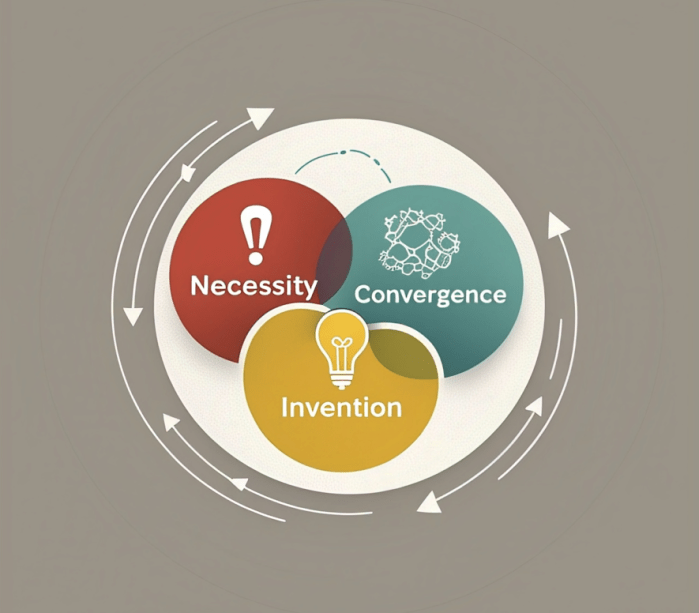
Throughout this four-part series, we’ve seen how necessity sparks invention – and together, they transform our society in profound ways. Today, our world faces an array of urgent challenges, from climate change and demographic shifts to economic and geopolitical instability, cybersecurity threats, and healthcare crises. These pressures are igniting a fresh wave of convergence, where inventive and innovative responses to pressing needs are poised to reshape our future. As we enter this transformative era, the cycle of necessity and invention reminds us that bold, purpose-driven invention and innovation is our best path forward.
Continue readingThe Necessity-Invention-Convergence Framework
The Necessity-Invention-Convergence Framework provides a structured way to analyze the forces that drive human progress. At its core, necessity serves as the fundamental driver of change, arising from pressing challenges, constraints, or demands. Whether economic, social, environmental, or geopolitical, necessity compels action and forces innovation. Throughout history, this dynamic has played out in transformative ways. The Industrial Revolution was fueled by labor shortages and an increasing demand for goods, just as the Digital Revolution emerged in response to the need for faster, decentralized communication. Today, the global energy transition is being shaped by the necessity of addressing climate change and resource limitations.
Continue readingThe Great Convergence: When Necessity Meets Invention and Innovation
History has shown that when necessity, invention and innovation converge, the result is transformative change. From the steam engine to artificial intelligence, periods of economic, societal, and technological strain have consistently pushed invention innovation to new heights. These inflection points – where high-pressure needs meet breakthrough ideas – can drive unprecedented leaps in productivity, reshaping industries, economies, and even entire civilizations.
Continue reading2025 Global Risks Report
Every year, the World Economic Forum’s Global Risks Report offers a critical snapshot of the forces shaping our world. The 2025 edition paints a picture of escalating tensions, deepening fractures, and an accelerating transformation of our societal foundations. As we navigate an increasingly complex landscape, the report underscores the necessity of adaptability, resilience, and the capacity to thrive – what I call the ART of navigating uncertainty.
More than ever, this year’s report validates the idea that we are in a period of convergence – where geopolitical instability, technological disruption, societal shifts, economic volatility, environmental stress, and philosophical reorientation are colliding in ways that will redefine our future. Below, I’ve categorized the major risks identified in the report under the seven core convergence domains that I frequently discuss: science, technology, society, geopolitics, economy, environment, and philosophy.
Continue readingA Sweeping Narrative Of Human Progress
In How Economics Explains the World: A Short History of Humanity, Andrew Leigh, a Harvard-trained economist, presents a comprehensive and engaging narrative that delves into the profound impact of economic forces on human history. This book, though concise at under 200 pages, spans a vast timeline from the advent of agriculture to the present day, including the era of artificial intelligence.
Continue reading2024 Consensus Predictions
In a recent article the team from Visual Capitalist put together a listing of the most common predictions, from over 700 analysts, as to what they believe we’ll see in the next 12 months. In this now fifth year of Prediction Consensus they summarized 25 of the most common predictions and forecasts by experts into a single visual of what’s expected to happen in 2024. The visual below and article referenced above offer an overview of the most cited trends and opportunities that experts are watching for the rest of the year. Have a look.
Navigating The Horizons Of 2024: Thoughts Across Diverse Fields
As we stand on the precipice of 2024, a year brimming with potential and uncertainty, experts across various domains will offer their insights into the shape of things to come. From scientific breakthroughs to geopolitical shifts, from societal transformations to environmental challenges, these insights paint a multifaceted portrait of the year ahead. I’ll add my thoughts to the conversation. The uncertainty that exists across these domains adds to the difficulty in understanding possible futures. It is convergence that occurs across them that illuminates the possibilities.
Continue readingPermacrisis – A Plan To Fix A Fractured World
I finished reading my most recent book titled Permacrisis, authored by Gordon Brown, Mohamad A. El-Erian, and Michael Spence. The book was recommended by Mimi Brooks, who did a review of it here. This was a very impactful book written by three of the most internationally respected and experienced thinkers of our time. As described by the Amazon abstract, the book focused on a cascade of crises: sputtering growth, surging inflation, poor policy responses, an escalating climate emergency, worsening inequality, increasing nationalism and a decline in global co-operation. While they do a great job of identifying the challenges, they also prescribe solutions. Given their experience base, we should pay very close attention to both sides of this story. I have added the book to my library and provide a brief summary below.
The world is undergoing a profound transformation marked by multifaceted economic, social, and technological shifts, altering the familiar landscape of the past three decades. This book delves into key messages regarding the challenges and opportunities presented by these changes, emphasizing the importance of understanding evolving dynamics.
Continue readingThe Forces Driving Our Economic Future
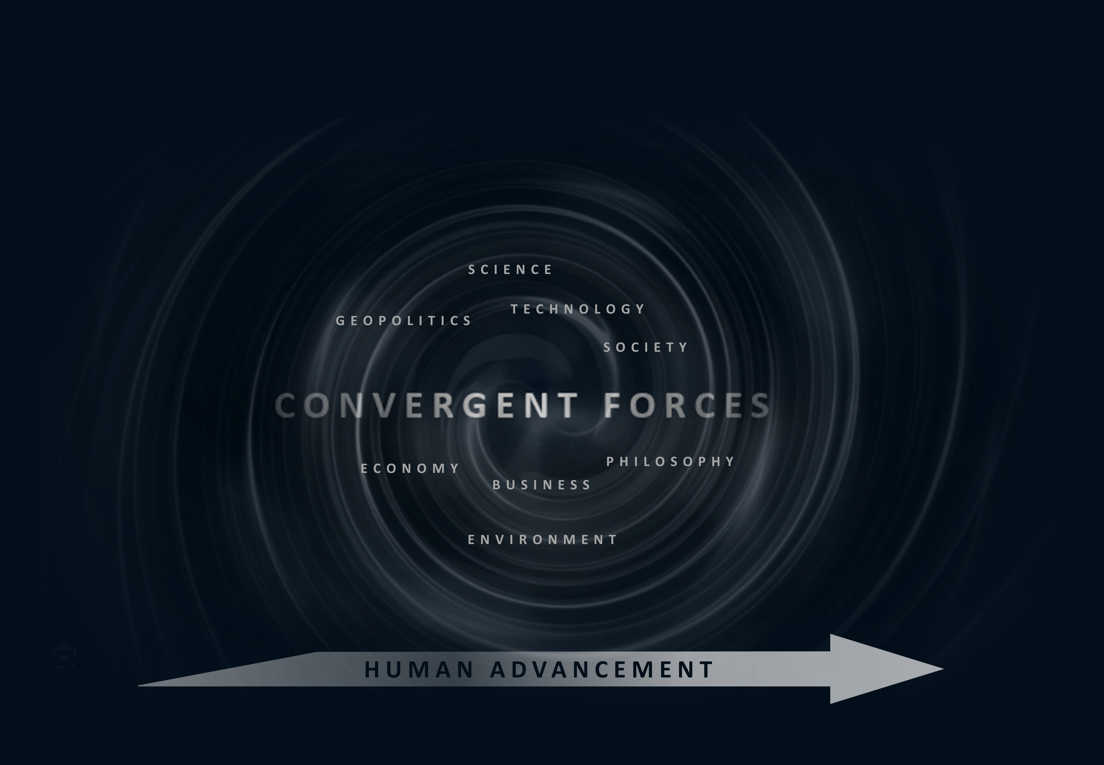
At the heart of our uncertain times lies an astounding level of convergence, with historical precedent dating back to the second industrial revolution and the decades that followed. It was Robert J. Gordon in his brilliant journey through the economic history of the western world that illuminated this convergence. In The Rise and Fall of American Growth, Gordon focused on a revolutionary century that impacted the modern standard of living more than any period before or after. It was also Gordon that concluded the world will never see a period like that again. It was his conclusion that prompted my development of a future innovation visual that sought to dispute it. While technology has driven human advancement for centuries, it has not done so in isolation. In periods like the one described by Gordon; other domains play a role in determining where technology takes us. This quote says it best:
Continue readingWhat History Tells Us About Human Action
Historically, it takes catastrophe to drive humans to act in periods where action is clearly needed. Wars and financial crashes are dominant catalysts throughout history. This poll considers the catalysts that drive humans to act in an era demanding action. Please take a minute to respond below. Pick those catalysts that you feel strongly about – and/or add to the list.
The Catalysts of Change
Two recent books The Fourth Turning is Here and The Coming Wave have each underscored the critical need for human action. But as I described in a post on Learning from History, it takes catalysts to drive actions that ultimately shape our future. A combination of breath-taking innovation, societal forces, depression and war, represent some of the catalysts that established a post-world war II era. As we stare into an uncertain, volatile and complex future, what are the catalysts likely to force human actions? The poll below has been conducted twice, pre-and-post pandemic. However, so much has changed since then. Please help me build on this list and identify the most significant catalysts. Choose all catalysts that you feel will contribute – or add anything that I am missing. For a deeper description of catalysts, please see the lessons from history post.
Continue readingGlobal Economic Prospects
The prospects for the global economy are a function of convergence. While geopolitics drives economic volatility, societal shifts create uncertainty, and science and technology lead us down divergent paths. The World Economic Forum provided their thoughts in a recent article that looked at global economic prospects.
Continue reading Reimagining the Future