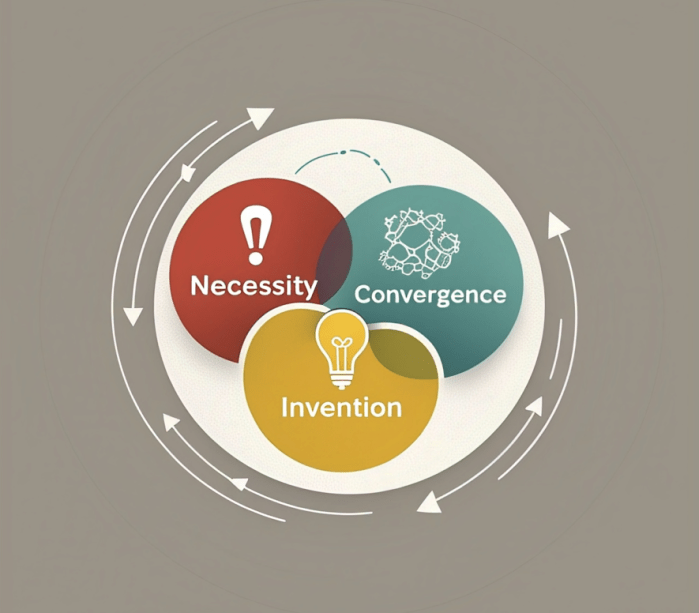
This post marks the beginning of a new series on systemic change — an exploration of how civilizations transform at the deepest level. Over the coming weeks, we’ll trace the rhythm of history, examine the forces that drive reordering, and explore why this moment may be the first time in history when every domain of human life is active at once. Each post will build on the last, revealing how science, technology, society, geopolitics, economics, philosophy, and the environment are converging toward a new operating logic for civilization.
Continue readingConvergence
A World Of Expanding Possibilities – And Accelerating Pressure
The world feels unfamiliar – more volatile, more complex, and harder to navigate than at any point in recent memory. That sense is not misplaced. It reflects the reality of a system under strain.
Across seven domains – science, technology, society, geopolitics, economy, philosophy, and environment – more than 1,700 convergent forces have been identified and mapped between 2025 and 2030, with the list continuing to grow. These forces are directional, accelerating, and deeply entangled. Together, they are expanding the possibility space – the set of plausible futures – faster than most institutions can observe, let alone act.
Continue readingWhen General-Purpose Technologies Intersect With Necessity, Invention, And Convergence
History teaches us that transformative technologies do not emerge in isolation, nor do they reshape the world overnight. Instead, they follow a discernible pattern – an evolutionary journey that unfolds in response to human needs. Two phenomena help us understand this journey: the Evolutionary Phases of General-Purpose Technologies (GPTs) and the role of necessity, invention, and convergence (NIC). When viewed together, they provide a powerful lens for understanding not just how technologies evolve, but why they emerge and when they reach their full potential.
Continue readingThe Eurasian Century – Navigating Global Convergence
I recently finished reading The Eurasian Century: Hot Wars, Cold Wars, and the Making of the Modern World by Hal Brands, a sweeping historical analysis that illuminates Eurasia’s enduring centrality in global geopolitics. The author convincingly demonstrates how Eurasia’s vast resources, immense population, and strategic location have continuously positioned it as the crucible of global power struggles – from the ideological confrontations of the twentieth century to today’s emerging geopolitical tensions. His narrative offers profound lessons for leaders navigating an increasingly interconnected and uncertain global landscape.
Continue readingMeeting Today’s Grand Challenges – The Next Wave of Convergence

Throughout this four-part series, we’ve seen how necessity sparks invention – and together, they transform our society in profound ways. Today, our world faces an array of urgent challenges, from climate change and demographic shifts to economic and geopolitical instability, cybersecurity threats, and healthcare crises. These pressures are igniting a fresh wave of convergence, where inventive and innovative responses to pressing needs are poised to reshape our future. As we enter this transformative era, the cycle of necessity and invention reminds us that bold, purpose-driven invention and innovation is our best path forward.
Continue readingThe Converging Forces Of Progress: Necessity, Invention, And Systemic Outcomes

What if the very inventions that propel humanity forward also sow the seeds of our greatest challenges? History shows that progress is rarely a straight line. Instead, it moves in cycles: necessity sparks invention, and inventions converge to reshape society. From the steam engine’s role in the Industrial Revolution to the internet’s impact on globalization, each wave of transformation has brought profound change – economic shifts, new social structures, and unintended consequences. These disruptions, from rising inequalities to environmental crises, often take decades to address. As we stand on the brink of the next great convergence – whether in AI, biotechnology, humanoid robots, cyber, climate or health – we must ask – how can we harness innovation to create a more equitable and sustainable future?
Continue readingThe Necessity-Invention-Convergence Framework
The Necessity-Invention-Convergence Framework provides a structured way to analyze the forces that drive human progress. At its core, necessity serves as the fundamental driver of change, arising from pressing challenges, constraints, or demands. Whether economic, social, environmental, or geopolitical, necessity compels action and forces innovation. Throughout history, this dynamic has played out in transformative ways. The Industrial Revolution was fueled by labor shortages and an increasing demand for goods, just as the Digital Revolution emerged in response to the need for faster, decentralized communication. Today, the global energy transition is being shaped by the necessity of addressing climate change and resource limitations.
Continue readingThe Journey: Convergence Drives Human Advancement
My previous posts launched a series that will tell the full story of a reimagined future. Described as a journey through the looking glass, the story began with a series description and a look back in time. The series continues, with each post featuring a piece of our journey. We explored the beginning of the most recent historical cycle in the last post. In this post, I will now shift gears and focus on the future. That focus begins at the heart of the story – convergence.
Continue readingBuilding Blocks Of The Future Explode In Number
Is it any wonder that leaders are overwhelmed? It’s not just the pace of change, extreme events, or challenges to existing mental models. It is the sheer number of building blocks that currently exist, and those that are emerging. Factor in convergence occurring across these building blocks, and you have a recipe for uncertainty, unpredictability and an overwhelming number of possibilities. It was the book titled The Second Machine Age written by Andrew McAfee and Erik Brynjolfsson, where the point was underscored.
Continue readingWhat to Expect in 2019
With the start of a new year, the traditional focus on predictions has begun. Prognosticators do so at their own peril – as this New Yorker Article clearly articulates. It seems that in 1968, the Foreign Policy Association (formed in 1918 to promote the League of Nations), celebrated its fiftieth anniversary by publishing a book of predictions about what the world would look like in fifty years. Well, here we are fifty years later, and if history is any guide, futurists have very little credibility. Although predictions these days may be even more difficult given our complex systems are progressing and scaling at an unprecedented rate, a macro-level focus can provide an ability to scan beyond the horizon. So rather than attempt to predict, here are my 2019 thoughts on several macro-level forces.