
In his thirteenth post in the series, Marshall Kirkpatrick focuses on the intersection between artificial intelligence and drones. By way of reminder, Marshall launched a 30 day series that explores the intersection between AI and the various innovation components on my emerging futures visual.
Future Scenarios
Artificial Intelligence Intersects with Robotics
In his twelfth post in the series, Marshall Kirkpatrick focuses on the intersection between artificial intelligence and robotics. By way of reminder, Marshall launched a 30 day series that explores the intersection between AI and the various innovation components on my emerging futures visual.
Artificial Intelligence Intersects with Nanotechnology
In his eleventh post in the series, Marshall Kirkpatrick focuses on the intersection between artificial intelligence and nanotechnology. By way of reminder, Marshall launched a 30 day series that explores the intersection between AI and the various innovation components on my emerging futures visual.
Artificial Intelligence Intersects with Autonomous Vehicles
In his tenth post in the series, Marshall Kirkpatrick focuses on the intersection between artificial intelligence and autonomous vehicles. By way of reminder, Marshall launched a 30 day series that explores the intersection between AI and the various innovation components on my emerging futures visual.
Artificial Intelligence Intersects With the Internet of Things
In his ninth post in the series, Marshall Kirkpatrick focuses on the intersection between artificial intelligence and the Internet of Things. By way of reminder, Marshall launched a 30 day series that explores the intersection between AI and the various innovation components on my emerging futures visual.
Artificial Intelligence Intersects with Blockchain
In his eight post in the series, Marshall Kirkpatrick focuses on the intersection between artificial intelligence and blockchain. By way of reminder, Marshall launched a 30 day series that explores the intersection between AI and the various innovation components on my emerging futures visual.
Artificial Intelligence Intersects with Genomics
In his seventh post in the series, Marshall Kirkpatrick focuses on the intersection between artificial intelligence and genomics. By way of reminder, Marshall launched a 30 day series that explores the intersection between AI and the various innovation components on my emerging futures visual.
Artificial Intelligence Intersects with Renewable Energy
In his sixth post in the series, Marshall Kirkpatrick focuses on the intersection between artificial intelligence and renewable energy. By way of reminder, Marshall launched a 30 day series that explores the intersection between AI and the various innovation components on my emerging futures visual.
Artificial Intelligence Intersects with Mobile and Cloud
In his fourth post in the series, Marshall Kirkpatrick focuses on the intersection between artificial intelligence and Mobile, and in the fifth he focuses on cloud. By way of reminder, Marshall launched a 30 day series that explores the intersection between AI and the various innovation components on my emerging futures visual.
Artificial Intelligence Intersects with Fintech
In his third post in the series, Marshall Kirkpatrick focuses on the intersection between artificial intelligence and Fintech. By way of reminder, Marshall launched a 30 day series that explores the intersection between AI and various future scenarios anchored by my emerging futures visual.
Artificial Intelligence Intersects with 3D Printing
In his second post in the series, Marshall Kirkpatrick focuses on the intersection between artificial intelligence and 3D Printing. By way of reminder, Marshall launched a 30 day series that explores the intersection between AI and various future scenarios anchored by my emerging futures visual.
Artificial Intelligence and Future Scenarios
I had the pleasure of talking to Marshall Kirkpatrick recently about his work at Little Bird and a new series on artificial intelligence that he just launched. Marshall has leveraged my emerging futures visual in the past, and is using it to steer the direction of his series. The first article focuses on How Artificial Intelligence Could Change the Future of Food.
Blockchain, Artificial Intelligence, Renewable Energy and More
The airwaves are filled with talk of exponential technologies like Blockchain, Artificial Intelligence, Robotics, Renewable Energy and more. In addition, societal factors that influence or are influenced by technology are getting more attention. So what’s the buzz?
Continue readingTransforming the Automotive Industry
A new McKinsey report focuses on the Disruptive trends that will transform the auto industry. Their work suggests that the world economies are dramatically changing via developments in emerging markets, the exponential pace of technology, sustainability policies, and changing consumer preferences around ownership. They see the rise of four disruptive trends in the automotive sector: diverse mobility, autonomous driving, electrification, and connectivity. For me, these findings underscore the movement from our current automotive industry to the future Mobility Ecosystem. If we can make the mental model shift from our long standing view of Industry and competition, to this emerging view of ecosystem and shared value, we can begin to visualize the different ways value will be created and captured in the future.
Creating a Wellness Ecosystem
I am a firm believer that platform supported ecosystems will ultimately displace our current industry constructs. Given the uncertain nature of this transition, Future Thinking is a critical skill for any leader or organization to embrace. I have used the Driverless Car scenario as a way to describe future thinking and in this case, the progression towards a mobility ecosystem. I did a similar piece on Connected Health, which is likely the early manifestation of an emerging wellness ecosystem. This recent report on The Future Health Ecosystem provides a glimpse into the transition towards this wellness ecosystem. The author describes an expected shift of $1 trillion of the $3 trillion spent on healthcare to new players and business models; which could have devastating consequences for incumbents.
A Forbes article on this recent report looks at the major life transitions that the two largest generations in history are in the midst of – and the profound impact it will have on healthcare. Some of the very interesting findings – and clear drivers of a wellness ecosystem – are:
The Maker Economy
“Any time you give the means of production to everybody, it changes the world.” Chris Anderson, CEO of 3D Robotics
So it goes with the Maker Economy – otherwise referred to as the Maker Movement. According to Industry Analyst Jeremiah Owyang, the Maker Movement puts power in the hands of people to fund, design, prototype, produce, manufacture, distribute, market, and sell their own goods. According to youth market research firm Ypulse, 69% of millennials wish they could create a new product, and 81% would be interested in helping a company design one. This shift in production also shifts power from large, capital intensive enterprises to individual prosumers. As the focus on a next economy increases, so does the likelihood that it is driven by networks of prosumers versus large corporations.
This movement is not a future movement. According to the Infographic below, 135 million makers in America are already growing local economies and creating new jobs – contributing 18 million small businesses in the U.S. and accounting for two out of every three new jobs. When viewed through the lens of 3D Printing Forecasts, the future looks bright as well. One such forecast has the 3D Printing Industry becoming a $16 billion global industry within the next five years, with a 45.7 CAGR. It is also reviving the hardware sector, as VCs pumped $848 million into hardware start-ups in 2013 – nearly twice the prior record of $442 million set in 2012.
The Smart City
Next up in this ongoing look at disruptive scenarios is the Smart City. For the first time in history, more than 50% of the world’s population lives in cities, and that percentage moves to 70% by 2050.
The Sharing Economy
Something Economy: seems like a popular trend – stick a word in front of economy and use it to describe the next big thing. Some of these words are: Peer, Maker, Sharing, Gig, Collaborative, Green, Circular, Mesh, Digital, Innovation, semantic, and more. This combining of words speaks to the truly disruptive nature of the early 21st century. As part of my focus on business evolution and the inevitable move towards digital enterprises, I have analyzed a number of disruptive scenarios and their implications to traditional companies. This visual describes a combinatorial innovation dynamic that spawns disruptive scenarios:
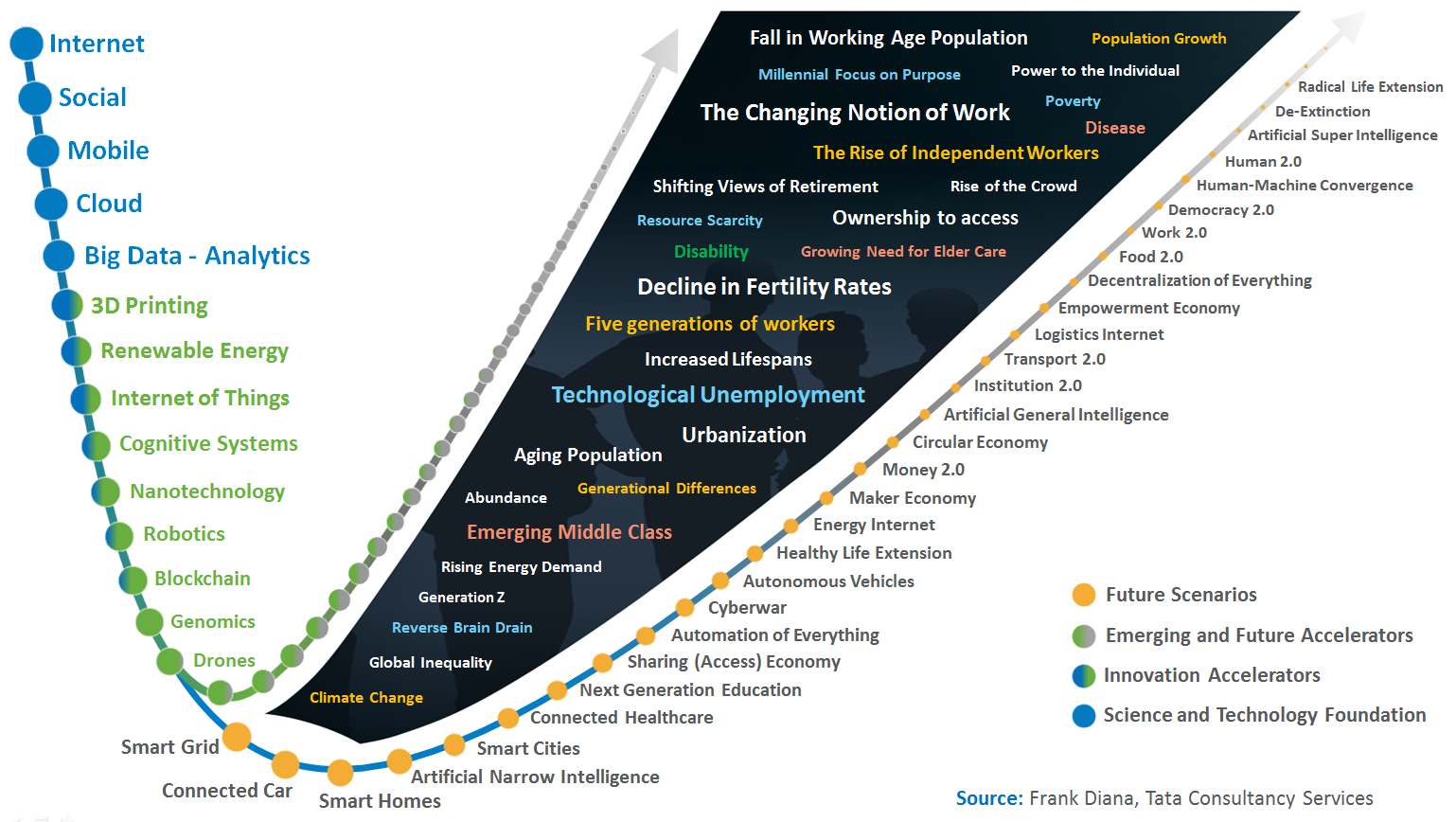
Combinations and Disruption
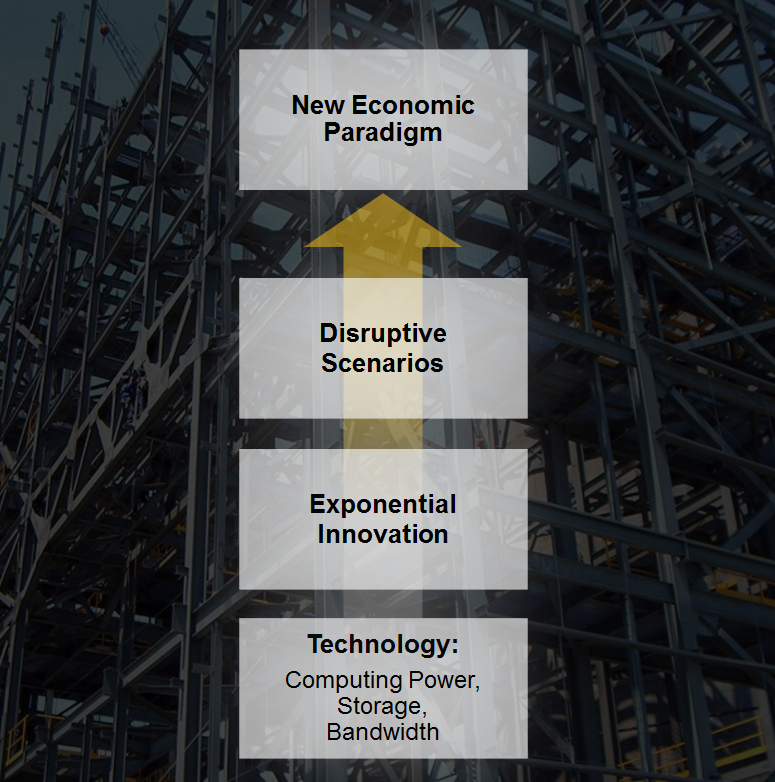
A recent Report by John Hagel and others describes how the exponential improvement in technology is driving exponential innovation. The core technology building blocks (computing power, storage and bandwidth) continue unabated on a cost-performance improvement curve. These building blocks create a foundation for rapid advances in innovation, which in turn combine to create disruptive scenarios. A visual depiction of this phenomenon might look like this:
The Logistics Internet
The next post in this continued look at disruptive scenarios focuses on the Logistics Internet. In his recent book titled The Zero Marginal Cost Society, Jeremy Rifkin describes an Economic Paradigm Shift driven by a Third Industrial Revolution (TIR) platform. The Logistics Internet is one of three components that make up this TIR platform (communications and energy are the other two). As the three components converge, they create a general purpose technology platform that drives a third revolution. Mr. Rifkin believes we are in the early stages of an automated transport and logistics Internet, and he describes his thinking in this short Video.
In his new book, Rifkin describes the process by which suppliers and buyers connect and conduct business (Logistics) as the driver of the whole economic system. Yet, he maintains that the means by which goods and services are stored and delivered is grossly inefficient and unproductive. Rifkin suggests that a rethinking of the way we store and ship materials and goods is in order. Several supporting facts are provided in the book.
 Reimagining the Future
