
Throughout history, demographic trends have shifted in ways that defy prediction. One such phenomenon is the decline in fertility rates, which serves as a powerful reminder that the current state is not the future state. Today, discussions around declining fertility often frame it as a looming crisis, raising fears of aging populations and economic stagnation. Yet, history provides a compelling counter-narrative. The reversal of fertility decline in the mid-20th century, driven by the baby boom, highlights the impossibility of predicting how societal, economic, and geopolitical forces will interact to shape our future.
Continue readingPopulation
Falling Birth Rates
In a 2022 Post I described a societal signal that represents a global phenomenon. A decline in fertility rates has wide ranging implications, introducing an area of uncertainty that ripples across multiple scenarios. The societal piece of the convergence framework is massively impactful, with fertility being just one of multiple forces. A recent article decribes this global trend of declining fertility rates.
The data from the UN World Population Prospects (2022) compiled by Our World in Data shows a consistent decrease in birth rates across the six most populated countries. Notably, China has experienced the fastest decline, which could lead to similar challenges as seen in Japan with an aging population and significant socio-economic implications. This decline in fertility rates underscores the broader global pattern, where the average number of births per woman has decreased from 3.2 in 1990 to 2.5 in 2019, with an expected further decline to 2.2 births by 2050. A visual from the article plots the trajectory.
Where Is Population Growth Actually Heading?
Demographics matter. An aging society, fewer children, less workers, immigration, to name a few, are likely to shape our future in ways we cannot predict. There is much uncertainty, exemplified by mixed messages regarding the global population. Some estimates have us reaching 11 billion people by the year 2100 – with most of that growth coming from Africa and some countries in Asia. Studies have now emerged with significantly less growth. A recent article describes one such study.
Continue readingThe Changing Human Life Cycle
Given the recent focus on demographics, I went back to review a book in my library titled “The Great Demographic Reversal.” In a post that reviewed the book, I mentioned that the authors state several times that their findings are controversial and counter to the views of mainstream economists. By way of review, the authors concluded that the future is one of:
Continue readingPossible Futures Over One Hundred Years
I just finished another book titled Future Stories authored by David Christian and have added it to my book library. The book focuses on future thinking, exploring the various ways that experts, plants, animals, and even cells manage the future. This visual from the book provides a glimpse of the possible futures explored.
Continue readingPopulation Growth
Recent estimates for population growth are at odds with one and other. Where the United Nations sees 11 billion people on the planet by 2100, the University of Washington’s Institute for Health Metrics and Evaluation sees growth to 9.7 billion initially and then a decline back to 8.8 billion by the end of the century. Future population sizes underpin future strategies for governments and industries around the world. This article via the World Economic Forum underscores the point. The quick video snippet in the Tweet below is fascinating.
Continue readingThe Journey: Dual Paths Of Innovation
In a continuation of my series titled “A Journey through the Looking Glass”, I will touch on two historical paths of innovation. The post picks up from the last one where I explored the building blocks of the future.
THE DUAL PATHS OF INNOVATION
Two major forces are likely to converge in very unpredictable ways. First, the road to abundance described by Peter Diamandis promises to advance our human development in ways not previously thought possible. At the same time, our journey will face several unintended consequences. The intersection of these two forces underscores the importance of focusing on emerging scenarios now, thus enabling human development and mitigating the risk of these unintended consequences.
Continue readingThe Impact Of Societal Forces On Our Future
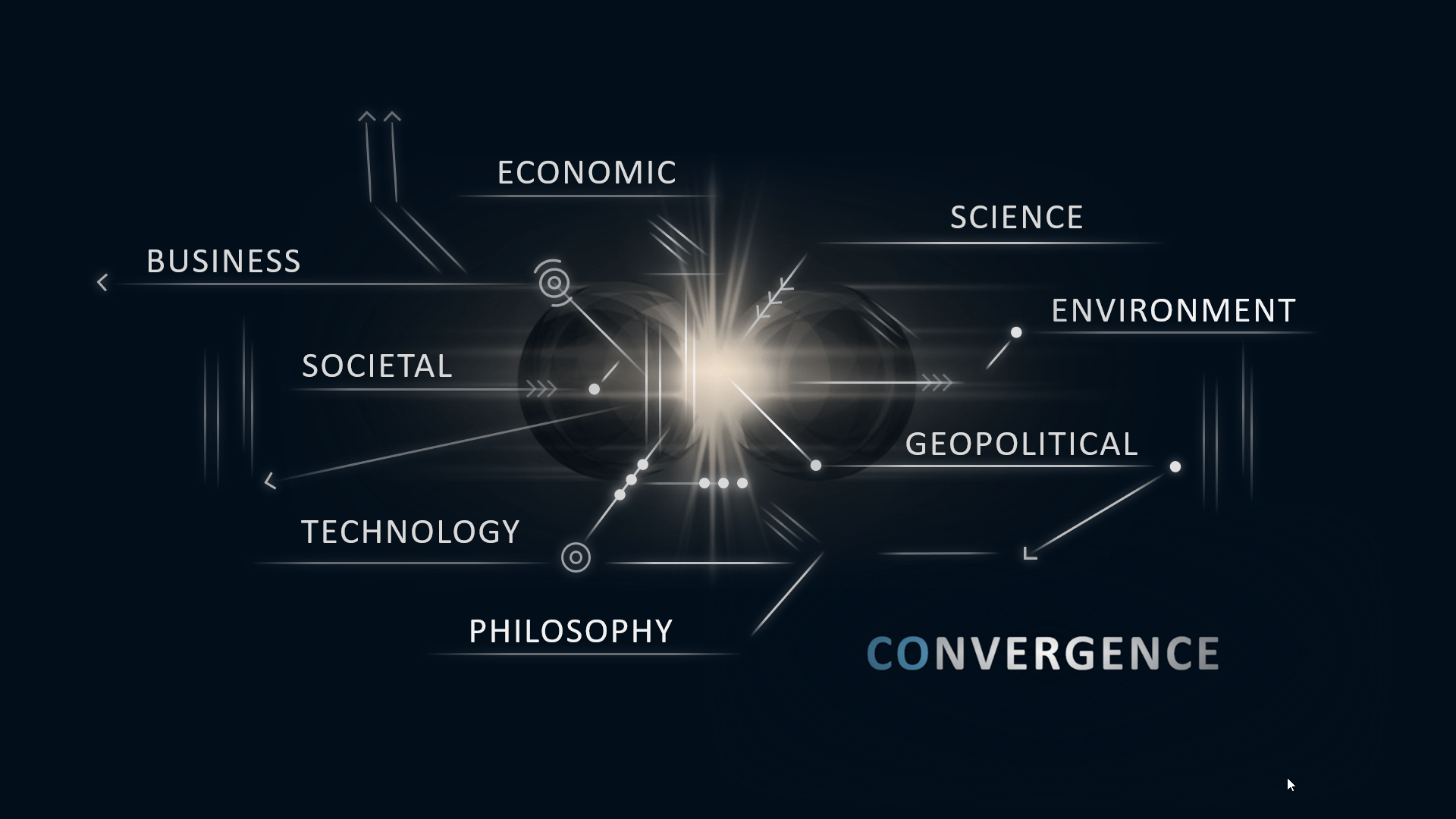
Convergence is a big part of how the future reveals itself. I have written often about convergence across geopolitics, science and technology, and other domains. Even a domain like philosophy is converging in ways that help shape our future. Macro-level forces illuminate possible futures, and forces in the societal domain play a major role in determining that future. This article on population provides a great example.
Continue readingThe Implications Of Slowing Population Growth
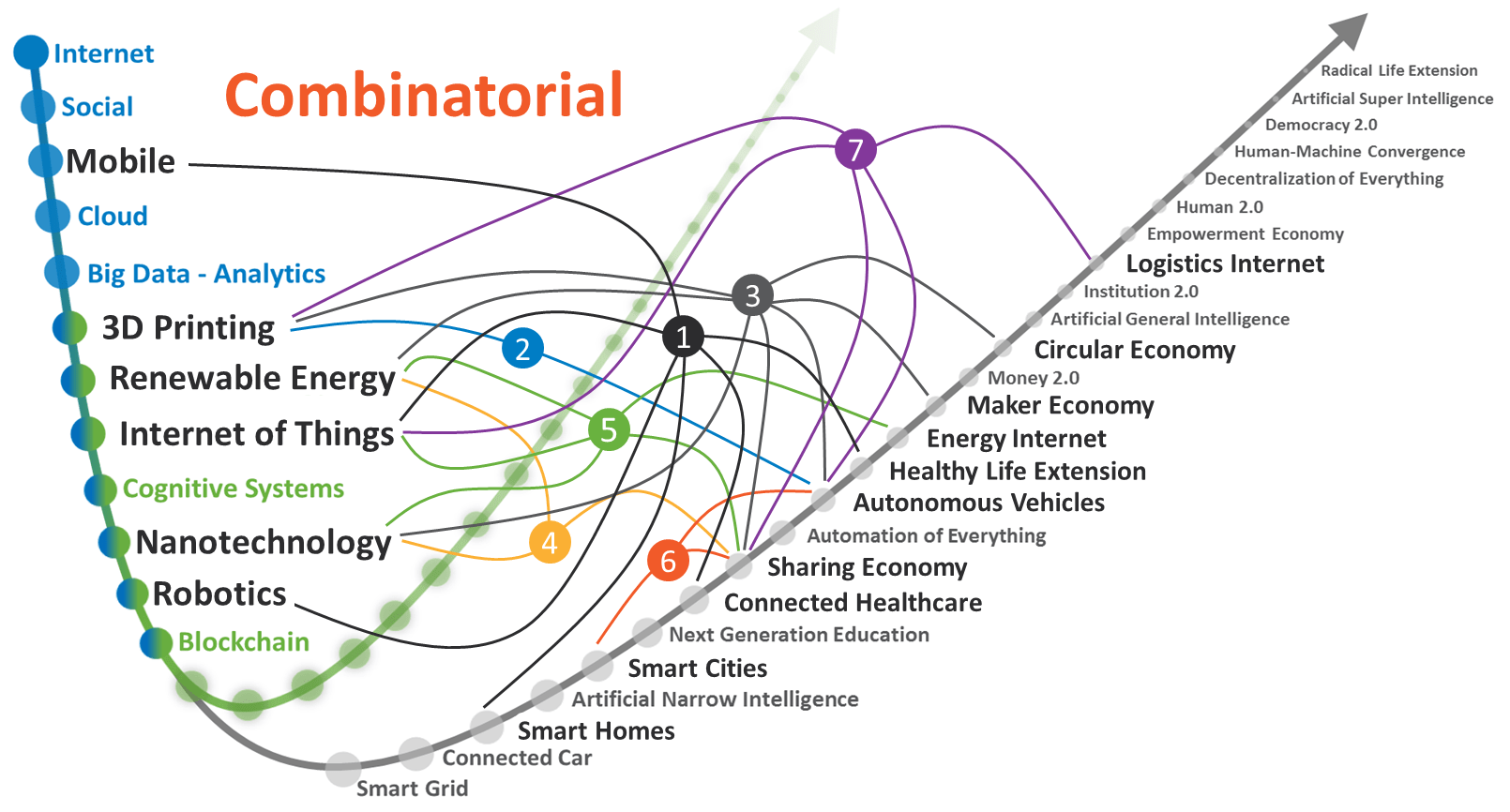
The power lies at the intersections. When I first started using the term “Combinatorial”, people thought I was making words up. Although I would like to take credit for the word, I first came across it when reading The Second Machine Age, a fascinating book by Andrew McAfee and Eric Brynjolfsson. In a post from 2015, I explored several possible combinations that represented disruptive power. A visual from that post attempted to show how science and technology spawned a number of several scenarios, using two curved lines, one for science and technology, and the other for scenarios. As the building blocks combined across the curves, the world would transform.
Continue readingThe Future Impact Of Societal Factors
Societal factors are one area of Convergence that is shaping our future. The accelerating progression of science and technology gets a lot of attention, but our various societal issues are a major part of the story. For example, there have been various projections for global population growth during this century. Early projections had the globe exceeding 11 billion people by the close of the century (the world is currently at about 7.8 billion people). The number of people on earth – and where those people live – will have profound implications.
Change Has Never Been This Fast – It Will Never Be This Slow Again
Happy New Year all! As we enter the next decade, an expression that is now popular rings true: Change Has Never Been This Fast – It Will Never Be This Slow Again. It is not just the speed of change – which many attribute to Exponential Progression driven in part by the Convergence of Science and Technology –  but the sheer number of Dots Connecting in what is a very complex system. As is customary this time of year, there is no shortage of content focused on the year or decade ahead.
The Global Fertility Crisis
Bloomberg BusinessWeek recently posted an article describing the Global Fertility Crisis. As we look at the forces likely to shape our future, we spend a lot of time and media cycles analyzing the exponential progression of science and technology.  This powerful force is having a profound impact on society. But the opposite is also true: society is influencing the path of innovation. Societal Factors play as big a role in establishing the path of our emerging future. I placed societal factors in the middle of the visual I use to connect an overwhelming number of dots. The two curves that surround them are the science and technology foundation; and the future scenarios that it spawns. Societal tension happens in both directions; out towards the curves, and in from the curves.
The Future of Farming
The global population is projected to reach 9.7 billion in 2050 – up from 7.6 Billion today. This population growth along with city expansions are having major consequences, driving a lack of growing space and food in many parts of the world. Add to this the concerns of extreme weather events that will disrupt food production, and you have a scenario that forces us to find creative solutions. According to various statistics, 795 million people don’t have enough food; and keeping pace with population growth requires a focused effort on realizing food abundance.
 Reimagining the Future