
When AI takes knowledge beyond human scale, the number of plausible futures expands dramatically. This is not because the world becomes more random, but because more options become visible. As knowledge is continuously interpreted and synthesized across domains, new combinations, pathways, and secondary effects emerge faster than humans can naturally track. The future stops narrowing on its own.
Continue readingFuture
Do We Shape The Future — Or Drift Into It?
This series began with a simple observation: something feels different about the world right now. Not just faster. Not just noisier. But more tightly connected, more reactive, and harder to stabilize using the assumptions we inherited from the last age. Over the course of these posts, we made that feeling legible. We explored how systems change, why pressure accumulates, and how societies move through periods of compression before reorganizing around new forms of order. We looked at history not to romanticize the past, but to recognize patterns that repeat when civilizations cross thresholds.
Continue readingHow The Gauges Were Built: Making Systemic Pressure Legible
Over the first six posts, I built the foundation needed to understand how civilizations change. I explored the seven domains that shape collective life, the forces that move within them, the thresholds that mark historical turning points, and the three drivers that push systems toward those moments. With that groundwork in place, I introduced a pair of gauges that make those movements easier to see. In this post, I describe the gauges in greater detail. TSDS reflects how much energy sits across the seven domains. AD shows how that energy is arranged. Before we apply these gauges to the long arc of history, we need to explain how they were built. Every measure rests on a set of choices. This post walks through those choices in a way that keeps the gauges intuitive while grounding them in the history they aim to describe.
Continue readingReading The Pulse Of A Civilization In Motion
The first five posts laid the foundation for understanding why the world feels dense, fast, and tightly connected. We explored the sense that something in the operating logic of civilzation is shifting. We looked at phase transitions, the four-stage pattern that repeats across history, and the seven domains that structure civilization. The last post introduced the three deep drivers that push civilizations across thresholds: growing convergence, system-shaping technologies, and the acceleration of knowledge. Taken together, they help explain why pressure builds, why systems couple, and why some ages move differently than others.
Continue readingWhy No Single Force Changes The World
RECAP FROM THE SERIES SO FAR
In the first post, I described the sense that the world’s operating logic is turning over. In the second, I explored what that feels like in daily life — the tightening, the pressure, the sense that everything is connected. The third post revealed the pattern beneath these moments: a four-stage rhythm of accumulation, compression, instability, and reordering that has shaped every major transition in history.
This post turns to a deeper question. If these shifts are so powerful, what triggers them? The answer is rarely what we expect.
Continue readingHow Big Shifts Unfold — And Where We Are Now
RECAP FROM THE SERIES SO FAR
In the first post, I explored why so many parts of life feel unsettled at the same time: all seven domains of civilization are active and amplifying one another. In the second post, I described the tightening that happens before major shifts — the compression that makes events feel more connected, faster, and harder to absorb. This post turns to the deeper structure beneath these shifts. When we look at history, we see a repeating pattern in how civilizations change shape.
Continue readingWhy Everything Feels Like It’s Changing At Once
Recap from Last Post
I opened this series by exploring why the world feels unsettled in ways that don’t fit the usual explanations. I introduced the idea of systemic change: moments when multiple parts of civilization become active at the same time, pushing and amplifying one another. I described today as a phase of compression, where pressures build across domains faster than old structures can absorb them. This post will bring that idea down to everyday experience. What do phase transitions feel like in normal life?
Continue readingWhen Systems Turn Over
This post marks the beginning of a new series on systemic change — an exploration of how civilizations transform at the deepest level. Over the coming weeks, we’ll trace the rhythm of history, examine the forces that drive reordering, and explore why this moment may be the first time in history when every domain of human life is active at once. Each post will build on the last, revealing how science, technology, society, geopolitics, economics, philosophy, and the environment are converging toward a new operating logic for civilization.
Continue readingWinston Churchill’s Famous Words
Winston Churchill’s famous words – “History will be kind to me, for I intend to write it myself” – are not simply a reflection of confidence or political legacy. They represent a profound truth: that those who step forward to shape the future ultimately influence how history remembers the past.
Continue readingPressure Points And Catalysts: Shaping Our World
I introduced the notion of pressure points and catalysts in an earlier post. Here are the results of my analysis.
Introduction
The trajectory of human civilization is not merely a linear progression but a complex interplay of forces that build, converge, and occasionally erupt into periods of profound transformation. Understanding these dynamics requires a framework centered on Pressure Points and Catalysts – concepts crucial to comprehending how global systems evolve and redefine themselves.
Continue readingBuilding Possibility Chains: Mapping Disruption Across A Converging World
As I’ve explored in Post One and Post Two of this series, history doesn’t move in straight lines. It moves in cycles of buildup and release – of pressure and systemic change. Across time, humanity has navigated moments when systems fray, institutions falter, and norms break down. These moments are rarely surprises. They’re preceded by converging signs – warning lights blinking across domains that something foundational is under strain. We are in such a moment now.
Continue readingWhen All Domains Move At Once – Understanding The Convergent Instability Of Our Time
In the first post of this series, I explored the expanding possibility space – the widening range of plausible futures shaped by more than 1,700 convergent forces unfolding across time and across domains. That post introduced the structural lens for understanding how pressure builds, how pathways emerge, and how catalysts may eventually reshape the system. This post focuses on what makes that possibility space so expansive in the first place: the simultaneous instability across seven foundational domains. Science, technology, economy, society, geopolitics, philosophy, and environment are not shifting sequentially or in isolation. They are all in motion, at the same time, and in constant interaction.
Continue readingA World Of Expanding Possibilities – And Accelerating Pressure
The world feels unfamiliar – more volatile, more complex, and harder to navigate than at any point in recent memory. That sense is not misplaced. It reflects the reality of a system under strain.
Across seven domains – science, technology, society, geopolitics, economy, philosophy, and environment – more than 1,700 convergent forces have been identified and mapped between 2025 and 2030, with the list continuing to grow. These forces are directional, accelerating, and deeply entangled. Together, they are expanding the possibility space – the set of plausible futures – faster than most institutions can observe, let alone act.
Continue readingIntroducing the Next Phase: Pressure Points, Catalysts, and the Forces That Shape Them
History doesn’t move in straight lines. It moves in cycles of buildup and release – of pressure and transformation. Across time, humanity has navigated moments when systems fray, institutions falter, and norms break down. These moments are rarely surprises. They are preceded by converging signs – warning lights blinking across domains that something foundational is under strain.
Continue readingThe Fastest Tech Transition In History: How Businesses And Governments Can Lead Or Lag
Historically, the diffusion of transformative technologies has been constrained by institutional inertia, workforce adaptation, and the challenge of transferring tacit, hands-on expertise. As a result, decades often separated invention from widespread adoption. Today, however, powerful General Purpose Technologies – artificial intelligence, quantum computing, and synthetic biology – may defy that pattern, diffusing faster than ever. What makes this era different, and how should businesses and governments respond?
Continue readingNavigating A World Of Permanent Crisis: A Review Of Robert D. Kaplan’s Waste Land
Robert D. Kaplan’s latest book, Waste Land: A World in Permanent Crisis, presents an unsettling yet necessary exploration into our current global predicament. True to Kaplan’s distinguished career, this book expertly connects historical contexts with today’s increasingly complex reality, a practice that resonates deeply with my own work on examining historical lessons to better understand our evolving future.
Continue readingThe Fragile Future: A Deeper Look At 2035
Yesterday, I launched a post titled The Fragile Future, exploring the uncertainty that lies ahead and the forces shaping our world. Today, I came across an article from the Atlantic Council titled Global Foresight 2025, which presents a range of possible futures through a survey of strategists and foresight practitioners. Their findings paint a stark picture of what 2035 might hold—a world teetering between worsening geopolitical conflict and cautious optimism about technology’s role in shaping our collective destiny.
Continue readingThe Fragile Future: Why Stability Is More Uncertain Than Ever
History does not repeat, but it often rhymes. As I read Robert D. Kaplan’s Waste Land: A World in Permanent Crisis, I was struck by his argument that the 20th and early 21st centuries have been especially bloody because the stabilizing force of monarchy has vanished. He suggests that despite our moral progress in areas like human rights and the environment, the world remains tightly wound, vulnerable to clashing interests and aggressive authoritarian states. He draws an analogy to Weimar Germany – a moment of fragile democracy, economic strain, and rising nationalism that ultimately collapsed into war.
Continue readingThe Eurasian Century – Navigating Global Convergence
I recently finished reading The Eurasian Century: Hot Wars, Cold Wars, and the Making of the Modern World by Hal Brands, a sweeping historical analysis that illuminates Eurasia’s enduring centrality in global geopolitics. The author convincingly demonstrates how Eurasia’s vast resources, immense population, and strategic location have continuously positioned it as the crucible of global power struggles – from the ideological confrontations of the twentieth century to today’s emerging geopolitical tensions. His narrative offers profound lessons for leaders navigating an increasingly interconnected and uncertain global landscape.
Continue readingMeeting Today’s Grand Challenges – The Next Wave of Convergence
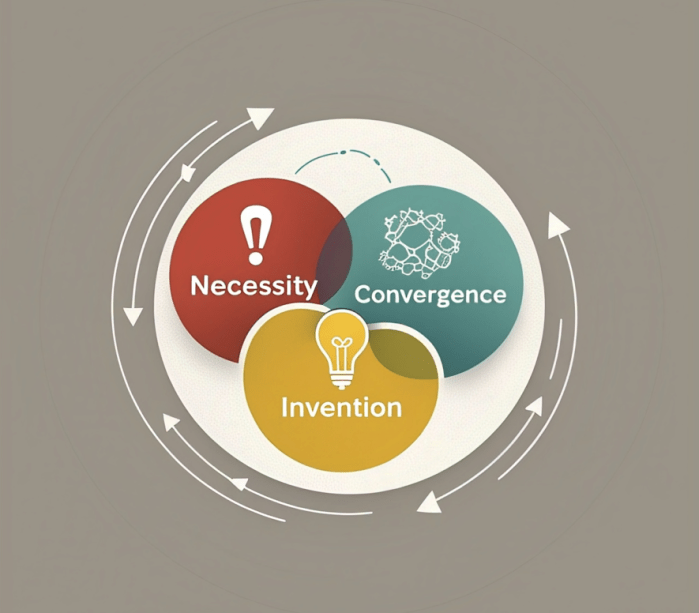
Throughout this four-part series, we’ve seen how necessity sparks invention – and together, they transform our society in profound ways. Today, our world faces an array of urgent challenges, from climate change and demographic shifts to economic and geopolitical instability, cybersecurity threats, and healthcare crises. These pressures are igniting a fresh wave of convergence, where inventive and innovative responses to pressing needs are poised to reshape our future. As we enter this transformative era, the cycle of necessity and invention reminds us that bold, purpose-driven invention and innovation is our best path forward.
Continue reading Reimagining the Future