
As we stand at the threshold of another profound technological shift, many refer to this moment as the “Fourth Industrial Revolution.” Historically, we’ve used the term “industrial” to describe revolutions centered primarily on advances in production, efficiency, and the scaling of physical labor – whether through steam-powered machines, electrical infrastructure, or digital automation. Each industrial revolution significantly reshaped how we lived and worked but always remained anchored in improving productivity and mechanization.
Continue readingElectricity
Book Review: Technology And The Rise of Great Powers By Jeffrey Ding
Why Diffusion, Not Invention, Determines Who Leads in the Age of Transformative Technologies
In an era obsessed with technological “firsts,” Jeffrey Ding’s Technology and the Rise of Great Powers delivers a counterintuitive revelation: the nations that dominate the future won’t necessarily be those that invent the most, but rather those that diffuse innovations the fastest. By shifting the spotlight from invention to diffusion, Ding fundamentally reframes the debate on global competitiveness – with profound implications for policymakers, businesses, and societies.
Continue readingWill This General Purpose Technology Cycle Accelerate System-Level Change Faster Than Ever?
Throughout history, General Purpose Technologies have reshaped economies, industries, and societies. Steam power, electricity, and computing all followed a familiar trajectory – initial invention, slow diffusion, and eventual transformation that restructured industries and economies. Each of these transitions took decades, often constrained by infrastructure needs, workforce adaptation, and institutional resistance. Yet today, as we stand at the intersection of artificial intelligence, synthetic biology, and quantum computing, the question arises: Will this General Purpose Technology cycle break historical patterns and accelerate system-level change faster than ever before?
Continue readingWhen General-Purpose Technologies Intersect With Necessity, Invention, And Convergence
History teaches us that transformative technologies do not emerge in isolation, nor do they reshape the world overnight. Instead, they follow a discernible pattern – an evolutionary journey that unfolds in response to human needs. Two phenomena help us understand this journey: the Evolutionary Phases of General-Purpose Technologies (GPTs) and the role of necessity, invention, and convergence (NIC). When viewed together, they provide a powerful lens for understanding not just how technologies evolve, but why they emerge and when they reach their full potential.
Continue readingThe General-Purpose Technology Evolution Framework
General purpose technologies, from the steam engine to electricity, have historically followed a predictable evolutionary path. Each GPT begins at the status quo, disrupting established ways of operating. Next, it moves to point solutions, where its application enhances specific areas without fundamentally transforming broader systems. Over time, these point solutions give way to broader applications, where the technology begins to reshape processes on a larger scale. Finally, the journey culminates in system-level change, where the technology redefines the way society, industries, and systems function as a whole.
Continue readingWill AI Reshape Our World Faster Than Electricity?
Imagine a world transformed not in decades, but years, by a single invention. That’s the potential future with Artificial Intelligence (AI). History offers a fascinating comparison: electricity. This seemingly simple technology took 40 years to fully revolutionize factories, forever altering manufacturing. Along the way, it changed how we lived in our homes, altered the workforce, and transformed various aspects of society. But will AI follow the same slow burn, or are we on the cusp of an exponential leap?
Continue readingPower And Prediction
As the artificial intelligence (AI) frenzy reaches new heights, everyone is focused on understanding possibilities. Much will be written on the topic, with some exploiting the frenzy and others offering valuable insights. A book I’m reading titled Power and Prediction fits the category of valuable insights. As I read it, multiple thoughts are swirling. The book looked at historical progressions of major general-purpose technologies (steam, electricity, Internet, etc.) that evolved from point solutions to applications, ultimately leading to system-level change. For example, when electricity simply replaced steam within the same system (point solution) the benefits were limited. When electricity drove the system-level redesign of factories, the game changed.
Continue readingThe Journey: Convergence Drives Human Advancement
My previous posts launched a series that will tell the full story of a reimagined future. Described as a journey through the looking glass, the story began with a series description and a look back in time. The series continues, with each post featuring a piece of our journey. We explored the beginning of the most recent historical cycle in the last post. In this post, I will now shift gears and focus on the future. That focus begins at the heart of the story – convergence.
Continue readingTransforming The Energy Paradigm
The most transformative periods in history are linked to eras of energy transition. The most impactful was the emergence of fossil fuels. What does that say about what lies ahead? Have we entered a period of energy transition, and if so, are we on the cusp of another highly transformative period? Energy is just one piece of a very disruptive decade ahead – but it is perhaps the biggest piece. As we Accelerate Towards a new energy paradigm, what can we expect? One thing is certain: there are societal and geopolitical implications to consider.
Continue readingThe New Map
I just finished another book and added it to my Library. Author Daniel Yergin explores the convergence of energy, climate change, and a world where an existing power is confronted by an emerging power. The New Map helps us understand global dynamics, historical perspectives, the entrenched role of oil and gas, the forces that are driving an energy transition, and the impact of a raging pandemic.
Daniel Yergin is a highly respected authority on energy, international politics, and economics, and a Pulitzer Prize-winning and bestselling author. He is vice chairman of IHS Markit, one of the leading information and research firms in the world, a member of the board of the Council on Foreign Relations, a senior trustee of the Brookings Institution, and has served on the Secretary of Energy Advisory Board under the last four presidential administrations.
Continue readingIs Wireless Electricity Part Of The New Energy Paradigm?
Yesterday, I wrote about the potential Acceleration towards a New Energy Paradigm. 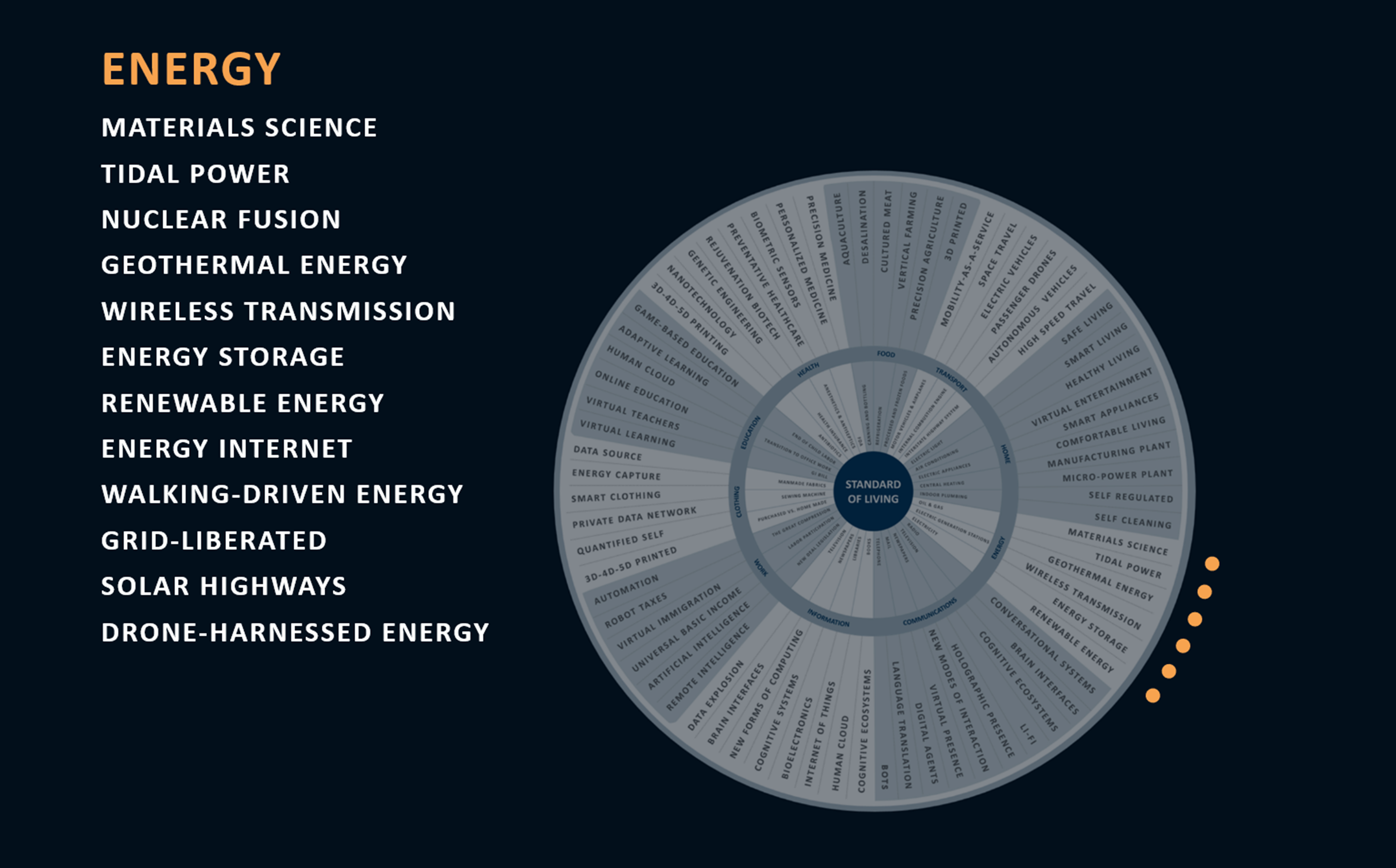 When we consider the building blocks on the innovation wheel that shape this emerging paradigm, the change is likely significant. One such building block is the wireless transmission of electricity.
This recent Article describes new innovation that enables this transmission. It was Nikola Tesla that first worked on Wireless Energy and Power Transfer. He almost succeeded when his experiment led him to the creation of the Tesla coil. It was the first system that could wirelessly transmit electricity. From 1891 to 1898 he experimented with the transmission of electrical energy using a radio frequency resonant transformer of the Tesla coil, which produces high voltage, high frequency alternating currents.
 Reimagining the Future