Vignette: Cooking With Grandma’s Digital Twin

It’s a rainy Sunday in 2029. You step into your kitchen and greet a familiar voice:
“Wash your hands first — and don’t forget, you always overcook the garlic.”

It’s your grandmother. Or rather, her AI-trained twin — a rich synthesis of voice recordings, handwritten recipe notes, photos, and family video calls. Her likeness lives in your kitchen’s AI assistant, trained not only on the technical aspects of her cooking but the emotional cues too — her sayings, her pacing, even her eye-roll when you forget the bay leaves.

Tonight, you’re making her famous Sunday stew.
As you begin, her voice guides you through each step.
“This is the part where we stir slowly — remember how we’d hum together at this point?”

The AI pulls up a shared memory — a short home video from when you were seven, standing on a stool next to her, stirring that same pot. You smile. You hum.

As you plate the stew, she adds one last note:
“Serve it with that crusty bread from the bakery — just like Grandpa liked.”

The food is real, the memory is enhanced, and your kitchen has become a portal to the past — powered by code, but steeped in love, culture, and identity.
Breaking The Cycle: How Digital Twins Can Preserve Wisdom And Rewire The Future

History doesn’t just repeat itself because we forget the facts. It repeats because we lose the wisdom of those who lived through it. When the last voices of a generation fade – those who endured war, depression, migration, or reinvention – we lose more than stories. We lose anchors. We lose quiet guidance in moments of moral fog. We lose the ability to ask: “What would you have done?”

Continue reading

Exploring The Potential Of AI Avatars: Reid Hoffman’s Experiment With Digital Twins

LinkedIn co-founder Reid Hoffman recently delved into the realm of AI avatars by engaging in a video interview with a remarkably human-like digital clone of himself. Developed by Hour One and featuring voice cloning by 11ElevenLabs, this AI replica not only mimicked Hoffman’s knowledge and voice but also exhibited nuanced body language, actively nodding, smiling, and shrugging in sync with the real-world counterpart.

Continue reading

Game-Changing Digital Twin Could Redefine Weather Forecasting

A recent article takes the concept of a digital twin to an interesting level. An earlier film developed by my team of Futurists rehearsed the possible future of digital twins. One possible future is a digital twin of the earth. The article describes how Nvidia recently unveiled Earth-2, a digital twin of the Earth aimed at revolutionizing meteorological simulations and visualizations on a global scale. This innovative platform, powered by Nvidia’s generative AI model CorrDiff, offers unprecedented speed and energy efficiency, enabling users to create high-resolution simulations of global weather patterns in seconds. By providing access through an API, Nvidia aims to enhance early warning systems for natural disasters and improve weather forecasts.

Government agencies and organizations like the Central Weather Administration of Taiwan and The Weather Company are already planning to utilize Earth-2 for forecasting and visualizing weather impacts. Nvidia’s venture into climate-focused technology reflects its commitment to addressing the challenges of climate change while capitalizing on the growing demand for AI-powered solutions. However, the long-term accuracy of such a complex system remains a pertinent question. The video below describes Earth-2.

Continue reading

Rehearsing The Future Of Digital Twins

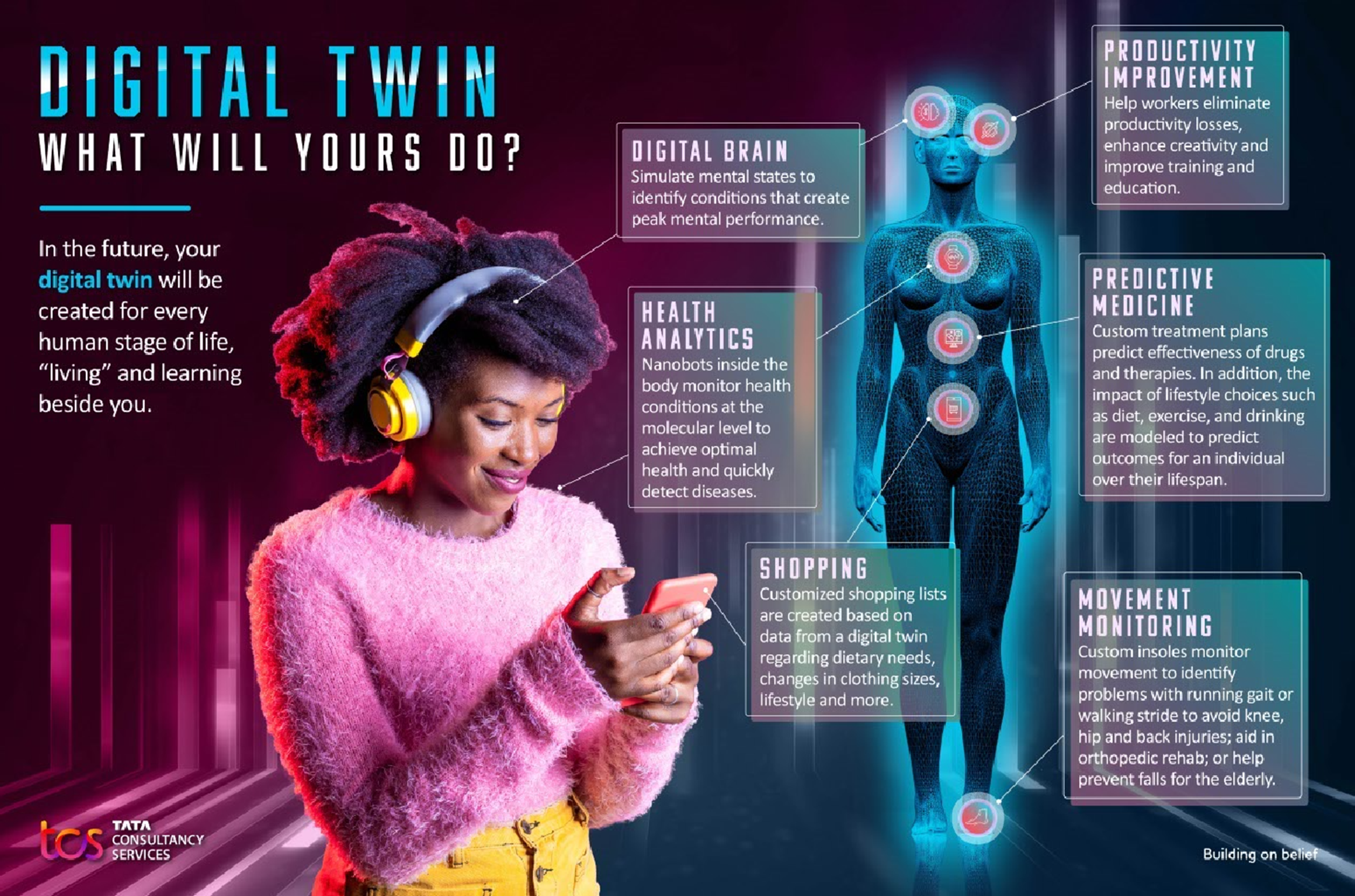
At an event earlier this week, TCS premiered a new film describing the past, present, and future of digital twins. The production team at TCS did a remarkable job – and I am proud of the end product. Hope you enjoy this journey to the past, present, and future.

The Virtual You

I have written about digital twins over the past year and participated in several articles describing a future where virtual representations of all things physical are viable. You can explore the topic here. The art of the possible is coming into focus.

Continue reading

Governments Need A “Digital Twin Division”

I wrote about the expanding possibility space for digital twins earlier this month. One domain that stands to benefit from the use of digital twins is the public domain. Government use of digital twins in the coming years, if pursued, can help leaders prepare for disruptions and disasters. This article – which I authored – was just published by Government Technology Insider. Several scenarios are described, with a vision towards a specific division focused on the possibility space.

What The Community Said about Interacting With Lost Loved Ones

In this post from February 2nd, I once again posed the question of interacting with a lost loved one. This scenario is part of a broad digital twins discussion, whether it is a digital version of a lost loved one, or a version of ourselves that lives on forever. In a post from February 2020, I included this video that showed a women reconnecting with her lost daughter virtually (digital twin):

Continue reading

The Expanding Possibility Space For Digital Twins

I have spent the last several months focused on all aspects of digital twins. The maturing of foundational building blocks has expanded their possibility space. Industrial applications are familiar to many, but the breadth of applications are now more visible. If we view digital twins through the lens of possibilities, we can apply them to the various challenges that continue to impact society. Using some of the UN sustainability goals as a guide, and with the help of ChatGPT via a question and answer session, let’s explore the possibilities:

Continue reading

Speaking To Those Who Have Passed

In early 2020 I wrote a Post about reuniting with a lost loved one. Since that time, the capacity to do so has expanded.

Rememory, the act of talking to the dead, is an idea as old as man himself. For pagans, it was a means of venerating ancestors who had passed. In Christianity, it remains the belief in afterlife through purgatory, heaven, or hell. What used to be science fiction for some and customary beliefs for others has now become a reality, by using the artificial intelligence technology created by DeepBrain AI.

Nana Coupeau – Rememory, The AI that Helps Us Talk to the Dead
Continue reading

Digital Twins Are Set For Rapid Adoption In 2023

Interest in Digital Twins is ramping, as evidenced by the number of media outlets showing interest in the topic. I have added a number of recent articles to my media library. A very good CNBC article was launched a couple of days ago. It provides a broad view of digital twins and the growing possibility space.

Continue reading

Big Things In Store For Digital Twins In 2023

I had the pleasure of talking to Paul Barker in an interview with IT World Canada. The resulting article just launched. We discussed the possibilities for digital twins in 2023. I really enjoyed our discussion, which he captured via a series of quotes in the article. In the context of foresight – a question that comes up a lot these days – he asked me what it is like to be a futurist:

Continue reading

Rehearsing 2023

As a new year approaches, it is natural to want to predict what’s next. But, a caveat: I prefer not to speak in terms of “predictions.” I speak about “rehearsing possibilities” – understanding possible futures and envisioning outcomes.

Frank Diana – Digital Twins Reach a Tipping Point & Save Lives

That quote above was included in a recent article about digital twins. That article focused on the role that digital twins are likely to play in 2023.

Continue reading

Digital Twins Have Evolved

I had the pleasure recently of talking to Fernando Guarneros Olmos about the evolving world of digital twins. Fernando is a journalist with a special interest in business related to technology and video games. Our discussion was captured in an article titled Digital twins also help prevent famine.

Continue reading