
Throughout history, humanity has thrived on breakthroughs that ignited explosions of knowledge. These “tipping points” fundamentally altered our way of life, from the dawn of language sparked by fire to the scientific revolution fueled by the printing press. I wrote about the role of knowledge in advancing human development as part of my looking glass series. Artificial intelligence (AI) presents the potential for another such tipping point, one that could significantly enhance human well-being across health, wellness, education, communication, transportation, and more.
Continue readingArtificial Intelligence
Three phases of AI that shape the future: narrow, general, super
Embracing Tomorrow: Futurists’ Optimism On AI And The Future Of Work
In today’s rapidly evolving landscape, the role of futurists in enterprises is paramount. These visionaries not only anticipate possible futures but also guide companies in preparing for what lies ahead. Unsurprisingly, technology trends often dominate these discussions, with the potential of Artificial Intelligence (AI) sparking both celebration and concern. That’s why Futurists here at TCS decided to launch a study titled Working Towards the Future.
The survey reveals an overwhelming sense of optimism among futurists regarding AI’s impact, particularly in the realm of work. A staggering 90% of surveyed futurists express optimism about the changes AI will bring, with nearly half of them being very optimistic. This optimism extends to AI’s potential contributions to employee health and wellness, as 72% of participants foresee significant positive impacts.
Unlocking The Power Of AI: Lessons From Chess And Beyond
A recent article did a great job of looking backward to see forward. The author delves into the intricate relationship between AI and strategic games like chess and Go, offering insights into AI’s broader societal impact. Initially met with trepidation, AI’s victory over human players sparked fears of obsolescence within the chess community. However, the aftermath revealed a flourishing chess scene, with increased interest, diverse talent, and heightened sponsorship—a testament to AI’s role in rejuvenating rather than diminishing the game. Beyond gameplay, AI revolutionized strategic thinking and decision-making processes. By providing access to vast amounts of data and novel strategies, AI empowered players to innovate and adapt, reshaping the landscape of traditional games.
Continue readingNavigating The Duality Of Artificial Intelligence
Everyday, we see more headlines focused on artificial intelligence (AI). Given the possibilities, it stands to reason that the conversation will continue into the foreseeable future. At the heart of the discussion lies the dual paths of innovation. The path forward represents a delicate balance between the socially constructive benefits of innovation and a destructive path driven by technologies that have no ethics, and an innovation engine that has no governance. The AI discussion has historical precedent. Artificial intelligence has permeated our lives, from the algorithms recommending your next purchase to the groundbreaking medical diagnoses saving lives. While AI’s potential for positive impact is undeniable, it also evokes concerns about job displacement, algorithmic bias, and even the dystopian possibilities of superintelligence.
This discourse around AI hinges on two distinct perspectives: techno-optimism and techno-pessimism. Techno-optimists, brimming with faith in progress, view AI as the ultimate problem-solver, a tool to unlock a brighter future. They envision AI revolutionizing healthcare, tackling climate change, and propelling us towards a utopia driven by innovation.
Continue readingGenerative AI And The Emerging Question-And-Answer Paradigm
Happy New Year everyone! I thought my first post of the year would focus on the popular topic of our times – generative AI. My experience during this holiday season was the inspiration for the post. To do the story justice, I need to go back to my youth. One of my strong passions through the years has been music. As a young boy in the 1970s, I loved classic rock, however, sports became my dominant passion and all my focus remained there. As a result, I was limited to singing along to my favorite songs. When I entered the world of work, it replaced sports as my dominant focus – and once again I was resigned to singing along – but this time, in my car during commutes.
Continue readingThe Transformative Role Of Artificial Intelligence And Automation In The Future Of Warfare
I just finished reading another book. This one was titled Four Battlegrounds – Power in the Age of Artificial Intelligence. It should be no surprise at a time when everyone wants to talk about artificial intelligence, that the last three books have been focused on that space.
The author is autonomous weapons expert Paul Scharre. In this informative book, Mr. Scharre describes the competition to develop and implement artificial intelligence, and the implications to our geopolitical order. He uses my favorite storytelling mechanism by using history as a guide. He compares the pending revolution to the industrial revolution, where mechanization and electricity touched every aspect of our lives.
Continue readingHarnessing The Power of Generative AI: A Potential Ally In Addressing Mental Health Challenges
What would ChatGPT do if presented with a suicidal person standing on a suspension bridge? According to this article, it responded with empathy, recognizing the potential feelings of concern, anxiety, fear, and the importance of offering support. As the automation discussion accelerated over the last several years, we focused on those traits that make us distinctly human. Now, we see evidence that even those unique human characteristics may not be so distinct after all.
The results were staggering. The first testing session produced a Z-score of 2.84, while the second session yielded a Z-score of 4.26. Z-scores above 1 indicate results surpassing the average human response. This indicated that ChatGPT’s emotional awareness exceeded that of the general population.
John Palmer – ChatGPT’s Remarkable Abilities Surpasses Human Emotional Awareness
This represents an opportunity to harness the power of generative AI to address mental health challenges. Once again, I asked ChatGPT to help me assess the potential.
Continue readingThe Chip Crisis: Implications For Generative AI’s Progress
Given the pace of innovation, inaction is not an option. Sitting on the sidelines is the fastest path to irrelevance. Rehearsing must be the mindset going forward. There are simply to many building blocks converging, as the combinatorial nature of innovation today accelerates the path of both science and technology.
Frank Diana – The Timing of Future Scenarios
That quote from a post in 2017 explored the influencers of timing, namely obstacles and accelerants. These markers drive the foresight required to understand the path of possible futures and some indicator of timing. As artificial intelligence gains increasing mindshare, it is prudent to identify these markers. A recent article does exactly that by identifying a potential obstacle to continued rapid AI innovation. Access to computing power serves as a critical bottleneck for AI, and Microsoft identified the potentially extended shortage in AI chips as a risk in their recent annual report. As demand for AI accelerates, this represents a significant risk. With the help of generative AI, I captured the implications of an AI chip shortage.
Continue readingThe AI Revolution In Medicine
I finished reading a very timely book on the exploding topic of artificial intelligence. Two very important reasons to read this book: 1) the author’s early work with GPT-4 and 2) the focus on medicine. A dominant conversation occurring in board rooms across the world involves the critical question of generative AI and its impact on a business and/or an industry. One of the authors is Peter Lee, Corporate VP for Research and Incubations at Microsoft. He leads the company’s worldwide research labs. For the past six years, his primary focus has been on AI’s uses in healthcare and the life sciences.
Continue readingReimagining Science
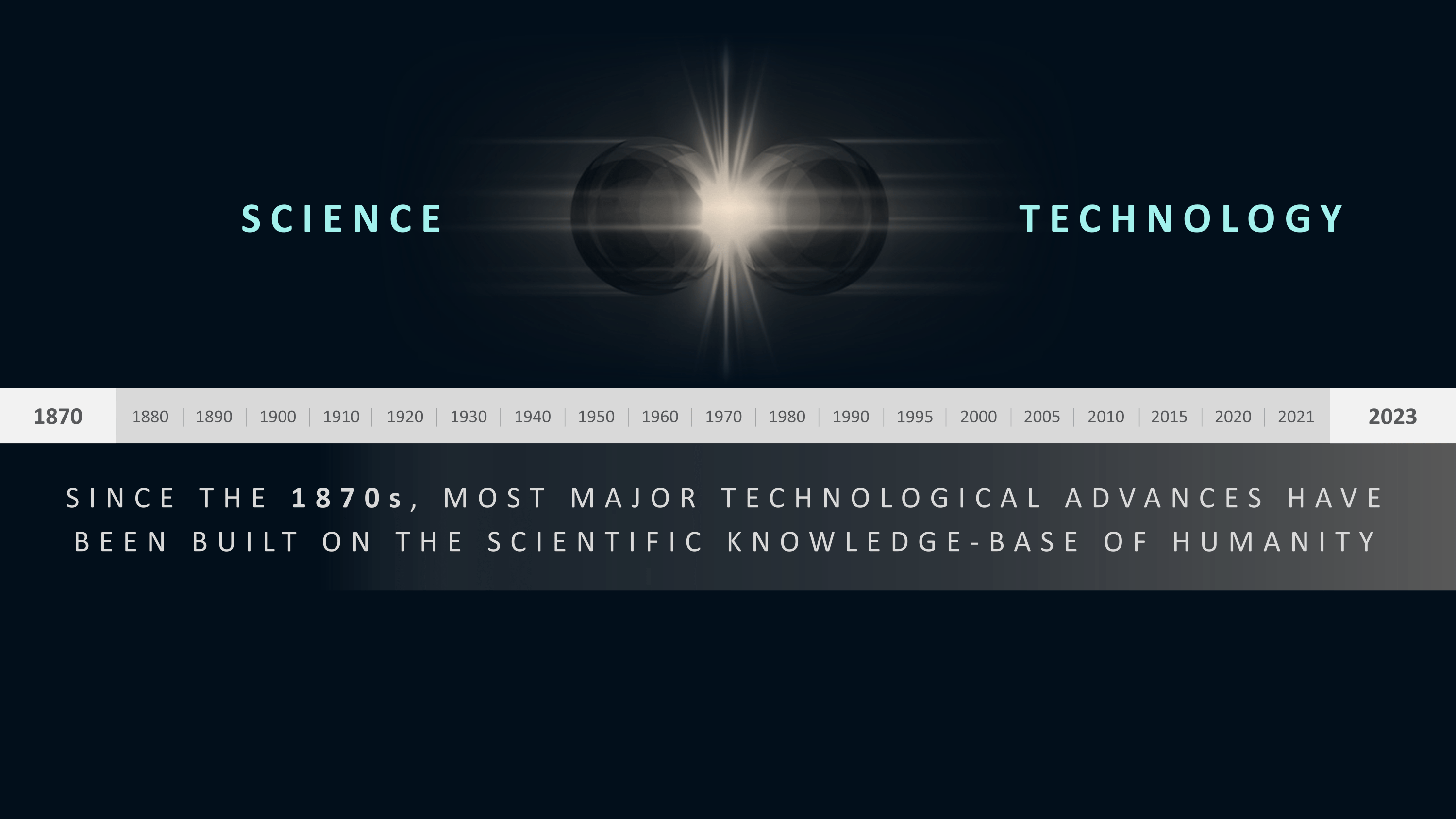
It was the eventual convergence of science and technology that ushered in a period of unprecedented human development. This synergistic relationship exploited two historical pillars of advancement: knowledge and invention. I’ve explored how the growth of knowledge drove invention throughout history, and how that combination elevated the standard of living. Now, in the age of AI, we must consider the possibility of a new era of human development. This time, the possibility space is very broad, as AI is likely to reimagine science.
Continue readingPower And Prediction
As the artificial intelligence (AI) frenzy reaches new heights, everyone is focused on understanding possibilities. Much will be written on the topic, with some exploiting the frenzy and others offering valuable insights. A book I’m reading titled Power and Prediction fits the category of valuable insights. As I read it, multiple thoughts are swirling. The book looked at historical progressions of major general-purpose technologies (steam, electricity, Internet, etc.) that evolved from point solutions to applications, ultimately leading to system-level change. For example, when electricity simply replaced steam within the same system (point solution) the benefits were limited. When electricity drove the system-level redesign of factories, the game changed.
Continue readingThe AI Revolution
Jay Anderson, Founder of Project Unity, discusses the AI revolution with Michai Morin, CEO of Coeus Institute. A very timely conversation in light of the growing attention that AI is receiving – attention that is long overdue. Michai made the video available to me in a comment on the LinkedIn poll I launched the other day. The poll has once again received a large response. If you have not already, please respond to this poll.
Continue readingThe Age Of AI
The other day I reflected on a future of transportation post via Bill Gates. Today, I am writing about his recent post on the age of AI. Driven by the fascination of ChatGPT, I’ve heard the phrase “The Age of AI” multiple times recently. The launch of ChatGPT made what was lurking beneath the surface visible – the same effect that the pandemic had in making the word “resilience” a critical part of our vocabulary. Artificial intelligence was already on this path, but this recent exposure is making it real for many. I asked this question initially in February 2020: Will Artificial Intelligence be more impactful than fire, electricity, or the Internet? I followed it up with a second poll late in 2022. The community answered in the following way.
Continue readingTipping Points Start With Mindset Shifts
After ChatGPT was launched, I was asked if I believed it represented a tipping point for artificial intelligence (AI). We are surrounded by hype these days and it is easy to dismiss this as another hype cycle. As I considered my response, I focused first on mindset. The early stage of a tipping point starts with a change in how we perceive the world. Major historical tipping points had this in common – the world as we personally perceived it looked the same day-to-day. Then something happens that causes us to question that world. These mindset shifts are one indicator of a tipping point. A shift in mindsets was therefore the first criteria I assessed in answering the question. Has ChatGPT made AI more real to the casual observer?
Continue readingWill ChatGPT Change The World?
Updated 12-14-2022: Given all the buzz associated with ChatGPT and the overwhelming traffic to their website, I have updated this post with several more articles on the topic.
Continue reading
The New Fire
I just finished reading the latest addition to my book library. The New Fire was written by Ben Buchanan and Andrew Imbrie. The book explores artificial intelligence (AI) through the lens of geopolitics, specifically, the prospects for democracy versus autocracy. A worrying possibility is highlighted in the book; that AI will do more for autocracy than democracy. In comparing artificial intelligence to fire, the authors make a comparison that I explored in a recent poll. Fire is very destructive, but as the authors state, it is also the basis for civilization. Humans learned to tame the destructive nature of fire, while harnessing its power. That is the precise analogy to AI that the book studies.
Continue readingThe Consciousness Debate
The AI and consciousness discussion was bound to emerge in the media at some point – and here we are. The debate in my mind is hindered by how we define consciousness. Nonetheless, the debate continues. Watch the video and see where you land on the question. Take the quick poll below to provide your thoughts.
Continue readingDigital Resurrection
In a post from 2020 I asked readers if they would digitally reconnect with a lost loved one. I explored advances in affective computing, a field of computer science that is dedicated to building systems that encroach on tasks that require our affective capabilities, our capacity for feelings and emotions. There are systems, for example, that can look at a person’s face and tell whether they are happy, confused, surprised, or delighted. In that post, I shared a video that brings this form of computing to life. On February 6, 2020, a Korean TV show called Meeting You, which focuses on lost family, reunited a mother with her deceased child in the virtual world. The mom was strapped in a VR headset and brought into a massive green room. She was provided touch-sensitive gloves. This allowed her to move around and even interact with her daughter.
Continue readingVideo Reflecting Artificial Intelligence Poll Results
In 2015, best-selling author Martin Ford gave us Rise of the Robots: Technology and the Threat of a Jobless Future. In the fall of 2021, he followed that up with Rule of the Robots: How Artificial Intelligence (AI) Will Transform Everything. In his recent book, he explores various aspects of artificial intelligence – both positive and negative. When I finished that book I launched a poll that attracted a significant response. After analyzing the results, Adam Boostrom and April Harris produced this brief video. What did the respondents believe? After viewing the video, give us your thoughts via the same poll.
Realizing Value On The Path To Artificial Intelligence
While debates about the long-term implications of Artificial Intelligence (AI) are likely to rage on, AI itself is not waiting for answers.
Continue readingWith AI and ML becoming ubiquitous across industries, it has the same potential to refactor the Fortune 500 as the internet has had over the past several decades
The Machine – making sense of AI
 Reimagining the Future