
Dan Wang’s Breakneck: China’s Quest to Engineer the Future is not just a book about China. It is a book about what happens when a society decides that building matters more than debating, that execution matters more than process, and that national ambition should show up in steel, concrete, factories, power systems, and supply chains. Wang’s central argument is memorable because it is so simple: China operates as an engineering state, while the United States has drifted into what he calls a lawyerly society. In his framing, China’s governing class tends to think like builders, while America’s elite class increasingly thinks like litigators, gatekeepers, and procedural managers. The result is not merely a difference in politics. It is a difference in what each society can actually get done.
Continue readingU.S.
What Happens When the World Stops Trusting the Dollar?
If you’ve followed my work, you know I don’t do panic. I look for patterns—quiet shifts beneath the noise. Kenneth Rogoff’s new book, Our Dollar, Your Problem, is one of those rare signals that cuts through. It’s not about predicting collapse. It’s about asking: What happens when the system we all rely on gets stretched too far?
Continue readingBook Review: Technology And The Rise of Great Powers By Jeffrey Ding
Why Diffusion, Not Invention, Determines Who Leads in the Age of Transformative Technologies
In an era obsessed with technological “firsts,” Jeffrey Ding’s Technology and the Rise of Great Powers delivers a counterintuitive revelation: the nations that dominate the future won’t necessarily be those that invent the most, but rather those that diffuse innovations the fastest. By shifting the spotlight from invention to diffusion, Ding fundamentally reframes the debate on global competitiveness – with profound implications for policymakers, businesses, and societies.
Continue readingWill This General Purpose Technology Cycle Accelerate System-Level Change Faster Than Ever?
Throughout history, General Purpose Technologies have reshaped economies, industries, and societies. Steam power, electricity, and computing all followed a familiar trajectory – initial invention, slow diffusion, and eventual transformation that restructured industries and economies. Each of these transitions took decades, often constrained by infrastructure needs, workforce adaptation, and institutional resistance. Yet today, as we stand at the intersection of artificial intelligence, synthetic biology, and quantum computing, the question arises: Will this General Purpose Technology cycle break historical patterns and accelerate system-level change faster than ever before?
Continue readingChina’s AI Breakthrough: What Does Manus Really Signal For AI’s Future?
A recent article described the launch of Manus, an autonomous AI agent developed in China. It has generated debate. in some circles. Some label it a leap in self-directed AI, while others see it as building on existing multi-agent frameworks. Speculation abounds about its true capabilities and how much of the attention is genuine progress versus media-driven hype. Throughout history, we have observed similar moments when an emerging technology prompts sweeping claims that may not align with its real-world limitations.
Continue readingThe Fragile Future: A Deeper Look At 2035
Yesterday, I launched a post titled The Fragile Future, exploring the uncertainty that lies ahead and the forces shaping our world. Today, I came across an article from the Atlantic Council titled Global Foresight 2025, which presents a range of possible futures through a survey of strategists and foresight practitioners. Their findings paint a stark picture of what 2035 might hold—a world teetering between worsening geopolitical conflict and cautious optimism about technology’s role in shaping our collective destiny.
Continue readingThe Most Innovative Countries
Continue readingIn 1960, the U.S. made up nearly 70% of global R&D spending, and by 2020 this had fallen to 30%. From job creation and public health to national security and industrial competitiveness, R&D plays a vital role in a country’s economic growth and innovation, impacting nearly every corner of society—either directly or indirectly.
Dorothy Neufeld – Mapped: The Most Innovative Countries in the World in 2022
The Cashless Revolution
I just finished a book titled The Cashless Revolution authored by Martin Chorzempa. The book was selected by the Financial Times as one of the best of 2022. Interestingly, one of the other recent books I read is also on their list – Slouching Towards Utopia. This latest read explored the world of FinTech and the cashless revolution happening in China – and the possible futures that may drive.
Continue readingAre We Heading Towards A New World Order?
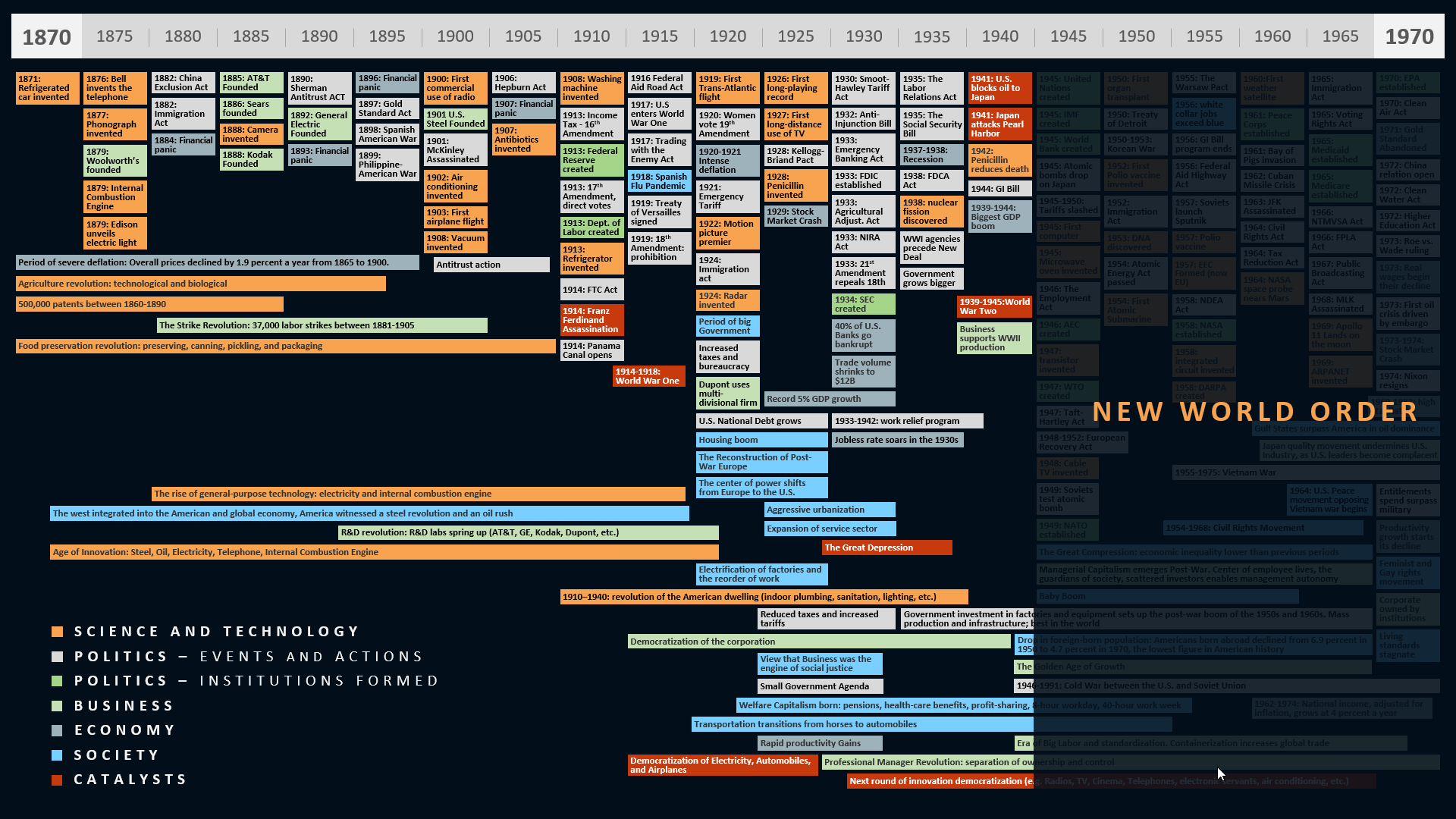
After World War Two, 730 delegates from all 44 Allied nations gathered in the U.S. at the Mount Washington Hotel in Bretton Woods, New Hampshire. The Bretton Woods Conference aimed to regulate the international monetary and financial order after the war ended. Held from July 1 to 22, 1944, agreements were signed and ratified by member governments, establishing the institutions that represented a new world order. This led to what was called the Bretton Woods system for international commercial and financial relations.
Continue readingWhy We’re Polarized
I have added a new book by Ezra Klein to my Library. The book titled “Why We’re Polarized” takes us on a fascinating journey to the past, helping us see that for all our problems, we have been a worse and uglier country at almost every other point in our history. Having said that, our current polarization has made it impossible to govern. I found his historical perspectives on the framing of our current political system very timely, and the notion that what works in one era fails in the next. The institutions, frameworks, and beliefs born in a vastly different era, struggle to keep pace in an era that looks very different.
The Global Fertility Crisis
Bloomberg BusinessWeek recently posted an article describing the Global Fertility Crisis. As we look at the forces likely to shape our future, we spend a lot of time and media cycles analyzing the exponential progression of science and technology.  This powerful force is having a profound impact on society. But the opposite is also true: society is influencing the path of innovation. Societal Factors play as big a role in establishing the path of our emerging future. I placed societal factors in the middle of the visual I use to connect an overwhelming number of dots. The two curves that surround them are the science and technology foundation; and the future scenarios that it spawns. Societal tension happens in both directions; out towards the curves, and in from the curves.
 Reimagining the Future