The Compressed Present

THE BIO-INTELLIGENT SIGNATURE: A LENS ON THE CURRENT AGE

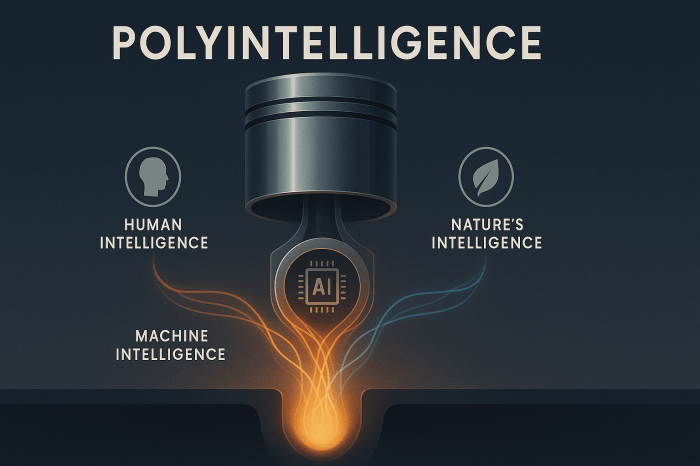
The present moment is shaped by three converging streams of intelligence: machine intelligence, biological intelligence, and planetary intelligence. These are the same sources that form what I have described elsewhere as polyintelligence — cognition distributed across humans, machines, and nature. Each stream is advancing on its own, but their deeper significance appears in how they now influence one another. Artificial intelligence extends cognition beyond the human mind. Synthetic biology brings design and computation into living systems. And the planet — long treated only as a resource base — is increasingly recognized as a source of insight. Through biomimetics, natural systems provide design principles refined through evolution: circularity instead of waste, resilience through diversity, and adaptation through constant sensing and feedback.

Continue reading

Crossing The Threshold

Civilization’s great shifts are the moments when continuity fails and a new order takes shape. Each historical age reached a point where the old logic could no longer hold, and pressures converged into a transformative release. By examining four major transitions – from Hunter–Gatherer to Agricultural, Agricultural to Axial, Axial to Renaissance, and Renaissance to Industrial – we can see how rising Total Systemic Domain Score (TSDS) and changing Activation Dispersion (AD) signaled that a threshold was near. Some transitions unfolded slowly over millennia, while others struck within a few centuries. In each case, the build-up of energy and imbalance hit a critical point, and society crossed into an irreversible new configuration that only in hindsight feels inevitable.

Continue reading

What The Gauges Reveal Across The Ages

Over the first seven posts, we explored the seven domains that shape civilization, the forces that move within them, the thresholds that mark major transitions, and the drivers that push systems toward those turning points. We also built two gauges that help make those movements visible. TSDS shows how much energy sits across the seven domains. AD shows how that energy is arranged. Together, they help us see the internal structure of an age: how active its domains were, how evenly that activity spread, and how tightly the system was coupled. With that groundwork in place, we can now use the gauges to trace the long arc of history and examine how pressure accumulated across major ages of civilization.

Continue reading

How The Gauges Were Built: Making Systemic Pressure Legible

Over the first six posts, I built the foundation needed to understand how civilizations change. I explored the seven domains that shape collective life, the forces that move within them, the thresholds that mark historical turning points, and the three drivers that push systems toward those moments. With that groundwork in place, I introduced a pair of gauges that make those movements easier to see. In this post, I describe the gauges in greater detail. TSDS reflects how much energy sits across the seven domains. AD shows how that energy is arranged. Before we apply these gauges to the long arc of history, we need to explain how they were built. Every measure rests on a set of choices. This post walks through those choices in a way that keeps the gauges intuitive while grounding them in the history they aim to describe.

Continue reading

Reading The Pulse Of A Civilization In Motion

The first five posts laid the foundation for understanding why the world feels dense, fast, and tightly connected. We explored the sense that something in the operating logic of civilzation is shifting. We looked at phase transitions, the four-stage pattern that repeats across history, and the seven domains that structure civilization. The last post introduced the three deep drivers that push civilizations across thresholds: growing convergence, system-shaping technologies, and the acceleration of knowledge. Taken together, they help explain why pressure builds, why systems couple, and why some ages move differently than others.

Continue reading

Why No Single Force Changes The World

RECAP FROM THE SERIES SO FAR

In the first post, I described the sense that the world’s operating logic is turning over. In the second, I explored what that feels like in daily life — the tightening, the pressure, the sense that everything is connected. The third post revealed the pattern beneath these moments: a four-stage rhythm of accumulation, compression, instability, and reordering that has shaped every major transition in history.

This post turns to a deeper question. If these shifts are so powerful, what triggers them? The answer is rarely what we expect.

Continue reading

How Big Shifts Unfold — And Where We Are Now

RECAP FROM THE SERIES SO FAR

In the first post, I explored why so many parts of life feel unsettled at the same time: all seven domains of civilization are active and amplifying one another. In the second post, I described the tightening that happens before major shifts — the compression that makes events feel more connected, faster, and harder to absorb. This post turns to the deeper structure beneath these shifts. When we look at history, we see a repeating pattern in how civilizations change shape.

Continue reading

Why Everything Feels Like It’s Changing At Once

Recap from Last Post

I opened this series by exploring why the world feels unsettled in ways that don’t fit the usual explanations. I introduced the idea of systemic change: moments when multiple parts of civilization become active at the same time, pushing and amplifying one another. I described today as a phase of compression, where pressures build across domains faster than old structures can absorb them. This post will bring that idea down to everyday experience. What do phase transitions feel like in normal life?

Continue reading

When Systems Turn Over

This post marks the beginning of a new series on systemic change — an exploration of how civilizations transform at the deepest level. Over the coming weeks, we’ll trace the rhythm of history, examine the forces that drive reordering, and explore why this moment may be the first time in history when every domain of human life is active at once. Each post will build on the last, revealing how science, technology, society, geopolitics, economics, philosophy, and the environment are converging toward a new operating logic for civilization.

Continue reading

The Evolution Of Political Order — And What Might Come Next

Every society invents new ways to organize power. Each system begins as an answer to the limits of the one before it – and eventually becomes the next problem to solve. As our world grows more interconnected, the frameworks that once defined legitimacy and belonging are starting to crack. Something new is forming in the spaces between.

Continue reading

The Nation-State Under Pressure: Who Governs The 21st Century?

When we talk about the future of global governance, we tend to start with the world we inherited – not the one we’re building. And the world we inherited was largely shaped by an idea born in 1648, at the signing of the Peace of Westphalia: the nation-state. It was a radical organizing principle for its time – one territory, one government, one sovereignty. This model didn’t just define borders; it defined identity, allegiance, and the rules of the game for centuries.

Continue reading

From Sense And Respond To Anticipate and Influence

In my recent post, Sense and Respond: A Survival Trait for a Converging World, I explored how the ability to detect and react to change in real time has become essential to survival. As convergence accelerates the pace of disruption across industries, systems, and geographies, the ability to sense what’s happening and respond effectively is no longer optional. It has become a core operating principle for organizations navigating uncertainty. But as the landscape continues to evolve, a deeper strategic shift is emerging—one that calls us to go beyond reacting quickly and begin shaping what comes next.

Continue reading

Breaking The Cycle: How Digital Twins Can Preserve Wisdom And Rewire The Future

History doesn’t just repeat itself because we forget the facts. It repeats because we lose the wisdom of those who lived through it. When the last voices of a generation fade – those who endured war, depression, migration, or reinvention – we lose more than stories. We lose anchors. We lose quiet guidance in moments of moral fog. We lose the ability to ask: “What would you have done?”

Continue reading

From Campfires To Code: The Systemic Shifts That Shaped Humanity

Human history has been anything but linear. While centuries can pass with relative stability, there are rare moments where everything changes—moments where converging forces across domains give rise to entirely new paradigms. These are not just periods of change. They are systemic transitions that reshape how we live, work, relate, and make sense of the world.

Continue reading

The Return Of The Polymath: Thinking Systemically In An Age Of Complexity

In times of profound change, the ability to connect dots across disciplines becomes essential. As the world faces converging forces across science, technology, society, economics, geopolitics, the environment, and philosophy, the polymath reemerges – not as a relic of the past but as a necessity for navigating the future.

Last year, I explored the polymath phenomenon and how our evolving world may be giving rise to a new kind of intelligence – polyintelligence. That post traced the lives of polymaths like da Vinci, Goethe, and others who shaped eras of discovery and disruption. If you haven’t read it, I encourage you to revisit that foundation here: Genius Across the Ages.

What we are experiencing today is not simply another technological cycle – it is a systemic shift. To make sense of that shift, we must look to history, and the eras where polymathic thinking played a central role in societal advancement.

Continue reading

Reflecting On Zurich And The AI Strategy Forum

Last week, I had the opportunity to keynote the AI Strategy Forum hosted by C-Level in Zurich – a gathering of senior leaders exploring how artificial intelligence is reshaping business, strategy, and society. It was a timely and important conversation. We are rapidly moving beyond AI as a tool for automation and optimization. What’s emerging is a deeper, more systemic shift – one that challenges the very foundations of how we think about intelligence, work, value creation, and the role of human agency.

Continue reading

When Systems Shift: The Rare Alignment Driving Change Today

History is filled with moments of disruption and reform. But true systemic change – when the very foundations of society are redefined – has been rare. These periods of profound transition are not triggered by short-term trends. They emerge when multiple deep forces move in tandem, setting in motion the restructuring of the societal platform itself.

Continue reading

Pressure Points And Catalysts: Shaping Our World

I introduced the notion of pressure points and catalysts in an earlier post. Here are the results of my analysis.

Introduction

The trajectory of human civilization is not merely a linear progression but a complex interplay of forces that build, converge, and occasionally erupt into periods of profound transformation. Understanding these dynamics requires a framework centered on Pressure Points and Catalysts – concepts crucial to comprehending how global systems evolve and redefine themselves.

Continue reading

Building Possibility Chains: Mapping Disruption Across A Converging World

As I’ve explored in Post One and Post Two of this series, history doesn’t move in straight lines. It moves in cycles of buildup and release – of pressure and systemic change. Across time, humanity has navigated moments when systems fray, institutions falter, and norms break down. These moments are rarely surprises. They’re preceded by converging signs – warning lights blinking across domains that something foundational is under strain. We are in such a moment now.

Continue reading

When All Domains Move At Once – Understanding The Convergent Instability Of Our Time

In the first post of this series, I explored the expanding possibility space – the widening range of plausible futures shaped by more than 1,700 convergent forces unfolding across time and across domains. That post introduced the structural lens for understanding how pressure builds, how pathways emerge, and how catalysts may eventually reshape the system. This post focuses on what makes that possibility space so expansive in the first place: the simultaneous instability across seven foundational domains. Science, technology, economy, society, geopolitics, philosophy, and environment are not shifting sequentially or in isolation. They are all in motion, at the same time, and in constant interaction.

Continue reading