
Throughout history, progress has been shaped by pivotal choices – moments where society stands at a fork in the road, with two distinct paths ahead. One path leads toward advancement, where invention, innovation, and human action address humanity’s most pressing challenges. The other veers toward fragmentation, where barriers to progress emerge, often in the form of resistance, skepticism, or unintended consequences of new technologies.
Continue readingInvention
When General-Purpose Technologies Intersect With Necessity, Invention, And Convergence
History teaches us that transformative technologies do not emerge in isolation, nor do they reshape the world overnight. Instead, they follow a discernible pattern – an evolutionary journey that unfolds in response to human needs. Two phenomena help us understand this journey: the Evolutionary Phases of General-Purpose Technologies (GPTs) and the role of necessity, invention, and convergence (NIC). When viewed together, they provide a powerful lens for understanding not just how technologies evolve, but why they emerge and when they reach their full potential.
Continue readingThe Fragile Future: Why Stability Is More Uncertain Than Ever
History does not repeat, but it often rhymes. As I read Robert D. Kaplan’s Waste Land: A World in Permanent Crisis, I was struck by his argument that the 20th and early 21st centuries have been especially bloody because the stabilizing force of monarchy has vanished. He suggests that despite our moral progress in areas like human rights and the environment, the world remains tightly wound, vulnerable to clashing interests and aggressive authoritarian states. He draws an analogy to Weimar Germany – a moment of fragile democracy, economic strain, and rising nationalism that ultimately collapsed into war.
Continue readingMeeting Today’s Grand Challenges – The Next Wave of Convergence
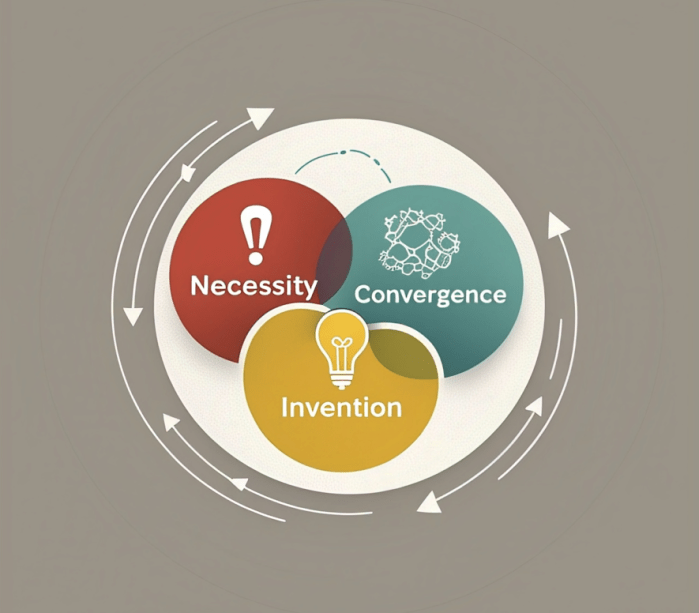
Throughout this four-part series, we’ve seen how necessity sparks invention – and together, they transform our society in profound ways. Today, our world faces an array of urgent challenges, from climate change and demographic shifts to economic and geopolitical instability, cybersecurity threats, and healthcare crises. These pressures are igniting a fresh wave of convergence, where inventive and innovative responses to pressing needs are poised to reshape our future. As we enter this transformative era, the cycle of necessity and invention reminds us that bold, purpose-driven invention and innovation is our best path forward.
Continue readingThe Converging Forces Of Progress: Necessity, Invention, And Systemic Outcomes
What if the very inventions that propel humanity forward also sow the seeds of our greatest challenges? History shows that progress is rarely a straight line. Instead, it moves in cycles: necessity sparks invention, and inventions converge to reshape society. From the steam engine’s role in the Industrial Revolution to the internet’s impact on globalization, each wave of transformation has brought profound change – economic shifts, new social structures, and unintended consequences. These disruptions, from rising inequalities to environmental crises, often take decades to address. As we stand on the brink of the next great convergence – whether in AI, biotechnology, humanoid robots, cyber, climate or health – we must ask – how can we harness innovation to create a more equitable and sustainable future?
Continue readingThe Necessity-Invention-Convergence Framework
The Necessity-Invention-Convergence Framework provides a structured way to analyze the forces that drive human progress. At its core, necessity serves as the fundamental driver of change, arising from pressing challenges, constraints, or demands. Whether economic, social, environmental, or geopolitical, necessity compels action and forces innovation. Throughout history, this dynamic has played out in transformative ways. The Industrial Revolution was fueled by labor shortages and an increasing demand for goods, just as the Digital Revolution emerged in response to the need for faster, decentralized communication. Today, the global energy transition is being shaped by the necessity of addressing climate change and resource limitations.
Continue readingUnleashing Artificial Intelligence As A General-Purpose Technology

In our era of rapid technological transformation, Artificial Intelligence (AI) stands on the brink of becoming a powerful general-purpose technology (GPT) akin to electricity or the steam engine. These foundational technologies fundamentally reshape industries and redefine society by following an evolutionary trajectory that moves from small improvements to system-level change. History shows us that realizing the full potential of GPTs demands both an understanding of their progressive phases and a forward-thinking mindset, especially to avoid the productivity lags that have plagued previous technological revolutions.
Continue readingUnlocking Human Potential – A New Age Of Invention
Having traced the evolution of knowledge democratization in part one, Let’s explore how this phenomenon ushers in a new age of invention with potentially transformative implications. As we venture further into the 21st century, we find ourselves on the cusp of breathtaking advances, exhibiting striking similarities to past periods of transformative change while presenting unique opportunities and challenges. To understand the significance of this moment, it’s crucial to distinguish between invention and innovation.
Continue readingUnlocking Human Potential: The Convergence Of Knowledge, Invention, And Societal Transitions
In this four-part series, I embark on a journey through the annals of human progress, exploring the intricate convergence between knowledge, invention, and societal transitions. I trace the democratization of knowledge from the dawn of language to our current era, examining how pivotal inventions have not only expanded our capabilities but reshaped the very fabric of civilization. As we stand on the brink of what could be a second scientific revolution, I delve into the dawn of a new age of invention, potentially rivaling or even surpassing the remarkable progress of past eras.
Continue reading Reimagining the Future